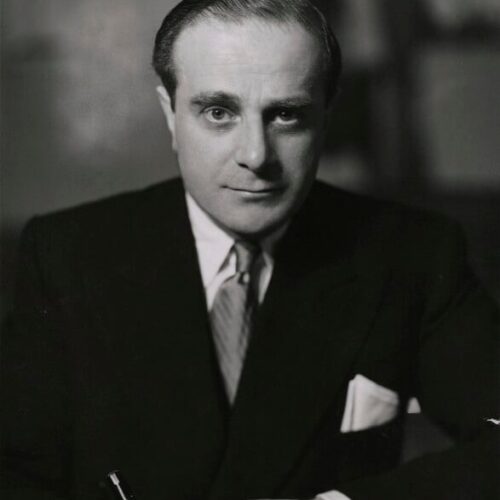
All through his life he fought fearlessly for the causes in which he deeply believed and he fulfilled himself in the struggle. He was a Humanist in the best sense of the word. He believed that the Good Society was one in which people were free to be happy in their own way. To work for such an end was, in a sense, his only religion.
Hector Hawton on Eustace Chesser, New Humanist, February 1974
Eustace Chesser was a doctor and psychiatrist whose frank, plainly written books on sex, marriage and family life sold in their millions and helped transform how a generation of Britons understood their own lives. His first sex manual, Love Without Fear, put him in the dock at the Old Bailey; three decades later, many of the ideas once thought too shocking to print had become commonplace. An agnostic and a committed humanist, he lectured for the Ethical Union (now Humanists UK), campaigned for the reform of the laws on abortion and homosexuality, and served as President of the Hampstead Humanist Society for the best part of two decades.
Chesser was born Isaac Chesarkie on 22 March 1902 in Edinburgh, the son of immigrants from Russia. He was educated at George Watson’s College and studied medicine at the University of Edinburgh, qualifying in 1926, the year he married Rose Morris; they had a son and a daughter. He worked for some years as a general practitioner in Cinderford and in Manchester, where, as his friend Hector Hawton later wrote, he met problems that arose as often from ignorance and bigotry as from disease. That experience drew him to psychiatry. During the Second World War he was a clinical assistant at the Tavistock Clinic in London, and he went on to build a successful psychiatric practice in the West End.
Convinced that books could reach far more people than any consulting room, Chesser began to write for a general readership. Love Without Fear (1940), a straightforward guide to sexual relationships in marriage, was an instant best-seller, and it led to his prosecution under the Obscene Publications Act. Rather than plead guilty and pay a fine in a magistrates’ court, he chose to stand trial before a jury at the Central Criminal Court. In 1942, after three doctors testified to the book’s value, he was acquitted, a verdict that Hawton saw as the start of a chain of events that led to real changes in the law. The book went on to be translated into many languages.
After the war Chesser became a familiar speaker in the Ethical Union, the forerunner of Humanists UK. He lectured on ‘Marriage Guidance’ in 1949, and the Union printed his talk in its journal Plain View, where he argued that the real need was education for marriage from childhood, not just repair work once things had gone wrong:
I have, in the course of my work, been very much struck by the amount of married unhappiness which exists all around us. I have been even more struck by the fact that it could all so easily have been avoided. Most human misery is unnecessary misery.
Eustace Chesser, ‘Marriage Guidance’, Plain View, July 1949
He spoke on ‘Freedom and Equality’ in 1950, chaired the Ethical Union’s popular series of meetings on ‘The Grammar of Marriage’, and at its 1953 reunion conference at High Leigh gave a talk on ‘Society and the Homosexual’, at a time when sex between men was still a crime and few public figures would discuss it. His large survey of women’s attitudes to sex, marriage and family life, The Sexual, Marital and Family Relationships of the English Woman (1956), became known as the ‘Chesser Report’. After the Wolfenden Report of 1957 recommended decriminalising homosexuality, he made the case for reform in Live and Let Live (1958), with a preface by Sir John Wolfenden himself, and Odd Man Out: Homosexuality in Men and Women (1959), and he supported the Homosexual Law Reform Society.
In 1959 the British Medical Association withdrew its booklet Getting Married after protests about his contribution, ‘Is Chastity Outmoded?’, which discussed premarital sex without condemning it. Chesser resigned from the BMA and expanded the article into a book of the same title (1960). Reviewing it, The Humanist praised its fair treatment of the subject.
Chesser was also a long-standing supporter of the Abortion Law Reform Association. When a 1961 bill to reform the abortion law was talked out in Parliament, he wrote in The Humanist that ‘the fight will go on’, and in November 1965 he spoke at the Association’s public forum on abortion. Two months later, in ‘Abortion and the NHS’, he argued that abortion should be available on the health service as preventive medicine and that contraception should be taught in schools, making clear where he stood:
I am not speaking as a Christian, but as an agnostic. I can appreciate and respect those who, because of strongly held religious beliefs, are unable to countenance abortion. No girl, however, should be denied abortion simply because of a particular doctor’s religious convictions.
Eustace Chesser, ‘Abortion and the NHS’, The Humanist, January 1966
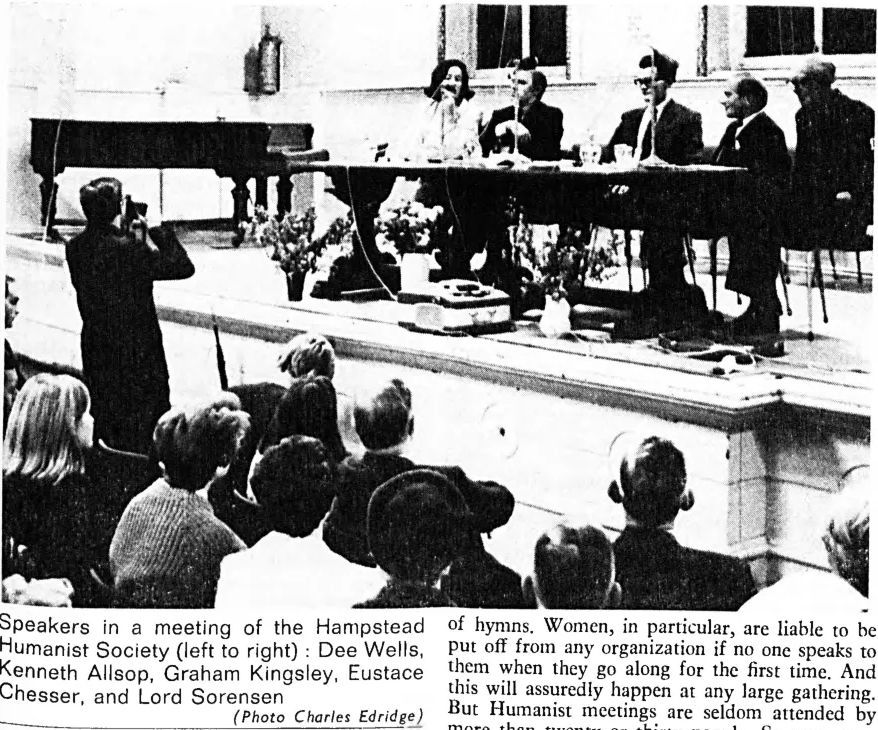
The Abortion Act was passed the following year. Chesser had long been active in the Hampstead Ethical Society, later the Hampstead Humanist Society, and became its President, a post he held for nearly twenty years. He would speak as happily to fifty people crammed into a members’ front room as to a packed meeting in Hampstead Town Hall. During Humanist Week in October 1967 he joined the journalists Dee Wells and Kenneth Allsop and the Labour peer Lord Sorensen in a Brains Trust on morals at the Old Town Hall.
He wrote prolifically and widely, on diet, cruelty to children, suicide, the theories of Wilhelm Reich, and the psychology of the young Shelley, but he rejected the label of ‘sexologist’. His books were banned in Ireland alongside those of Marie Stopes and Doris Lessing, and in 1969 he joined writers including Samuel Beckett and Anthony Burgess as a supporter of the Defence of Literature and the Arts Society against censorship. He also supported the Rationalist Press Association, the British Social Biology Council, the International Committee for Sexual Equality and the Society for the Study of Addiction. His second wife, Sheila, was an artist.
A serious illness in the late 1960s left him disabled for the rest of his life, though he remained President of the Hampstead society until shortly before his death in 1973. Hector Hawton, his friend of many years, wrote in New Humanist that the humanist movement had lost ‘a powerful champion’, and the Hampstead society’s tribute concluded that no one had done more to improve people’s sex lives and make marriages happier across a vast area of the world.
Chesser was one of the 20th century’s great popular educators about sex and relationships. His books brought plain, compassionate information to millions of readers when most doctors would not discuss the subject, and his willingness to face prosecution, lose the BMA’s endorsement and argue publicly for abortion and homosexual law reform helped shift public opinion towards the reforms of the 1960s. He believed, in Hawton’s words, that the good society was one in which people were free to be happy in their own way, and he brought that humanist conviction to his patients, his readers and the movement he served for more than twenty years.
This obituary, written by Hector Hawton, was published in New Humanist in February 1974.
By the death of Dr Eustace Chesser the Humanist movement has lost a powerful champion of many of the reforms with which it has been specifically concerned. It would be difficult to exaggerate the part he played in changing the climate of opinion on sexual behaviour. His campaign for a sane and rational attitude to sexual problems began in 1940 with the publication of Love without Fear. It was an instant best-seller and since then it has been translated into many languages and is still in brisk demand. But it landed its authors in the dock of the Central Criminal Court under the old Obscene Publications Act. His decision to fight the case at the Old Bailey instead of a magistrate’s court was bold and characteristic. He was not only vindicated, but his triumph started a chain of events that led to substantial changes in the law.
In 1959 his article ‘Is Chastity Outmoded?’ in a BMA booklet led to the publication being withdrawn. By contemporary standards the booklet seems so mild that the storm it aroused is scarcely comprehensible. Like other reformers who were villified in their day, Eustace Chesser lived to see ideas that were once so shocking as to be unmentionable become almost commonplace—and in little more than a decade.
Like other reformers who were villified in their day, Eustace Chesser lived to see ideas that were once so shocking as to be unmentionable become almost commonplace—and in little more than a decade.
Born in 1902 he qualified in Edinburgh in 1926 and for a period he was in general practice in Cinderford, Manchester. His subsequent interest in psychiatry owed much to the experience he gained in dealing with problems that arose as often from ignorance and bigotry as disease. In London he was an assistant at the Tavistock Clinic for a time and thereafter built up a brilliantly successful career in the West End.
His skill in handling sexual and marital difficulties was largely due to his intuitive understanding and a capacity for sympathy where many people would be merely impatient. He was singularly free from doctrinaire rigidities. But he soon realised that the people who would be helped by personal contact were only a fraction of those who might be reached through books and broadcasts.
His skill in handling sexual and marital difficulties was largely due to his intuitive understanding and a capacity for sympathy where many people would be merely impatient. He was singularly free from doctrinaire rigidities.
He was a prolific writer and he developed a style free from technicalities that enabled him to attract a wide and responsive public. But he repudiated the label of ‘sexologist’. In fact, he wrote on such diverse subjects as diet, suicide, the theories of Wilhelm Reich and the psychology of the adolescent Shelley. His sociological survey of womens’ emotional attitudes in marriage and family life which came to be known as the Chesser Report was published in 1956 and is a lasting contribution to studies in this field.
All through his life he fought fearlessly for the causes in which he deeply believed and he fulfilled himself in the struggle. He was a Humanist in the best sense of the word. He believed that the Good Society was one in which people were free to be happy in their own way. To work for such an end was, in a sense, his only religion. The organizations to which he gave unstinted support included the Rationalist Press Association, the Hampstead Humanist Society (of which he was President), the Abortion Law Reform Association, the British Social Biology Council, the Homosexual Law Reform Society, the Medico-Legal Council, the International Committee for Sexual Equality and the Society for the Study of Addiction.
All through his life he fought fearlessly for the causes in which he deeply believed and he fulfilled himself in the struggle… He was a very special kind of person, and the community is poorer without him.
For me the loss of a close friend of many years standing is a heavy blow. He had an enormous sense of fun, yet he would erupt into anger at the least sign of intolerance or hypocrisy. His exuberant spontaneity and infectious enthusiasm were not extinguished even by the crippling illness which struck him down in 1969. He bore his disability with calm and fortitude. He was a very special kind of person, and the community is poorer without him.
Hector Hawton
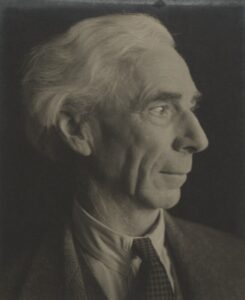
Main image: Eustace Chesser by Elliott & Fry, bromide print, NPG x86693 © National Portrait Gallery, London
One sees rise ultimately… in place of Religion—Nothing… one does not seek to replace a fever by an attack of […]
Differences of opinion, strongly held, there will be and they will be passionately argued… But in a democratic socialist party […]
The good life is one inspired by love and guided by knowledge. Neither love without knowledge, nor knowledge without love […]
Why are these minds left without the means of obtaining that knowledge which they so ardently desire and why are […]