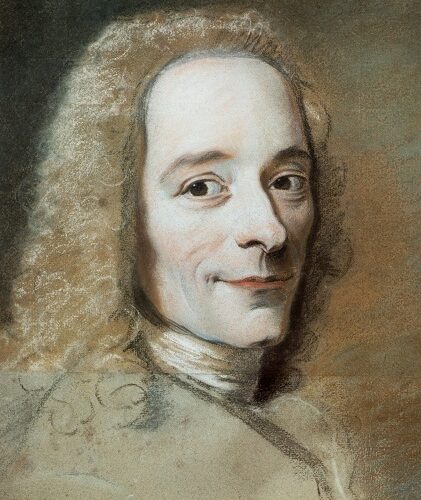
What is tolerance? It is the consequence of humanity. We are all formed of frailty and error; let us pardon reciprocally each other’s folly — that is the first law of nature.
Voltaire, ‘Tolerance’ in Dictionnaire philosophique (1764)
François-Marie Arouet, who wrote as Voltaire, was the most famous writer in Europe for half a century and the most effective enemy the churches ever had. A deist, he believed in a creator but rejected revelation, miracles, priests, and every claim of any church to authority over conscience. His campaigns against religious persecution in the 1760s made him the model for humanists and other champions of freedom of thought and expression. He also spent two and a half years in England, and what he saw there shaped the rest of his life.
Life is bristling with thorns, and I know no other remedy than to cultivate one’s garden.
Voltaire, letter to Pierre-Joseph Luneau de Boisjermain, 21 October 1769
Voltaire was born in Paris on 21 November 1694 and educated by Jesuits, whom he later thanked for teaching him to argue. Early fame as a poet and dramatist was interrupted by imprisonment in the Bastille and, in 1726, by a quarrel with a nobleman which ended with a beating and exile. He chose England, and lived there until 1728, meeting Pope, Swift, and Congreve, attending Newton’s funeral, and observing a country in which a dozen religions coexisted, the press was relatively free, and a merchant could be more respected than a marquis.
The result was the Letters Concerning the English Nation (1733; in French as the Lettres philosophiques in 1734), a book so admiring of English liberty and so implicitly critical of French absolutism and Catholic uniformity that it was burned by the Paris parlement. Voltaire spent much of the following decades outside Paris, at Cirey with Émilie du Châtelet, at the court of Frederick the Great, and from 1758 at Ferney, on the Swiss border, where he could cross a frontier if the authorities came for him.
It was at Ferney that Voltaire wrote Candide (1759), his mockery of the claim that this is the best of all possible worlds, and where he took up the case of Jean Calas, a Huguenot merchant of Toulouse broken on the wheel in 1762 for a murder he had not committed. Voltaire’s pamphlets, letters, and Treatise on Toleration (1763) secured Calas’ posthumous exoneration and turned a judicial killing into a European scandal. He followed it with further cases, the Philosophical Dictionary (1764), and a stream of anonymous and pseudonymous attacks on what he called l’infâme: the institutional religion that burned books and men. He returned to Paris in 1778, aged 83, to public acclaim, and died there on 30 May.
Voltaire’s god was a remote watchmaker who did nothing, asked nothing, and needed no church. What he cared about was the human world: that no one should be tortured for their beliefs, that reason should be free to speak, and that cruelty done in the name of heaven should be called by its right name.
Perhaps his greatest influence on British freethought, though, rests on words he never wrote. In 1906 his English biographer Evelyn Beatrice Hall, writing as S. G. Tallentyre, summarised his reaction to the burning of Helvétius’s De l’esprit in a sentence of her own composition: ‘I disapprove of what you say, but I will defend to the death your right to say it.’ Hall meant it as a distillation of his attitude rather than a quotation, and said so repeatedly in the decades that followed, but the correction never caught up with the phrase. Taken up by secularists, rationalists, and campaigners against blasphemy law, it has arguably shaped the British understanding of free expression — and of Voltaire himself — more than any line he actually put on paper.
His name was attached, too, to Humanists UK’s flagship annual lecture, endowed by a legacy from the Voltaire biographer and bibliographer Theodore Besterman. Fittingly for a series in his name, the Voltaire Lecture was not always reverent about him. In 2019 the geneticist Adam Rutherford, later Humanists UK’s President, used it to trace the Enlightenment origins of scientific racism and Voltaire’s own contribution to them — an argument that became his bestselling How to Argue With a Racist (2020). The 2025 lecture, delivered by the neuroscientist Anil Seth at Conway Hall, was the last to carry the name. With the Besterman fund long exhausted and the Rationalist Association having merged with Humanists UK that January, it was announced that the series would continue from 2026 as the Rationalist Press Lecture.
Main image: Pastel sketch of Voltaire by Maurice Quentin de La Tour, 1735
Humanism is an attitude to life that has solidly practical implications… it implies a commitment to helping run the community […]
The time has arrived for us humans to stop leaning on ideas for a creator god; we should get down […]
To accept life fully seems to me the hallmark of the fine spirit. I think that it is possible for […]
Robert Owen was a utopian socialist, philanthropist, and reformer, whose own religious scepticism fostered his desire for a secular society, […]