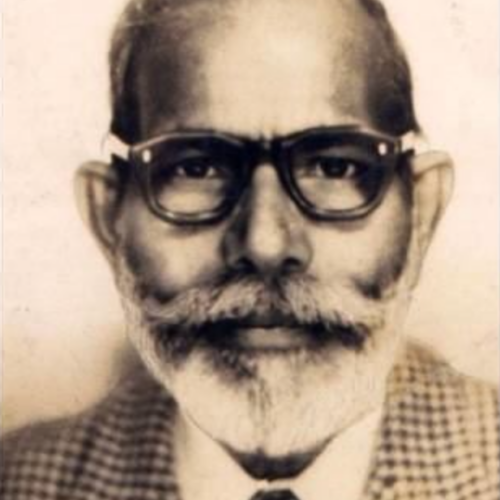
As the Indian freethought papers have said, by his personal example he left a thousand Kovoors, and this is his main legacy.
‘Kovoor’s Death’ in New Humanist, February 1979
From New Humanist, February 1979
Kovoor’s death
Kovoor came from a Christian Syrian family in Southern India, being born on 10 April 1898 at Tiruvalla, in what is now Kerala. Like many freethinkers, he was the son of a clergyman, his father being a leading member of the Syrian Church, but he soon abandoned all religion and superstition. He graduated in biology at Calcutta, did postgraduate work in botany, and taught science in Ceylon from 1928 until his retirement in 1959.
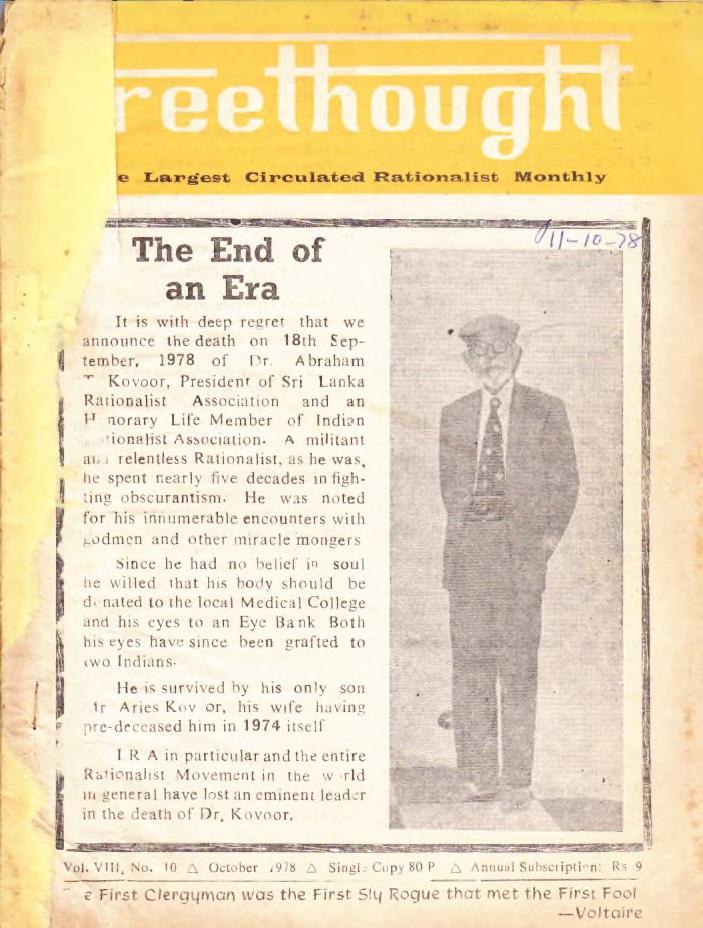
Kovoor spent much of his time studying religious and paranormal claims of all kinds, and he took a doctorate from the Minnesota Institute of Philosophy on the psychology of parapsychology, arguing that no one had supernatural powers and that those who claimed such powers deceived themselves or other people, or both. During the last twenty years of his life he devoted himself to a public campaign of exposure against what he unequivocally described as fakes and frauds, and he became the best-known opponent of irrationalism throughout India as well as Sri Lanka.
Kovoor made repeated attacks on “godmen, saints, yogis, sidhas, gurus, swamis” and “miracle performers, charmists, astrologers, palmists, spiritualists, numerologists, necromancists, and all other types of charlatans”. He included such internationally known figures as the Maharishi Mahesh Yogi and the Guru Maharaj Ji, and also Western figures such as Dr J.B. Rhine and Uri Geller. He had no hesitation in describing those who claimed supernatural powers as crooks and those who believed in such powers as fools. He insisted that, while gods do not exist, godmen do exist and are a menace to mankind. He attacked not only Hinduism and Buddhism, but also Christianity and the new religions of the West.
In 1963 Kovoor issued a public challenge that he would pay a large sum (it began as 25,000 rupees and ended as 100,000 rupees) to anyone who could perform any one of a list of dozens of paranormal tricks in controlled conditions. The only qualification was that a candidate must pay a deposit before any attempt was made. In fifteen years hardly any of hundreds of potential claimants dared to accept this challenge, and they all failed to perform even the simplest trick.
Kovoor appointed more than a dozen representatives all over India and Sri Lanka to make his challenge known, and he publicised his work energetically in all the media, including the cinema. It is especially significant that in a part of the world which is dominated by astrological considerations, no astrologers ever took up his elementary tests of their powers.
Kovoor was President of the Sri Lanka Rationalist Association, and a member of several freethought organisations in India. By the time he died he was the leading rationalist in the Indian subcontinent.
Kovoor’s wife was closely associated with his work. When she died in 1974 the press notice attracted wide interest. “Mrs Acca Kovoor expired leaving behind neither a mind nor a spirit to bother credulous people,” it began; and it ended: “No funeral, no cremation, no flowers.” Her body was given for medical research.
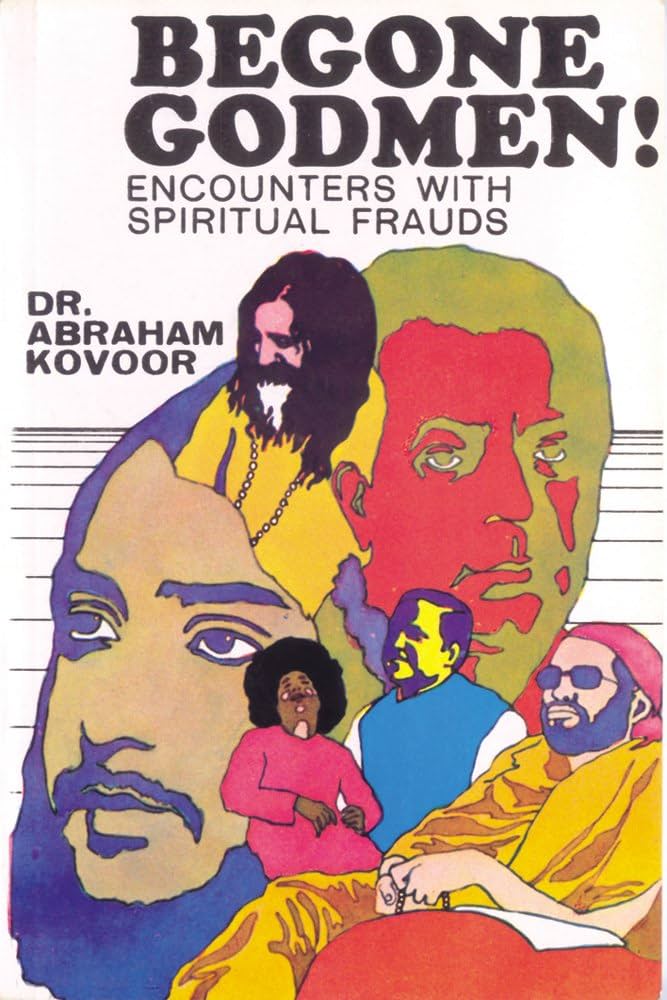
In 1975 Kovoor conducted a “Divine Miracle Exposure Campaign” throughout India, speaking in hundreds of places and issuing thousands of copies of his challenge. No one dared to confront his propaganda, and the effect of such practical work is incalculable. And in the following year Kovoor produced a paperback book — Begone Godmen! (Bombay: Jaico, 1976) — describing the enormous range of his work of exposing particular claims and of explaining general beliefs in supernatural and paranormal phenomena.
Kovoor left his body for medical research, and his corneas were grafted immediately after his death. As the Indian freethought papers have said, by his personal example he left a thousand Kovoors, and this is his main legacy.
I have been the more bold in exposing my opinion because I believe it to be the dictates of truth […]
Conscious morality cannot exist in any being except so far as it can look behind, before, and around; and can […]
How strange is the lot of us mortals! Each of us is here for a brief sojourn; for what purpose […]
What the sciences discover about the natural world and about the origins, nature and destiny of man is the truth […]