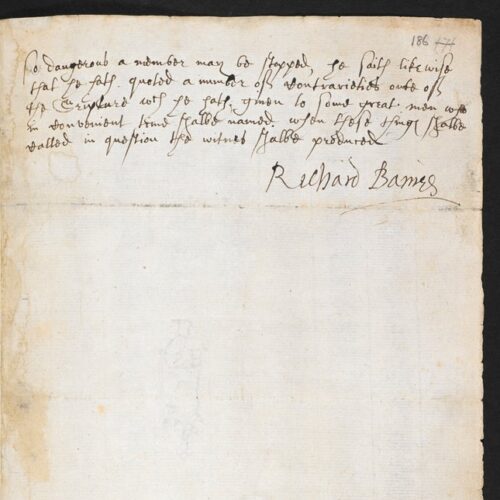
These thinges, with many other shall by good & honest men be proved to be his opinions and common speeches, and that this Marlowe doth not only holde them himself, but almost into every Company he commeth he persuades men to Atheism, willing them not to be afeard of bugbears and hobgoblins, and utterly scorning both God and his ministers…
Extract from the Baines Note (1593)
The Baines Note is one of the most notorious surviving documents in the history of English literary heresy. A product of the 1593 heresy crackdown, and submitted to the Privy Council by government informer Richard Baines, the note purports to detail the private blasphemies of the playwright Christopher Marlowe. Its claims helped fuel the state’s suspicion of Marlowe in the final weeks of his life and have shaped his posthumous reputation as a defiant atheist, libertine, and philosophical subversive.
Today, the document offers a rare and unsettling glimpse into the surveillance culture of Elizabethan England and the dangers faced by those suspected of heterodox belief.
Richard Baines was a former student of divinity who became a government agent. He had worked undercover on the continent to monitor Catholic seminaries and had previously been arrested himself, accused of forging coins and circulating dangerous texts. By the early 1590s, he was well embedded in the Elizabethan intelligence network.
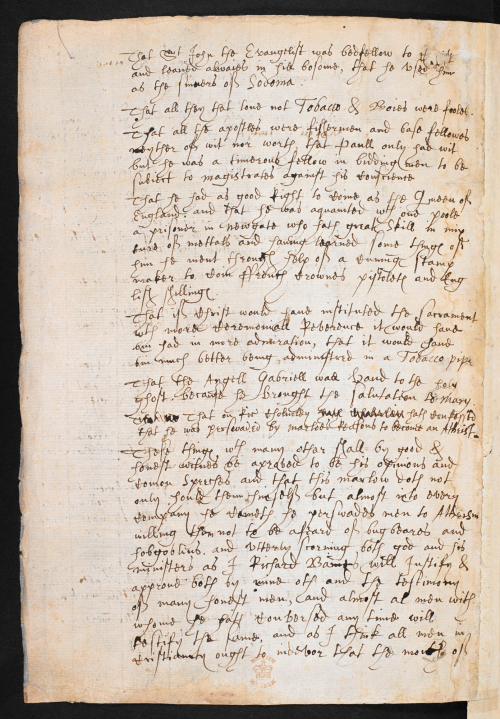
Baines was likely acting on instruction when he compiled his note. It was submitted just days before Marlowe was killed in Deptford and may have been intended to justify detention or interrogation. His tone is not neutral. The document reads more like a denunciation than a report.
The content of the note
The note lists what Baines claimed were Marlowe’s private opinions and conversations. Among the most striking allegations are:
– That Jesus Christ was ‘a bastard and his mother dishonest’;
– That the New Testament was ‘filthily written’ and the evangelists ‘simple men’;
– That he preferred the (Catholic) Church of Rome to the Protestant religion ‘because it was the ancienter’;
– That ‘if there be any God or good religion, then it is in the papists, because the service… is performed with more ceremony’;
– That ‘all they who love not tobacco and boys are fools’;
– That ‘all religion was a device to keep men in awe’.
These thinges, with many other shall by good & honest men be proved to be his opinions and common speeches, and that this Marlowe doth not only holde them himself, but almost into every Company he commeth he persuades men to Atheism, willing them not to be afeard of bugbears and hobgoblins, and utterly scorning both God and his ministers, as I Richard Baines will justify both by my oathe and the testimony of many honest men, and almost all men with whom he hath conversed any time will testify the same.
Baines closed with a warning. If Marlowe were not stopped, he would continue to spread his views and seduce others to his judgement. The note framed Marlowe not only as a private sceptic but as an active corrupter of public morals and religious order.
Scholars have long debated the reliability of the Baines Note. Some believe it reflects real conversations, though likely exaggerated or taken out of context. Others view it as a politically motivated attempt to discredit Marlowe or to shield others under suspicion. Either way, the accusations were never tested in court. There was no trial, and Marlowe was killed in suspicious circumstances before any formal hearing could take place.
While many scholars today believe, based on his associations and the radical undercurrents of his work, that Marlowe was probably an atheist or held profoundly sceptical views, the document itself remains a partisan artefact. It tells us less about what Marlowe may have believed with certainty, and more about what kinds of ideas were feared. In that sense, the Baines Note stands not only as an accusation, but as a record of how thought itself could be policed.
The fears it expresses did not emerge in isolation. Marlowe had previously been accused of promoting atheism alongside a wider circle of writers, scientists, and courtiers who nicknamed the ‘School of Atheism’ or the ‘School of Night’.
The Baines Note became central to later portrayals of Marlowe as a rebel, an atheist, or a martyr to free thought. In the absence of letters, memoirs, or confessions, the note has served as a rare source for those seeking insight into Marlowe’s beliefs. But it is a hostile source, shaped by fear, ideology, and political calculation. Whether its claims are true or not, they have shaped the way his work is read. Characters like Faustus, Tamburlaine, and Barabas speak and act in ways that echo the accusations: ambitious, defiant, and morally unbound.
For humanists today, the Baines Note is a cautionary object. It shows how irreligion, doubt, and private speech could become grounds for accusation. It reveals the extent to which heresy was imagined not just as a spiritual error but as a social threat. Whether Marlowe believed everything Baines claimed is ultimately unknowable. What the note makes clear is that in Elizabethan England, suspicion alone could end a life.
Discovering Literature: Accusations against Christopher Marlowe by Richard Baines and others | British Library (via the Wayback Machine)

Max Gate is the former home of Thomas Hardy in Dorchester, Dorset. Hardy designed and lived in Max Gate from 1885 until […]
Man’s life is well comparèd to a feast,Furnished with choice of all variety;To it comes Time; and as a bidden […]
He was a great humanist whose religion lay in loving his fellow men and trying to serve them. These are […]
Humanism is less concerned with what to believe than with how to live. The meaning it gives to life lies […]