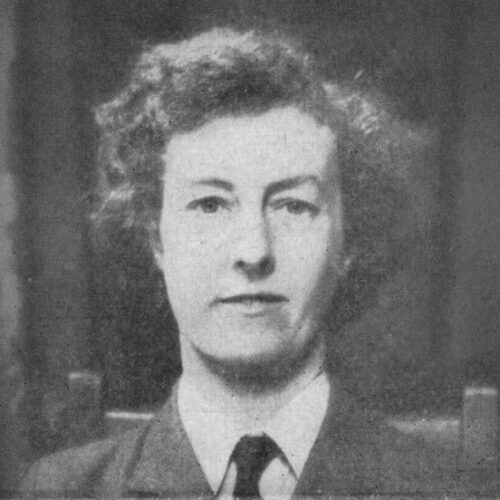
Should STV ever be introduced in Westminster elections—as it has been in the Republic of Ireland, for Northern Ireland Assembly elections and for Scottish local government—perhaps it should be called the Lakeman system, because no one did more than that tireless and extraordinary woman to ensure that its virtues were fully understood.
Lord Alton of Liverpool in the House of Lords, 11 January 2010
Enid Lakeman was a prominent campaigner for political reform, and lifelong humanist. She was a passionate supporter of proportional representation and is recognised for her tireless campaigning and key works on this subject.
Born near Tonbridge in Kent, Enid was the only child of Horace Bradlaugh Lakeman, an excise officer, and Evereld Simpson. Hers had long been a political family: her great grandfather, Henry Heavisides (1791–1870), campaigned for the 1832 Reform Bill and supported the Chartist movement, and her maternal grandmother, Jane Simpson (1826–1914), was a campaigner for votes for women, a member of the Proportional Representation Society, and a London School Board candidate in 1879. Her father and mother were founding members of the Hampstead Ethical Institute (later the Hampstead Humanist Society). After moving to Tunbridge Wells in Kent, Horace became similarly involved, together with Enid, in the Tunbridge Wells Ethical Society and local Liberal party.
In 1923 Enid was awarded the Arnott science scholarship to study at Bedford College London. After graduating with a First Class Degree in Chemistry, she worked in the chemical industry in Britain and in Germany until the Second World War, when she joined the Women’s Auxiliary Air Force as a radar operator.
After the war Enid worked at the Proportional Representation Society (later the Electoral Reform Society), firstly as a research secretary, then in various posts up to Director from 1960 until 1980 when she retired. The Electoral Reform Society (ERS) was and still is a lobby group campaigning for the introduction of the Single Transferable Vote (STV) in multi-member constituencies, to replace the first-past-the-post electoral system used in most British elections. Enid promoted the Society’s case for the STV whenever an opportunity presented itself. She spoke at public meetings throughout the UK, and took part in debates. She wrote many newspaper articles and conducted an intensive campaign of letter writing to the press on the iniquities of the first-past-the-post system. She drafted the Society’s submissions to official inquiries, including the Hansard commission on electoral reform, and electoral arrangements for countries achieving independence from Britain.
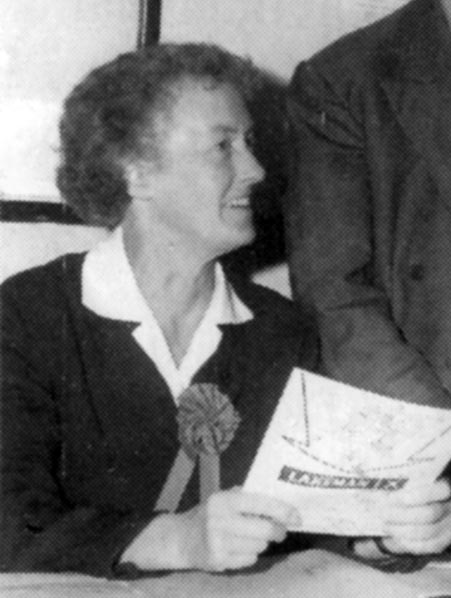
Her most significant campaigns were in Ireland, when the government wanted to abandon the STV and to revert to first-past-the-post. Enid led the Electoral Reform Society’s successful campaign to retain STV, as the two referendums in 1958 and 1968 failed. She was also instrumental in securing the adoption of STV in Northern Ireland in 1972.
Noted for her clarity and conciseness of her writing, she wrote several books mainly relating to electoral systems. The most influential, How Democracies Vote (1974), is a detailed comparative study of electoral systems in several European countries and continues to be a standard reference work on proportional representation and the STV. It won the George H Hallett award in 1993 for encouraging interest in electoral systems. This award is given annually by the American Political Science Association ‘to a book, at least 10 years old, that has made a lasting contribution to the literature on representation and electoral rules’.
Enid was a lifelong activist in the Liberal Party (now Liberal Democrats) and was one of only three women service personnel to stand as a parliamentary candidate in the 1945 general election. She stood again for parliament in 1950, 1955, and 1959. Though unsuccessful in these efforts, she was elected as a member of Tunbridge Wells Borough Council in 1962, serving three years. She also supported organisations promoting free trade, land value taxation, and international cooperation, women’s organisations and organisations encouraging young people into public affairs. Today, the Electoral Reform Society’s fellowship for diversity in politics bears her name. Enid was awarded the OBE in 1980 for ‘political and public service’.
Following her death in 1995, Enid was cremated following a humanist meeting celebrating her life.
Newspaper letter column editors will henceforth have a much lighter postbag. Few individuals have had greater tenacity for a single cause than Enid Lakeman had for electoral reform over the past 50 years.
Michael Meadowcroft, ‘Enid Lakeman’ in The Independent, 12 January 1995
Enid Lakeman campaigned tirelessly for the introduction of proportional representation and had a direct impact on its retention in the Republic of Ireland. She devoted her life to efforts for democracy. The library at the Electoral Reform Society offices is named after her, and annual lectures at her old college and at the Politics Association keep her memory alive.
Enid Lakeman | Electoral Reform Society
Enid Lakeman | Oxford Dictionary of National Biography
The Lakeman Fellowship for Diversity in Politics | Electoral Reform Society
Enid Lakeman: Liberal Democrat History Group obituary | Michael Meadowcroft
By Hilary Barber
Mackenzie Hall is a community space in the village of Brockweir, Gloucestershire, given by Millicent Mackenzie in memory of her […]
Mary Holland was a doyenne of Irish journalism. She epitomised the highest journalistic standards – she inquired, she informed, she […]
Ernestine Mills, an enamelist, and her husband Dr. Herbert Henry Mills were both active members of the Ethical movement, and […]
I like life with its mysteries. I don’t need my imponderables filled in for me. Michael Manley quoted by Rachel […]