One thing I would earnestly maintain; Ibsen comes home to us. His problems are real problems and are ours. If for the most part he only states them, if he tears down more than he builds up, if he shows us ugliness rather than beauty, at least he awakens us, as pain does, to evil, at least he works out for us many modes and ideas which we, some of us, are inclined to try as means of escape, and he shows us that the end of these things is death.
Mary Gilliland Husband, Ibsen’s Women: A Lecture Given Before The London Ethical Society (1894)
Henrik Ibsen, often called ‘the father of modern drama’ or ‘the father of realism’, was a Norwegian playwright whose fierce commitment to personal freedom, truth-telling, and questioning societal norms place him firmly within the humanist tradition. Although his plays shocked many contemporaries, they have endured precisely because of their insistence on the value of the individual and the courage needed to live truthfully. Though condemned by religious critics as immoral, Ibsen was in reality a moralist, framing his work within a broader humanism and an explicit commitment to the betterment of humanity as a whole.
Ibsen’s impact on British and Irish culture was profound. His plays helped inspire a revolution in English and Irish theatre, influencing writers such as George Bernard Shaw, Harley Granville Barker, and W. B. Yeats. His commitment to realism, ethical inquiry, and individual autonomy resonated with the growing secular and humanist movements in Britain, shaping conversations about freedom, conscience, and social reform at the turn of the twentieth century.
Born in Skien, Norway in 1828, Ibsen grew up in a family whose fortunes collapsed during his childhood, an experience that sharpened his lifelong skepticism toward bourgeois respectability. His early exposure to rigid Lutheranism also fostered a questioning attitude toward religious and social authorities.
After working as an apprentice pharmacist, Ibsen pursued a career in theatre, beginning in Bergen and then Kristiania (now Oslo). Early works like Brand (1866) and Peer Gynt (1867) established his reputation, but it was his middle and later plays — many written during his self-imposed exile in Italy and Germany — that made his name internationally. A Doll’s House (1879), Ghosts (1881), and An Enemy of the People (1882) tackled marriage, morality, public opinion, and religious hypocrisy with an unflinching realism.
While A Doll’s House is today Ibsen’s best-remembered play and seen as a feminist masterpiece, it was Ghosts that first sensationalised critics with its extended metaphor of a spreading venereal disease that represented moral contamination. Despised by traditionalists and figures on the political right, it also cemented Ibsen’s reputation as a playwright and clear moral vision among liberals, radicals, and progressives across Europe.
In 1891, Ghosts received its first English-language performance in London at the Royalty Theatre, staged privately by the Independent Theatre Society to avoid censorship. This marked the beginning of Ibsen’s serious impact on British theatre. Other members of the theatre society included notable literary figures such as Thomas Hardy, Henry James, and George Bernard Shaw.
The conservative backlash to the play was instantaneous and ferocious. The furore over Ghosts in the Daily Telegraph and other London papers was enough to inspire Shaw to publish his essay The Quintessence of Ibsenism, in which Shaw defined British society as divided into four categories: philistines, realists, idealists, and ‘the superman’. Shaw reserved most of his scorn for the ‘idealists’, who he argued sought ‘plausible’ excuses to ‘attack… the nonconformist’ as a disguised means of preserving establishment dominance over artistic and intellectual life. In contrast, Shaw associated Ibsen with the ‘realists’, praising him as a skeptic who rejected romanticised ideals in favour of exposing uncomfortable truths.
By 1893, Ibsen’s plays and their humanist themes had become a popular topic in the organised humanist movement, with feminist lecturer Mary Gilliland delivering a popular lecture for the London Ethical Society, published the following year. Gilliland hailed Ibsen as an early transgressive artist whose work ‘makes us aware of the terrors that lie around us and within us’, and an advocate for equality of the sexes whose ‘vote, so to speak, is always given for the courage and force of character in women’ and whose writing ‘encourages us to hope, largely by women, to “go out and open the door to the younger generation”.’ In a 1897 interview with F. J. Gould she called Ibsen ‘one of the strongest voices on the side of morality’.
Ibsen returned to Norway in the 1890s, a celebrated if controversial figure. His final years were marked by ill health following a series of strokes. He died in 1906, leaving behind a body of work that helped redefine the possibilities of modern drama.
By 1913, the Literary Guide (today’s New Humanist) reflected on the far-reaching impact of the Ghosts furore, and that Ibsen had ultimately had the last laugh:
It is twenty-two years since Ibsen’s Ghosts was performed in London and fluttered the dainty dovecotes of British respectability. As expected, the whole vocabulary of orthodox abuse was levelled at the work of the master-genius who had dared to challenge convention. The play was denounced as “literary carrion,” “putrid indecorum,” “a loathsome sore,” and other whole-hearted epithets, which were paid for at the usual rates. Literary London was divided into hostile camps, and Bernard Shaw wrote The Quintessence of Ibsenism, a splendid piece of polemic which has stood the test of the years.
Since that far-off time… [Ibsen’s] genius has crossed all frontiers, and has won general European recognition, while Bernard Shaw himself is now our foremost dramatist.
‘Book chats’ in The Literary Guide, 1 October 1913
Ibsen was clear about the humanist foundations of his work. Speaking at a meeting of the Norwegian Women’s Rights League in 1898, he said:
I must disclaim the honour of having consciously worked for the women’s rights movement. I am not even quite clear as to just what this women’s rights movement really is. To me, it is a problem of human rights in general…
My task as an author has been the description of humanity… to advance our country and to elevate our people to a higher standard of humanity. This feeling must be awakened before it will be possible to lift up humanity to a higher plane. Therefore it is women, and most of all mothers, who shall take forward the human cause… Here lies a great task for women! Thank you, and I wish every success to the Women’s Rights League!’
The above statement is sometimes mistranslated or paraphrased as ‘I am not a feminist, but a humanist.’ This probably comes from the tendency to translate the Norwegian ‘kvinnesak’ (women’s cause) as ‘feminism’ and therefore ‘menneskesak’ (human cause) as ‘humanism.’ Equally valid readings suggest he was contrasting ‘women’s rights’ or ‘women’s issues’ with ‘human rights in general’ or ‘the wider cause of humanity’. Yet in context, his fundamental contention was that women’s liberation held positive implications for the whole of the human race, not just because of its benefits to women (or indeed men) but because it would help create the conditions for a more humane, critical-thinking generation to come.
Certainly, Ibsen did not advocate humanism as an alternative to feminism. Rather, he affirmed that feminism was part and parcel of a humanist approach to life and that women’s innate equality with men was certainly a given, even if not realised in society. This perspective is evident in A Doll’s House when Nora Helmer’s crystallises Ibsen’s humanist ethos through her famous realisation:
I believe that before anything else I’m a human being — just as much as you are.
Other lines in his plays speak to courage, conscience, and reason as being core components of Ibsen’s humanism, including the courage to be different or to stand up to authority. In An Enemy of the People, Dr Stockmann, persecuted for speaking an unpopular truth, declares:
The strongest man in the world is he who stands most alone.
Ibsen’s stance toward religion was similarly critical and independent. In plays like Brand, he depicted the dangers of a fanatical, all-or-nothing approach to faith, illustrating the personal and social destructiveness that could result from rigid moral absolutism. Ghosts went further still, portraying religious piety as a corrupting force that perpetuated suffering across generations. Ibsen rejected the idea of divine providence shaping human affairs, insisting instead on the need for individuals to take responsibility for their own lives, here and now.
His vision of human life was rooted firmly in this world: complex, difficult, and demanding continual self-examination rather than faith in otherworldly salvation. Through his theatre, Ibsen advanced a profoundly this-worldly ethics, one that saw truth, responsibility, and selfhood as human tasks, not divine gifts.
Freedom, and responsibility,—these two ideas Ibsen sends far and wide.
Mary Gilliland Husband, Ibsen’s Women: A Lecture Given Before The London Ethical Society (1894)
Henrik Ibsen’s work remains a touchstone for humanist thought in the arts. His fearless interrogation of social norms, his defence of personal freedom over collective superstition, and his insistence on the dignity of the individual continue to inspire. His affirmation of human rights or ‘the human cause’ over religious or social orthodoxy places him firmly among the leading humanist voices of his era.
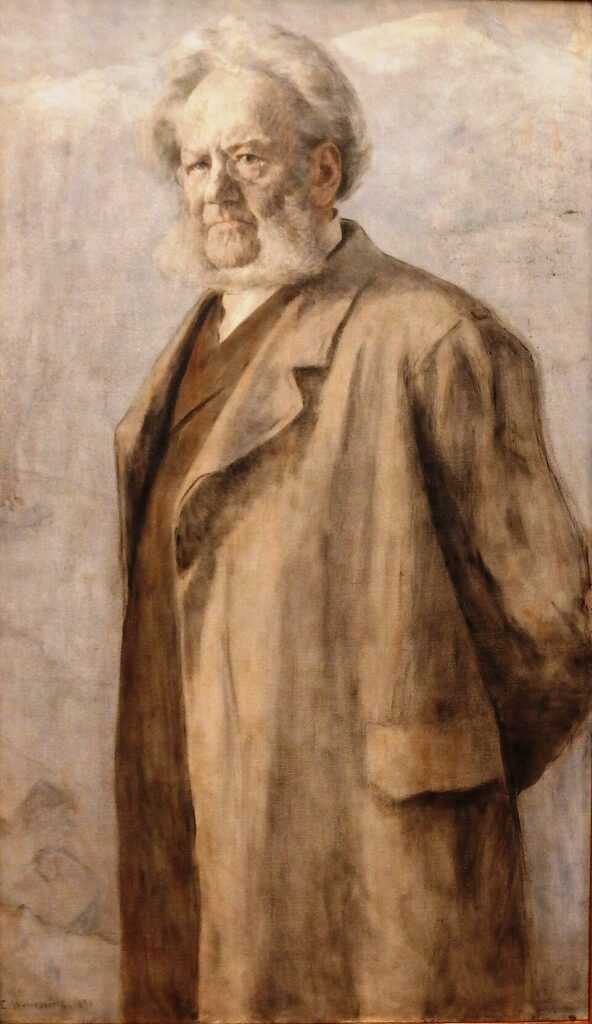
In Britain and Ireland, Ibsen’s influence on drama, criticism, and social thought was transformative. The ‘Ibsenite’ movement in London theatre in the 1890s, spearheaded by the Independent Theatre Society, introduced audiences to works that dealt seriously with moral conflict, gender inequality, and the hypocrisies of religious and social conventions. Humanist contemporaries like George Bernard Shaw and feminist critics like Mary Gilliland Husband hailed his drama as a liberating force, crediting him as an inspirational thinker who would help to break the stranglehold of Victorian moralism to affirm a more rational, secular, and humane view of life.
Widely hailed as a literary genius, how then might we judge Ibsen against the statement that his ‘task’ or ‘mission’ was to usher in a more rational and humane vision of Norway?
Though he himself was baptised Lutheran, the law necessitating this was abolished just after Ibsen’s lifetime, in 1912, with women gaining the right to vote the following year in 1913. The Lutheran church lost its position as state church in 2017. Although Ibsen was obliged to undertake church confirmation, today around one in five young Norwegians choose a humanist ceremony instead, with the largest in 2023 held at Ibsen House in Skien. The Norwegian Humanist Association, founded in 1956, now operates in a highly secularised society with around 150,000 members, making it the largest humanist association in the world relative to population size. At least viewed in these terms, his speech to the Women’s Rights League reads as prophetic, and suggests Ibsen was emblematic of a thriving humanist zeitgeist on both sides of the North Sea.
Today, Ibsen is remembered alongside the actor Bjørn Bjørnson and painter Edvard Munch as one of the greatest humanists in Norwegian history, and he is sometimes described as the world’s greatest playwright after Shakespeare. His plays are regularly adapted in English with all-star casts, drawing large audiences. Their central concerns of truth, freedom and self-realisation remain as urgent today as they were at the time of writing.
Mary Gilliland Husband, Ibsen’s Women: A Lecture Given Before The London Ethical Society (1894)
By Liam Whitton, Director of Communications and Development at Humanists UK.
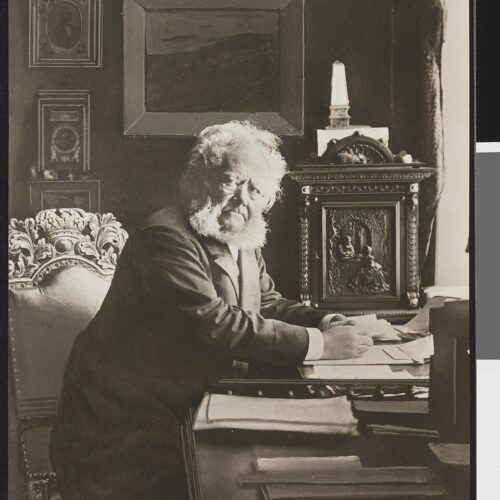
Main image: Henrik Ibsen in 1900 by Hulda Szaciński. National Library of Norway
It is a very strange idea that moral and various spiritual educations can be learned only by getting people together […]
In all her work for the humanist movement, Constance Dowman said little and did much… She was one of the […]
The human species so deeply loved by Bertrand Russell and so much enriched by his life’s work is now in […]
The basic human value is freedom, which means the right of a human being to live a human life. V.M. […]