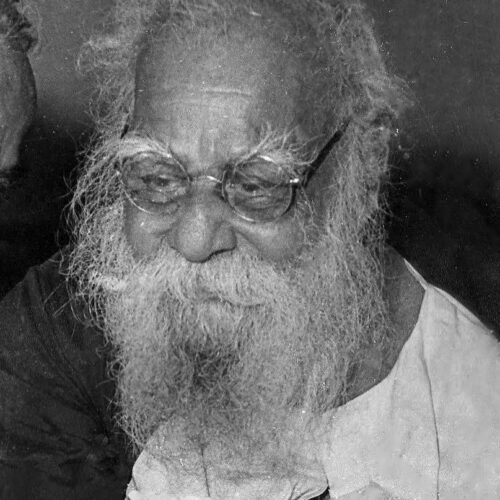
A life devoted to uncompromising rationalism, rich in achievement.
Obituary for E. V. Ramasamy (Periyar) in New Humanist, April 1974
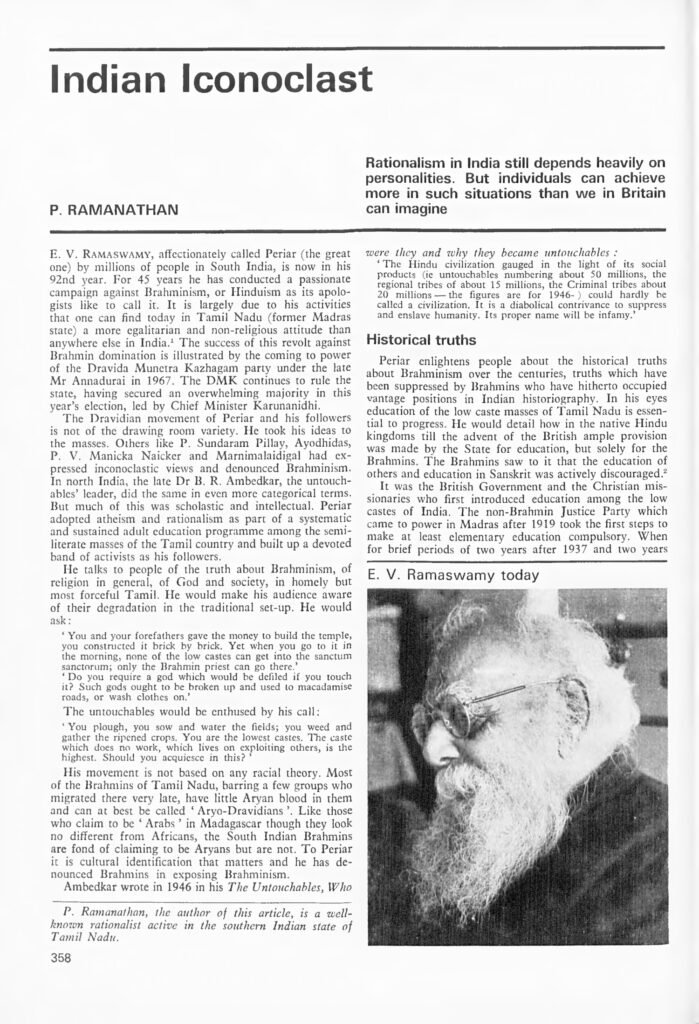
E. V. Ramaswamy (known as Periyar, the ‘great one’) was a prominent Indian rationalist, whose interest for the UK humanist movement can be seen in the two articles reproduced below, each written by P. Ramanathan. Periyar was an organiser within the Self-Respect Movement, opposing the caste system, and promoted women’s rights. In 2021, 17 September (Periyar’s birthday) was named ‘Social Justice Day’ by the government of Tamil Nadu, in honour of his efforts.
by P. Ramanathan
From The Humanist, December 1971
Rationalism in India still depends heavily on personalities. But individuals can achieve more in such situations than we in Britain can imagine.
___
E. V. Ramaswamy, affectionately called Periar (the great one) by millions of people in South India, is now in his 92nd year. For 45 years he has conducted a passionate campaign against Brahminism, or Hinduism as its apologists like to call it. It is largely due to his activities that one can find today in Tamil Nadu (former Madras state) a more egalitarian and non-religious attitude than anywhere else in India.1 The success of this revolt against Brahmin domination is illustrated by the coming to power of the Dravida Munetra Kazhagam party under the late Mr Annadurai in 1967. The DMK continues to rule the state, having secured an overwhelming majority in this year’s election, led by Chief Minister Karunanidhi.
The Dravidian movement of Periar and his followers is not of the drawing room variety. He took his ideas to the masses. Others like P. Sundaram Pillay, Ayodhidas, P. V. Manicka Naicker and Marnimalaidigal had expressed inconoclastic views and denounced Brahminism. In north India, the late Dr B. R. Ambedkar, the untouchables’ leader, did the same in even more categorical terms. But much of this was scholastic and intellectual. Periar adopted atheism and rationalism as part of a systematic and sustained adult education programme among the semiliterate masses of the Tamil country and built up a devoted band of activists as his followers.
He talks to people of the truth about Brahminism, of religion in general, of God and society, in homely but most forceful Tamil. He would make his audience aware of their degradation in the traditional set-up. He would ask:
‘You and your forefathers gave the money to build the temple, you constructed it brick by brick. Yet when you go to it in the morning, none of the low castes can get into the sanctum sanctorum; only the Brahmin priest can go there.’
‘Do you require a god which would be defiled if you touch it? Such gods ought to be broken up and used to macadamise roads, or wash clothes on.’
The untouchables would be enthused by his call:
‘You plough, you sow and water the fields; you weed and gather the ripened crops. You are the lowest castes. The caste which does no work, which lives on exploiting others, is the highest. Should you acquiesce in this?’
His movement is not based on any racial theory. Most of the Brahmins of Tamil Nadu, barring a few groups who migrated there very late, have little Aryan blood in them and can at best be called ‘Aryo-Dravidians’. Like those who claim to be ‘Arabs’ in Madagascar though they look no different from Africans, the South Indian Brahmins are fond of claiming to be Aryans but are not. To Periar it is cultural identification that matters and he has denounced Brahmins in exposing Brahminism.
Ambedkar wrote in 1946 in his The Untouchables, Who were they and why they became untouchables:
‘The Hindu civilization gauged in the light of its social products (ie untouchables numbering about 50 millions, the regional tribes of about 15 millions, the Criminal tribes about 20 millions — the figures are for 1946- ) could hardly be called a civilization. It is a diabolical contrivance to suppress and enslave humanity. Its proper name will be infamy.’
Historical truths
Periar enlightens people about the historical truths about Brahminism over the centuries, truths which have been suppressed by Brahmins who have hitherto occupied vantage positions in Indian historiography. In his eyes education of the low caste masses of Tamil Nadu is essential to progress. He would detail how in the native Hindu kingdoms till the advent of the British ample provision was made by the State for education, but solely for the Brahmins. The Brahmins saw to it that the education of others and education in Sanskrit was actively discouraged.2
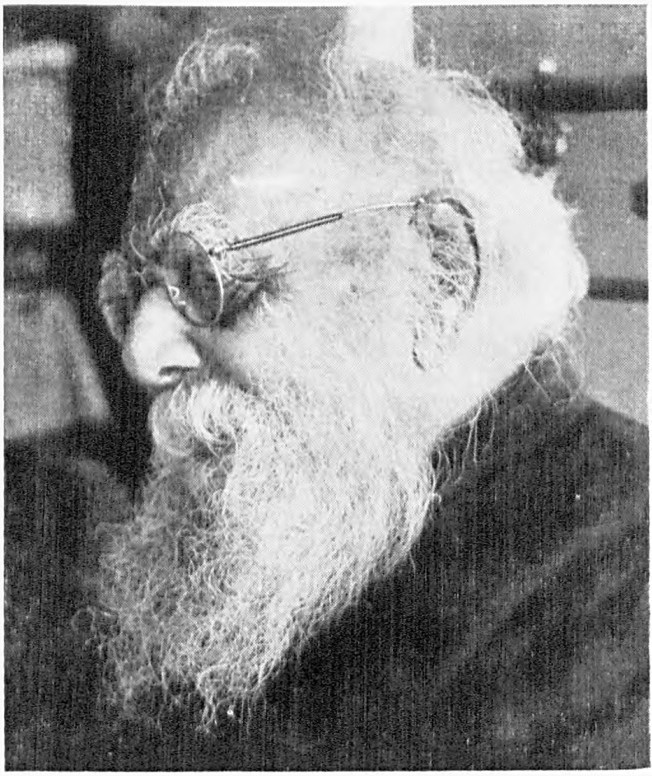
It was the British Government and the Christian missionaries who first introduced education among the low castes of India. The non-Brahmin Justice Party which came to power in Madras after 1919 took the first steps to make at least elementary education compulsory. When for brief periods of two years after 1937 and two years after 1952 a Brahmin became the Chief Minister of Madras he launched programmes which would if implemented over a long period have had the effect of curbing the spread of education among the non-Brahmin masses — especially the lower castes. It was the public opposition to these programmes launched after 1952 which enabled K. Kamaraj, with the blessing of Periar, to topple C. Rajagopalachari from power and himself assume the chief ministership of Madras from 1954 to 1962. The number of schools and especially secondary schools spiralled during this time and this was a matter which Periar was never tired of referring to as a great achievement in Tamilian history.
Apologists like Vivekananda and Dr Radhakrishnan describe Hinduism as a religion which never persecuted, nay never proselytized. Periar would call the lie direct to it by referring to the savage persecutions by Brahminism whenever it was powerful enough to indulge in them. The impaling of 8,000 Tamilian Jains on a single day by the Tamil Brahmin Thirugnanasambandha at Madurai at about 600 AD is a matter which is even now celebrated by an annual festival in the Meenakshi temple at Madurai and at many other temples. The Vaikunta Perumal temple in Kanchipuram is only one among numerous containing bas relief sculptures of the murder and torture of Tamilian Buddhists and Jains. Many a present day Hindu temple was originally constructed by Tamilian Buddhists or Jains. There are archaeological grounds to believe that the Varadarajaperumal temple in Kanchipuram was originally devoted to the Buddha under the name Arulala Perumal and that the Buddhist sanctum was walled up and now the Brahminical deity is on the first floor. The Kamatchi temple and Ekambareswara temple in Kanchipuram are believed to have been originally Buddhist or Jain. Periar has been exposing these facts.
Another aspect of Brahminical oppression has been control of land. The Brahmin settlements in the fertile river valleys of Tamil Nadu — like those in Thanjavur and Tirunelveli — were set up by the rulers of the middle ages who were puppets in the hands of the Brahmins, after driving out the original owners belonging to the lower castes of pure Dravidian stock or reducing them to the rank of serfs.3
The logic of Periar is matched by his humour. A man asked him in a temple town ‘How dare you call the god of this town a stone?’ Periar retorted ‘We will settle this at once. If you will accompany me, we will go to the temple immediately and I shall strike at the idol with my walking stick to see if it sounds like a stone or not.’ One of his quips was that the British did well to whitewash the milestones erected by them on the highways; otherwise they ran the risk of being worshipped as symbols of Siva. Accused by opponents that he was pro-British, that he ‘was licking the feet of white men’, he replied, ‘At least they wear shoes’.
He has led many agitations. The latest was in January this year when a big procession was taken out before a Superstition Eradication Conference in Salem. An effigy of Rama was beaten with shoes all along the way. Posters satirised the ludicrous stories of the birth of Hindu gods. Till then the press had uniformly adopted a policy of total black-out of Periar’s activities, but it lost its head and raised a hue and cry. One of the resolutions passed at the Salem conference was that a married woman should be free to leave her husband if she wished. This was twisted by the press, which went about telling people that the Salem conference wanted to legalise wife-snatching. As the elections were imminent, the opponents made a sustained propaganda that to vote for the Dravidian party would be to vote for atheism. But the DMK increased its majority in the State Assembly, getting 183 of 234 seats.
Practising Humanist
Unlike many in India whose rationalism is a mere veneer, Periar and his followers have been practising humanists. Intellectual honesty has made them stick to their views. As Periar says, often with a wink, he can overnight become a patron saint of Brahminism, with his portrait in every Brahmin eating place, if he was to admit error in preaching atheism.
The social effects of his teaching have been considerable. Those in the Dravida movement belonging to castes that traditionally employed Brahmin priests (scheduled castes and tribes as well as Nadars, Maravars, etc never did so) have given up calling Brahmins to officiate at ceremonies and, what is more, now celebrate marriages as civil contracts. Most of them have no belief in astrology or palmistry. Periar himself goes much further in his social views. He has no use for patriotism and advocates complete freedom for women in matrimony. He has been advocating birth control in Tamil Nadu for four decades.
In every leading political party in Tamil Nadu, there are men and women who have been influenced by him. The most notable was Annadurai, who broke away from the Dravida Kazhagam to form the Dravida Munetra Kazhagam. While adhering to Periar’s basic ideas, Annadurai made some diplomatic adjustments to lessen opposition to the movement. After independence he softpedalled atheism and anti-Brahminism. This policy paid dividends in 1967 when the party was returned to power. Brahminism was in dismay. It could not stomach the fact that ‘for the first time in centuries, the dark skinned low caste people of Madras… had snatched the seats of power’ (The Economist, July 8, 1967) on their own strength and not as stooges of Brahmins.
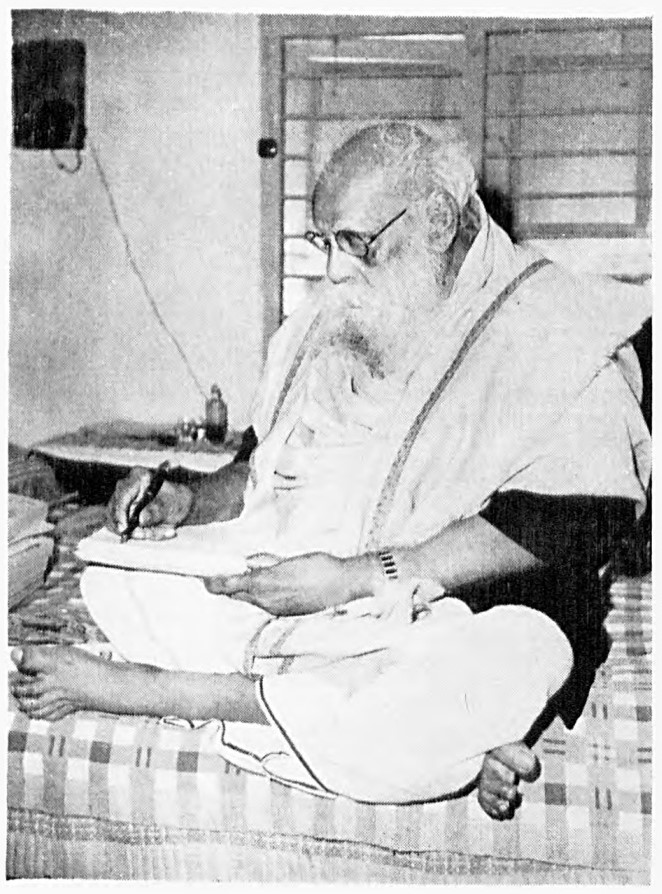
E. V. Ramaswamy was born in 1879 to a rich Kannadiga merchant in Erode in Coimbatore district. He had little formal education and began life as a businessman. He entered politics in 1919 when he resigned his chairmanship of the Erode Municipality and joined the Congress. He was imprisoned many times for his Congress activities. He and his wife and sister played a prominent part in the satyagragha at Vaikom in the present Kerala in protest against untouchability. He was for some time President of the Tamil Nadu Congress Committee.
Soon his acute mind saw through the fact that the Congress as then constituted was for all practical purposes an instrument for achieving the social and political aims of the Brahmins. He quit the organisation in 1925 and started the atheistic and rationalistic campaign called the Self-respect Movement. Politically, he collaborated with the Justice Party, which represented mainly the upper non-Brahmin castes. The Justice Party could not become a mass party because its leaders did not build up any mass cadres. In 1939 it made Ramaswamy president in a tardy attempt to secure a mass base. In 1944 Periar changed its name into the Dravida Kazhagam, though a rump group continued to exist.
In 1929 Ramaswamy went on a visit to Malaya. In 1932 he toured Britain, the USSR and other European countries. In 1937 C. Rajagopalachari as Chief Minister of Madras introduced the compulsory study of Hindi in schools. The step would have had the effect of subverting what remained of Dravidian culture. It was Ramaswamy who spearheaded the campaign against Hindi. For about five months he was jailed by the then Congress Government. In 1939 he led a deputation before the Cripps Mission and pleaded for proportional representation for the non-Brahmins. During the period of the Second World war the British Governor requested him as the leader of the Justice Party to form a Government in Madras but he refused.
Idol breaker
After independence he has been launching militant agitations with the aim of breaking the stranglehold of obscurantism and of the reactionary elements. He and his followers have tarred Hindi name boards in railway stations, burnt copies of the Constitution of India because it contains provisions for thrusting Hindi on non-Hindi people and because it contains safeguards for reactionary and obscurantist values. About 4,000 went to jail after burning the Constitution in 1957, and 15 of them died there. In 1960 they burnt copies of the map of India in protest against injustices to Tamil Nadu. They broke Hindu idols throughout Tamil Nadu in 1953, and burnt copies of the Ramayana in thousands in 1956. Under the lead of that famous rationalist actor M. R. Radha, they have staged many anti-religious plays. In 1957 they agitated throughout Tamil Nadu for erasing the epithet ‘Brahmin’ from the names of restaurants.
In 1932 Periar had injected a large dose of communism into his policies after return from the Soviet Union. But he soon jettisoned communism from his programme when the British Government started suppressing communists, and continued his iconoclastic movement aimed at longterm results. He has always been pragmatic, kept his followers under strict control and never allowed violence to creep into his agitations. His astuteness was also shown in disagreeing with Ambedkar who suggested that with their followers they should quit Hinduism and embrace another religion. Periar realised that if they left the Hindu fold, the ground for criticizing Brahminism would be cut from under their feet. He argued that they stood to lose nothing by remaining nominally under the label of Hinduism which was in any case an abstraction to refer to any Indian who was not a Muslim or Christian. (In 1956, Ambedkar and 800,000 of his followers became Buddhists).
In the Tirunelveli District Gazeteer H. R. Pate wrote in 1917
And in spite of all the wealth and undoubted social influence of Brahmans, the religion of the great mass of the population remains essentially, in form and spirit, as purely Dravidian today as we may imagine it was before the Brahmans set foot in the country.
These remarks are as much applicable to other parts of Tamil Nadu as to Tirunelveli, and as true today as in 1917. Hence Ramaswamy’s attack on Brahminism estranged none but the Brahmins, who survived by its perpetuation.
Attempts at subversion
Tamil has withstood the attempts of the Brahmins to subvert it, though Brahmins succeeded in wholesale substitution of Tamil place names and Tamil proper names with Sanskrit ones. Tamil is the only classical language which has been spoken continuously for more than 2,000 years and it is spoken by about five millions of people in Tamil Nadu, Ceylon, Malaysia, and by Tamil migrants in such far off places like Fiji and South Africa. Till a few centuries ago Kerala was a part of Tamil Nadu, with only Tamil spoken there. But the Brahmins were able to infuse large doses of Sanskrit vocabulary into the language and change it into Malayalam.
What are the prospects of the Dravidian movement? Hitherto it has received mass support from the scheduled castes (former ‘untouchables’) as well as the other lower castes. But in many rural areas the economic and class interests of these two do not coincide and even now there is a section of the former who complain that their contribution to the movement has not been recognised. The movement’s strength will depend on the extent to which the leadership succeeds in safegarding the interests of the scheduled castes who are bound to be more assertive of their rights with increasing political awareness. It will take considerable courage to make the Nadars, the Maravars, the Padayachits and other to concede their just demands, specially in the villages. But the ruling DMK seems to be aware of this, and has been taking steps to veer the movement towards this course.
___
1 On the Dravidian movement and Periar see Eugene Irschick: Politics and Social Conflict in South India; University of California Press, 1969. Robert L. Hardgrave: The Dravidian Movement. Selig Harrison: India, the Most dangerous decades; OUP, 1961, and Periar E. V. R.-— a Pen Portrait; Rationalist Publications; Madras-2.
2 Nelson: The Madura country Manual; Madras Govt Press, 1868; pps 168-169 of Part III.
3 In the Jummabundy report of 1802 for Tinnevelly District it is mentioned that ‘the greater part of the cultivators of the fertile villages on the banks of the Tambrapumi were at one time driven out to make room for colonies of Brahmins’.
A. J. Stuart (of the Madras Civil Service) in Manual of the Tinnevelly District (Madras, 1879) Chapter IV; Land Revenue page 70, writes: ‘ Tinnevelly belonged during the first 35 years of the last century to the Madura Nayak kingdom. Being comparatively open and fertile it was not, as was usual, assigned to chieftains for tribute, but managed directly by the Rajahs from their capital at Madurai. One of their measures most pregnant in after consequences was the removal of the indigenous cultivators from the rich portions of the Tamrapurni valley to make way for colonies of Brahmins from the north. These remain to the present day the owners of much of the best land in Tinnevelly.’
For case studies of the oppression of the lower castes where the economic and political power in rural areas is concentrated in Brahmins see: Kathleen Gough: ‘Caste in a Tanjore village’ in Aspects of Caste in South India, Ceylon and North West Pakistan by E. R. Leach; Cambridge, 1960. Dagfinn Sivertsen: When Caste Barriers fall (study of Thyaga samuthiram 6 miles from Kumbakonam); Allen and Unwin; London; page 121.
From New Humanist, April 1974
E. V. Ramaswamy Naicker, hero of many battles for the rights of the downtrodden and passionate fighter for rationalism in day to day life died recently in India at the age of ninety-five. For the past fifty years he had carried on a sustained effort to spread rationalism among the Tamils of southern India, who number 45 million. He became a father figure not only among them, but also for the Tamils of Sri Lanka and Malaysia, though not all may have become the kind of rationalists he would want them to be. His efforts were more successful among members of his own movement, the Dravida Kazhagam (Dravidian Brotherhood) and to a lesser extent in its offshoot, the DMK, the ruling party in the Tamil Nadu state. Through the two organisations he was able to influence a vast number of people and convert them to his way of thinking.
The Humanist (as this journal was then known) published a portrait of Periyar (the great one—a title given to him by the people) in December 1971. That article described his life and work. The epithets atheist, rationalist, freethinker and humanist can all be applied to him justifiably, depending on the angle from which his achievements are evaluated. It is certainly difficult to think of anyone else who has succeeded in instilling rationalist views among several million people, many of them semi-literate, through the medium of the spoken word. In the past half century, barring the time he was in prison, there were hardly any days when he did not address the public on the roadside or in some open space somewhere in the state of Tamil Nadu. In earlier years he used trains and Buses, but later travelled only in the van his followers had given him and was constantly on the move. In the last years of his life he had often been ill and in pain, but his iron will enabled him to carry on his mission to the last.
He was buried in Madras on December 25, without any religious ceremony, amidst expressions of spontaneous grief on the part of a vast concourse of people, estimated at nearly a million, from all over Tamil Nadu. So large was the funeral procession that the police had twice to use tear gas to control it. Such scenes were seen only once before, when the late Chief Minister C. N. Annadurai (also a humanist) and his follower had died. On the Periyar’s death a public holiday was declared, flags flew half mast on public buildings, and the state government, with leaders of all other political parties, paid homage. The President of the Republic and the Prime Minister sent messages of condolence.
Ramaswamy Naicker commanded wide support and influence in his crusade against the Brahmin domination of South Indian society. But unlike other reformers he attacked not only Brahminism but the whole paraphernalia of the Hindu religion. He opened every public tweeting with the words: ‘There is no God; there is no God; there is no God whatsoever. He who invented God was a fool; he who spread the idea of God was a rogue; he who worships God is stupid’. Yet in his earlier years he had to brave not only brickbats, shoes and dung thrown at him, but also several hundred threats to his life. His outspoken views naturally antagonised many and he went some way towards rooting out religion as such. But his achievements in fighting against social injustice are acknowledged even by his political opponents. His campaign against untouchability began in the 1920s, first in association with Gandhi though they parted company later. The Vaikkom civil disobedience was a major event of those times and the struggle against caste continued through the years. In 1953 the Periyar launched a campaign to break up Hindu religious images so as to break people’s superstitious worship of idols. And three years ago he organised the controversial Salem conference against foolish religious beliefs. But attacks on religion and on caste domination and economic exploitation went hand in hand in Ramaswamy’s philosophy. Basic to his ideas was the need to arouse the people against the latter and give them a sense of dignity. In this he undoubtedly succeeded. In the Tamil Nadu of today the tables have been turned against caste Hindus, and the suppressed Tamil has acquired a sense of self-respect. Chief Minister Karunanidhi spoke for millions of his countrymen when he said ‘The country cannot forget the saga of this ninety-five-year-old rationalist lion’s fight for social reformation till his last breath. He was the great leader who has enabled Tamil Nadu today to stand upright with a sense of self-respect. The millions of backward and downtrodden people who secured a social status because of the Periyar will find it difficult to bear his loss’. A life devoted to uncompromising rationalism, rich in achievement.
In the absence of a better—the palladium of what liberty we have… the birthplace of mind, and the focus of […]
Josephine Gowa was an active member of the Hampstead Ethical Institute (later Hampstead Humanist Society) for over three decades, many […]
This article was written for Humanist News by Harold Blackham, who is viewed today as the architect of the modern […]
From the Agnostic Annual, 1900, edited by Charles A. Watts (founder of the Rationalist Press Association). THE RATIONALIST PRESS ASSOCIATION, […]