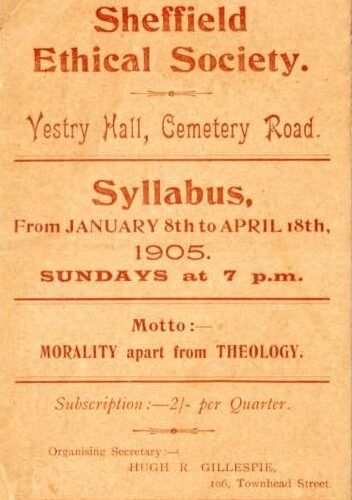
Morality apart from theology
Motto of the Sheffield Ethical Society, from a poster of 1905
The founding meeting of the Sheffield Ethical Society took place at the Wentworth Cafe (58 Pinstone Street) on 8 July 1903. During its first years the Society met at the Cemetery Road Vestry Hall, later moving to the Isaacs Building and what they called Stanton Hall, possibly after Stanton Coit, a leading figure in the Ethical movement.
The Society’s aims were fellowship, social reform, and the ‘cultivation of moral character’, a 1909 leaflet giving them as:
The Sheffield Ethical Society, which became affiliated to the Union of Ethical Societies (now Humanists UK) in 1905 and the Rationalist Peace Society in 1910, was active for more than two decades, winding up in 1924. During these years, speakers for the group included feminist writer Zona Vallance, leading freethinker Joseph McCabe, and poet and gay rights activist Edward Carpenter.
In 1920 the Society hosted the first ever annual conference of the Union of Ethical Societies to take place outside of London, at the Builders’ Exchange on Cross Burgess Street.
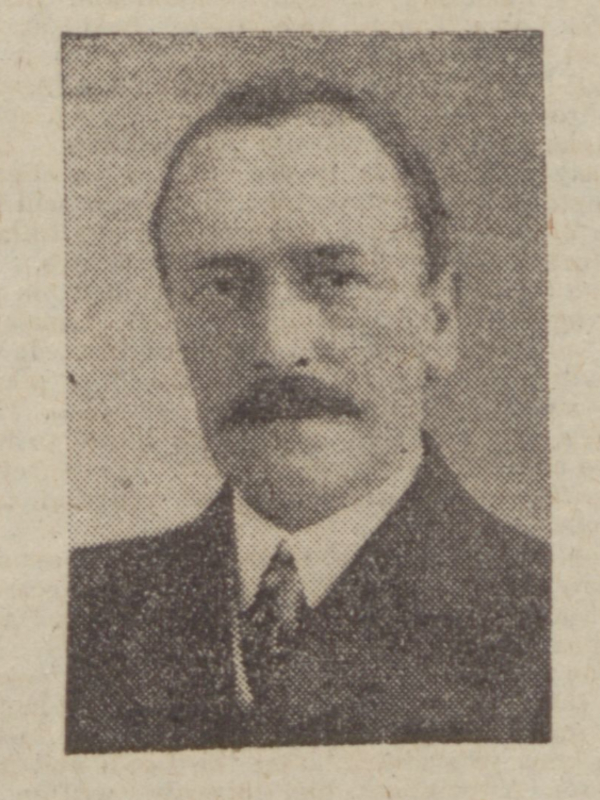
A leading figure in the Sheffield Ethical Society for much of its existence was local Labour councillor R. H. Minshall, who at various times was president, secretary, and speaker.
Richard Harry Minshall was born in Stoke on Trent, where he worked first as an assistant schoolmaster. His career was in the civil service as a Customs and Excise Officer, from which he retired in 1922. On moving to Sheffield, he quickly became connected with a range of societies, including the Literary and Philosophical Society, the Fabian Society, the Workers’ Educational Association, the Sheffield branch of the National Committee for the Prevention of Destitution and Reform of Poor Law, and the Sheffield Independent Labour Party. He was an advocate of prison reform, a supporter of the League of Nations, and a committee member of the Sheffield Council of Social Service.
In 1924, following two defeats, Minshall was elected to the City Council as a member for Darnall, and was particularly active in areas concerning education. He was admired for his ability to command respect even from his opponents. The Sheffield Independent noted too that ‘as a lecturer, he was always popular, and his wide knowledge of literary matters enabled him to combine a vast amount of interesting and factful information with an easy and piquant wit’.
On Minshall’s death in September 1933, the Ethical Societies’ Chronicle mourned the loss of a ‘valued member of the [Ethical] Union’. Minshall’s committal at Sheffield’s City Road Cemetery was led by Harry Snell, who remarked that ‘Mr. Minshall’s keen social idealism was something made real by unremitting labour’. Snell’s address, reported the Sheffield Independent, ‘was one not of sorrow, but of thankfulness for the work of a man of culture and of great social usefulness’. So many people attended the service that they could not all fit into the chapel, and Snell gave a second, shorter address outside.
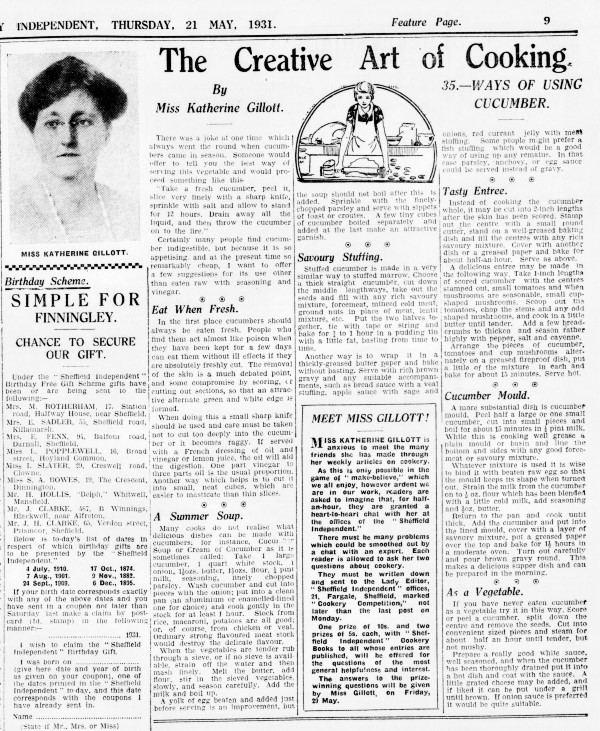
Sheffield-born Katherine Lucy Gillott worked as a cookery teacher and as a canteen supervisor in Sheffield steelworks Hadfields Limited, later becoming a steelworks welfare supervisor. During the early 1930s, Gillott had a cookery column in the Sheffield Independent, focused on practical and economical cooking – giving advice and responding to reader enquiries.
Like Minshall, Katherine Gillott was president of, secretary to, and speaker for the Sheffield Ethical Society over the course of its existence. Her brother Frank was also a longtime member of both the Sheffield Society (for which he had acted as treasurer), and the Ethical Union. His 1963 death, and loss to the humanist movement, was remarked upon in the pages of its magazine News and Notes.
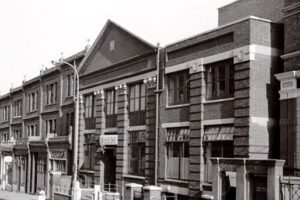
The object of this Society is: To increase the knowledge, the love, and the practice of the right. Its bond […]
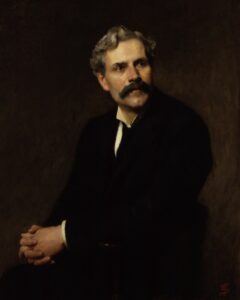
The moral value of a belief in eternal life is a doubtful matter. But this is certain, that where rest […]
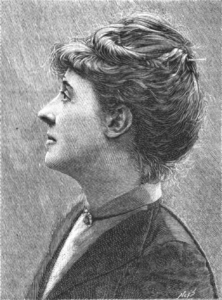
Belief in the power of man to choose his direction of change: this is the creed of the future, and […]
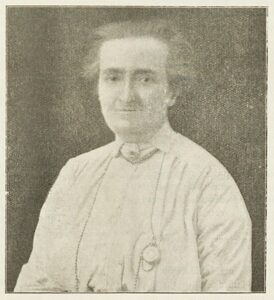
Nellie Freeman was an indefatigable organiser within the Ethical Union (today’s Humanists UK) for decades of her life. Beginning in […]