Thus must we toil in other men’s extremes,
Thomas Kyd, The Spanish Tragedy, Act III, sc. VI (1592)
That know not how to remedy our own.
A pioneer of the Elizabethan stage, Thomas Kyd was the author of The Spanish Tragedy, the play that helped define English revenge tragedy and laid the groundwork for works such as Hamlet. Though long overshadowed by his contemporaries, Kyd played a foundational role in the development of English drama. Focused on human emotion, political corruption, and the absence of divine justice, his plays helped open the stage to a more mature theatre that explored moral and philosophical questions grounded in human experience, laying the groundwork for the psychological realism of writers like Shakespeare.
In 1593, he was arrested, imprisoned, and tortured after heretical writings were found in his possession. Though he insisted the blasphemous papers belonged to his former roommate, the leading playwright Christopher Marlowe, the damage to his reputation and career was irreversible. He died the following year, destitute and disgraced. In a culture where religious heterodoxy was treated as treason, Kyd’s downfall makes him one of the first English writers persecuted for irreligion — an early, if unwilling, martyr for freedom of thought.
Born in 1558, the son of a London scrivener, Kyd was educated at the Merchant Taylors’ School, where the curriculum emphasised Latin, rhetoric, and classical literature. Little is known about his early adulthood, but by the mid-1580s he had entered the world of the theatre and likely worked as a dramatist for an acting company known as the Queen’s Men.
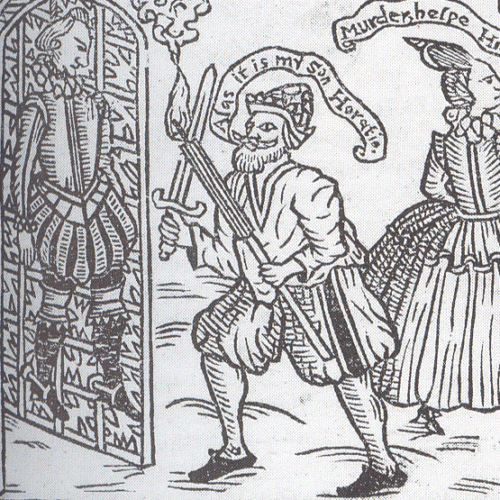
Kyd’s The Spanish Tragedy (c. 1587) was a runaway success, remaining in performance into the next century and shaping the dramatic landscape for a generation. Its tale of a grieving father seeking justice for the murder of his son, navigating a corrupt and indifferent court, struck a chord with audiences and introduced new conventions such as soliloquies, ghostly visitations, and internal conflict. These would later be adopted and refined by Shakespeare and others.
The play’s engagement with justice, retribution, and grief is strikingly secular. Though a ghost appears, it serves as a narrative device rather than a moral guide, and divine justice is repeatedly deferred or denied. The law offers no recourse. What emerges instead is a bleak portrayal of the cyclical nature of violence, as one act of vengeance leads inexorably to another. There is no final reckoning beyond human hands, only the repetition of suffering, loss, and revenge. This was not religious consolation but psychological realism.
In 1593, during a period of political tension and anti-immigrant unrest, Kyd was arrested and tortured after papers deemed heretical were found among his possessions. These writings, which denied the divinity of Christ, were later claimed by Kyd to have belonged to Christopher Marlowe, with whom he had shared lodgings. Though Kyd was eventually released, his career was irreparably damaged. He died a year later, aged around 35, possibly in poverty.
The precise nature of Kyd’s own beliefs remains unknown. His association with Marlowe, and by extension with the so-called ‘School of Night’ — a loosely linked group of sceptical, intellectual figures such as Sir Walter Raleigh — has led to speculation about his sympathies. But there is no evidence of a formal philosophical position. What his writing does show is a deep concern with the moral limitations of systems of power, a suspicion of theological explanations for suffering, and a focus on the emotional complexity of human beings caught between duty, grief, and justice.
Kyd’s contribution to the English stage was profound. His blending of classical influence, vernacular drama, and philosophical questioning helped usher in an era of theatre more concerned with the motives and consequences of human action than with divine order. In doing so, he became one of the early architects of a dramatic tradition that reflected the secularising currents of the late 16th century: a theatre that asked what justice might look like in a world where the gods are silent.
Though long overshadowed by his contemporaries, Kyd’s work reminds us of the writers who, even in repressive and uncertain times, helped to move public storytelling towards human empathy, ethical ambiguity, and critical reflection — hallmarks of the humanist tradition.
By Liam Whitton
Main image: Section from the title page of the 1615 edition of Kyd’s The Spanish Tragedy.
From the outset IAS aimed to have an open approach to prospective adopters irrespective of their race, religion and creed, […]
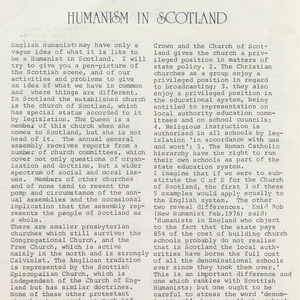
In 1983 Nigel Bruce, chairman of the Scottish Humanist Council, explained to readers of the BHA’s Humanist News why Scotland needed a humanist body of its own. His article, reproduced here, is the clearest statement of the case made six years before the Humanist Society of Scotland was founded.
A wide-ranging Humanism will always seek to extend to more and more people, through education and opportunity, the enrichment of […]
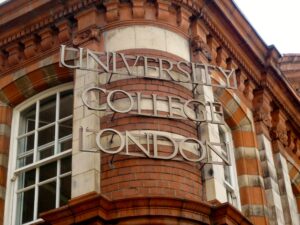
University College London was founded in 1826 as the University of London; the city’s first university, and a consciously secular […]