It may be expedient but it is not just that some should have less in order that others may prosper.
John Rawls, A Theory of Justice (1971)
American philosopher John Rawls was one of most important political philosophers of the 20th century. His major work, A Theory of Justice (1971), has become the book against which every subsequent or competing account of a fair society since has measured itself. Having lost his Christian faith as a young soldier in the Pacific, Rawls spent the rest of his life working out how people who disagree about the meaning of life could nonetheless agree on the terms of living together. A year studying alongside British philosophers at Oxford left a marked impression on the humanist bent of his later work.
How could I pray and ask God to help me, or my family, or my country, or any other cherished thing I cared about, when God would not save millions of Jews from Hitler? When Lincoln interprets the Civil War as God’s punishment for the sin of slavery, deserved equally by North and South, God is seen as acting justly. But the Holocaust can’t be interpreted in that way, and all attempts to do so that I have read of are hideous and evil. To interpret history as expressing God’s will, God’s will must accord with the most basic ideas of justice as we know them. For what else can the most basic justice be? Thus, I soon came to reject the idea of the supremacy of the divine will as also hideous and evil.
John Rawls, ‘On My Religion’”’ [1997] in A Brief Inquiry into the Meaning of Sin and Faith (2009)
Rawls was born in Baltimore on 21 February 1921. Two of his younger brothers died in childhood of illnesses they had caught from him, a fact he never forgot. He went to Princeton intending to take Episcopal orders, and in December 1942 submitted a devout senior thesis on sin and faith before he was drafted.
He served as an infantryman in New Guinea, the Philippines, and occupied Japan, where he saw the ruins of Hiroshima. By his own dating, his faith was gone by June 1945. In On My Religion, a short memoir drafted in 1997 and published after his death, Rawls set down the three episodes that stood out. On Kilei Ridge in the Philippines, a Lutheran pastor preached that God was aiming American bullets at the Japanese and turning Japanese bullets away; Rawls, angry in a way he could not fully account for, confronted him over what he called falsehoods about divine providence. A friend named Deacon, with whom he shared a tent, was chosen over him for a mission that proved fatal — a contingency that could as easily have gone the other way. Then came the first army news reports of American troops reaching the camps, when he found he could no longer pray. He could not ask God to protect him, or his family, or anything he cared about, through a providence that had not saved millions of Jews from Hitler. Every attempt he had read to interpret the Holocaust as divine justice struck him as evil.
Rawls returned to Princeton for a doctorate in philosophy, completing it in 1950, and in 1952–53 held a Fulbright fellowship at Christ Church, Oxford. There he sat in on a seminar run jointly by H. L. A. Hart, Isaiah Berlin, and Stuart Hampshire, and encountered in draft various arguments about law and about liberty that Hart and Berlin would publish later in the decade. Both stayed with him. He taught at Cornell and then MIT before moving to Harvard in 1962, where he remained for the rest of his career.
His A Theory of Justice asked what principles people would choose to govern their society if they had to choose from behind a ‘veil of ignorance’, not knowing whether they would be rich or poor, religious or not, talented or not. Rawls argued they would choose equal basic liberties for all, and would permit inequalities only where they benefited the least advantaged. His later Political Liberalism (1993) refined this account for a society in which citizens hold incompatible religious and philosophical views: the terms of public life, Rawls argued, must be ones that people of any reasonable view could accept, without any one doctrine being imposed on the rest. He died in Lexington, Massachusetts, on 24 November 2002.
Rawls did not call himself a humanist in any published writings and was a private man about his own beliefs. But the project of his mature work — a fair society justified by reasons all its citizens can share, in which no church or creed has public authority over anyone — is the secular state as humanists have argued for it, given its most rigorous philosophical defence.
British humanists have taken him up accordingly. The veil of ignorance has become a standard teaching tool on Humanists UK’s Understanding Humanism site, where it is offered to schools as a way of getting pupils to reason about fairness from first principles, and it forms its own step in Introducing Humanism, the organisation’s online course presented by Sandi Toksvig. In September 2024 the economist and philosopher Daniel Chandler was awarded the Voltaire Lecture Medal for his lecture at Conway Hall on Free and equal: what would a fair society look like?, arguing that a politics reduced to incremental fixes had lost any shared picture of the society it was building, and proposing Rawls’ framework as the missing prospectus — from electoral reform to the distribution of economic power.
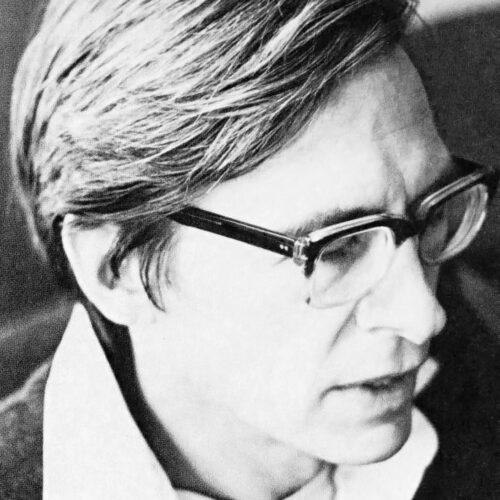
Main image: John Rawls by Alec Rawls, originally printed on the dust jacket of A Theory of Justice (1971)
No law can be effective which has not behind it the sanction of the people. Dorothy Thurtle, quoted by David […]
University College London was founded in 1826 as the University of London; the city’s first university, and a consciously secular […]
Essentially, I am interested in this world, in this life, not in some other world or a future life. Whether […]
Not by the Creed but by the Deed. Motto of the Society for Ethical Culture of New York, founded in […]