We are members of a community. We are indissolubly connected with the society of our fellowmen. We have duties.
William Godwin, ‘Liberty’ in Essays of the Late William Godwin (1873)
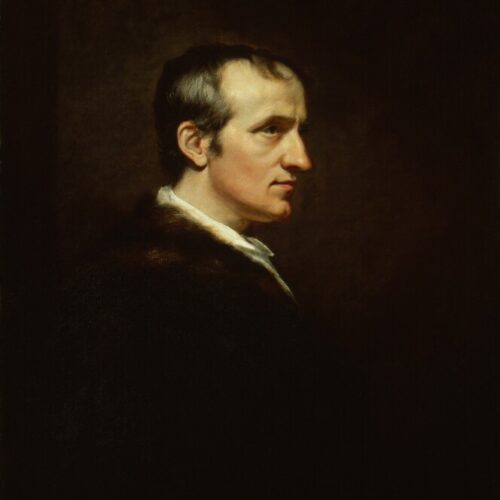
William Godwin was a philosopher and novelist, and the most celebrated radical thinker in Britain in the 1790s. A former dissenting minister who abandoned Christianity for a thoroughgoing rationalism, he argued in An Enquiry Concerning Political Justice (1793) that human beings, freed from superstition and coercion, were capable of continual moral improvement through the use of reason. Known commonly as the founder of philosophical anarchism, Godwin put forward that government is an inherently corrupt force, and laid out how he saw a society without a state functioning. Though not as famous as his better-known wife, Mary Wollstonecraft, or his daughter, Mary Shelley, Godwin was a humanist philosopher whose influence was felt by generations of thinkers and activists.
Let us look back, that we may profit by the experience of mankind; but let us not look back, as if the wisdom of our ancestors was such as to leave no room for future improvement.
William Godwin, An Enquiry Concerning Political Justice Vol. I (1793)
William Godwin was born on 3 March 1756 in Wisbech, Cambridgeshire, the seventh of 13 children born to Anne Hull and John Godwin, a dissenting minister. Godwin was first educated by a religious elderly woman, and when he moved to a new school after her death, he remained a religious enthusiast and dissenter. Despite opposition from his father, he had a strong desire to become a minister himself, and from 1767 boarded with Samuel Newton, minister of an independent congregation in Norwich. However, Godwin would leave him in 1770 as a result of his violent treatment, and abandon his intended vocation in favour of bookselling.
He was later persuaded to continue his tutelage for another year, and was eventually admitted into Hoxton Academy. In 1780, he found a role in Suffolk, which he held for two years. During this time, his religious views underwent significant change, moving towards deism after reading the French philosophes. By the mid-1780s he had left the pulpit to earn his living by his pen, and by the end of the decade he had abandoned belief in a god altogether.
In the summer of 1791, Godwin began writing what would become his most famous work: An Enquiry Concerning Political Justice. This work laid the foundations of philosophical anarchism, and made him a central figure in radical political and literary circles. Published in February 1793 at the height of alarm about the French Revolution, the book argued that government was at best a necessary evil, that the great engine of human progress was the free exchange of ideas, and that people would act justly if only they were allowed to think clearly. Its expensive price is said to have saved it from prosecution; Pitt’s government reckoned that a three-guinea book could do little harm. Godwin followed it with Caleb Williams (1794), a novel dramatising the same ideas through a servant hounded by a powerful master, and with public support for the radicals tried for treason that autumn.
In 1796 Godwin began a relationship with Mary Wollstonecraft. In spite of shared objections to marriage, they wed in March 1797 when Wollstonecraft became pregnant. She died in September, days after the birth of their daughter Mary. Godwin’s grief produced the Memoirs of the Author of A Vindication of the Rights of Woman (1798), a candid account of her life, loves, and suicide attempts which he intended as a tribute but was received as a scandal. It damaged both their reputations for a generation.
The long remainder of Godwin’s life was quieter. He remarried, ran a children’s bookshop and publishing business with his second wife, Mary Jane, and wrote further novels, histories, and essays. His influence on the younger Romantics was direct: Percy Shelley read him at Oxford, sought him out, and eloped with his daughter. Godwin died on 7 April 1836 and was buried beside Wollstonecraft in St Pancras Old Churchyard.
The proper method for hastening the decay of error, is not, by brute force, or by regulation… to endeavour to reduce men to intellectual uniformity; but on the contrary by teaching every man to think for himself.
William Godwin, An Enquiry Concerning Political Justice Vol. II (1793)
Godwin’s account of morality, as something to be reasoned out by human beings, for human benefit, without reference to divine command, was foundational in the humanist tradition that followed. A lifelong champion of free enquiry, he believed, alongside many classical liberal thinkers preceding and succeeding him, that individuals needed to be free to criticise authority in order for the improvement of society to be achieved, believing that judgement was founded on evidence, and that compulsion was insufficient in delivering uniformity.
By Lewis Norton
Main image: William Godwin by James Northcote, oil on canvas, 1802 NPG 1236 © National Portrait Gallery, London
… purely human and natural ethics, and not theology, was the source of this pioneer woman’s enthusiasm for justice, even […]
What primarily unites Humanists is not a set of propositions to be believed but moral values to be freely chosen… […]
Her beautiful life, her truth, her unwearied charities, proceeded from her own heart. They were not inspired by any thought […]
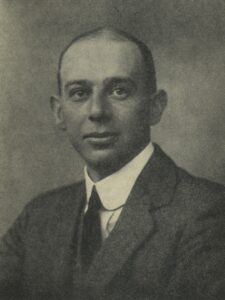
To know him added a zest to existence, and was rich compensation for much that depresses the idealist. Percy Vaughan […]