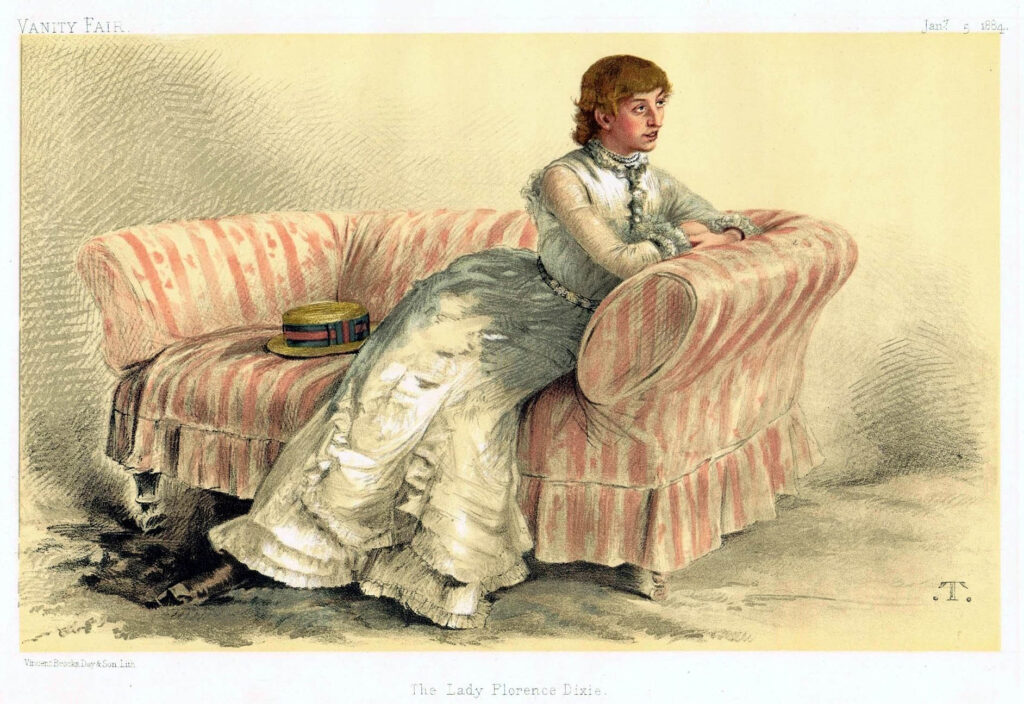
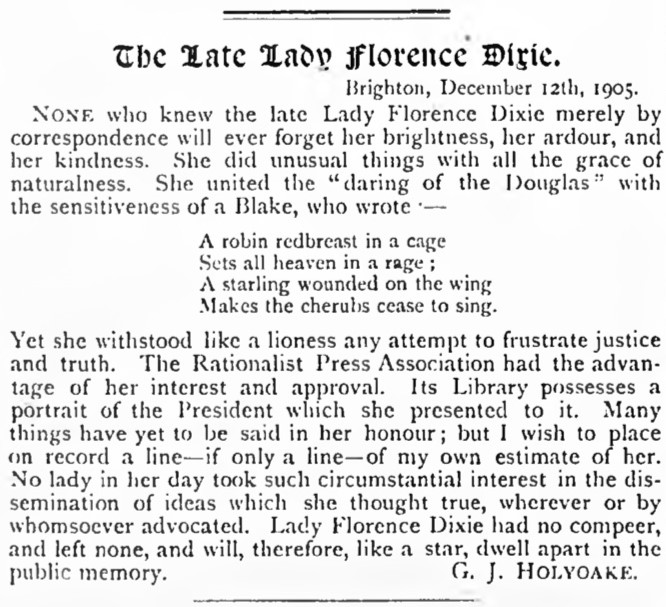
Lady Florence Dixie had no compeer, and left none, and will, therefore, like a star, dwell apart in the public memory.
George Jacob Holyoake, The Literary Guide, January 1906
On 7 November 1905 Lady Florence Dixie died at Glen Stuart, her home near Annan in Scotland, aged 50. She had caught diphtheria, The Literary Guide reported, ‘on an errand of mercy’. Traveller, war correspondent, novelist, and campaigner for women’s rights, she was also one of the most outspoken freethinkers of her day.
This article looks at her last four years through the magazines of the Rationalist Press Association, exploring what she wrote, what her fellow freethinkers made of her, and why her ideas still speak to humanists today.
Dixie joined the Rationalist Press Association in spring 1902. The Literary Guide, the association’s monthly paper and forerunner of New Humanist, announced her among its ‘recent recruits’ alongside H. G. Wells. It had already reviewed her Songs of a Child, poems written between the ages of 10 and 17, including a verse drama in which Cain revolts against the God of Genesis. The reviewer called her ‘a writer who dares to think for herself’.
The Story of Ijain (1902) followed, a thinly veiled account of her own childhood revolt against religious teaching. Then came the drama Isola; or, The Disinherited (1903), ‘a revolt for woman and all the disinherited’, dedicated to George Jacob Holyoake, the veteran secularist who was the association’s first chairman. Reviewers found its style rough, but praised its sincere case for equality between the sexes and kindness to animals.
Her books reached readers that freethought pamphlets rarely did. In 1905 she quoted a letter from a woman who had picked up Ijain by chance in a hotel:
I no longer curse God in my heart, for now I know whence all my sorrows come, and that these are the outcome not of God’s will, but unjust law.
A reader’s letter, quoted in Florence Dixie, ‘Thoughts after Reading “The Religion of Woman”’, The Literary Guide, March 1905
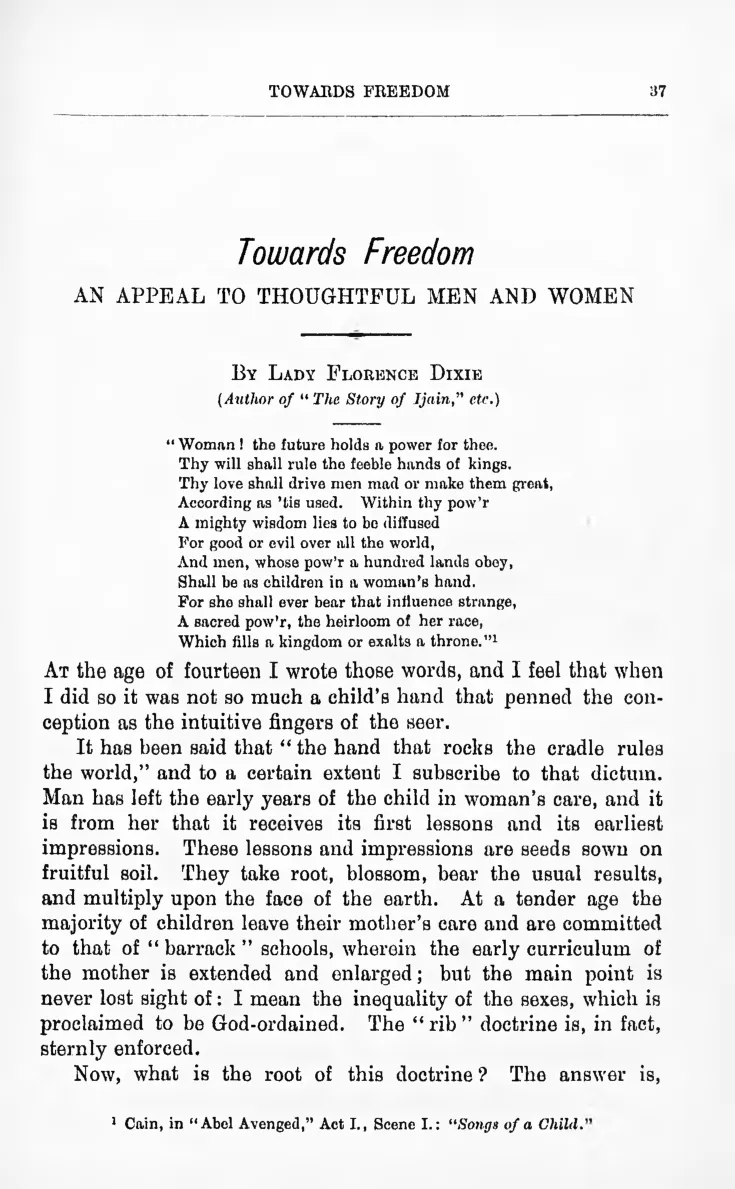
Her most widely read freethought essay was ‘Towards Freedom: An Appeal to Thoughtful Men and Women’, published in the Agnostic Annual for 1904. The story of Eve, made from Adam’s rib, had taught generations that women’s subjection was ordained by God, she argued, and laws on property, marriage and the custody of children rested on it. Science, she wrote, had ‘broken the legs of the Bible’. She urged every reader to test their beliefs:
Use your own common-sense and reason for yourselves, and refuse to have your belief ladled out to you.
Lady Florence Dixie, ‘Towards Freedom’, 1904
Its closing pages are a very humanist statement of ethics. ‘The service of man to fellow-creatures,’ she wrote, ‘is a nobler and more satisfying religion than that which incites to injustice and cruelty.’ The essay was reprinted as a pamphlet within weeks, and nearly half the edition sold at once. Readers sent money so copies could be given away, one from as far as Shanghai, and in 1904 a French translation appeared in Brussels.
In December 1903, a correspondent asked Dixie (as ‘a prominent Freethinker’) whether she sympathised with those who mocked Christianity with ‘offensive caricature’. Her reply, printed in January 1904, was a firm no. She called the blasphemy law ‘utterly effete’ and ‘inconsistent with justice and the trend of modern thought’, wanting it repealed, but she believed ridicule only hardened believers against the critic:
There is only one legitimate mode, and that is the argument and fact of logic and the friendly criticism of beliefs which have no foundations of support save faith. Sound reasoning will convert many where vulgar and coarse assault can do nothing but disgust.
Florence Dixie, ‘Freethought and Blasphemy’, The Literary Guide, January 1904
Not everyone agreed. A Dr Robert Park wrote in to defend the more combative freethinkers, and she answered him in March, reiterating her belief that ‘controversy can be effectively conducted without recourse to coarse and vulgar phraseology or offensive cartoons.’ It would be more than a century before blasphemy laws were repealed, after long campaigns involving many humanists: in England and Wales in 2008, and in Scotland in 2024.
Education was at the heart of her programme. In ‘Rational Education’ (The Literary Guide, February 1904) Dixie argued that children should be taught facts, not fables, and that kindness to people and animals should be cultivated from the start. She condemned single-sex ‘barrack’ schools and called for boys and girls to learn and play together as equals. She urged rationalists to refuse the marriage service, which in her view made a wife her husband’s property, and insisted that motherhood must be a woman’s own choice.
Fact, truth, kindness, should form the basis of a child’s early teaching.
Lady Florence Dixie, ‘Rational Education’, 1904
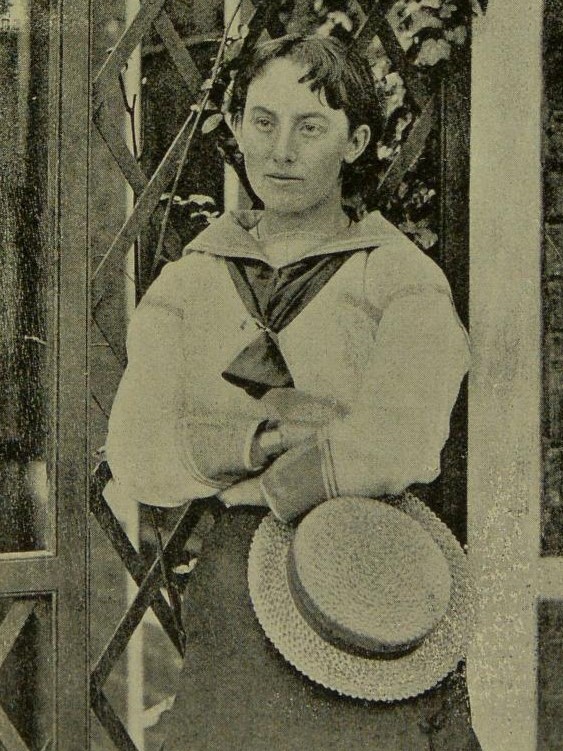
She knew that women could change little of this without the vote. ‘Although I may protest, I cannot alter,’ she wrote in 1905.
I may whine, I cannot legislate; and, having no vote, I can be safely neglected.
Some of her arguments, though, reflect prevailing ideas of her time, and are out of place in ours. Like many neo-Malthusians, who blamed poverty on large families and urged people to have fewer children, she wrote that people with hereditary diseases should not become parents. In one 1904 letter she also blamed ‘aliens and miseries’ in Britain’s cities for ‘physical degeneration’. Humanists today would firmly reject those views, but letters from Literary Guide readers at the time suggested wider support.
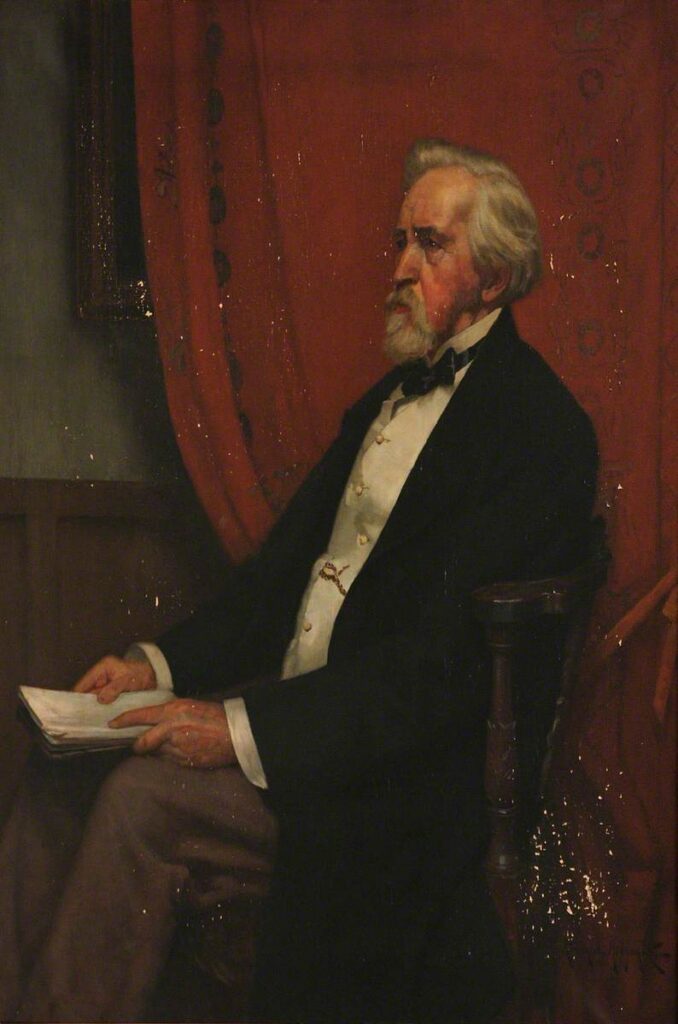
Dixie backed the movement with money as well as words. In June 1903 she sent £50 to buy a portrait of Holyoake for the association’s library, ‘the grateful gift of Isola’, in thanks for his ‘consistent and unfailing championship of fair-play and justice to women’. Today, this hangs at Conway Hall. In the same letter she wrote:
Depend upon it, superstition will live on till free woman arises to strike it down.
Lady Florence Dixie to Charles A. Watts, 27 June 1903
She gave £5 to the fund that kept the association’s sixpenny reprints of freethought classics in print, and £3 towards the International Freethought Congress in Paris in 1905. Only after her death did The Literary Guide reveal that she had also given, anonymously, more than £300 to a testimonial for the freethought lecturer Charles Watts.
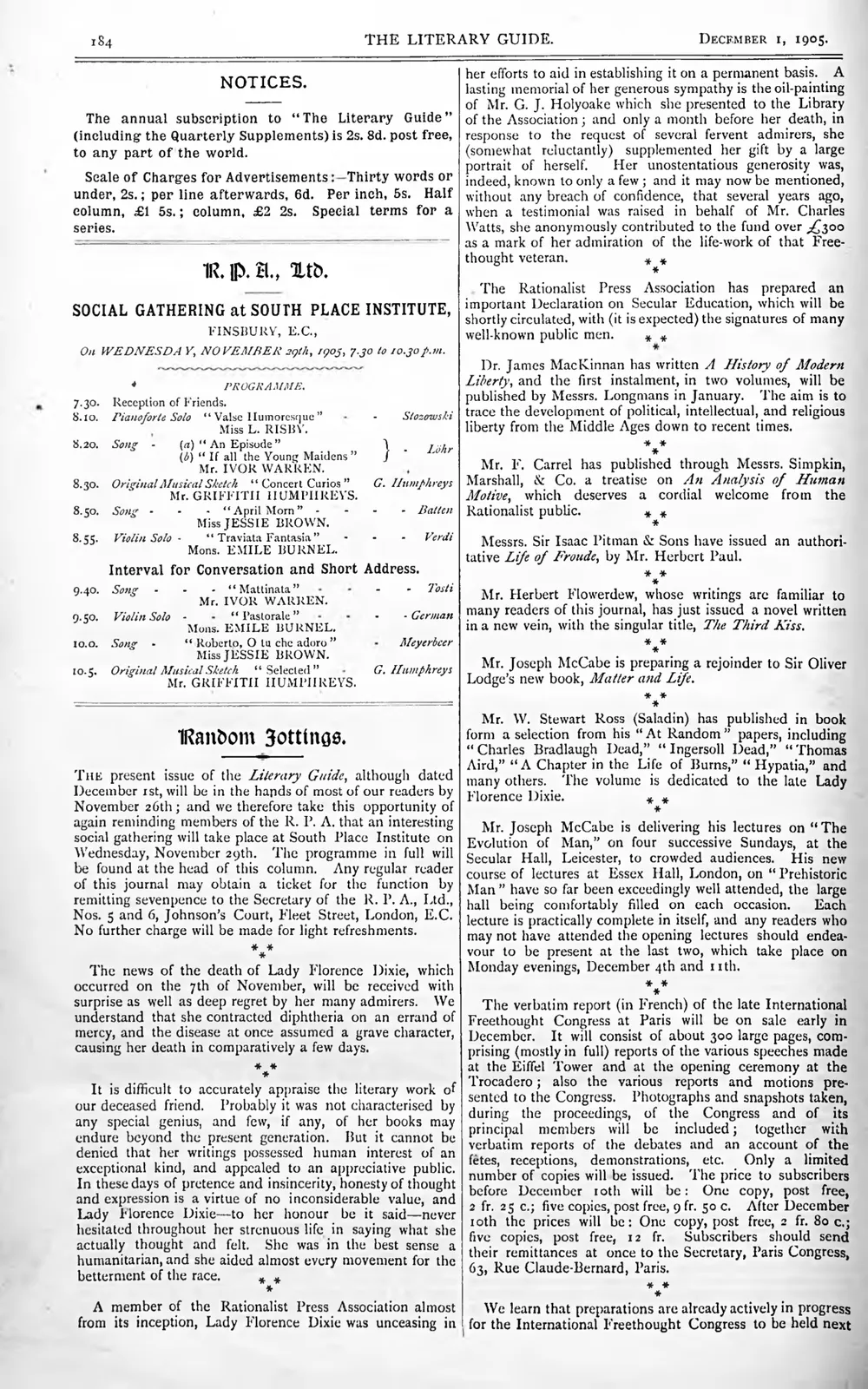
News of her death reached The Literary Guide as its December 1905 issue went to press. Its notice was candid: few of her books, it guessed, would outlast her generation. But it praised what it thought mattered more:
In these days of pretence and insincerity, honesty of thought and expression is a virtue of no inconsiderable value, and Lady Florence Dixie—to her honour be it said—never hesitated throughout her strenuous life in saying what she actually thought and felt. She was in the best sense a humanitarian, and she aided almost every movement for the betterment of the race.
‘Random Jottings’, The Literary Guide, December 1905
In time for the January issue Holyoake, then 88, sent a short tribute from Brighton. He wrote of ‘her brightness, her ardour, and her kindness’, and of a woman who ‘did unusual things with all the grace of naturalness’. Holyoake himself died just a few weeks later.
Yet she withstood like a lioness any attempt to frustrate justice and truth.
George Jacob Holyoake, The Literary Guide, January 1906
Holyoake predicted Dixie would ‘dwell apart in the public memory’, and in a sense she has. Where she is remembered today, it is generally as a traveller, a war correspondent, and the first president of the British Ladies’ Football Club, rather than as a freethinker. Yet many of those she argued for in The Literary Guide remain humanist causes: equality, agency, education that teaches children to think for themselves, compassion for animals, and freedom of expression, defended with reason rather than abuse.
Above all, she believed that people need no supernatural law to live well, and that ‘the service of man to fellow-creatures’ was a nobler creed than any other.
The full issues of The Literary Guide can be read in New Humanist’s digital archive, available via Exact Editions. Subscribe at newhumanist.org.uk/subscribe.