Sir Patrick Stewart (1940–2026)
(13 July 1940 – 28 October 2026)
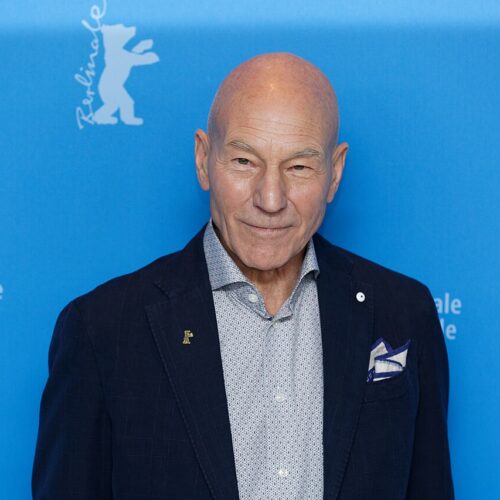
(13 July 1940 – 28 October 2026)
The human is the best we have – and all we have.
Patrick Stewart, on becoming a patron of the British Humanist Association, 2012
Sir Patrick Stewart was one of the finest classical actors of his generation, and for millions around the world the face of a humanist future. As Captain Jean-Luc Picard in Star Trek: The Next Generation, he gave life to a vision of humanity guided by reason, diplomacy, and compassion rather than dogma – a vision which, he was always clear, reflected the humanist convictions by which he lived. A patron of Humanists UK from 2012 until his death, Stewart matched his art with activism: against domestic violence, for the mental health of veterans, and for the legal right of dying people to choose the manner of their death.
Patrick Stewart was born on 13 July 1940 in Mirfield, West Yorkshire, into a working-class household. His mother, Gladys, was a weaver and textile worker; his father, Alfred, a regimental sergeant major who returned from the Second World War with what would today be recognised as post-traumatic stress disorder, and whose violence towards Gladys darkened Stewart’s childhood. These experiences shaped the causes he championed for the rest of his life.
Stewart left school at 15, working briefly as a junior newspaper reporter before being sacked for spending too much time at the theatre. He began his professional career in repertory in Lincoln, and in 1966 joined the Royal Shakespeare Company, where he became one of the celebrated Shakespearean performers of his era. He never lost his Yorkshire roots: from 2004 to 2015 he was Chancellor of the University of Huddersfield, a role he cherished, saying he was ‘extremely proud of the University of Huddersfield and all it has achieved’. He was appointed OBE in 2001 and knighted for services to drama in 2010.
In 1987, at 47, Stewart was cast as Captain Jean-Luc Picard in Star Trek: The Next Generation, the revival of the optimistic vision of the future created by fellow humanist Gene Roddenberry, whose Starship Enterprise famously carried no chaplain. The thoughtful, principled captain – a diplomat and explorer who reached for understanding before force – made Stewart a global star, and the role grew inseparable from the man. Picard’s place in a longer tradition of humanist storytelling is explored in our exhibition Science fiction and humanism.
Halfway through season 3 of Next Generation, I no longer knew where Jean-Luc started and Patrick Stewart left off. We became melded, and he has never left me.
Patrick Stewart, Television Critics Association press tour, 2020
From 2000 Stewart also played Professor Charles Xavier in the X-Men films: the teacher and leader of a persecuted minority, in stories widely read as an allegory of the civil rights struggle and the case for tolerance. He returned to both roles late in life, in Logan (2017) and the series Star Trek: Picard (2020–23), and published a memoir, Making It So, in 2023.
Stewart married the singer-songwriter Sunny Ozell in 2013, in a ceremony conducted by his friend and X-Men co-star Ian McKellen. He died at his home in Los Angeles on 28 October 2026, aged 86, having lived with Alzheimer’s disease and Lewy body dementia. At the time of his death his final screen appearance, as Professor X in Avengers: Doomsday, was still to be released.
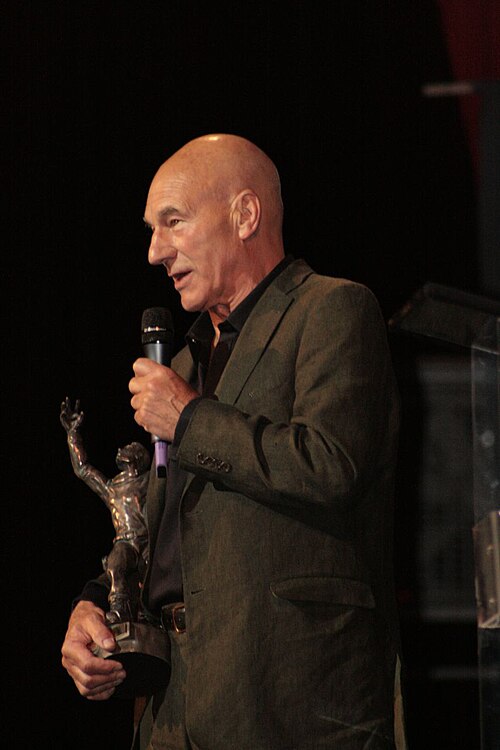
Stewart became a patron of the British Humanist Association (now Humanists UK) in 2012. The words he offered on joining – ‘The human is the best we have – and all we have’ – were displayed on the masthead of the Association’s website until the late 2010s, and in surveys of new members from those years, many said it was his patronage that had first drawn them to learn more about humanism and to support Humanists UK’s campaigns.
His humanism was practical. Drawing on his childhood, he became a patron of Refuge, the national domestic abuse charity, and a prominent voice in Amnesty International’s campaign to stop violence against women. Understanding, late in life, that his father’s violence had its roots in untreated trauma, he also became a patron of Combat Stress, the veterans’ mental health charity – though he never accepted trauma as an excuse. Speaking in 2013, he explained:
I do what I do in my mother’s name, because I couldn’t help her then. Now I can… I work for Refuge for my mother, and I work for Combat Stress for my father in equal measure.
Patrick Stewart, responding to a question at Comicpalooza, 2013
Above all, Stewart was a passionate ally in one of Humanists UK’s longest-running campaigns: the legalisation of assisted dying. Humanists have championed compassionate reform for over a century, and when Stewart took up the cause the British Humanist Association stood among the leading organisations pressing for a change in the law. Also a patron of Dignity in Dying from 2011, he declared that assisted dying ‘should become a right’, and that he would want that choice for himself. In 2015 he addressed MPs and peers in Parliament in support of the Assisted Dying Bill, telling them that to be terminally ill without the choice of an assisted death was ‘a kind of imprisonment and a kind of torture’: imprisonment by one’s condition, and by the law. He later lent his voice to efforts to change the law in Scotland, a cause also championed by Humanist Society Scotland. ‘Assisted dying must be a fundamental right for us all,’ he said. ‘We have no choice about how and when we come into this world, but it seems that we should be able to have a choice in how we leave it if our death is fast approaching.’ Humanists UK continues that campaign today, and backed the Terminally Ill Adults (End of Life) Bill when it was introduced in Parliament in 2024.
On news of his death, Chief Executive of Humanists UK Andrew Copson paid tribute to ‘a committed humanist and a cherished patron’, whose ‘portrayal of a hopeful, rational future resonated because it genuinely reflected the humanist convictions by which he lived his life’, and whose legacy is ‘a profound enlargement of the resources we have for a more humane future’.
Humanists UK mourns Sir Patrick Stewart (1940–2026), Humanists UK (2026)
Science fiction and humanism, Humanist Heritage exhibition (2026)
Patrick Stewart, Making It So: A Memoir (2023)
Patrick Stewart, ‘Domestic violence blighted my home. That’s why I support Refuge’, The Guardian (2009)
‘Assisted dying’, New Humanist, July/August 2011, in the New Humanist archive

George Broadhead was a humanist activist and gay rights campaigner, motivated by a twin commitment to humanism and human rights. […]
I for one don’t believe in looking regretfully back into the past or forward with illusive hopes into the future, […]
Founded in 1263, Balliol College is one of the oldest colleges at the University of Oxford. Established by the English […]
Our goal must be the good of the whole human society. Henry Noel Brailsford, Olives of Endless Age: being a […]