Sheffield has been home to a network of freethinkers over hundreds of years, who met, wrote, campaigned, and connected with each other, whether as individual activists or as organised groups. While many of the buildings in which they met have been lost or profoundly transformed, there are still echoes of this humanist heritage throughout the city today.
This page accompanies our printable Sheffield walk, with more about each stop and links to everyone and everything mentioned along the way.
This beautiful Georgian square was a major open-air meeting place for radicals from the end of the 18th century. The Sheffield Society for Constitutional Information, formed in 1791, had its headquarters here. Inspired by the writings of Thomas Paine, its members believed that ‘the Want of Knowledge and Information in the general Mass of the People has exposed them to numberless Impositions and Abuses’, and aimed to spread political knowledge and agitate for reform.
Later, the square became notable for thousands-strong gatherings of chartists: part of a working-class movement for parliamentary reform and universal (male) suffrage which began in the late 1830s. One activist who addressed meetings here was the self-described ‘infidel’ Isaac Ironside: chartist, socialist, freethinker, and founder of the Hall of Science, opened in Rockingham Street in 1839 for education, socialising, and social reform.
The first building here was the parish church, built by the Norman lord William de Lovetot around 1101. It was demolished and replaced around 1430, with additions over the following centuries. Early organised freethinkers were acutely aware of goings-on in the churches, including suggestions by ministers that unbelief was responsible for unpleasant happenings in the world.
In 1914, the Literary Guide (now New Humanist) reported that the Bishop had told an assembly of schoolteachers gathered here that a turning away from faith was to blame for the outbreak of war. The Literary Guide noted that as the ‘hideous panorama of war’ filled the world’s eyes, it was all the more necessary to guard against ‘the unscrupulous attempts of Christians to load Rationalism and Materialism with the responsibility for this catastrophe’.
Find out more: Charles Albert Watts, founder of the Literary Guide
From the early 1960s to the late 1970s there was an active humanist group in Sheffield: successors of the Sheffield Ethical Society (see stop 5) and precursors of today’s Sheffield Humanists. The group revived in the 1990s and was active into the 2000s. Its activities included large-scale events with leading humanists like Peter Tatchell and Jim Al-Khalili, letters to the press, and a stand outside the Town Hall in the lead-up to the 2011 Census, encouraging non-religious people to tick ‘no religion’.
Today, Sheffield Humanists are a Humanists UK local group, meeting regularly for socials and events.
Find out more: Find a local humanist group
The Peace Gardens are on the site of what was originally the churchyard of the 18th century St Paul’s Church. This was demolished in 1938 to make way for a proposed extension to the Town Hall, which was never built. A temporary garden was created, named St Paul’s Gardens but known as the Peace Gardens from a wartime longing for peace; the name became formal in 1985.
Today, the Peace Gardens are home to the Holberry Cascades, named for the chartist Samuel Holberry, who died aged just 27 after imprisonment in brutal conditions. A funeral address was delivered by the freethinker George Julian Harney, who called on those assembled ‘to labour with heart and soul for the destruction of the horrible system under which Holberry has perished’.
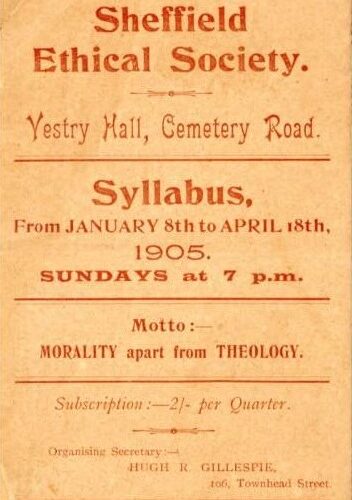
Now Pinstone Chambers, 58 Pinstone Street was once the Wentworth Cafe. It was here, on 8 July 1903, that the founding meeting of the Sheffield Ethical Society took place: a forerunner of later humanist groups in the city. Ethical societies, which flourished in the UK from the 1880s, aimed to bring people together for socialising, education, and discussion, without reference to supernatural ideas. The Sheffield society’s aims included fellowship rooted in ‘the needs of man as a social and rational being’, and to ‘reform social conditions by the application of Ethical principles to all social problems, and to remove social evils such as war, poverty, superstition, privilege and inhumanity’.
Its key figures were the local councillor R. H. Minshall and Katherine Gillott, cookery columnist for the Sheffield Independent, and its speakers included the poet and gay rights activist Edward Carpenter. The society’s success showed when the first annual congress of the Union of Ethical Societies (now Humanists UK) ever held outside London was hosted here in 1920.
Find out more: Sheffield Ethical Society · 125 Years of Humanists UK
In May 1950, City Hall was the site of a ‘Freethought Demonstration’: a public meeting with a range of speakers, intended to educate people about the values and aims of freethought. It was addressed by leading humanists and secularists from across the country, including Nottingham’s Thomas Major Mosley, a prominent public square debater. A report of the evening noted that the speakers put across ‘various aspects of Freethought in clear, crisp and pointed terms to an interested audience’.
Running alongside and behind City Hall is Holly Street, once home to the Sheffield Public Hospital for Diseases of the Skin, established in March 1880 for the benefit of poor people. Its founder, Herbert Junius Hardwicke, was a freethinker. In 1887 he published Evolution and Creation, a follow-up to his earlier Popular Faith Unveiled, which had sought ‘to expose the real nature of popular superstition’.
Take the walk: download the printable Sheffield walk (PDF), or see all of our walking tours.
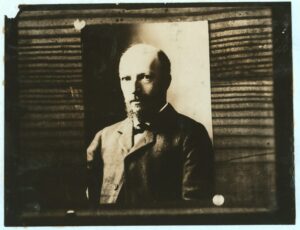
In order to find meaning to one’s life, one must find a meaning in the life of the [human] race. […]
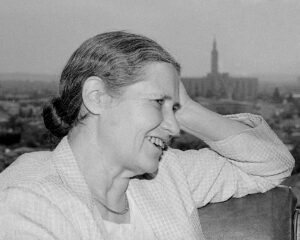
I lost religion in a breath; Heaven fled from me on the wings of Reason… Doris Lessing, Under My Skin: […]
Humanists International was formed in 1952 as the International Humanist and Ethical Union (IHEU): a federation of the American Ethical […]
Conservation… draws us towards not only a scientific but a philosophical and historical approach to the problems of the earth […]