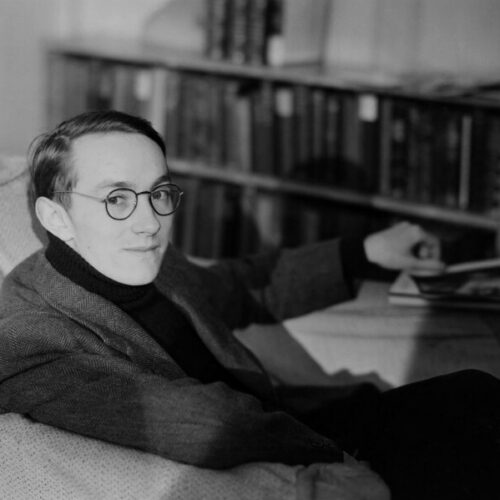
By humanism I mean the belief that man is morally and physically in the same position as the newly adult bear. Not that he is up a tree, but that he is on his own.
Alex Comfort, ‘The Case for Humanism—or Can Science Make Us Good?’, broadcast by the BBC, 13 February 1957
Alex Comfort was a doctor and research scientist who did pioneering work on the biology of ageing, a prolific poet and novelist, and a lifelong anarchist and pacifist. To the wider world he became ‘Dr Sex’, author of The Joy of Sex (1972), an international bestseller. To the humanist movement he was a scientist who had ‘long ago declared himself a militant scientific humanist’, in the words of a 1958 profile in The Humanist, and whose broadcasts on humanism, morality and sex were printed, debated and argued over in its publications for three decades. He made the case for ethics without religion on BBC radio and television, wrote for the Ethical Union and the Rationalist Press Association, and gave the Conway Memorial Lecture in 1990.
Alexander Comfort was born on 10 February 1920 in Palmers Green, north London, the son of an education administrator for the London County Council and a former teacher. At Highgate School he tried to improve on gunpowder and blew away all but the thumb of his left hand. At 17 he sailed to South America and West Africa and wrote up the voyage as The Silver River (1938). He went on to read natural sciences at Trinity College, Cambridge, trained in medicine at the London Hospital, and qualified as a doctor in 1944. He later took a PhD on the pigments of mollusc shells (1949) and a DSc in gerontology (1962).
Comfort came of age as a writer during the Second World War. He was linked with the ‘New Apocalypse’ poets, edited the anthology Lyra (1942) with Robert Greacen, and published the novels No Such Liberty (1941) and The Power House (1944), followed by On This Side Nothing (1949) and A Giant’s Strength (1952), as well as several collections of poems. An absolute pacifist who described himself as ‘an aggressive anti-militarist’, he refused war service and attacked the Allied bombing of German cities. The Rationalist Press Association’s Literary Guide followed his career from the start, and in 1945 its critic John Rowland wrote that it was difficult to believe that ‘such a brilliant young writer as Mr. Alex Comfort will not in the end come over wholeheartedly to Rationalism’.
His pacifism grew into a reasoned anarchism, set out in Art and Social Responsibility (1946), the pamphlet Peace and Disobedience (1946), and Authority and Delinquency in the Modern State (1950). He was active in the Peace Pledge Union, the Campaign for Nuclear Disarmament and the Committee of 100, and in 1958 appeared on a BBC Panorama panel questioning the Home Secretary R. A. Butler about the H-bomb. As Robert Greacen summed up his position in The Humanist, the truly heroic man of the age was not the bomber pilot but the conscientious objector:
Against irresponsible society the individual’s chief weapon is disobedience.
Alex Comfort, quoted in Robert Greacen, ‘The Militant Pacifist’, The Humanist, November 1958
Comfort first set out his humanism in a series of BBC radio talks, published as The Pattern of the Future (1949). The Rationalist Press Association’s President, A. E. Heath, quoted them in the Rationalist Annual the following year:
We have not abandoned Christianity as a source of attitudes because it is difficult or exacting, or because we are wicked, but because it does not appear to us to be true.
Alex Comfort, BBC broadcast, quoted in A. E. Heath, ‘The Missing Statue’, Rationalist Annual, 1950
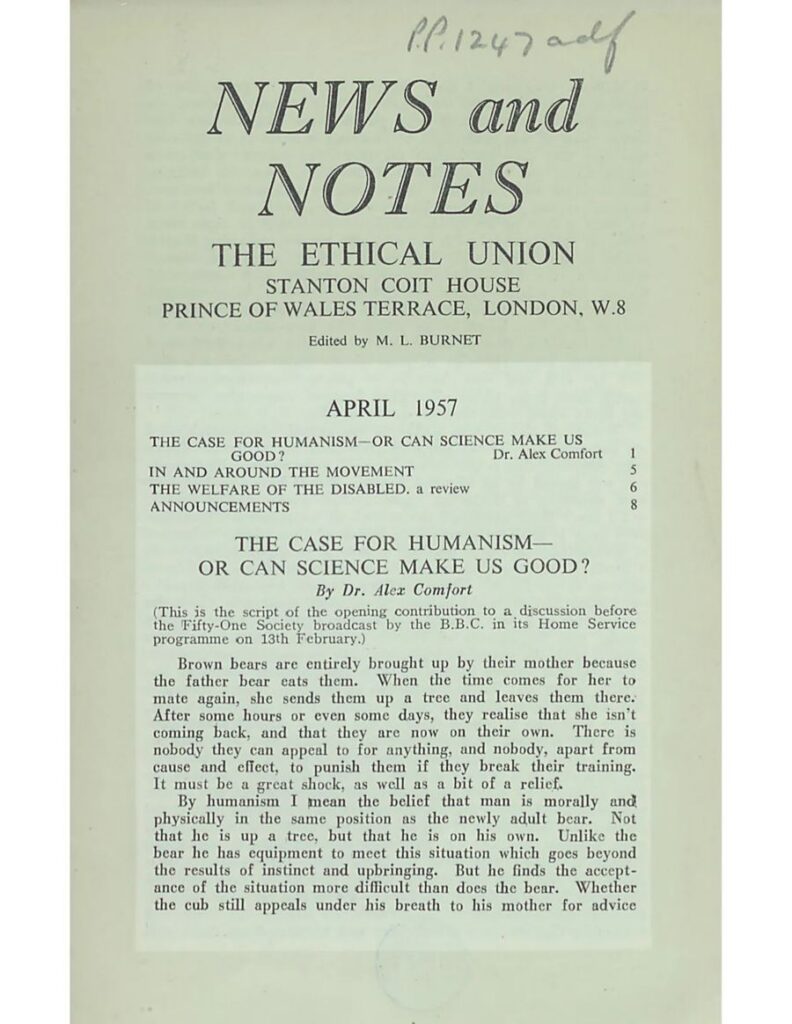
In 1957 he addressed the Fifty-One Society, a Manchester discussion club whose debates were broadcast by the BBC, on ‘How Bad Are Britain’s Morals?’ and ‘The Case for Humanism—or Can Science Make Us Good?’. The Ethical Union (now Humanists UK) printed both talks in its paper News and Notes. Humanism, he argued, meant accepting that we are on our own; supernatural beliefs were not so much disproved as outgrown, and ‘human moral conduct is not a holy subject, but an investigable and rational one’. Science itself, he said, had brought into daily life a demand for intellectual integrity ‘which no religion has ever tried to demand’. Not everyone in Manchester was convinced: The Humanist’s reporter noted that the discussion felt he had claimed too much for science as a moral force.
His scientific career was devoted to ageing. As a Nuffield Research Fellow at University College London he wrote The Biology of Senescence (1956), which became a standard work, and the popular The Process of Ageing (1964), and he did much to make the biology of old age a serious field of research. In 1969 he predicted that human life expectancy might reach 120 within 20 years.
He also wrote as a scientist about sex, in Barbarism and Sexual Freedom (1948) and Sexual Behaviour in Society (1950), revised as Sex in Society (1963). In July 1963, in the middle of the Profumo affair, he argued on BBC Television that older teenagers should make their own decisions about sex, with access to contraception, and that the idea of chastity as a virtue should go. ‘The fact of having made sex into a problem’, he said, ‘seems to me to be the major negative achievement of Christianity.’ In place of the old rules he proposed two commandments: not to exploit another person’s feelings, and never to risk producing an unwanted child through negligence. He ended:
If you want a short summary of my own morality, it is one which has been so concisely put by Bertrand Russell—that life should be motivated by love, and directed by intelligence.
Alex Comfort, This Nation Tomorrow, BBC Television, 14 July 1963, printed in News and Notes, October 1963
The broadcast caused a storm, and humanists were divided. That autumn the first annual conference of the new British Humanist Association, at Nottingham, adopted a statement on the issues raised by the Profumo affair and by the broadcasts of Comfort and the psychiatrist G. M. Carstairs, calling for reform of the laws on marriage, divorce, abortion and homosexuality. In the correspondence that followed, some members accused him of a ‘loose’ attitude to marriage, while others defended him; one colleague from University College replied that his views on sexual morality were ‘anything but “loose”’.
Comfort returned to religion in ‘A Technology of the Emotions?’, an address printed in the Rationalist Annual for 1967. The churches, he argued, had lost their hold by making factual claims that could not compete with science, yet people still needed ways of nourishing their emotional lives: ‘Man is indeed built for religion, but it isn’t the kind of religion which the professionals market.’ Science was a protective ‘boiler suit’ for special tasks, not something to live in. He later developed these ideas in The Anxiety Makers (1967) and I and That: Notes on the Biology of Religion (1979).
The Joy of Sex, published in 1972, became an international bestseller and made him a celebrity, a reputation he came to resent. In 1973 he moved to California to join the Center for the Study of Democratic Institutions at Santa Barbara, and he held academic posts on the West Coast before returning to England in 1985. On 20 September 1990 he gave the Conway Memorial Lecture at Conway Hall, on ‘Science and Religion’, with the theologian Don Cupitt in the chair. The following year a severe stroke ended his working life. He was married twice, to Ruth Harris and then to Jane Henderson, and had a son from his first marriage. He died in Banbury, Oxfordshire, on 26 March 2000, aged 80.
Comfort was one of the most distinctive humanist voices of the 20th century: a scientist who insisted that morality could be studied and reasoned about like any other part of human life, and a writer who applied that conviction to war, authority, old age and sex. His frank arguments for sexual freedom divided humanists in the 1960s, but they were part of the debate that drew the movement into the campaigns for reform of the laws on divorce, abortion and homosexuality in the 1960s, and his view that a good life should be motivated by love and directed by intelligence remains as close to a humanist creed as any.
Alex Comfort, The Pattern of the Future (1949)
Alex Comfort by Claire Rayner, The Guardian, March 2000
Alex Comfort, ‘How Bad Are Britain’s Morals?’, News and Notes, March 1957, and ‘The Case for Humanism—or Can Science Make Us Good?’, News and Notes, April 1957
Robert Greacen, ‘The Militant Pacifist’, The Humanist, November 1958
Alex Comfort, ‘Pre-marital sex and morals in marriage’, News and Notes, October 1963
Alex Comfort, ‘A Technology of the Emotions?’, Rationalist Annual, 1967
David Goodway (ed.), Writings Against Power and Death: The Anarchist Articles and Pamphlets of Alex Comfort (Freedom Press, 1994)
Madeleine Goodall, ‘Digging for rainbows’, New Humanist, Winter 2024
The full issues of The Humanist, Rationalist Annual and New Humanist can be read in New Humanist’s digital archive, available via Exact Editions. Subscribe at newhumanist.org.uk/subscribe.
Main image: Alexander Comfort by Howard Coster, half-plate film negative, 1943 NPG x10886 © National Portrait Gallery, London
The good life is one inspired by love and guided by knowledge. Neither love without knowledge, nor knowledge without love […]

I will never voluntarily obey any law which is an outrage on human reason. Matilda Roalfe Matilda Roalfe was an […]
Is it not the duty of every person to promote the happiness of others as much as lies in their […]

June suns, you cannot store them To warm the winter’s cold, The lad that hopes for heaven Shall fill his […]