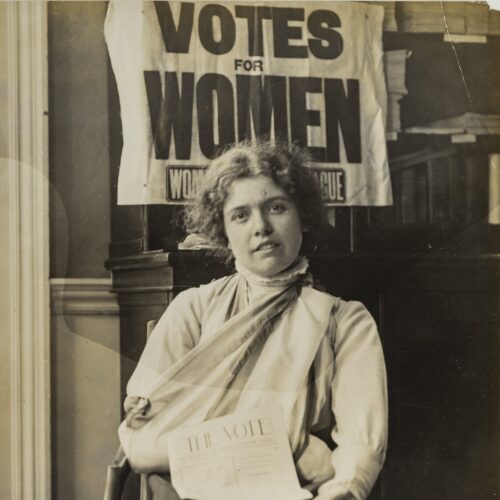
If we really believe in democracy it is our duty not only to emphasise freedom, but also to continually remind ourselves and our youth that freedom for the individual means the complete acceptance by the individual of full responsibility for his, or her, conduct.
Alison Neilans, ‘Morality in War Time’ in the Ethical Societies’ Chronicle, March 1940
Alison Neilans was a political activist and social reformer who campaigned to improve women’s lives. She was involved with several groups campaigning for votes for women, and a lifelong champion of women’s rights, particularly those of sex workers and working women. Neilans spoke on a number of occasions for various ethical societies (including South Place, South London, Hampstead, and the Young People’s Group), as well as at the annual conference of the Ethical Union (now Humanists UK). In her lifelong championing of democracy, equity, and mutual responsibility, Neilans was greatly admired by these early humanist groups.
We can make an effort towards a high, equal and responsible standard for both sexes. I believe that this is the only workable standard of morality; it rests on something which I have come to regard as a natural law, quite apart from orthodox religion—to do unto others as you would they should do unto you.
Alison Neilans, lecture on ‘Changes in Sex Morality’ at Conway Hall, 30 January 1938
Alison Neilans was born in June 1884 in South London, the only daughter of Robert Neilans, a commercial traveller, and his wife, Alison. Both parents’ families were farmers in southeast Scotland. Neilans had a comfortable childhood, including education in a private school in Dulwich, but the sudden death of her father in 1897 caused an abrupt change in her financial circumstances. She had to become independent and lived in lodgings and hostels while working as a bookkeeper.
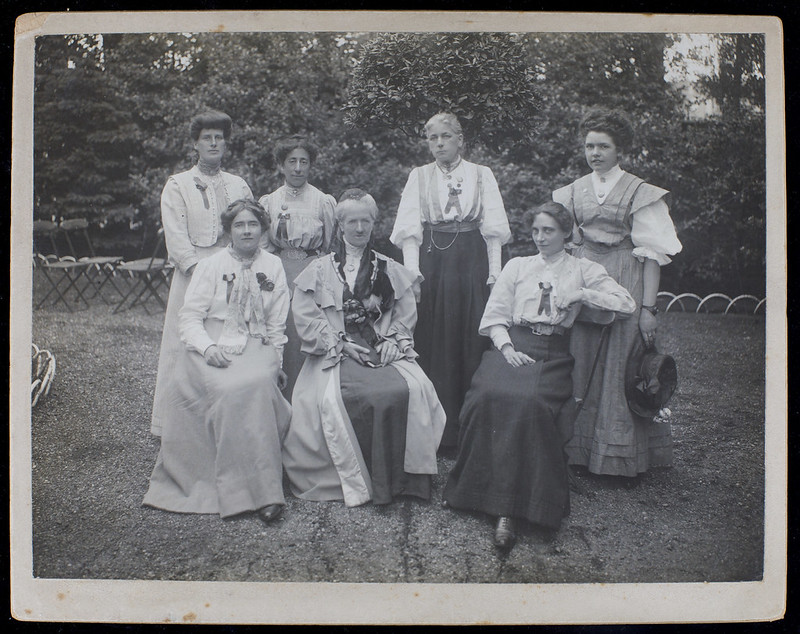
Neilans campaigned for votes for women, including involvement in Sylvia Pankhurst’s East London Federation of Suffragettes. She joined the Women’s Freedom League, a suffragist organisation campaigning for equal rights, becoming financial secretary in 1908 and a member of its executive committee from 1910. She gained notoriety as a militant suffragette and was arrested and imprisoned three times for short periods in 1908 and 1909. Her most publicised arrest was for her part in plans to spoil ballot papers during the 1909 Bermondsey by-election. Unfortunately, the ammonia used accidentally caused an eye injury to an electoral official. She was sentenced for three months, went on hunger strike and was force-fed. On another occasion she was arrested and charged with disorderly conduct for her part in a protest in the House of Commons in October 1908, known as the ‘grille incident’, during which several women shouted from the ‘ladies’ gallery’ and two chained themselves to a grille. This was widely reported at the time, and the speaker of the house ordered the closure of the public galleries for several months.
Neilans was involved in campaigns to promote the rights of female sex workers and prevent the international trafficking of women into forced prostitution. In 1912 she joined the British branch of the International Abolitionist Federation (IAF), which supported the civil rights of women in prostitution and denied that the state had the right to organise prostitution. Legislation introduced in the 1860s had aimed to reduce venereal disease, but was draconian in its impact for sex workers, who were required to submit to intrusive medical examination checks and were incarcerated for long periods. In the 1920s Neilans was general secretary of the Association for Moral and Social Hygiene (a member of the IAF, and later known as the Josephine Butler Society). In this role she campaigned to end solicitation laws, introduce sex education and to strengthen age of consent law for the protection of young girls. She took part in international networks and served on an advisory committee of the League of Nations. She was also on the executive council of the Open Door Council in 1934, which sought equal rights for women in employment.
Neilans testified to several government commissions as an expert on prostitution, including the street offences committee in 1928. This sometimes put her at odds with other campaigners, who placed more importance on preventing immorality than the plight of the women involved. However, with the help of supportive MPs (including Nancy Astor) she oversaw the introduction of several bills into parliament to repeal the laws against solicitation, and replace them with a general regulation that would apply to ‘annoyances’ by any person on the street.
Across the 1920s and 1930s, Neilans spoke many times for different ethical societies, on subjects ranging from economics to sexual morality. Her audiences included the South Place, South London, and Hampstead ethical societies, as well as the Young People’s and Women’s groups. Neilans also lectured as part of the annual conferences of the Ethical Union in 1927 and 1936, and contributed more than once to the Union’s paper, the Ethical Societies’ Chronicle. In all of this, she argued for a shared standard of morality, rooted not in religious beliefs but in individual liberty, mutual responsibility, and care.
Neilans died in 1942 at her home in Hampstead Garden Suburb, aged 58, after suffering from a rare and rapidly progressing illness that caused the paralysis of her limbs, and she eventually lost the power of speech. She was cremated at Golders Green crematorium. A memorial service was held later that year at St Martin-in-the-Fields church, attended by the archbishop of Canterbury.
Justice is higher than mere morality, and the test of our justice is the way we treat those who are held to be of little esteem.
Alison Neilans in The Shield, 1917
Alison Neilans dedicated her life to campaigning for equal rights for women and improving the life chances of some of the most vulnerable in society, both in Britain and across the world. On her death, she was mourned by both the South Place Ethical Society and the Ethical Union (now Humanists UK), who expressed their admiration for a life devoted to championing ‘the need for a single moral standard’ for all. (Ethical Societies’ Chronicle, October 1942).
Alison Neilans | Spartacus Educational
Neilans, Alison Roberta Noble by Julia Ann Laite | Oxford Dictionary of National Biography
By Hilary Barber
The Universities Tests Act, which ended religious discrimination in admissions and employment at the universities of Oxford, Cambridge, and Durham […]
F.J. Gould was an influential educationist, writer, and humanist, whose tireless work towards secularising education helped to lay the groundwork […]
They weren’t just trying to sell something to parents, they were helping them to understand how to play with and […]

The difference and variety of our human family more and more seems to me to be a wise provision that […]