start typing and results will show

or press esc

Harriet Law: Socialist, Feminist, Atheist

Duncan Bowie is a London based historian and the author of a number of books and papers on radical and socialist politics. He is co-chair of the Socialist History Society and reviews editor for Chartist.


Harriet Law was a leading secularist in the 1860s and 1870s, and was editor of the Secular Chronicle between 1876 and 1879. She lived in Walworth in South London and established the Walworth Freethought Institute, as well as being involved in the management of Cleveland Hall in Marylebone in central London as a secularist lecture hall.

Harriet Law was born Harriet Frost in Ongar, Essex in 1831, daughter of a small farmer. When the farm failed, the family moved to London’s East End. Brought up as a Strict Baptist Harriet taught in a Sunday School. In the 1850s she attended lectures by followers of Robert Owen, including George Holyoake and Charles Southwell. She apparently tried to defend Christian principles in a discussion with Holyoake at a meeting in Philpot Street in Whitechapel but, by 1855, she had lost her religious beliefs and became a supporter of Holyoake, embracing atheism, feminism and Owenite co-operation. In January 1855, Harriet married another freethinker, Edward Law, who she had met at Philpot Street, and moved to 38 Boyson Road in Walworth, where they had four children.
In the secularist movement

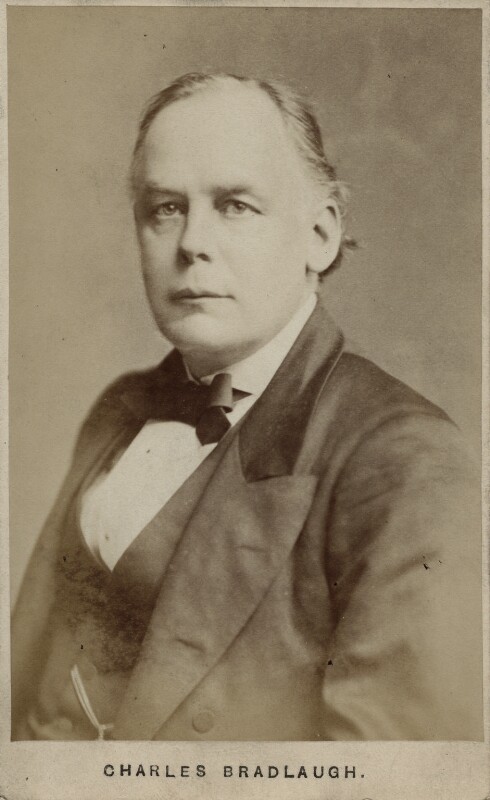
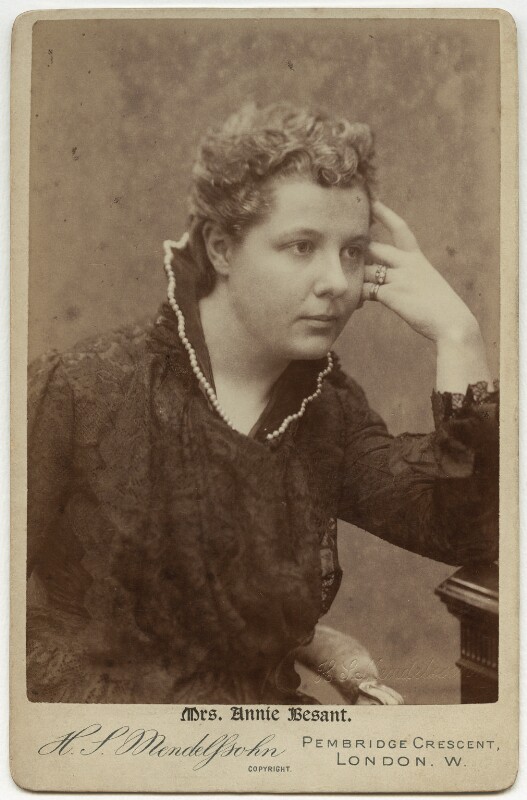
By 1859, Harriet was a paid lecturer for the secularist movement, though she appears to have been an independent lecturer, paid by lecture by local groups, rather than a paid lecturer for Charles Bradlaugh’s National Secular Society (NSS), which was founded in 1866. However, she did stand unsuccessfully against Bradlaugh in the contest for NSS president. She was repeatedly elected as a vice-president of the NSS, though she declined to take up the role, but was marginalised by the leadership following disagreements with Bradlaugh and his co-leader Annie Besant. In 1877, primarily because she did not support the association of secularism with the birth control movement, brought to the fore by the trial of Bradlaugh and Besant for publishing what became known as the Knowlton pamphlet — a birth control text by the American doctor Charles Knowlton titled The Fruits of Philosophy — Law sat with Holyoake on the platform of the first secularist meeting called to criticise Bradlaugh and Besant, though they did not speak. Law later commented that she did not approve of the Knowlton pamphlet and felt that the association of freethought with ‘literature of the class to which the book in question belongs’ made it harder to convince people of the principles of secularism (Schwartz 2013; Socialist Chronicle 22 July 1877; 29 July 1877). Law left the NSS with George Holyoake and Charles Watts to form the British Secular Union, which used Holyoake’s Secular Review as its mouthpiece, though the Union was to dissolve in 1884. In 1869, she was president of the short-lived non-Bradlaughite Freethought League.

Law was a feminist before she became a secularist. Royle has suggested that it was her feminism that first led her to criticise Christianity as she was unable to accept St Paul’s injunction against women speaking in the church (Royle 1979). In 1878, Law was to write:

While Christians retain the bible, and believe in it, women will always be kept in subjection. The Secularist has acknowledged the equality of women and men; and the aggressive spirit of Secularism must knock down the Christian barrier, and give women a better and higher freedom than they have ever had.

Secular Chronicle, 20 October 1878, quoted by Royle

In the 1860s and 1870s, Harriet was the only woman secularist speaker. Her first lecture was in the Hall of Science at 58 City Road, the base of the London Secular Society, on 24 June 1860 (Royle 1974). She later became a regular speaker there, one of a roster of speakers which included John Watts, Bradlaugh, and Holyoake. In 1866, the Hall was moved to 207 City Road, and then in 1868 to a purpose built building in Old Street. Law was actively involved with Bradlaugh and Charles Watts in the fundraising for the new hall.

In 1876, after the secularist split, Law took control of Cleveland Hall in Marylebone, a former Owenite centre, and managed it as a rival base to Bradlaugh’s Hall of Science, though this was passed two years later to the Methodist Hugh Price Hugh’s West London Mission (Royle 1980). For her provincial tours, her husband stayed at home looking after the children while she lectured all over the country, though apparently with the assistance of a nurse.

A daughter of thunder

One biographer of her secularist colleague Annie Besant refers to Law as ‘a stout loud-voiced person, a daughter of thunder’, and comments that ‘For thirty years she travelled up and down the land, crude, earnest, the only woman Atheist speaker, and one of the very few women speakers in England.’ (Williams 1931). Annie Taylor, a later biographer of Besant, commented that Law was ‘in florid middle age, genial, loud-voiced, perfectly able to deal with the hecklers and roughs who frequented the gatherings she addressed. Malcolm Quin, in his Memoirs of a Positivist, commented that Law’s:

violent declamations used to make themselves heard, and almost felt, far beyond the limits of the hall in which she spoke. She had the courage of her belief, or unbelief, at time when it required no little courage to be the public champion of any unpopular cause against the oppressiveness of English conventions. But I must own that those of us who supposed ourselves to have some literary or artistic fastidiousness could not easily love Secularism as it came to us from the mouth of such a daughter of thunder.

Besant’s elderly secularist mentor, the pamphleteer and publisher Thomas Scott, however, disapproved of Law’s ‘unmitigated atheism’, though he also disapproved of all women who lectured – ‘She has her sphere, that of household economy and social morality… She seems to me to unsex herself when she lectures on abstract themes to poorly educated men’ a misogynistic and classist view, that was no doubt not uncommon for the time’ (Taylor). Law often shared a platform with Bradlaugh, though she was later replaced by the younger Besant.

In the later 1860s, Law was active in the Reform League, which campaigned for extension of the parliamentary franchise. She was one of the speakers at the rally in Hyde Park in July 1866, when she gave a speech on women’s right to vote. She apparently spoke for two hours in defiance of the Commissioner of Police who had banned the demonstrators from the park. Her husband, Edward, however seems to have disagreed with her on this issue (Royle 1979).

In the First International

In 1869, Law joined the General Council of the International Working Men’s association (later known as the First International) led by Karl Marx, being the only woman on the Council. She had written a letter on Women’s Rights and at the council meeting on 16 April 1867, the positivist and journalist had proposed she be invited to attend council meetings and attend the planned congress at Lausanne. (GC Minutes, Volume 2). At the meeting on 18 June, Fox formally proposed Law join the Council, a proposal which was seconded by Frederick Lessner and formally agreed at the following meeting. She attended the meeting on 2 July and subsequent meetings on 16 and 23 July. On 6 August, she agreed to enquire as to whether Cleveland Hall coffee-room was available for meetings and was then nominated to represent the Council at the cooperative congress in Paris. On 27 August, recorded as ‘Mistress Law’ she spoke in favour of the forthcoming congress including debates, an idea not supported by Marx, who was ‘against turning our Association into a debating club’. In June 1868, she proposed that a fellow secularist, Copeland, was invited to join the Council, which was agreed. She was a regular attender of meetings in the summer of 1868, but seems to have contributed little to discussions, though in one meeting in a discussion on the displacement of manual labour by machinery, she pointed out that machinery had made women less dependent on men and would eventually emancipate them from domestic slavery. Harriet was re-elected to the 26 member General Council at the Brussels conference, still being the only female member. In February 1869, Law, together with the O’Brienite George Milner, represented the Council at a meeting on providing employment for the unemployed but was told to limit her contribution to the issue of and reform (perhaps because they did not agree with the council’s views on employment policy). Milner reported back that ‘Mrs Law had made the speech of the evening’.

In July 1869, when the General Council was debating the agenda for the Basel congress. At the meeting on 6 July, Law declined an invitation to contribute to a discussion on land reform. In August she argued that church property should be secularised and devoted to schools – ‘We wanted fewer parsons and more schoolmasters’. She noted a comment in a journal that the Established Church would not last another ten years. Interestingly, Marx was opposed to the International taking a stance on the religious question, despite it being raised (but only in this instance) by Law, but also more vigorously by some of the French members, Le Lubez and Tolain, the Belgian De Paepe and the Pole, Haltorn, but also, perhaps more surprisingly, by the English trade unionist, George Howell (Collins and Abramsky 1965).

At the meeting on 31 August, there was a discussion on banking and production. Cohn of the cigar-makers argued for the establishment of a central bank, which could lend money to trade societies. Milner argued for co-operative production, while his fellow O’Brienite Martin Boon, while arguing that a central bank would not solve the problem of market competition with a mechanism for value exchange, supported the Owenite proposal for a central store. Law however, noting that the Owenite experiments had not been very successful, urged the need for central planning as the only alternative to a market economy: There was a need for a ‘directing power that could determine how much was to be produced of each particular kind of goods.’ She stated that she was in favour of communism, as ‘under no other form could the right of labour be guaranteed’.

Law failed to attend meetings in the next 18 months, and in fact one member, the O’Brienite, George Harris in November 1871 queried whether she was still a member of the General Council. Law, however, considered that she still was. Law then attended the meeting on 19 December, though she does not appear to have contributed to the discussion.

In January 1872 she addressed the Manchester branch of the International on behalf of the refugees from the French commune, and contributed the proceeds of £2 to a refugee fund. She also attend one council meeting on 30 January, though again staying silent. Her signature was nevertheless attached to the Council’s pamphlet in March 1872 on ‘fictitious Splits in the International’, the attack on Bakunin written by Marx and Engels and the statement in April condemning Police Terrorism in Ireland (it being normal practice to append the names of all council members).

There is no record of Law attending any Council meetings after January. Law however was nominated to attend the Hague general congress in September 1872, representing a ‘central section of working women’, which was based in Geneva. Her delegate mandate was signed by V Tinayre. The mandate included the statements:

That the working woman’s needs are equal to those of the working man and that the pay for her work is much less.

Agreements reached between employers and strikers of a trade in which women are employed will stipulate the same advantages for them as for men.

Hague Congress

Law did not actually go to The Hague. The Hague conference transferred the General Council to New York, which meant that members based in UK and the rest of Europe dropped out. However, in December 1877, Law, who had long supported trade unionism, was to become a member of the council of the International Labour Union, an organization to promote graduated land and inherited taxes, initiated by Bradlaugh, joining Annie Besant and the radical priest and School Board member, Stuart Headlam.

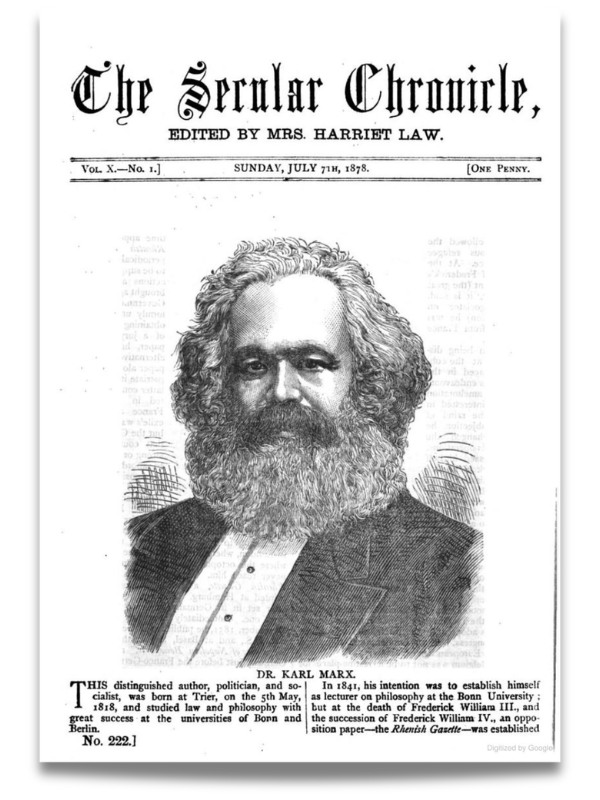
Law clearly respected Marx and kept in touch with him. In July 1878, the Chronicle printed, in its series of portraits of secularists and other radicals, a portrait of Marx with a sketch written by Law’s daughter, Harriet. After a summary of Marx’s career and writings, the sketch refers to Marx’s role in the IWMA: ‘Almost all the publications issued by this mighty organization came from the pen of Dr Marx.’ The sketch then refers to Marx, having moved on from ‘breaking up the very foundations of the social order’ to the more peaceful occupation of writing the second volume of Das Kapital. The following month, the Chronicle published Marx’s critique of George Howell’s history of the International Working Men’s Association, after the Nineteenth Century journal had refused to publish it.

Law and the Secular Chronicle

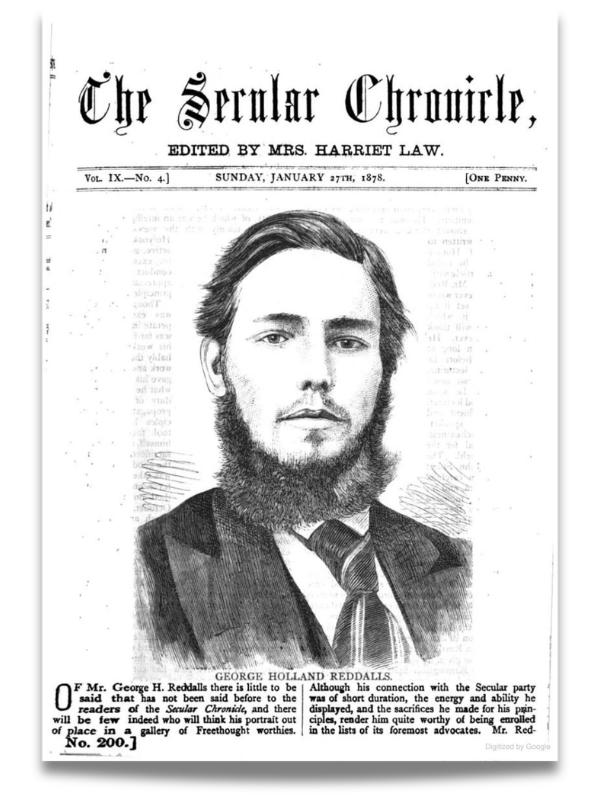
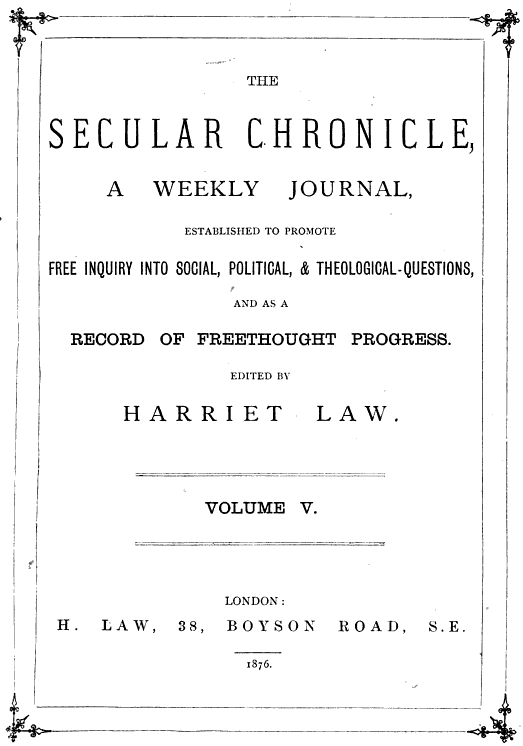
Law, though, was focused on her main preoccupation of secularism. In January 1876, she took over the editorship of the Secular Chronicle. This journal had been launched in 1872, by the secularist George Reddalls, a printer, engraver and bookbinder, who was based in Digbeth, Birmingham. It was ‘a monthly journal established to promote free enquiry into social, political, and theological questions, and as a record of freethought progress’.

Reddalls was later to publish Modern Spiritualism: an Examination and Exposure. Much of the journal content was written by Reddalls himself and a few other secularists in the West Midlands, including Thomas Evans, Francis Neale, Charles Cattell, and H. V. Mayer, with reports of meetings generally being limited to the Midlands and Yorkshire. There were, however, contributions from the Owenite socialist and co-operator, Henry Travis. Later issues had a somewhat wider coverage, with occasional reports of meetings in London, including Bradlaugh’s Hall of Science in Old Street and T. E. Green’s Richmond and Surbiton Progressive Society. From October 1874, the journal was published on a weekly basis. Reddalls, however, died of typhoid in October the following year aged only 28, with the paper being transferred by Reddalls’ father to Law, and published from Law’s address in Walworth. While Law had never written for the journal, Reddalls had reported on some of her lectures in her provincial tours. Under Reddalls, the paper had supported Holyoake’s view of secularism, but Law was to take a more pluralist approach, taking contributions and reporting meetings from a wider range of secularist, socialist, and co-operative perspectives, demonstrating for example her own interests in the development of socialism and the women’s movement in Europe. She considered the English women’s movement to be backward as compared with their sisters in Germany. Reddalls had lost money on the paper, while it was reported that Law was to lose £1,000 in the three years she managed the Chronicle.

The Secular Chronicle was not the only secularist newspaper. Charles Southwell had published a weekly atheistic journal The Oracle of Reason from 1841. George Holyoake published The Reasoner from 1846. Bradlaugh had edited the National Reformer since 1860. William Stewart Ross started the Secular Review in 1876, and in 1881, G. W. Foote was to start the Freethinker.

In her first editorial, Law set out the principles of the paper under her editorship:

Liberty, fraternity and equality will be its motto; measures rather than men its objects; principle rather than policy its guide…

Its politics will be Republican. Believing, as we do, every form of monarchy to be injurious and degrading to both sovereigns and subjects, the chief cause of war, waste and want, of ignorance, superstition and crime…

The highest and broadest kind of co-operation, as embodied in the communistic system of Robert Owen, will be maintained, as calculated to promote the mutual benefit of all – to destroy those monstrous combinations of caste and capital which enslave the many to the few and mar the true peace and purity of the whole human family…. Communism (which is national co-operation) combines the strength of unionism, the zeal of patriotism, and resources of individualism; and would, if adopted, introduce that social millennium, sung of by poets, and longed for by every lover of mankind.

Utility or “the greatest happiness principle” will be recognized as the foundation of morality.

Harriet Law, ‘A Few Words to Freethinkers‘ in The Secular Chronicle, 2 January 1876

Law stated that ‘Although an Atheist and Republican and woman’s rights advocate, we hope to have important topics examined and discussed in our paper in a fair and impartial spirit, as its columns are accessible to all – Christians and Secularists alike – who treat their subjects with competence and their opponents with courtesy.’ She sought to reassure her readers that ‘As the opportunity offers there will be delineated in the pages of the Secular Chronicle the brilliant wit of a Voltaire, the sterling common sense of a Paine, the uncompromising courage of a Carlisle, the scathing sarcasm of a Southwell, the loving kindness of an Owen, the profound logic of a Mill, with the glorious poesy of a Pope, a Byron and a Shelley.’

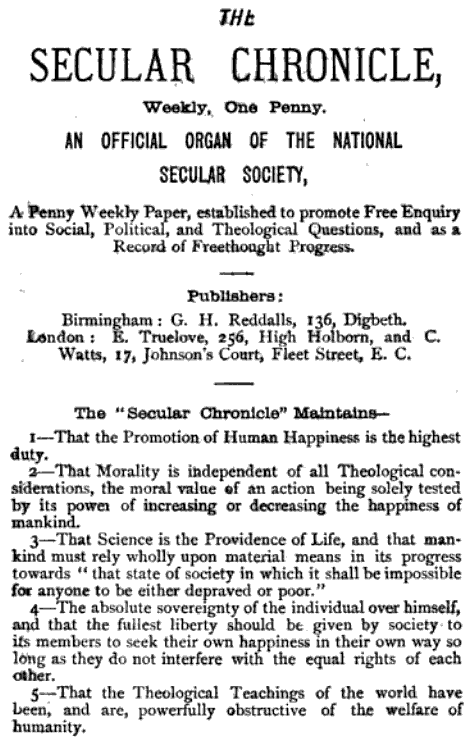
Under the Chronicle’s heading, the journal stated that it was ‘an official organ of the National Secular Society’. This had been inserted by Reddalls the previous August, together with the following statement:

The ‘Secular Chronicle ‘ Maintains —

  1. That the promotion of Human Happiness is the Greatest Good.
  2. That morality is independent of all Theological considerations, the moral value of an action being solely tested by its power of increasing or deceasing the happiness of mankind.
  3. That science is the Providence of Life, and that mankind must rely wholly on material means in its progress towards ‘that state of society in which it shall be impossible for anyone to be either depraved or poor.
  4. The absolute sovereignty of the individual over himself, and that the fullest liberty should be given by society to its members to seek their own happiness in their own way so long as they do not interfere with the equal rights of each other.
  5. That the theological teachings of the world have been, and are, powerfully obstructive of the welfare of humanity.

Law introduced a ‘Ladies Page’ into the journal. She also extended the section of Societies reports to cover a much wider range of meetings, including both national groups and local societies both in London and across the country. She also introduced biographies of leading radicals and socialists, both historical and contemporary, later including their portraits on the front page.

The Walworth Freethought Institute and the end of the Secular Chronicle

As well as her editorship of the Secular Chronicle and lecturing for a wide range of organisations across the country, Law was also active in secular agitation in South London and in establishing the Walworth Freethought Institute near her Peckham home, an aspect of her work not considered by previous commentators. The activities of the Institute can be tracked from the regular reports in the Chronicle. For an in-depth look at the work of the Institute, click here.

In addition to her prominent role in Walworth, Harriet Law had continued with her provincial lectures, remaining an important figure in the national secularist movement. At the end of November 1878, she resigned the editorship of the Secular Chronicle, with the paper being handed over to George Standring, who turned the weekly paper into a monthly journal, which meant keeping a record of the week’s meetings and giving notice of future meetings was no longer possible. This change proved unpopular, and there was clearly no market for such a publication, least of all because the journal’s readers were mainly interested in reports of local societies. In the January 1879 issue of the Secular Chronicle, the first of only four issues under Standring’s editorship, appeared a brief farewell from Harriet Law. She thanked the paper’s friends who had ‘supported us in the arduous, expensive, but not we hope, useless work of conducting an independent Freethought paper’ and thanked her team for their ‘gratuitous labours and unflinching consistency’, naming Mr Maccall, Mr Neale, Mr Atkinson, Mr Travis and Mr Heaford. She signed off, hoping that the Chronicle would continue to prosper under the new editorship. This hope was however not fulfilled. The March 1879 issue, No 25 of Volume 10, which included William Heaford’s article on ‘Eternal Torment’, was the last.

By 1879, Law’s health gave way, and she had been eclipsed by Annie Besant, who was now secularism’s most prominent woman speaker. Law nevertheless attended the opening of Leicester’s Secular Hall in 1881, speaking with Holyoake, Bradlaugh, and Besant. Law later moved to 7 Victoria Road in Peckham and subsequently to 24 Somerville Road in Penge. She died on 19 July 1887 from a heart attack, having been ill with bronchitis for some time, and was buried in Forest Hill cemetery.

Harriet’s legacy

Harriet Law however left a local legacy. A South London Ethical Society was founded in 1892 and based at the Chepstow Hall in Peckham, the secretary being Harriet Law’s younger daughter, Florence Aspasia Law. In 1898, it had a membership of 180: ‘none of whom are rich, and many poor’. It organised lectures, discussions, reading groups, social meetings and monthly rambles. The Society moved to the Surrey Masonic Hall in Peckham in 1894. In 1908, the leading secularist, Harry Snell (later Lord Snell), delivering an address, invited ‘all those present  who had not already done so to become members of a society which knows no creed beyond the simple one of helping  men, by purely natural and human means to love, know, and do the right, and which seeks to put this simple creed into practice by meeting as a fellowship, and making itself known to all sympathisers with such a work.’ After the First World War, the Society moved to Oliver Goldsmith School, where it hosted a wide range of speakers including Stanton Coit, Bertrand Russell, and James Ramsay MacDonald.  Florence Law’s successor as secretary was the school teacher Nellie Freeman, who was also secretary of the national Ethical Union.

Law was a socialist and feminist as well as a leading secularist. Her approach was pluralist and she sought to distance herself from the factional politics both within the First International and the secular movement. This was demonstrated by the range of contributors to the Secular Chronicle and to the speakers invited to speak at Walworth – socialists and anarchists and radical reformers, as well as secularists from a range of traditions. Holyoake, Bradlaugh, and Besant all spoke at Walworth, as did Charles Watts and younger secularists such as Arthur Moss. George Standring and Robert Forder were both regulars. Anarchist speakers included Frank Kitz and Toussaint Parris. The London radical, James Rowlands, spoke on several occasions, including on foreign politics, given the prominence at the time of the ‘Eastern Question’. Law also sought to promote speaking opportunities for less prominent secularists, and build up a strong local team, including George Bone. Her husband Edward took a key role as both chairman and speaker of meetings, though clearly in a supporting role to his more prominent wife. The Walworth Institute provided a platform for a wide range of reformers, some of whom might now be regarded as faddists – anti-vaccination campaigners, health and education campaigners, advocates for reforming the lunacy laws, as well as locals whose main interest was local history – such as Mr Bursill. Even members of the Christian Evidence Society were invited to present their case on a number of occasions. Harriet was prepared to take on all kinds of opponents, but in a manner that promoted discussion rather than aggression. She was, unlike some of her colleagues, not a ranter or an obsessive. She deserves much greater attention by historians of socialism, secularism, feminism, and political reform.

References

Collins, Henry and Abramsky, Chimen, Karl Marx and the British Labour Movement (London: Macmillan 1965)
Documents of The First International: Volumes 2, 3, and 4 (Moscow: Progress Publishers 1963)
MacKillop, I D, The British Ethical Societies (Cambridge University Press 2011)
Nethercot, Arthur, The First Five Lives of Annie Besant (London: Hart Davis 1961)
Quin, Malcolm, Memoirs of a Positivist (London: Alan and Unwin 1924)
Royle, Edward, Victorian Infidels (Manchester University Press 1974)
Royle, Edward, Radicals, Secularists and Republicans: Popular Freethought in Britain 1866-1915 (Manchester University Press 1980)
Royle, Edward, ‘Harriet Law’ in Bellamy and Saville, eds. Dictionary of Labour Biography, Vol 5, pp. 134-7 (London: Macmillan 1979)
Schwartz, Laura, Infidel Feminism (Manchester University Press 2013)
Schwartz, Laura, ‘Infidel ‘Feminism in Victorian Freethought’, a lecture at Conway Hall, London, 29 October 2013
Harriet Law | Leicester Secular Society
Secular Chronicle Vols 1-10 1872-1879
The Secular Chronicle | Humanist Heritage
The Hague Congress of the First International: Minutes and Documents, Vol 1 (Moscow: 1976)
Tribe, David, 100 Years of Freethought (London: Elek Books 1967)
Tribe, David, President Charles Bradlaugh MP (London: Elek Books 1971)
Williams, Gertrude, The Passionate Pilgrim (New York: Coward McCann 1931)


Main image: Woman Seen From the Back, Onésipe Aguado, ca. 1862. Image sourced from the Public Domain Image Archive / The Metropolitan Museum

Made by Heritage Creative