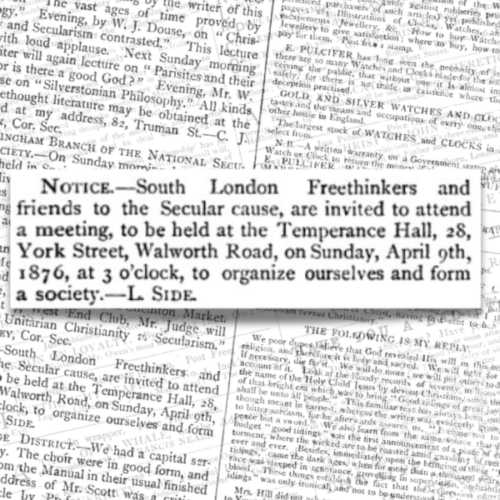
This society, formed in the midst of a piously orthodox neighourhood, virgin soil to the seed-sowing of Freethought, would be enabled to do much good and real service in the dissemination of our common principles if only a few friends rally together, and determine to make the thing a success.
‘Walworth Association of Freethinkers’ in the Secular Chronicle, 28 May 1876
As well as her editorship of the Secular Chronicle and lecturing for a wide range of organisations across the country, Harriet Law was also active in secular agitation in South London and in establishing the Walworth Freethought Institute near her Peckham home. The activities of the Institute can be tracked from the regular reports in the Secular Chronicle.
There had been a South London Secular Hall at 132 Blackfriars Road in the 1860s and in fact the Richard Carlile’s Rotunda just south of Blackfriars Bridge had been the earliest centre of secularism in London, but the Walworth centre was to draw members from a wide area. After the demise of the Walworth project, a new South London Secular Hall was built in Camberwell in 1885, managed by a branch of the National Secular Society and still in operation in 1915.
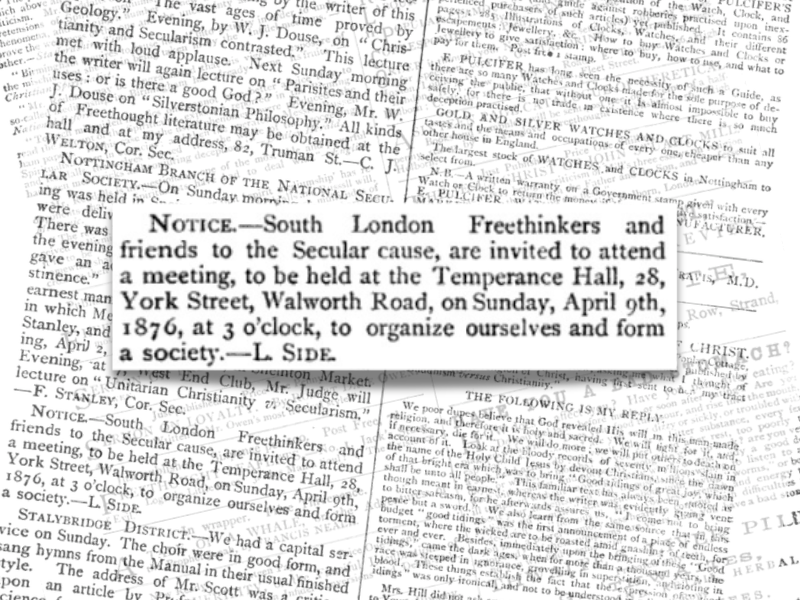
On 2 April 1876, a notice appeared in the Secular Chronicle, under the name of L Side:
South London Freethinkers and friends to the Secular cause, are invited to attend a meeting, to be held at the Temperance Hall, 28 York Street, Walworth Road, on Sunday April 9th 1876 at 3 o’clock , to organize ourselves and form a society.
This meeting decided to take on the management of the hall, which could accommodate 300 people. A committee was elected – Harriet’s husband, Edward Law became secretary. The committee comprised Bine, Challenger, J. Davis, W. Davis, Frith, Lanspard, Sharp, Side, and Mrs Walters (Secular Chronicle, 16 April 1876). At the following meeting, William Heaford of 120 Lambeth Road became secretary while Edward Law became chairman. John Davis became vice-president. Asking for support from friends of the secular cause, Heaford made an appeal: ‘Let us show that a better cause than your Christian brethren can emulate to better deeds than theirs’ (Secular Chronicle, 14 May 1876). At the following meeting, 20 members were enrolled. Heaford noted that the society was ‘formed in the midst of a piously orthodox neighourhood, virgin soil to the seed-sowing of Freethought, would be enabled to do much good and real service in the dissemination of our common principles if only a few friends rally together, and determine to make the thing a success.’ It was announced that Charles Bradlaugh would speak on ’Freethought’ on 29 May, with Harriet Law on ‘Science versus Christianity’ on the following evening (Secular Chronicle, 28 May 1876).
At the first meeting it was actually Harriet Law who spoke on the subject of ‘Are the Gospels True? with Bradlaugh presiding rather than lecturing. The follow evening, she was again speaking on ‘The Bible tested by Science.’ At the first Sunday evening lecture the previous week, Dr Bikkers had given a ‘Word sermon’ on the theme of ‘Sceptic, Mystic and Toleration’ with Mr Levy presiding, but with Harriet Law also on the platform (Secular Chronicle, 18 June 1876). They may be the Darwinian Dr Alex Bikker and the economist Joseph Hiam Levy, who was a member of the London Dialectical Society, but this is uncertain.
The following meeting was a Mr O’Byrne on ‘The Redemption of our Race’, which noted that the Christian attempt at redemption had ‘failed to stamp out tyranny and oppression, corruption and cruelty and that the work of human amelioration has been wrought by human means and human appliances alone’ (Secular Chronicle, 2 July 1876). The first meeting in July attracted the secretary of the National Secular Society, George Standring, who spoke on ‘The Decay of Christianity — its causes and consequences’.
It was also announced in the 9 July issue of the Secular Chronicle that the Walworth Freethought Institute was now establishing a night school and had secured the services of a certificated schoolmaster. The night school would provide ‘a good, sound, practical elementary education… comprising the 3 R’s, higher arithmetic, such as fractions, decimals, commercial rules, with square and cube roots, &c., penmanship and composition, which will include the writing of themes, essays, lectures; algebra as quadraies, elementary mathematics, mechanics, simple and applied, &c., &c… We are sanguine of success’ (Secular Chronicle, 9 July 1876). The night school opened the following week and was to meet for two hours on Monday, Wednesday, and Friday evenings.
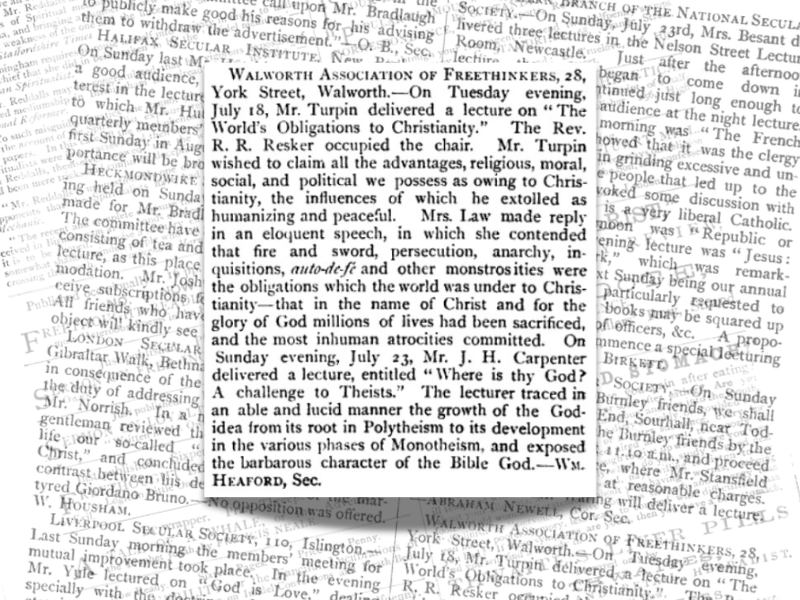
The Walworth Society was prepared to give its religious opponents a platform. The speaker at the meeting on 18 July was a Mr Turpin (possibly George Turpin, born in Walworth in 1842), who spoke on the ‘World’s obligations to Christianity’, with the Rev Robert Resker (the author of a commentary on St Mark’s gospel and later the vicar of Purley) in the chair. Turpin extolled Christianity as ‘humanizing and peaceful’, to be challenged by Harriet Law who contended that ‘fire and sword, persecution, anarchy, inquisitions, auto-de-fe and other monstrosities were the obligations the world was under to Christianity — that in the name of Christ and for the glory of God millions of lives had been sacrificed and the most inhuman atrocities committed.’ The Chronicle report did not mention whether the lecturer or the chairman had an opportunity to respond to what was noted as Law’s ‘eloquent speech’.
On 23 July, J. H. Carpenter spoke on ‘Where is thy God? A Challenge to Theists’, who traced the development of monotheism from polytheism, ‘exposing the barbarous character of the Bible God’ (Secular Chronicle, 23 July 1876).
The lecture on 29 July was by James Rowlands, who was later a Lib-Lab MP, first for East Finsbury and then for Dartford. Rowlands spoke on ‘The Tendency of Modern Religious Thought’. Heaford reported that:
After viewing the various theological aspects of the Christian sects, the lecturer pointed out the crumbling action of science and philosophical inquiry on the creeds and dogmas of Christianity which are gradually relaxing their hold on the popular mind, and maintained that science and criticism have been, and still are giving, a liberal and progressive tendency to modern religious thought.
Secular Chronicle, 30 July 1876
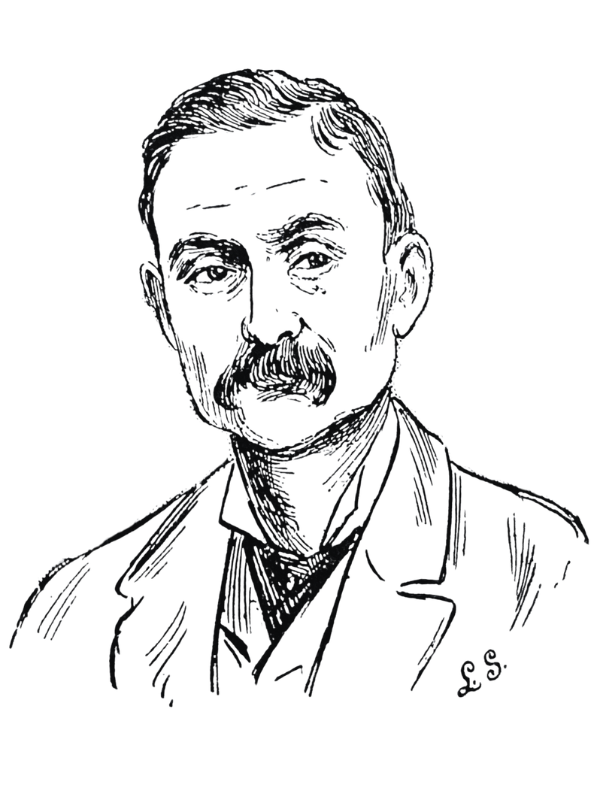
On 30 July, Mr Horner lectured on the ‘science’ of phrenology (Secular Chronicle, 7 August 1876). This was followed in August by Robert Forder of the National Secular Society, who had just established a secular society in Woolwich and was later to establish another in Deptford. Forder’s background as an agricultural labourer was somewhat different from that of most of his NSS colleagues. Forder lectured on ’Early witnesses to Christianity and their opinions’. He argued that these witnesses were ‘steeped in the most absurd superstitions. That it was a virtue among them to tell a lie for the Lord’s sake, some of them being said to perform miracles, which put to the blush the most wondrous miracle-workings recorded of their Lord and master’ (Secular Chronicle, 27 August 1876).
The subsequent Sunday evening meeting involved a further lecture by Mr Carpenter, this time on ‘Jesus Christ considered as a Human Exemplar’. Carpenter contended that the teaching of Christ was often immoral and unjust, ‘as in his doctrine of the beatitude of poverty’. This was preceded by a talk in the morning on Galileo’s persecution by the church by Mr Matthews, which appears to have been poorly attended. The Society was perhaps ambitious in expecting its supporters to attend two separate lectures on their Sundays (Secular Chronicle, 3 September 1876).
On 5 September, the speaker was the leading secularist, G. W. Foote, editor of The Secularist, who had also been secretary of the London Republican Club and the national Republican League, and who was to be a colleague of Harriet Law’s in the non-Bradlaughite British Secular Union. Foote spoke on ’Secularism Superior to Christianity’. Foote sought to contrast the ‘fallacies of Christian belief with the rational creed of the secularist’, which would ‘concentrate human effort on the attainment of human happiness here’, and ‘not waste man’s sympathies and energy on things of God and heaven’. On the previous Sunday, Dr Bikkers had continued his previous lecture on ‘Life and Growth of Language’ (Secular Chronicle, 17 September 1876).
Sunday 12 September saw a lecture by Annie Besant on ‘Is there a God?’ to a large and demonstrative audience, with Harriet Law presiding. The Chronicle report gave a detailed summary of the lecture, which sought to explain how non-belief derived from the lack of proof that there was a God who designed and made the universe. Besant was able to respond to four attendees who sought to oppose her argument, as reported in the Secular Chronicle, 24 September 1876.
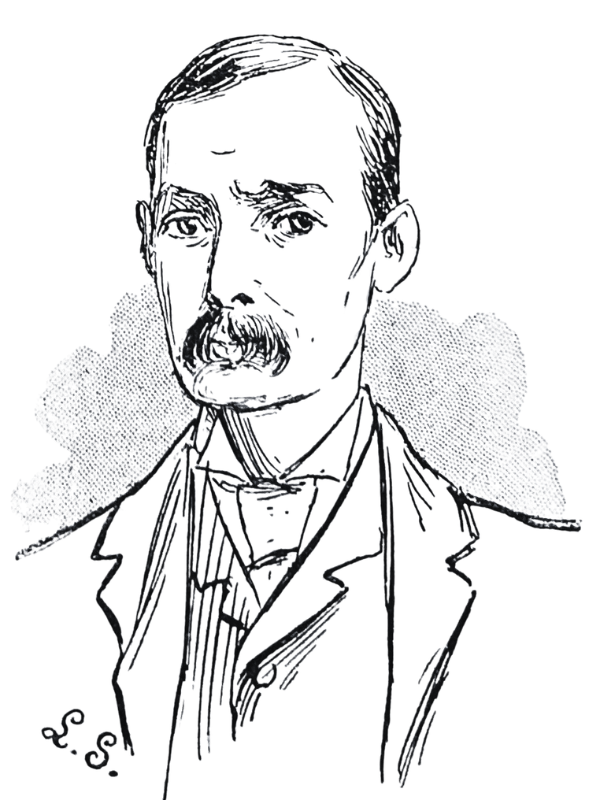
The Society had now been in operation for three months and there was a member meeting to discuss its progress. The Society had some fifty thorough members. It was agreed to affiliate to the National Secular Society, though some members appear to have dissented from this. The Society was in good financial health, as long as members kept up with their subscriptions. John Babbs was appointed chair, with Mr Errington and Edward Law as vice-chairmen, and George Bone taking over from William Heaford as secretary. John Davies was appointed financial secretary. Louis Side as librarian maintained a library of forty volumes. The committee also comprised Mrs Walters, and eight more men: Lampard, W. Davies, Briggs, Mathews, Sowden, Collins, Watkins, and Waters. There was no reference to Harriet Law’s role. The meeting also heard a talk from George Standring on ‘Christianity: A Failure’ which was opposed by a Mr Bates and a Mr Reeve, which, according to Bone’s report in the Chronicle, generated ‘smart retorts’ from the lecturer. Standring claimed that the ‘infidels’ were better followers of Jesus than ‘so-called Christians’, as they were prepared to denounce the ‘frauds and humbugs of teachers of Christianity’ just as Jesus denounced the ‘vain gloriness and doings of the Pharisees’ (Secular Chronicle, 24 September 1876).
On 24 September, Mr Reeve, who had intervened at the previous meeting, gave a lecture entitled ‘Atheism examined’. John Babbs, the chairman, also announced progress with the earlier proposal to set up an evening school, which was being taught by A. W. Collins, a schoolmaster, who had been connected with the South London Secular Society in the Blackfriars Road for some years. The school had been suspended in the summer due to poor attendance and the warm weather) but was now to be reopened, with a charge of two pence per session (Secular Chronicle, 1 October 1876).
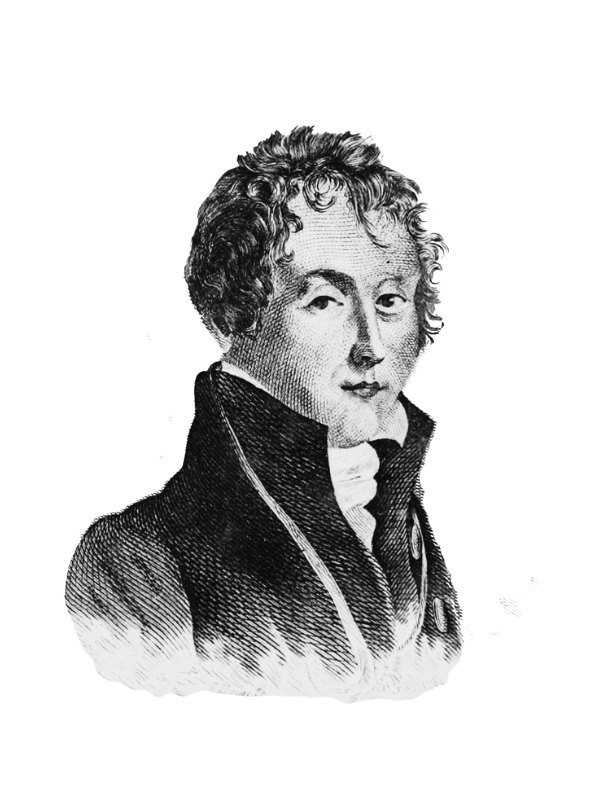
On 26 September, Mr Hanwell questioned ‘Is Theism more consistent with science than Atheism?’, responding that it was not. A Christian, Mr Tarry, argued that earthquakes were the safety valves of the earth. Robert Forder gave a talk on a ‘freethought martyr of South London thinker of fifty years ago’, who was eventually revealed to be Robert Taylor, a veterinary surgeon and friend of Richard Carlile who was known as ‘the devil’s chaplain’. Taylor had preached with Carlile at the Blackfriars Rotunda, together with Eliza Sharples, who was known as ‘Isis’ or ‘the Lady of the Rotunda’ (Secular Chronicle, 8 October 1876).
The following week, Tarry and Carpenter debated ‘Is Theism more consistent with Science than Atheism?’. Frederick Cook then gave a lecture on ‘Moloch and Jehovah’, based on his reading of Exodus (Secular Chronicle, 15 October 1876).
Carpenter followed this up with two lectures seeking to refute the arguments in a book Bible Difficulties recently published by the Walworth vicar, George Copeland. Copeland seems to have declined an invitation to join the discussion. Tarry then debated ‘Christianity and Secularism contrasted’ with the chairman Babbs and Edward Law. Miles McSweeney, formerly an Irish chartist and now an associate of Bradlaugh, gave a talk on ‘The non historic existence of Jesus Christ in the New Testament’, noting that many of these events narrated also were recorded as occurring in the lives of Buddha and Krishna. He argued that nothing but knowledge and information would ‘drive force and fraud out of the world’ (Secular Chronicle, 22 October 1876).
George Standring gave a talk on ‘The Church and the World’, in which he suggested that the Church has always retarded progress, and that it had put back the study of geology by at least fifty years. It was also reported that Peter Taylor, the radical Liberal MP for Leicester, had given the Society 57 books for its library, while a Mr Bird had donated a book on ‘Reptiles’ (Secular Chronicle 5 November 1876).
On 31 October, Iver Mac Donnell opened a discussion on ‘Modern Spiritualism and Science’. Mr Willis then lectured on ‘The Soul and a Future State’, questioning the biblical case for immortality. The Society was also establishing a course on elocution to be taught by Willis, and was considering classes on shorthand and, perhaps surprisingly, the bible (Secular Chronicle, 12 November 1876).
On Sunday morning, 12 November, Edward Law spoke on ‘Modern Spiritualism’, but the evening lecture by J Grout on ‘Fading Christianity’ attracted a smaller audience, perhaps because it was raining (Secular Chronicle, 19 November 1876).
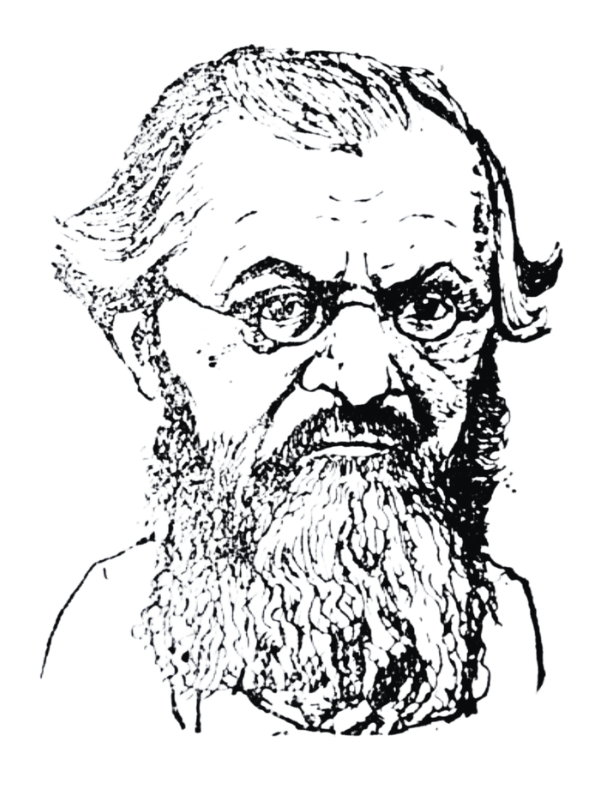
On 14 November, Mr R. A. Cooper, a member of the Norwich School Board and a vice-president of the National Secular Society, gave a talk on education. It was reported in the Chronicle that Mr Willis’ first elocution lesson had focused on the letter H, giving examples of when it was silent, before extracts from three books were read. Mr E. Shaw of the South London Secular Society, based in Blackfriars, gave a talk on ‘The Good Old Days’ (Secular Chronicle, 26 November 1876).
On the 26 November, the speaker was the Marylebone radical, Edwin Dunn, who was secretary of the North London Secular Society and was later involved in the founding of Henry Hyndman’s Democratic Federation. Dunn spoke on ‘Christianity compared with other religions’, discussing ‘Brahmanism, Mahommedanism and Buddhism’, arguing that Buddhism was the purest religion (Secular Chronicle, 5 December 1876).
The 27 November was Harriet Law’s turn to lecture. Her chosen topic was ‘If a Man Dies Shall he live again?’ with the alternative title of ‘Has he an immaterial and immortal soul?’. Later in the week, Mr Collins opened a discussion on ‘Human Physiology’, and Mr Henry Savaraux of the National Sunday League spoke on ‘Sunday culture for the people’. The society’s reports in the Chronicle also listed each book studied at the elocution class. It was also proposed to run a debating class on Sundays (Secular Chronicle, 12 December 1876).
At the following two meetings, Tarry and Carpenter led a discussion on the ‘Attributes of God’. The subject chosen for the first debating class was ‘The Eastern Question’. Robert Forder from the National Secular Society gave a dissertation on ‘The Devil’ which was recorded as ‘original and amusing’. He advised against reading the description of the Devil in Revelations as ‘if a person is ere mad before he commences, it will leave him mad before it is done’ (Secular Chronicle, 19 December 1876). The final meetings of the year were Mr Heaford on ‘Are Christian doctrines of rewards and punishments moral and beneficial?’, Mr Wood on ‘Christian Creed the source of Error but not of Virtue’, the latter being opposed by Mr Lee, a Unitarian, which generated ‘a pleasant discussion’ (Secular Chronicle, 31 December 1876).
The New Year started with G. W. Foote speaking on ‘The Turks and Their Bible’ on New Year’s Day, with two days later, Francis Soutter, the Camberwell radical who was to be agent for Helen Taylor in her parliamentary candidacy in 1885, speaking on ‘Sunday restrictions’, with George Shipton of the London Trades Council, and president elect of the Trades Union Congress, in the chair (Secular Chronicle, 14 January 1877).
The Walworth Institute was continuing to draw in star speakers. On 8 January, Charles Bradlaugh spoke on ‘Voltaire, Owen and Paine’ to a packed hall, despite the inclement weather. George Standring spoke on ‘Science and Faith’. Mr Symons two lectures on ‘The Beginning of Life’ and ‘The Beginning of Thought’. (This was probably John Addington Symonds, the cultural historian, who also wrote on homosexuality in classical times). On 22 January George Jacob Holyoake spoke on the ‘Curious materialism of Christianity’. The debating class discussed trade unionism. A tea party was organised at 8 pence a ticket or 1 shilling for two tickets. The event lasted from 6pm to 10.30 and included ‘amusements with performances on the concertina’. Three free evening lectures on health by Dr Pope of the National Health Society, a former staff surgeon in the Royal Artillery, were planned. These would cover ‘Number One and How to Take Care of Him’, ‘The Air He Breathes’ and ‘The Water He Drinks’ (Secular Chronicle, 28 January; 4 February 1877).
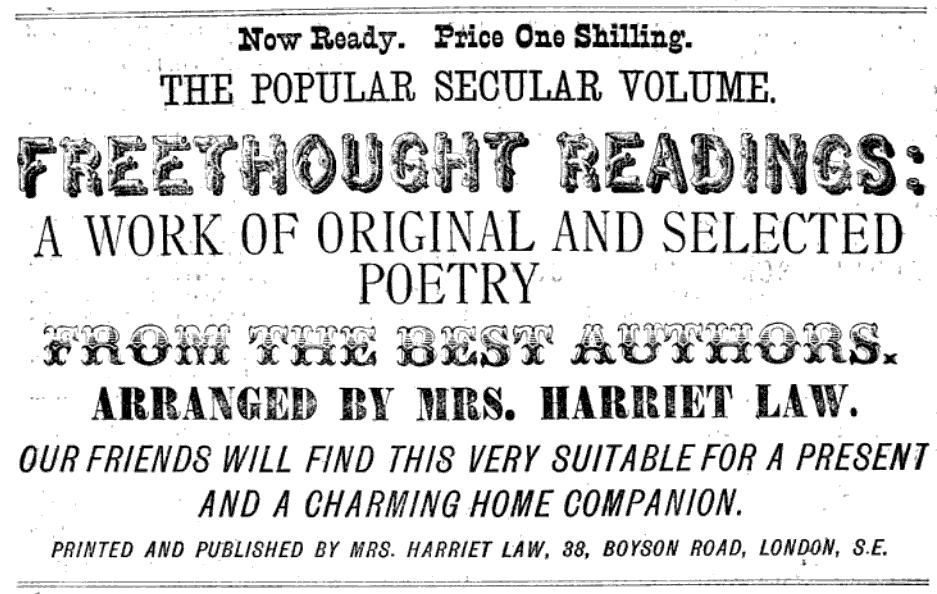
The following Sunday evening, the speaker was the former Chartist, John Bedford Leno, who spoke on ‘Poetry and the mission of the poet’, and read one of his poems. The debating class discussed ‘the population question’. The Chronicle advertised a book by Harriet Law comprising ‘Freethought Readings, A Work of Original and Selected Poetry from the best authors‘, promoted as ‘very suitable for presents and a charming home companion’. The book was priced at one shilling (Secular Chronicle, 18 February 1877). On 13 February, a talk was given by Mr Avant of the National Sunday League – ‘Do the workers support it as they ought?’, followed by Colonel Henry Clinton on ‘Anti-Monarchism’, with Dr Bikkers in the chair (Secular Chronicle, 25 February 1877).
George Bone, the Institute secretary, gave a talk on vaccination. Robert Forder gave a talk on how Mohammedanism was preferable to Christianity. There was a debate on whether or not Mary Queen of Scots had been responsible for the murder of Lord Darnley. Charles Watts lectured on ‘Atheism, Secularism and Christianity’. A Mr Mott initiated a discussion on ‘Radical Organisation’ setting out a political programme, comprising Universal Suffrage; Disestablishment of the Church of England; Compulsory, Free and Secular Education and the Abolition of Hereditary Privileges. At the following meeting, Mr Haslan spoke on the Revolutions in France which was followed by the singing of ‘The Marseillaise’ (Secular Chronicle, 11 March; 18 March 1877).
On 14 March, Mr Hudson spoke on the ‘Philosophy of Death’ and Aristotle. J. H. Carpenter was due to speak on ‘Common Sense Ethics’ on 18 March, but was ill, so Dr Bikkers gave a talk on the Jewish philosopher Spinoza and how he had been ex-communicated by the chief Rabbi. On 25 March, Rev Woffendale attended for the first time to give a talk on ‘the Whole Duty of Man’, basing his talk on the bible, substituting for the absent Collins, who no doubt would have based his talk on Mazzini’s work. This was followed by Heaford on ‘Suicide’ and George Standring on Robespierre. Members were reminded that subscriptions were due on 1 April and it was ‘requested that friends will throw off the cloak of apathy which they appear to have but too thoroughly developed themselves in, and lend their aid in making Walworth the nucleus of Freethinkers and Secularists south of the Thames’ (Secular Chronicle, 25 March; 15 April 1877).
In April and May, Dr Bikkers, who was actually Dutch, gave a series of four talks on the English language. A Mr Johnson gave a talk on ‘Kung-foo-tsee, Mang-tsee and Jesus’. This was actually about Confucius and Tibetan Buddhism. On 23 April, Mr Touzeau Parris gave a talk on ‘Democratic Teachings of History’, though the secretary George Bone recorded that there had been a poor attendance, and appealed to the society’s members to be more considerate of visiting speakers. Parris had been a unitarian minister but had become a secularist and anarchist and a lecturer for the National Secular Society. He was later a member of William Morris’ Socialist League and the Hammersmith Socialist Society as well as the Malthusian League. It was also reported that Mr Harrington of the Christian Evidence Society had booked the hall for a series of six lectures, and freethinkers were requested to attend to challenge the speaker. (The following Sunday evening, the speaker was the former Chartist, John Bedford Leno, who spoke on ‘Poetry and the mission of the poet’, and read one of his poems. The debating class discussed ‘the population question’. The Chronicle advertised a book by Harriet Law comprising ‘Freethought Readings, A Work of Original and Selected Poetry from the best authors‘, promoted as ‘very suitable for presents and a charming home companion’. The book was priced at one shilling (Secular Chronicle, 18 February 1877). On 13 February, a talk was given by Mr Avant of the National Sunday League – ‘Do the workers support it as they ought?’, followed by Colonel Henry Clinton on ‘Anti-Monarchism’, with Dr Bikkers in the chair (Secular Chronicle, 25 February 1877); 6 May 1877; Royle 1980). On 6 May, Myles McSweeney lectured on ‘Priests and their stock words—Heaven, Hell, God, Devil, Sin, Soul’ (Secular Chronicle, 13 May 1877).
On 28 May, Harriet Law lectured on ‘Is it possible to make the best of both worlds?’. She was opposed by a Mr Burgess, who, after speaking three times, stormed out before waiting for Law’s response – which was recorded as ‘not being the behaviour of a gentleman’. Louis Side was appointed to represent the Institute on the executive committee of the National Secular Society (Secular Chronicle, 10 June 1877). On 4 June, Charles Watts spoke to respond to the ’Fallacies of Secularism’, a book published by Dr Sexton. Apparently. Members of the Christian Evidence society who were present declined an invitation from the chairman to defend Dr Sexton’s position. On 10 June, there was a concert, with members giving readings, including a specially written poem by Harriet’s daughter, Alice, entitled ‘Peace and Freedom’ (Secular Chronicle, 17 June 1877). On 1 July, Mr Prior gave a talk on his experience in the Catholic Apostolic Church (known as the ‘Irvingites’) in which he had been a Minister for 20 years. He was followed by Mr Spencer, a Swedenborgian. On 3 July, Mr Collins returned to the issue of vaccination, this time in the context of smallpox and treating the issue from a philosophical rather than medical perspective. In something of a contrast, on 8 July, H. F. Jung gave a talk on the Federal republic of Switzerland. 15 July witnessed a talk by Mr O’Byrne on ‘Miracles Made Easy’. He commented that it was a bad thing for Christians that the emperor Constantine had relocated his metropolis from Constantinople to Rome (Secular Chronicle, 15; 22 July 1877).
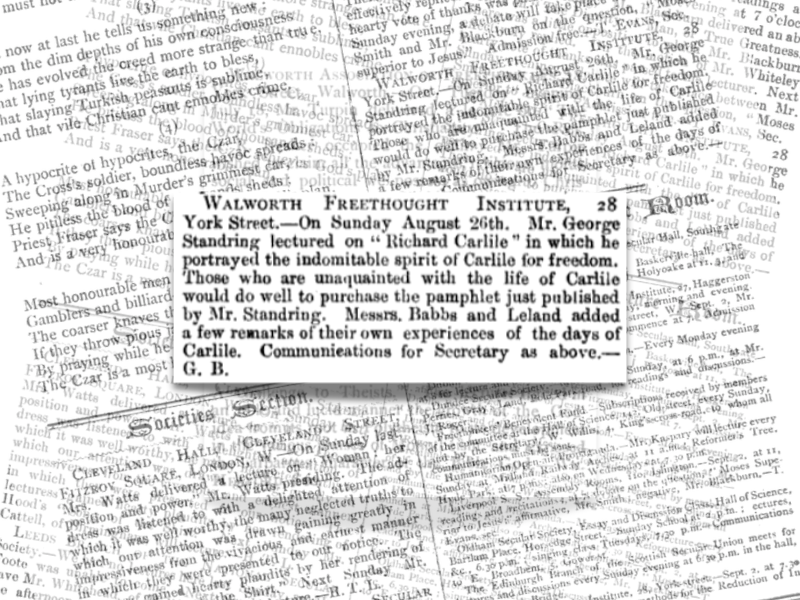
On 26 August, George Standring lectured on Richard Carlile, about whom he had just published a pamphlet. On 2 September, Mr Ramsey opened a discussion on ‘Heaven and Hell’ , which he regarded as ‘phantoms of a perverted diseased imagination’, to be repeatedly interrupted by Mr Middleton of the Christian Evidence Society, who had brought a group of ‘roughs’ to support him. On 16 September Henry Savaraux of the National Sunday League spoke on ‘The Progress of Freethought: From Darkness to Dawn’ On 23 September, James Rowlands of the London Municipal Reform League, who was later an MP, spoke on ‘The Crisis in France’, where the prime minister Jules Simon had been dismissed by the conservative Catholic president Marshal McMahon (Secular Chronicle, 2 ; 9; 23; 30 September 1877).
The half-yearly meeting of members on 7 October discovered that the Association was in financial deficit. The meeting also took the unusual step, on the proposal of Edward Law, of deciding to elect a chairman each month, rather than for a year. Peter Taylor MP was thanked for donating 85 books to the library. Neither Harriet or Edward Law or their daughter Alice were appointed to the Association committee (Secular Chronicle, 14 October 1877). The winter season of meetings started with Mr Symes speaking on ‘My Path from the Wesleyan pulpit to the Secularist platform’. He was challenged by two members of the Christian Evidence Society, Mr Turpin and the Rev Woffendale. Harriet Law was in the chair, though it was noted that ‘she was not in her usual robust health’ and that ‘she had been unwell for some time’. James Rowlands concluded his earlier talk on French politics. (Secular Chronicle, 21 October 1877).
On 28 October, Mrs Simpson spoke on ‘Sunday observance and the Claim of Children’. At the following meeting, it was decided to establish an ‘Anti Compulsory Vaccination Society’ for South London, with George Bone as secretary and John Babbs as treasurer. The new society had its first meeting on 13 November and agreed the following objects: 1) The total, immediate and unconditional repeal of the Compulsory Vaccination Acts; 2) The support of the wives and families of those who may go to prison for their principles; and 3) The payment of fines in accordance with Guarantee Fund. (Secular Chronicle, 25 November 1877).
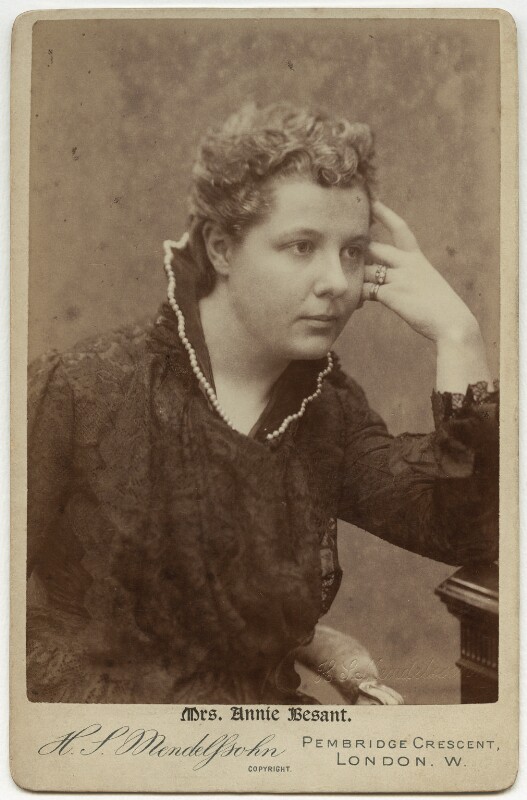
On 6 November, Annie Besant, vice-president of the National Secular Society (Bradlaugh being President) lectured on ‘Thomas Paine: Republican and Freethinker’. She agreed to let the Institute keep the lecture takings. It was also noted that both the South London Chronicle and the National Independent, were now reporting the Association’s meetings. The 11 November, the meeting was handed over to the Christian Evidence Society, who provided the speaker, Mr B. H. Cowper, with his supporter Mr Turpin chairing. The talk focused on the Apocrypha. On 18 November, James Rowlands spoke on ‘Our Hereditary legislators’ for an hour and a half, mainly an examination of how the Normans had taken over land from the Saxons (Secular Chronicle, 25 November 1877). On 27 November, Cowper and Harris were back to discuss ‘The authorship and truth of the gospels’, with Arthur Moss on 1 December on ‘Free-will and Responsibility (Secular Chronicle, 9 December 1877). Moss, a young Bermondsey teacher, was later to become prominent in the secularist movement, publishing a book of secularist essays in 1886. On 4 December, Mr Babbs responded to Cowper’s two lectures, while on 9 December, James Cheeseman lectured on ‘Child Culture, Physical, Intellectual and Moral’, with the Southwark radical, Fred Soutter in the chair. Cheeseman argued that children should be taught from objects not books (Secular Chronicle, 16 December 1877). G. W. Foote returned on 11 December on the subject ‘Christianity Impeached at the Bar of History’ (Secular Chronicle, 23 December 1877).
The new year started with John Bursill on the history of Temple Bar (in the City), the speaker having just published a book on the subject, followed by Robert Forder on ‘The Fall and Creation of Man’, and a further talk by Foote, entitled ‘An Evening with the Devil’. Meetings were enlivened by singing from a newly established choir. Meanwhile the Anti-Compulsory Vaccination Society was busy. As well as George Bone, Colonel Clinton and Harriet Law were actively involved. Louisa Lowe of the Lunacy Reform Association (who later wrote a book on asylums, The Bastilles of England, was made a vice-president as was Dr Houghton. Amos Booth of Leicester gave a talk on 15 January to the Freethought Association, entitled ‘Vaccination—a Gigantic Swindle’ (Secular Chronicle, 13 January; 3 February 1878).
On Tuesday 5 February, Frank Kitz led a discussion on opposing the Permissive Bill, which was a proposal led by Sir Wilfrid Lawson and the temperance lobby to restrict the sale of intoxicating liquor in certain areas, a talk which was continued on 19 February. The following Sunday, James Marshall spoke on ‘National and Social Evils considered’ (Secular Chronicle, 10; 24 February 1878) On 5 February, Thomas Slater lectured on ‘What is Secularism?’ his view being that it was ‘a philosophy of life’, with Harriet Law contributing to the discussion. The next talk was by Bursill (the historian of Temple Bar), who managed to discuss both ‘The Arctic Expedition’, illustrated by dioramic views, and Cleopatra’s Needle. On 12 February, John Babbs returned to the subject of ‘Russia and Turkey’, which was followed by James Rowlands on ‘The Present Crisis in connection with the Eastern question’, noting that Gladstone had kept to the policy he had set out in his speech at Blackheath the previous September, and that had the policy been followed, war could have been avoided. This was Gladstone’s speech condemning the ’Bulgarian atrocities’—their oppression by the Ottoman government, and attacking the policy of the British Prime Minister, Disraeli. The discussion continued at the following meeting on 25 February (Secular Chronicle, 24 February; 3 March 1878).
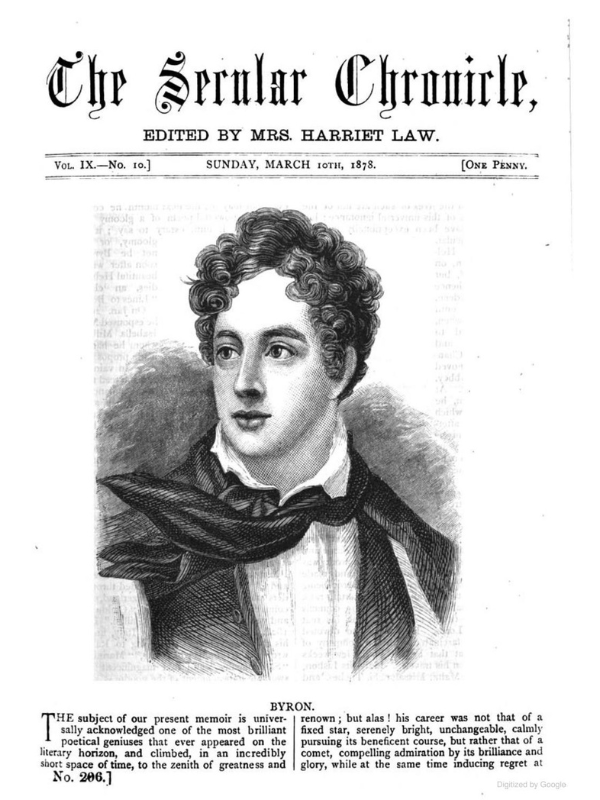
George Standring spoke on 3 March on ‘The Coming Revolution’, though the Chronicle report was unspecific on the nature of this revolution. On 10 March, Charles Watts, editor of the Secular Review, returned to a more traditional secularist topic – ‘The True Character of Christ’, expressing the view that Christ was not perfect. On 12 March, the republican, John de Morgan, spoke on ‘The Origin and Growth of the Religious Idea’. On 26 March, Harriet Law returned to speak on ‘The Priest and the Confession’, while her daughter, also called Harriet, chose the topic of ‘An Hour with the Poets’ for the following meeting, which included Byron and Macaulay. The younger Harriet also sang ‘The meeting of the waters’ at the monthly concert on 21 April (Secular Chronicle, 7; 28 April 1878).
On 5 May, instead of the usual lecture, there was a play – ‘Rent Day’. According to the Chronicle report, ‘the play was well suited for a Freethought platform. As it showed how aristocrats with their thousands ground down the poor and turned them out of their homes’ (Secular Chronicle, 12 May 1878). At the following meeting, Arthur Moss returned to the subject of ‘Theism criticised’. This was followed by Mr Holmes on ‘The Christian Church opposed to Science and Progress’, and Mr F. Cook on ‘ The Adventures of the Prophet Jonah’, which kept the audience laughing at the absurdity of the tale. (Secular Chronicle, 9 June 1878). On 4 June, Thomas Slater lectured on ‘ The Hopes of the Human Race’, with Harriet Law back in the chair.
On 17 June, the speaker was Professor H. D. Garrison from Chicago, who spoke on ‘The Conflict between Science and Superstition’, attracting ‘an unusually large’ attendance. Apparently, Garrison gave a ‘clear exposition of scientific truth’ combined with ‘witty anecdote and quaint terms of expression’. Earlier that month, Charles Watts had spoken on ‘Ancient Theology and Modern Philosophy’ and James Rowlands on ‘Our State Pensioners’, which presumably comprised a criticism of the monarchy and the court, given as yet there were no state pensions for anybody else (Secular Chronicle, 23 June 1878).
On June 18, Charles Bradlaugh returned to speak on ‘Eternal Torment’. This was a significant appearance given the disagreements between Bradlaugh and Harriet Law, and the withdrawal of the latter from Bradlaugh’s National Secular Society. On 2 July, Annie Besant, who was Bradlaugh’s closest colleague in the National Secular Society, spoke on ‘Atheistic Disabilities’ to criticise the blasphemy laws. On 7 July, Louisa Lowe returned to give a further talk on reform of the lunacy laws, which was supported by the meeting with the chair signing a petition for reform (Secular Chronicle, 14 July).
On 11 August, George Standring lectured on ‘Our National Liberties – How they were won and how they may be lost’. On 18 August, Robert Forder spoke on ‘Miracles’ (Secular Chronicle, 18; 25 August 1878). On 20 August, Mr Holmes repeated his earlier talk on ‘My Path from the Christian Pulpit to the Secular Platform’ (Secular Chronicle, 1 September 1878).
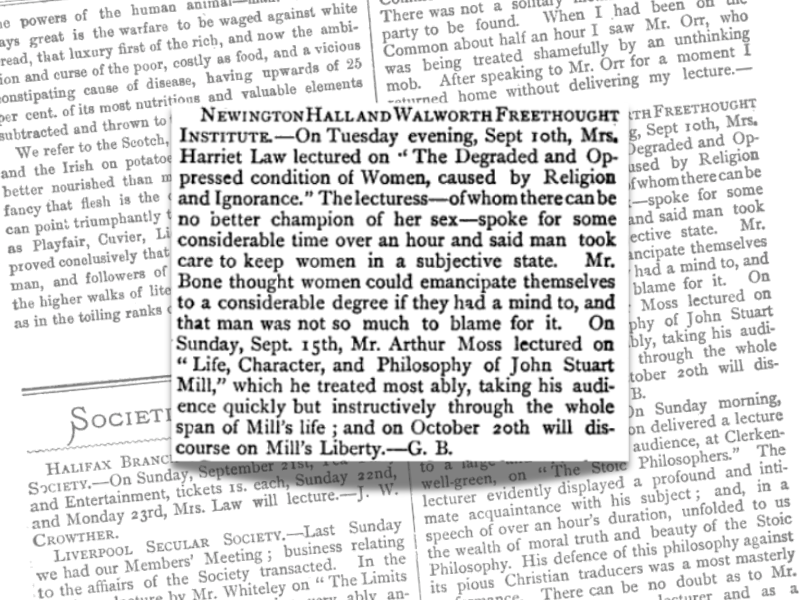
In early September, it was announced that the Association’s hall at 28 York Street would be renamed as the Newington Hall and Walworth Freethought Institute and its meetings were now recorded in the Secular Chronicle under this new designation, though the reasons for the change of name are unclear, especially given the hall was not in Newington, which was to the west of Walworth. Mr Fagan spoke on ‘Recantations’ followed by Robert Forder on ‘The Zodiac’. On 10 September, Harriet Law lectured on ‘The Degraded and Oppressed Condition of Women, as Caused by Religion and Ignorance’. Speaking for over an hour, she argued that ‘man took care to keep women in a subjective state’. George Bone, the Institute secretary, responded that ‘women could emancipate themselves to a considerable degree if they had a mind to and that man was not so much to blame for it’.
This was followed by two lectures by Arthur Moss on ‘Life, Character and Philosophy of John Stuart Mill’, the first covering Mill’s life and the second covering Mill’s volume On Liberty. On 17 September, Charles Watts lectured on ‘The Unique Wonders of the Bible’ (Secular Chronicle, 15; 22; 29 September 1878).
The Walworth Freethinkers also decided to challenge the Christian Evidence Society on their own territory. Bone and a newcomer, Alfred Johnson, challenged Rev Allen, vicar of St James’, Bermondsey, at a meeting at the Bermondsey Mission Hall. Allen’s subject had been ‘Why I am not an Infidel’. Herbert Burrows of the National Secular Society (and future treasurer of Hyndman’s Democratic Federation) had been expected to speak at a further Mission Hall meeting, but was ill and was replaced by Mr Goodall, a member of the Christian Evidence Society, to be challenged again by Bone and Johnson (Secular Chronicle, 29 September; 6 October 1878). Johnson then gave his first talk to the Walworth Institute on the subject ‘Epicurus and Jesus contrasted’ with one Christian present saying they were content with Jesus and not interested in the ancient Greek philosopher. The following meeting returned to the subject of vaccination, the speaker being Dr C. T. Pearce MD. Talks in the following weeks were Mr Heaford on miracles and George Standring on secularist principles (Secular Chronicle, 13 October; 10 November 1878).
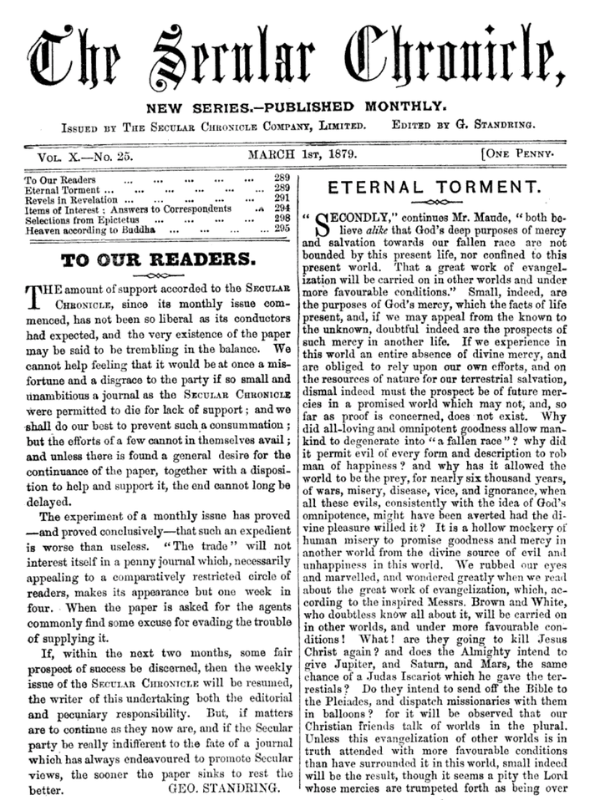
The reports of the Institute’s meetings then ended as, at the end of November, Harriet Law resigned the editorship of the Secular Chronicle, with the paper being handed over to George Standring, who turned the weekly paper into a monthly journal, which meant keeping a record of the week’s meetings and giving notice of future meeting’s was no longer possible. This change proved unpopular, and there was clearly no market for such a publication, least of all because the journal’s readers were mainly interested in reports of local societies. The March 1879 issue was the last. The Institute, however, continued to operate until April 1887, with meetings reported in the National Reformer. Following its closing, members were invited to join the North Lambeth branch of the National Secular Society (National Reformer, 29 May 1887).
Royle, Edward, Radicals, Secularists and Republicans: Popular Freethought in Britain 1866-1915 (Manchester University Press 1980)
Secular Chronicle Vols 1-10 1872-1879
By Duncan Bowie, a London based historian and the author of a number of books and papers on radical and socialist politics. He is co-chair of the Socialist History Society and reviews editor for Chartist.
Women, like men, should try to do the impossible. And when they fail, their failure should be a challenge to […]
The good life is one inspired by love and guided by knowledge. Neither love without knowledge, nor knowledge without love […]
Without any great effort of thought, I believe that I could, in an instant, propose other systems of cosmogony, which […]
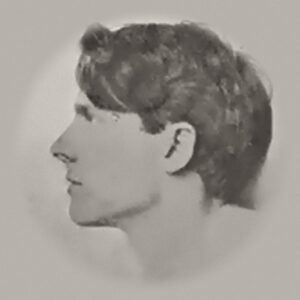
Rupert Brooke’s 1914 sonnets made him a national symbol of patriotic sacrifice, but the man behind the legend was a sceptic and a socialist, at home among the freethinkers of pre-war Cambridge, who left religion behind before he left school and never returned to it.