Colin Tyler is Professor of Applied Ethics and Political Theory at the University of Hull, where he serves as Director of the Institute of Applied Ethics and the Centre for Idealism and the New Liberalism. His most recent monograph is Common Good Politics: British Idealism and Social Justice in the Contemporary World (Palgrave Macmillan, 2017), which brings the traditions of British Idealism, the New Liberalism, and the politics of the common good into dialogue with contemporary debates on inequality, citizenship, and the state.
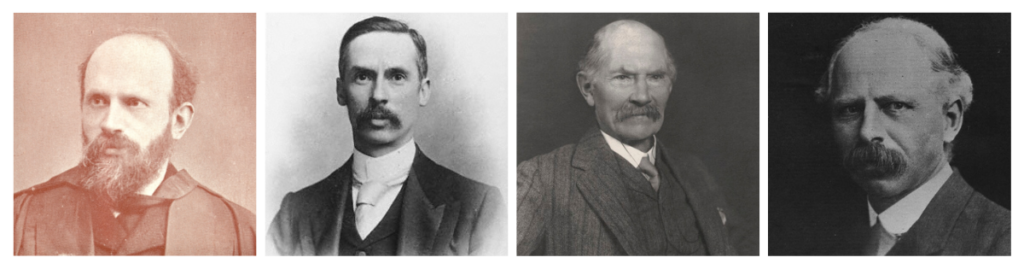
Despite its historical association with Roman Catholic social thought, the idea of the common good has a great deal to offer to contemporary humanists. One way to give greater precision to this often nebulous idea is by turning the writings and activism of the first four presidents of Humanists UK. These were John Stuart Mackenzie (Pres. 1918-21), John Atkinson Hobson (Pres. 1921), John Henry Muirhead (Pres. 1922), and Leonard Trelawny Hobhouse (Pres. 1923). Each of these thinkers contributed through their writings and reformism to a tradition that began with the ethical and political thought of the British idealist Thomas Hill Green (1836-82). Their respective metaphysics meant that while Mackenzie and Muirhead were British idealists, Hobhouse and Hobson were New Liberals who contributed to the intellectual foundations of the governments of Sir Henry Campbell-Bannerman and H. H. Asquith (himself a former student of Green). Through their influence on these governments, the conception of the common good popularised by these four presidents helped lay the foundations of the welfare state. This mission was given particular impetus by another student of British idealism, William Beveridge, whose reformist drive was shaped by Edward Caird, under whom he studied at the University of Oxford.
Through their influence on these governments, the conception of the common good popularised by these four [Humanists UK] presidents helped lay the foundations of the welfare state.
So, what was their humanist theory of the common good? A core element of that theory was what another British idealist David George Ritchie called the concept of “social labour” (Darwin and Hegel, p.191).
The soldiers that guard a country from invasion, so that harvests can be reaped in peace; the magistrates who are a terror to evil-doers; all those who increase the knowledge, quicken the intelligence, and raise the character of the community, and so make complicated industrial relations more possible between human beings; – all these might claim a part in the making even of a loaf of bread. That is to say, the loaf is not merely the product of Nature plus Labour, but of Nature plus Social Labour; and that this social labour is not merely an aggregate of the labour of various individuals, but it is the labour of individuals working in an organised society.
Social labour puts the lie to the radical individualism that underlies any glib appeal to the fiction of the self-made individual. It is a concept that has been invoked by many politicians and social reformers, famously including Barack Obama during his 2012 presidential campaign speech at Roanoke VA.
A second key element of a humanist notion of the common good is the fact that we build our personalities and identities through our interactions with others.
A second key element of a humanist notion of the common good is the fact that we build our personalities and identities through our interactions with others. The ways that our family, teachers, friends and others shape us as children. The same processes continue throughout our lives. Our parents treat us like we are clever or stupid, industrious or lazy, a child of God or a sinner, and we tend to internalise that image. Even if we come to kick against it, we cannot ignore it. The ways they and others treat us stays with us, even when we define ourselves against those expectations. These expectations can accord with our deepest instincts about ourselves or they can conflict with them. But they cannot be ignored and we cannot develop a personality without them.
So, here we have two key elements of the common good. One shapes the material conditions of our individual lives, the other shapes the psychological conditions of those lives. Without them, we could not live a life beyond the most basic. Hence, we must live in a world based on the common good. The textures of our self-understandings, our material conditions and hence our lived reality are as various as the practical complexities of lived experiences. It is vital to emphasise that this is a practical reality, albeit theoretically expressed here. The lives we live are imbued with truths that can be expressed in the misnomer of “theory,” but their importance comes from their practical implications.
The textures of our self-understandings, our material conditions and hence our lived reality are as various as the practical complexities of lived experiences. It is vital to emphasise that this is a practical reality…
A significant problem is that, while necessary, their collective roots mean that inevitably they will always clash with our instincts about how we are as individuals, our natural tendency towards cooperation over competition (or vice versa), our drive to be a parent or not, our sexual preferences, and so on. The conflicts are acute in societies that deny us opportunities to question economic systems in which we live or the underlying patterns of belief in which we are raised. This is particularly true of any society founded on blind faith or an interpretation of a sacred text. It was for this reason that the British idealist men dedicated themselves to extending educational and political opportunities for women, for example, by working with women (including their wives in the case of Charlotte Green’s work with T. H. Green) to create Somerville College, Oxford. (Similarly, Caroline Caird and Edward Caird gave practical support to Emily Hobhouse’s campaign against British concentration camps in the Transvaal.) Practical inclusion is a necessary feature of a common good society.
The very qualities that reduce the tensions inherent in any society are precisely those that we prize as humanists: openness, curiosity, reason, compassion, community, hope and fundamentally a respect for the individual free from the constraints so often associated with religious versions of the common good.
This is yet another reason why humanist societies are most likely to enable their members to construct happy and fulfilling lives. The very qualities that reduce the tensions inherent in any society are precisely those that we prize as humanists: openness, curiosity, reason, compassion, community, hope and fundamentally a respect for the individual free from the constraints so often associated with religious versions of the common good. History might well be on our side as humanists, with the theory being revived in both the academic literature and among activists such as Will Hutton and others.
L.T. Hobhouse, Liberalism (London: Williams and Norgate, 1911, with many reprints)
Will Hutton, This Time No Mistakes: How to Remake Britain (London: Head of Zeus, 2024)
David George Ritchie, Darwin and Hegel, and other philosophical studies (London: Swan Sonneschein, 1893)
Colin Tyler, Common Good Politics: British idealism and social justice in the contemporary world (Palgrave MacMillan, 2017)
Colin Tyler, “The Liberal Radicalism of T.H. Green and Edward Caird,” Revue française de civilisation britannique, 31:1 (2026): 45-61 https://journals.openedition.org/rfcb/15002
Main image: John Stuart and Millicent Mackenzie, 1928