Every person upon objecting to being sworn, and stating, as the ground of such objection, either that he has no religious belief, or that the taking of an oath is contrary to his religious belief, shall be permitted to make his solemn affirmation instead of taking an oath in all places and for all purposes where an oath is or shall be required by law.
Oaths Act 1888
For most of British history, taking a seat in Parliament, giving evidence in court, or serving on a jury meant swearing a religious oath: a solemn promise made in the name of god, and usually upon the Bible. The Oaths Act 1888 changed that, establishing for the first time as a general principle the right to make a solemn affirmation — a binding promise carrying the same legal weight as an oath, but with no reference to any god — in place of swearing. For non-religious people in the United Kingdom it removed a major barrier to honest participation in public life, and it was achieved largely through the tenacity of freethinkers.
An oath is a promise sworn in the name of a deity, calling on that deity as a witness. For those who did not believe in any god, such an oath was either meaningless or an act of hypocrisy, and refusing to swear it meant exclusion from the courts, from juries, and from Parliament itself. Quakers, Moravians, and Separatists, whose faith forbade oath-taking, had gradually won the right to affirm from the 18th century onwards. But that right rested on religious conscience, and did not extend to those who had no religious belief at all.
Removing this disability became one of the central aims of the organised freethought movement. George Jacob Holyoake, who coined the word ‘secularism’ and was the last person in England imprisoned on a charge of atheism, spent decades pressing for the civil rights of unbelievers, including the right to give evidence and to affirm. Supported by figures such as the philosopher John Stuart Mill, and by hundreds of petitions organised through the secular societies, the campaign secured two important reforms: the Evidence Further Amendment Act 1869 and the Evidence Amendment Act 1870. Together, these allowed people without religious belief to affirm rather than swear when giving evidence in the courts of England and Wales. Charles Bradlaugh himself affirmed in court on this basis for years.
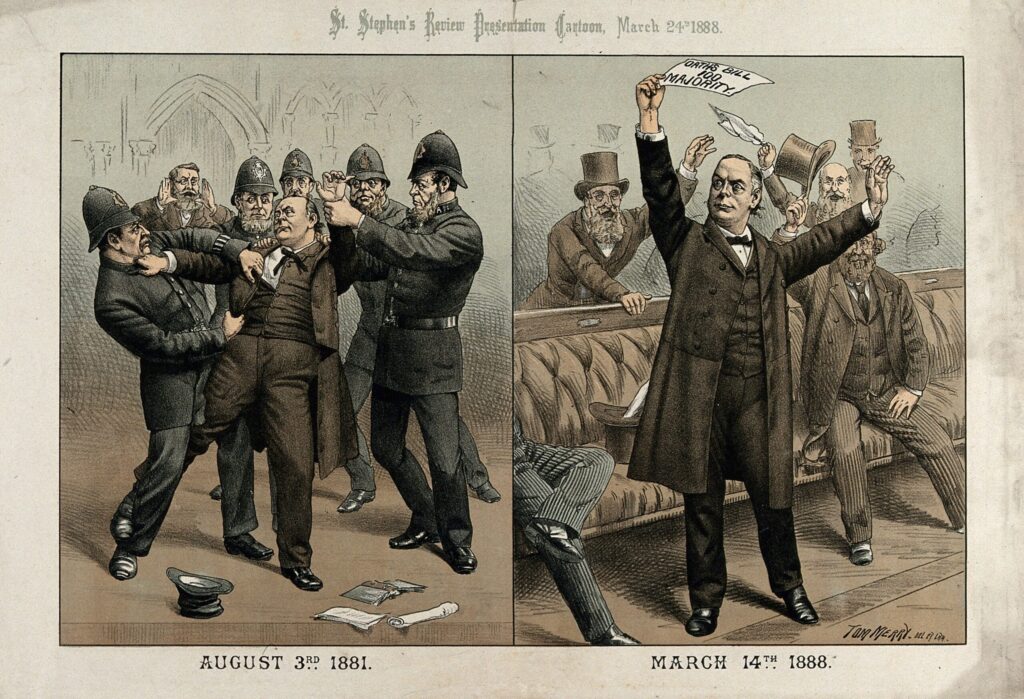
The courtroom was one thing, but Parliament proved to be another. Bradlaugh — atheist, republican, and founder of the National Secular Society in 1866 — was elected Member of Parliament for Northampton in 1880. He asked to affirm on taking his seat, citing the Acts under which he already affirmed in court, but the House of Commons refused. When he then offered to swear the oath instead, its words being to him without meaning, he was refused that too.
What followed was a six-year constitutional battle. Bradlaugh’s constituents re-elected him four times over, and four times he pleaded his case at the Bar of the House. In 1883 an Affirmation Bill supported by Prime Minister William Gladstone’s government was defeated by just three votes, opposed by the Archbishop of Canterbury, Cardinal Manning, and Conservatives such as Lord Randolph Churchill. Only in January 1886, when a new Speaker, Arthur Peel, allowed him to take the oath without challenge, was Bradlaugh finally able to sit — almost six years after first being elected.
Once seated, Bradlaugh set about securing for everyone the right he had been denied. He introduced an Oaths Bill to place affirmation on a clear and general footing. It passed its second reading on 14 March 1888 and its third on 9 August, and received royal assent on 24 December 1888.
The Oaths Act 1888 swept away the earlier patchwork of narrow and overlapping statutes and established that anyone required to take an oath could instead make a solemn affirmation, in Parliament, in the courts, and beyond.
The principle established in 1888 endures. It was carried forward, almost unchanged, into the Oaths Act 1978, which remains the law today. Every Member of Parliament, witness, and member of a jury now has the choice to affirm, and growing numbers do so: at the opening of Parliament in 2024, around 40% of MPs chose to affirm rather than swear — the highest proportion ever, and a reflection of a country that is now, for the first time, majority non-religious. What began as one man’s insistence on being treated fairly as an atheist has now become a commonplace, seemingly unremarkable freedom.