We should not instruct our children: we should educate them.
Bryan Davies MP, House of Commons debate on religious education, 19 March 1976
Bryan Davies was a Labour politician who spent more than half a century in Parliament and the party machine: as MP for Enfield North and later Oldham Central and Royton, as the long-serving Secretary of the Parliamentary Labour Party, and finally as Lord Davies of Oldham, a government whip and minister in the House of Lords.
In March 1976, when the Commons debated a motion to strengthen religious education and the daily act of worship in schools, he was the only speaker to stand up as a humanist and argue the other side. More than 30 years later, as a minister, it fell to him to answer for the Government when the Lords debated whether humanists should be heard on BBC Radio 4’s ‘Thought for the Day’.
Davies was born on 9 November 1939 in Tredegar, the South Wales town that was also the birthplace of Aneurin Bevan. He grew up in a staunchly Labour family: his father was a painter and decorator, and his mother’s six brothers were miners. The family moved to Worcestershire, where he went to Redditch County High School before reading history at University College London, graduating in 1961. He trained as a teacher at the Institute of Education and later took a degree in economics at the London School of Economics.
He taught history at the Latymer School in Edmonton from 1962 to 1965, then lectured in history and social science at Middlesex Polytechnic in Enfield, where he was active in the lecturers’ union NATFHE. He joined the Labour Party in 1958 and fought Central Norfolk in 1966. In February 1974 he won Enfield North, defeating the future Conservative Cabinet minister Cecil Parkinson, and held it until 1979, serving as a parliamentary private secretary to several ministers and briefly as a government whip.
In early 1976, the British Humanist Association (now Humanists UK) published proposals for a Bill to change the law that made religious worship and instruction compulsory in state schools. On 19 March the Conservative MP Michael Alison answered with a Commons motion calling for opportunities for religious education and an act of worship in schools to be maintained and improved. Speaker after speaker defended the 1944 Education Act’s religious clauses, and several attacked the BHA by name.
Davies opened his speech by declaring his position plainly:
I am a humanist and I must also confess that I am a product of that institution which used to be known as the godless institution in Gower Street. But University College has no responsibility for my beliefs because I took up my position before I began my higher education.
House of Commons, 19 March 1976
He argued that Britain was now a plural society, that the religious provisions of the 1944 Act were widely disregarded in practice, and that teaching about religions and moral codes should be objective and balanced, presenting a range of views rather than a single faith. Compulsion, he said, was the heart of the problem:
In my view, it is not consistent with respect for mutual values to compel children to participate in religious worship when they themselves have genuine reasonable doubts.
House of Commons, 19 March 1976
He pointed to Northern Ireland as a warning of what religious worship on sectarian lines in schools could do. Two MPs answered him by name: the Conservative William van Straubenzee, a former education minister, took issue with his case for a pluralist approach, and Labour’s Dick Crawshaw also replied to him. New Humanist, reporting the debate in April 1976, noted that Davies was the single humanist speaker, and regretted that his criticism of compulsory worship had been only a moderate one. The motion was agreed without a vote.
Davies returned to the subject of religious privilege in the law. In February 1978 he asked the Home Secretary whether he would review the offence of blasphemy, and was told that the Law Commission was about to begin a review. It would be another thirty years before the offence was abolished in England and Wales.
After losing his seat in 1979, Davies became Secretary of the Parliamentary Labour Party and the Shadow Cabinet, the post he held until 1992. It made him one of the people who kept Labour’s parliamentary operation running through the breakaway of the Social Democratic Party and the divisions of Michael Foot’s leadership. He narrowly missed returning to the Commons at Newport West in 1983, losing by 581 votes, and was elected for Oldham Central and Royton in 1992. From 1993 he spoke for Labour on further and higher education. When boundary changes abolished his seat in 1997, he lost the selection for the new Oldham West and Royton to Michael Meacher.
Davies was made a life peer in October 1997 as Baron Davies of Oldham, of Broxbourne in Hertfordshire. He chaired the Further Education Funding Council from 1998 to 2000, then joined the Government as a whip in the Lords. From 2003 to 2010 he was Deputy Chief Whip and Captain of the Yeomen of the Guard, and he was sworn of the Privy Council in 2006. Like other Lords whips, he answered for many departments, and in the final year of the Labour government he was a minister at the Department for Environment, Food and Rural Affairs.
In the Lords he answered for the Government on church schools, religious broadcasting, and multi-faith provision at the 2012 Olympic Games. During the 2006 debate on the BBC’s new Royal Charter, he told peers that the BBC had a key role in reflecting ‘different religions and other beliefs’, and gave an assurance to the Labour peer Lord Macdonald that scepticism and challenge to religion would also be part of the broadcaster’s output.
In November 2009 Davies twice answered for the Government on humanism and the BBC. On 4 November Lord Harrison, a Distinguished Supporter of the BHA, led a debate on humanism and the BBC, focused on the exclusion of non-religious speakers from ‘Thought for the Day’, on the eve of a BBC Trust decision on the question. Davies said that the Government had no say in the BBC’s editorial choices, but praised the debate:
This House prides itself on its ability to raise issues that it is often infinitely more difficult to raise at the other end of the building, if only because religious and humanist beliefs can from time to time raise passions and produce stances that, for elected Members of Parliament, can be difficult.
Lord Davies of Oldham, House of Lords, 4 November 2009
Three weeks later Lord Harrison returned with an oral question, and Davies set out the issue in terms that humanist campaigners would recognise:
I do not think that the argument is for preferential treatment. However, there are specific religious broadcasting slots and the question is whether they should also be available—or one, at least, being ‘Thought for the Day’—for the humanist perspective.
Lord Davies of Oldham, House of Lords, 25 November 2009
He also pointed out that a humanist sat on the standing conference on religion and belief that the BBC consulted. The BBC Trust nevertheless decided that ‘Thought for the Day’ should remain a slot for religious speakers only.
After Labour left office in 2010, Davies spoke for the opposition on transport and Treasury affairs. His membership of the Lords ended in July 2024 under the rules on non-attendance. He married Monica Shearing in 1963, and they had two sons and a daughter. He died in October 2026, aged 86.
Davies spent most of his career as a party organiser and minister rather than a campaigner, but he was willing to stand up as a humanist in Parliament. In 1976 he was the only MP to make the humanist case in a debate dominated by defenders of compulsory worship, arguing that children in a plural society should be educated about beliefs fairly rather than required to worship. Those arguments, and the questions he later answered in the Lords about humanist voices on the BBC, remain at the centre of the humanist movement’s work for inclusive education and broadcasting today.
Schools (Religious Education), House of Commons debate, 19 March 1976
‘The RE debate in Parliament—and outside’, New Humanist, April 1976
Blasphemy, written answer, 8 February 1978
Government asked to assess the extent of the BBC’s humanist broadcasting, Humanists UK, 27 November 2009
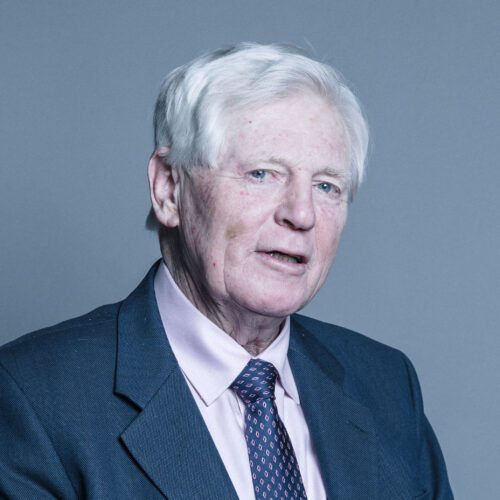
Main image: Lord Davies of Oldham, UK Parliament official portrait by Chris McAndrew, CC BY 3.0.
Antony Flew was a British philosopher and was, for much of his life, a renowned atheist and eloquent proponent of […]
Hath man no second life? Pitch this one high! Sits there no judge in Heaven our sin to see? More […]
Welsh teacher, anti-apartheid campaigner, MEP, and Labour minister who was a patron of the British Humanist Association (today’s Humanists UK).
From the outset IAS aimed to have an open approach to prospective adopters irrespective of their race, religion and creed, […]
