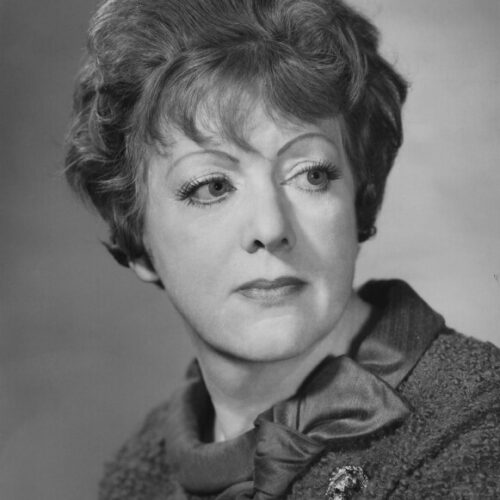
Whatever our background, from whatever country we come, we are all united in the constant struggle for freedom and progress and for the right to express what we believe to be right—even when we are in the minority… I am certain that Humanists stand in the vanguard of the struggle for a better life and for freedom for the oppressed.
Renée Short, opening speech to the International Humanist Congress at the London School of Economics, 1 August 1978, .
A firm humanist and passionate politician, Renée Short was a Labour MP for over two decades, best known for her dedicated campaigning for abortion law reform. A staunch advocate for women’s reproductive rights and a committed social reformer, Short was an Honorary Associate of the Rationalist Press Association and an early member of the Humanist Parliamentary Group.
Irene ‘Renée’ Short was born in Leamington Spa, Warwickshire, on 26 April 1916. Her early life was marked by dislocation; her father died shortly after her birth, and she was raised in Nottingham by her paternal grandparents with little contact with her mother, though she did join her for Friday night celebrations of their Russian-Jewish ancestry. She went on to study modern languages at Manchester University, where she met her husband, Andrew Short (born Endre Schwarz), a Hungarian-speaking Romanian national. They married in 1940 and had two daughters.
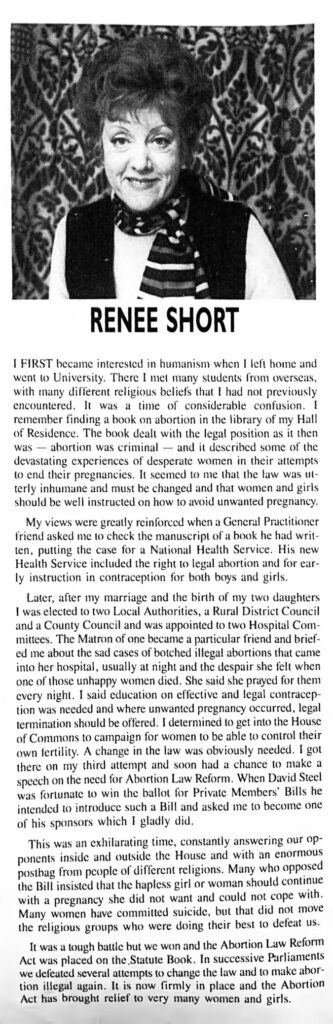
After working as a journalist and theatrical costumier, Short entered local politics in Hertfordshire, serving as a Labour member of the county council from 1952. Following two unsuccessful parliamentary campaigns, she was elected as the Member of Parliament for the heavily working class constituency of Wolverhampton North-East in the 1964 general election.
Particularly passionate about matters concerning health, education, and social services (she chaired the Commons select committee on social services for eight years), Short’s most significant contribution came in the area of abortion law reform. She was among the most devoted proponents of reform in the 1964 and 1966 parliaments, continuing to defend the hard-won rights of the 1967 Abortion Act once passed. Her commitment to social progress also extended to penal reform, a subject on which she published a book, The Care of Long-Term Prisoners, in 1979. However, her politics also reflected the complexities of her era and the demands of her constituency. While opposing the inflammatory anti-immigration rhetoric of her parliamentary neighbour Enoch Powell, she also spoke in favour of controversial legislation that denied the British citizenship rights of Kenyan Asians.
Short was a vocal humanist and active member of the Humanist Parliamentary Group, of which she became convenor in 1974. The following year, alongside fellow humanist politicians including Fenner Brockway, Lord Chorley, and Douglas Houghton, she was part of the Committee for the Defense of Morgentaler, in support of Canadian physician Henry Morgentaler who was charged with carrying out illegal abortions. In 1976, she took part in a public meeting with Diane Munday and Barbara Smoker on the subject of ‘Religious Opposition to Sexual Freedom’, and in 1978 was President of the Congress of the International Humanist and Ethical Union (now Humanists International).
After narrowly surviving a reselection contest in 1981, Short decided to retire from politics ahead of the 1987 general election. She died in Oxfordshire on 18 January 2003.
Renée Short’s lasting legacy is in her unwavering and effective advocacy for abortion rights. Her work, alongside that of many fellow humanists, was instrumental in the passage of the landmark 1967 Act, a piece of legislation that has had a profound and lasting impact on the lives and autonomy of millions.
Renee Short | The Guardian
Renée Short | The Independent
Flaming Renee! How Renee Short MP blazed a trail | Parliamentary Archives
Short [née Anderson], Irene [Renee] (1916–2003), politician | Oxford Dictionary of National Biography.
Main image: Renée Short by Godfrey Argent, bromide print, 12 February 1969 NPG x165872 © National Portrait Gallery, London
I have no desire… to bring the religion or the laws of this country into contempt, although I am a […]
Not by the Creed but by the Deed. Motto of the Society for Ethical Culture of New York, founded in […]
Why are these minds left without the means of obtaining that knowledge which they so ardently desire and why are […]
Humanism is… a tradition of thought and feeling combined with social action which stems from classical times and which has […]