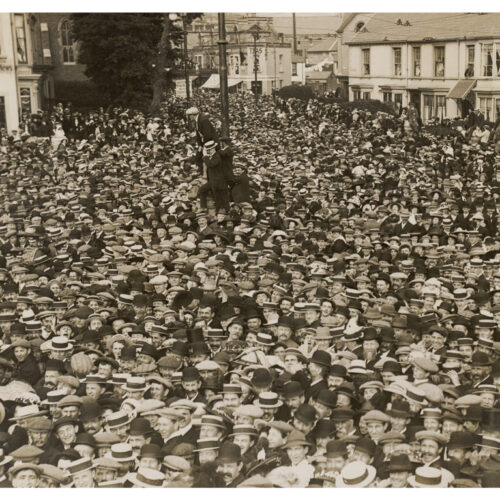
‘Why ought the Church in Wales or England to be disestablished? Why was it just for France to disestablish both Catholic and Protestant Churches?’
F. J. Gould, ‘Disestablishment’, The Literary Guide, March 1912
On 31 March 1920 the Church of England in Wales was disestablished. Under the Welsh Church Act 1914, its bishops left the House of Lords, its church courts lost their legal force, and part of its endowments passed to public bodies; the newly independent Church in Wales became a voluntary body, separate from the state. It was the first time an Anglican church in Great Britain had been cut loose from the state, and the start of a long secularisation of Welsh public life.
By the late 19th century most Welsh churchgoers were Nonconformists, yet they paid tithes to support a Church of England they did not attend. Demands for disestablishment grew alongside a new sense of Welsh nationhood, and the young David Lloyd George made the cause his own from the 1890s. Rationalists joined in on grounds of principle: in 1912 F. J. Gould argued in The Literary Guide (today’s New Humanist) that spiritual and temporal power should be kept apart, while warning against permanently endowing any system of thought.
The Welsh Church Act was passed in 1914 over the opposition of the House of Lords, but its operation was postponed for the duration of the First World War. A further Act in 1919 softened the financial settlement in the Church’s favour, a compromise the Rev. R. Roberts attacked in November 1919 in The Literary Guide as handing it a million pounds of national funds. Disestablishment finally took effect on 31 March 1920, with Lloyd George, by then Prime Minister, in office to see it through.
Some Anglican clergy took the Act as an affront to God, and The Literary Guide recorded their reactions with relish. In 1915 a Dorset rector wrote to the Globe arguing that the Allies’ setbacks in the war were divine punishment for Welsh disestablishment. The same year a Cheshire priest, the Rev. William James, issued a poster headed ‘The Accursed Thing’, claiming that God had sent the sinking of the Titanic, the loss of the Empress of Ireland and the outbreak of war as warnings against the bill at each stage of its passage.
‘It is well to consider the mental attitude of a Christian priest who admits—nay, boasts—that his God has drowned all these innocent human beings in order to warn the country against laying hands on the incomes of the clergy.’
The Literary Guide, October 1915
The Guide suggested that rationalists send for copies of the poster, at a penny each, to circulate among their Christian friends.
Disestablishment did not make Wales a secular polity (nor an irreligious society) overnight, but it ended the formal tie between the state and any one church there, a separation England has still not made. Wealth and powers that had belonged to the established church passed to local authorities and universities, strengthening civic institutions across the country.
Wales Humanists (part of Humanists UK) argues that the Act accelerated Wales’s development as ‘a progressive, confident nation with a largely secular and pluralistic approach to government and civic society’. When devolution came, the National Assembly, now the Senedd, was set up as a secular body, and both it and the Welsh Government have been run as pluralist institutions open to people of every religion and belief. The one state funeral of the devolved era, for First Minister Rhodri Morgan in 2017, was a humanist ceremony reflecting his own beliefs. Wales also led the UK in introducing opt-out organ donation, and its new curriculum includes humanism alongside religions.
Marking the centenary in 2020, Wales Humanists published a report on secularism in Wales that celebrated these achievements while setting out the work still to do, from ending religious discrimination in faith schools and compulsory collective worship to non-religious pastoral care in hospitals and the legal recognition of humanist marriages. As it acknowledged, Wales is not yet a fully secular country.
The New Humanist archive, including The Literary Guide, is available via Exact Editions. Subscribe at newhumanist.org.uk/subscribe.
In some way or another time for quiet concentrated thought must be found for our youth… Perhaps we are a […]

In common with other humanists, I believe that the only possible basis for a sound morality is mutual tolerance and […]
Her beautiful life, her truth, her unwearied charities, proceeded from her own heart. They were not inspired by any thought […]
“Yet, upon the whole, the History of the Decline and Fall seems to have struck root, both at home and […]