He was one of the few of whom it can be said that he had a gift for friendship… There could not easily be a more diversified gallery of friendships than his.
J. M. Robertson, ‘In Memoriam: Edward Clodd’ in The Literary Guide, May 1930
Edward Clodd was a banker, writer, anthropologist, and humanist. Widely lauded as having ‘a genius for friendship’, his circle included artistic and scientific luminaries from Thomas Hardy and George Meredith to T. H. Huxley and Herbert Spencer. Chairman of the Rationalist Press Association 1906–1913, Clodd was also President of the Omar Khayyam Club and of the Folklore Society, as well as serving on the council of the Secular Education League from its foundation in 1907.
The lengthy tribute and report of Clodd’s funeral reproduced below appeared in The Literary Guide (now New Humanist) of May 1930, and demonstrate the high and fond regard in which he was held by his fellow rationalists.
THE right commemoration of Edward Clodd would be the work of one who, with something of his gift of portraiture, should have known him in the happy and intimate way in which he knew the men of his Memories. He was one of the few of whom it can be said that he had a gift for friendship; and in his case the remarkable thing was that the gift was not a mere geniality which flourished on lack of conviction, but a humanism in which convictions nourished catholicity of feeling. There could not easily be a more diversified gallery of friendships than his.
In the prefatory note to the Memories he ends with these words concerning his friends: “if they have cared for me half as much as I have cared for them, I have not been badly loved.”
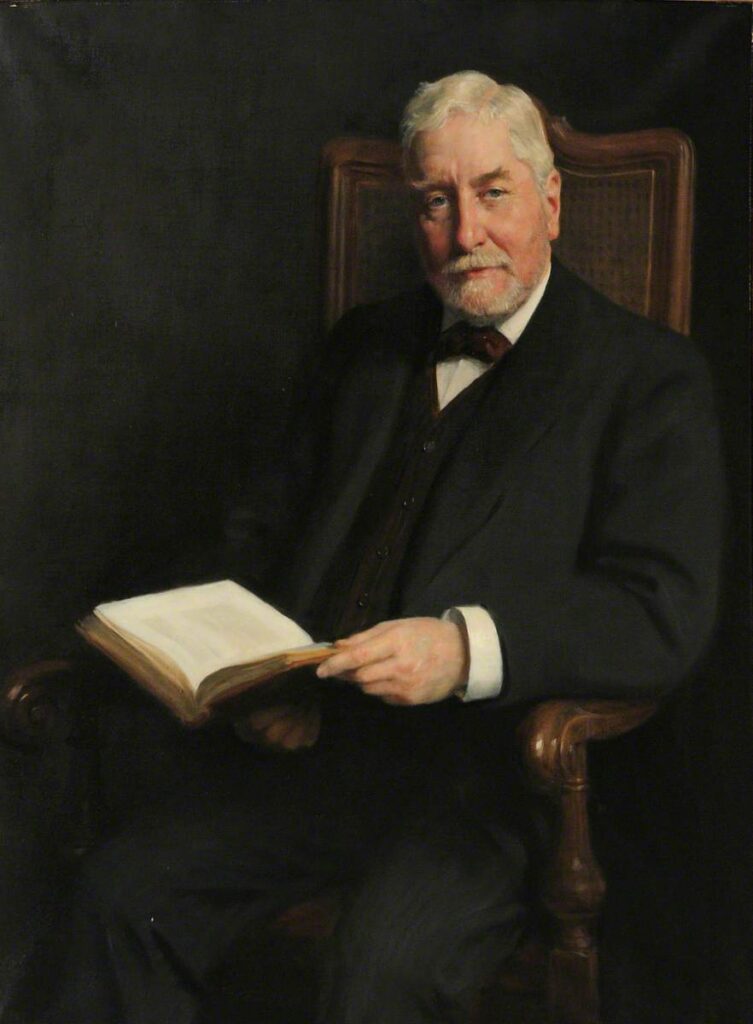
In the prefatory note to the Memories he ends with these words concerning his friends: “if they have cared for me half as much as I have cared for them, I have not been badly loved.” It is the man with the gift who can most fitly feel so; and the blending of that gift in Clodd with a deep and constant concern for the life of Reason is the aspect of him that is specially memorable. It all consists, visibly, with the quality of character which enabled him to grow, with slow circumspection, from religious roots, in a religious environment, to a thoroughgoing Rationalist. As a critic of faith he had the large advantage of “having been through it.”
In fact, the outline of his literary life might serve as an outline of the education undergone by the reason of the more rational minds in his country during his period. He was about twenty at the coming of The Origin of Species, and the titles of his earlier books—The Childhood of the World (1872), The Childhood of Religions, The Story of Creation—are, as it were, the headlines of the great campaign of evolutionary science in the last century. They had the virtue of being the products, not of a platform militant, but of a good man of business who had nothing to impel him but the sheer concern to bring to others the light which had reached him, and who therefore got inside the guard of the orthodox world, making quiet converts by the hundred.
The outline of his literary life might serve as an outline of the education undergone by the reason of the more rational minds in his country during his period… He was about twenty at the coming of The Origin of Species, and the titles of his earlier books are, as it were, the headlines of the great campaign of evolutionary science in the last century.
The influence so acquired was earned by the thoroughness of the study he undertook in order to write for the general reader. If ever he accepted a conventional opinion, in a field which he had not explored, he made more than amends by his exactitude wherever he did explore. On Egyptology he spent study enough to qualify him as a critic; and the fashion in which he checked the references of his friend Andrew Lang was a monition to a student. Thus his main convictions had the firm quality of a habit of thought which always took the trouble to know before believing, having known only too well the bane of being taught in advance to believe things unknown.
Under the trivial-looking title of Tom-Tit-Tot he develops, from a bit of folk-lore, not merely “An Essay on Savage Philosophy in Folk-Lore” but a comprehensive view of the roots and growths of the higher faiths so-called, with a clear vision of the philosophy of it all. And the book, packed with knowledge from his manifold reading, is as well written as it is well thought. For there was in Clodd a man of letters as well as a man of humanist science, and the terse, alert style is akin to the clear thinking. In all his books there is never any waste of words. I should like to see reprinted as a piece of literature an essay of his which appeared some half-dozen years ago in the Fortnightly, which gave one a partly new perception of him as the master of a style of classic quality.
I forget how many tough little yachts he outlived, sailing them as competently as he handled the problems of belief. His strong, short, untiring figure was the symbol of his whole-heartedness in friendship and in investigation.
And it all belonged to the strong, masculine character, which to call typically English would be to give a very good account of the race. One suspects a Suffolk man of coming of the Danish stock, which at the time of Domesday Book had in it the largest element of freemen in so-called Anglo-Saxondom. Clodd’s long life seems the co-efficient of his oaken strength—for one thinks of the force of his cordial organism as oaken, not iron. To this age of pleasure he adjusted himself with perfect healthiness, taking his physical recreation largely on his own little yacht in the bracing air of Aldeburgh. I forget how many tough little yachts he outlived, sailing them as competently as he handled the problems of belief. His strong, short, untiring figure was the symbol of his whole-heartedness in friendship and in investigation.
Il
In the obituary notice of him in the Times (March 18) there is a typical treatment of his mental outlook. The Times being, broadly speaking, produced for the unintellectual rich—whose lore is of motor-cars and golf and whatsoever things are told of in the newspapers, including the weird politics of the Prayer Book—he must be “put in his place” for that auditory. As thus :—
As for his Rationalism, it is to be regarded as his particular reaction from the harsh Calvinism in which he had been brought up. Clodd’s bias was hearty and robust, but it tended to keep him in the valley, content with the short view.
And again :—
Mr. H. G. Wells took over the task of stimulating Clodd’s old-fashioned anti-clerical animosity to further exertions by means of caricature drawings…
It would be quite unjust to regard the vendors of this sort of venal criticism as bigoted believers. They are simply the penmen of the world of the well-to-do ignoramus who goes to church on Sundays too wet for motoring, and who on the strength of a well-cultivated incompetence supposes his table-twaddle to be philosophy. It is the atmosphere of the present intellectual decadence of the well-to-do world in England and America, born of many dividends. And that kind of polished imbecility is what we shall always get from the Times in obituaries of Rationalists whose Rationalism cannot well be totally ignored, as Archer’s was.
Of course, the penman may himself be one of the explicit Irrationalists whom even Father Knox indignantly repudiates. But they, if not he, are definitely examples of intellectual corruption, possible only in a corrupt period.
Of all Freethinkers he had the least of the so-called ‘old-fashioned anti-clerical animosity.” Few avowed unbelievers, probably, had a larger list of clerical friends than he.
Clodd would not have paid the venality the tribute even of a sarcasm. Of all Freethinkers he had the least of the so-called ‘old-fashioned anti-clerical animosity.” Few avowed unbelievers, probably, had a larger list of clerical friends than he, and if, naturally, he had a special affection for the lovable and selfless Reverend Charles Anderson, who had no theological creed left, but lived and spent for his poor parishioners, he could nonetheless commune genially with any sane cleric content to be clubbable. He was himself the most clubbable of men. And so the really educated men of the world appreciated him in turn. The “animosities”? in that atmosphere to-day, apart from those of the microcephalous zealots, are those of the Times penman’s type, marked by the “inferiority complex” which yearns to belittle the clear and instructed thinker as holding a “short view,” they being incapable of any “view” whatever.
I have talked with Clodd on the national situation for hours without knowing what his party politics were, though I might guess. His Memories exhibit his living interest in literature as such; and if he saved much time by not scrutinizing Shakespeare he had lived in the full current of the literary movement of his day, as catholic in his reading as in his talk. Some men, as Grant Allen, are made permanently known to us by Clodd with the sureness of touch that marks him out as an admirable biographer; and his memoir of Bates, which he is said to have counted his most important work of that kind, is further a testimony to the exactness of his scientific research.
The scientific temper and method, in fact, are as distinctive of his mind as comradeship was of his character.
The scientific temper and method, in fact, are as distinctive of his mind as comradeship was of his character. What impressed his readers from the first was the compulsive power of his induction, and his mastery of critical positions which could not be gainsaid without mere refusal to reason. When the Times obituarist writes of the “daringly rationalistic treatment of Jesus of Nazareth in the book of 1880,” he exhibits his general aloofness from modern studies, for Clodd’s procedure is solidly grounded, in the first part, on the expert hierology of the age, and, in the second part, on that of Renan and Strauss, reduced to precision. I am not aware that he ever assented to the Myth Theory, preferring as he did to stand to what had been reached by scientific disproof, and adding a sympathetic interpretation.
His characteristic clearness and firmness in such debates are well exhibited in his volume The Question: If a Man Die, Shall He Live Again? and his two lectures on Occultism. The contrast between his exact pursuit and analysis of the evidence for the Spiritualists’ case and their lax exploitation of it, his stringent reasoning and the unscrupulous asseveration of the occultist brotherhood, is well fitted to reveal to every thoughtful reader the profound antagonism between the scientific spirit and its contrary. For Clodd, modern occultism was the sinister, if pitiful, survival of all the mindless myth-mongering of the ages of faith from the cave-man upwards. But all the more vigilant was he in tracking the records. The occultists never deal systematically with the literature against them. He read all theirs.
Nowhere, perhaps, is the high texture of his style better exampled than in the summation of his two lectures :—
In dealing with Occultism science discharges its functions in explaining it… Its long history is made bare; its place in the unfinished chapter of illusions is assigned. But let us live in no fool’s paradise as to its forthcoming defeat and death from the weapons which science hurls against it. Argument will not arrest the mischief working in our midst, nor decrease the crowd of those in whom the wish to believe kills the desire to know…
Science can be disloyal to its high mission only in making concessions to Occultism. And of this there is danger; risk of pollution of its invigorating air in the import of what is known as “Vitalism” by some who speak in its name… This has no warrant; it is a reversion of science to the animism of the barbaric mind which explains movements as things due to an indwelling spirit. Such an hypothesis deludes the unwary into thinking that a mystery is solved by giving it a name…
At a time when symptoms of intellectual degeneration and the note of decadence arise rather insistently in the national mental life, the alert attitude and the unfaltering mood of Edward Clodd are as inspiring as they are monitory. To the age of 75 he was as active and efficient a man of business, in his position of Secretary to the London Joint Stock Bank, as he was in his propaganda. A powerful builder of Rationalism by the methods of sheer evidence, argument, and persuasion, he was an even more powerful combatant against the degenerative forces.
The comrades of his earlier days, the scores of men of the Omar Khayyam Club, the Johnson Club, and other groupings and gatherings, must mostly have predeceased him, leaving us anxious that he should find a fit biographer with the necessary first-hand knowledge of the living and vital man of the greater period. But to us the mere record of his achievement and the stimulant of his writing are at once inspiring, medicinal, and instructive. It is in his temper and with his unflagging vigilance that the never-ending task of Rationalism is to be carried on.
A powerful builder of Rationalism by the methods of sheer evidence, argument, and persuasion… It is in his temper and with his unflagging vigilance that the never-ending task of Rationalism is to be carried on.
Looking back on the death-roll of our membership in recent years, recalling the passing of such men as William Archer, George Whale, Professor Bury, and dwelling now on the loss of Edward Clodd, one asks again: What cause, or what company, had such men to lose? It is good to remember that not one of them would have given any other answer than this: Let the Cause, as it should, be the undying parent of an unending Company, the vanguard that rests not when its veterans rest.
Mr. CLODD’S death is not merely the loss of a personal friend. It is the passing, also, of a scholar whose service to the cause of Rationalism those of my generation are proud to salute. His learning was as profound as his humanity. His skill in the presentation of complex issues, his quality of judgment, his analytic insight— these have given him a high place among those to whom the cause of Freethought owes a heavy debt.
He had a genius for friendship, and I have heard testimony to his vigour of mind and generosity of heart from men of every kind of outlook. There must be many to whom, on the verge of manhood, his books came, as they came to me, as a light in the darkness of difficulty.
He had a genius for friendship, and I have heard testimony to his vigour of mind and generosity of heart from men of every kind of outlook. There must be many to whom, on the verge of manhood, his books came, as they came to me, as a light in the darkness of difficulty. There must be many, also, who can register, as I do, a poor meed of thanks, for courtesy and kindness, and endless patience in answering questions. Mr. Clodd was, in the full sense of the word, an eminent humanist; his love of truth was, above all, a love of the freedom which should be the heritage of mankind. We are still the prisoners of an outworn religious tradition. When, at long last, we cast off our shackles he will have a high place in the ranks of the pioneers.
Mr. Clodd was, in the full sense of the word, an eminent humanist; his love of truth was, above all, a love of the freedom which should be the heritage of mankind.
He was of a generation which took its task of destroying superstition with a seriousness worthy of its importance. Much has been written in these latter days of the Victorians and their complacency. Any one who considers Mr. Clodd’s fifty years of devoted service to a great cause will realize that to him, at least, nothing of such criticism can apply. He never wrote without scrupulous investigation; he never investigated without a thoroughly open mind. The quality which, to me, is outstanding in his work was that of integrity. He was zealous for truth, whatever the results of its discovery. He is not the least of a great company to whom our debt is immeasurable.
H. J. LASKI.
Mr. CLODD’S remains were cremated at Ipswich Crematorium on March 20, in the presence of a number of friends. Mr. J. F. Green conducted the service, and, the music was arranged by Mr. Jonathan Job, F.R.C.O. The Rationalist Press Association was represented by Mr. E. S. P. Haynes, Mrs. H. Bradlaugh Bonner, Mr. C. Bradlaugh Bonner, and Mr. F. C. C. Watts.
After a few appropriate readings, Mr. Green said :—
This is not the time or place to discuss the opinions and work of our deceased friend. We are here to pay a tribute to the devoted husband, the devoted father, the devoted grandfather, the devoted friend—one who had a genius for friendship, whom every one of us who had the privilege of calling him friend admired and loved. We may just remind ourselves of his remarkable career, the loyal servant of the great Bank of which he became Secretary at an early age, and which he served for half a century. Yet he found time in his spare hours to study the latest discoveries in biological and anthropological science, and to write a series of popular expositions of the works of the leaders in those sciences. I like to think of the peaceful days of rest in the evening of life, after his retirement, by the sea he loved—“the dear sea,” as he called it. It was my privilege to see more of him during the last period of physical disability than any of his friends outside own family, and what struck me most was the wonderful patience and sweetness of temper he displayed in the face of physical trouble, which he obviously felt keenly. Beautiful, too, was his gratitude for any little service rendered. It was, indeed, a privilege to be with him, and to render any service one could. It will be a lasting memory, and I shall ever be grateful for it. And now, after a long and useful life, he has gone, and the lines of Milton come to one’s mind :—
Nothing is here for tears, nothing to wail
Or knock the breast, no weakness, no contempt,
Dispraise or blame; nothing but well and fair
And what should quiet us in a life so noble.
Professor H. E. Armstrong, F.R.S., then delivered the following short address :—
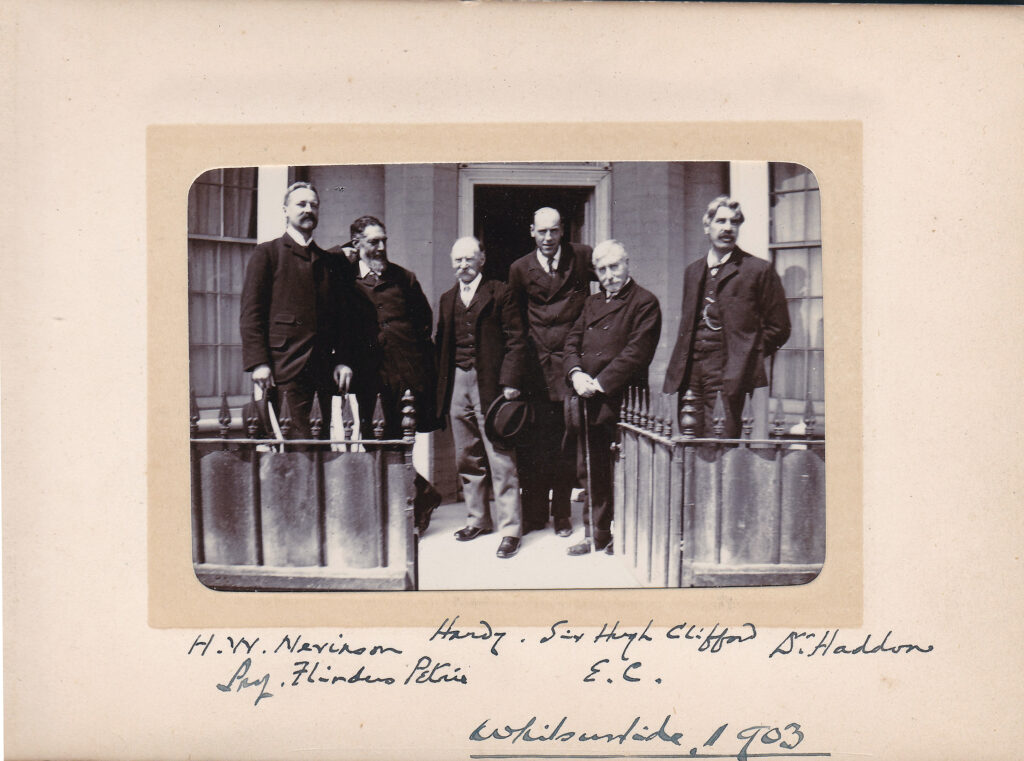
Edward Clodd was my senior friend. I believe I am the senior, and one of the few left, of the very large circle of friends he has had. No man has stood higher in the esteem of those who have known him. They have been of every walk in life, except politicians —artistic, diplomatic, literary, and scientific, but scarce a cleric. He had wonderful genius for friendship. During many years he was the Great Magnet of Aldeburgh, and made the Lotus hold a very happy well of illuminating and engaging talk. He was so trusted that he became the universal Trustee—of men so diverse as Holman-Hunt the painter and Hughes the inventor of the microphone. The close friend of poets—Hardy and Meredith—he was also intimate with Huxley and Huggins, two Presidents of the Royal Society. His mental gifts, and especially his courageous, clear-spoken honesty, appealed to all who knew him. The great work he did in aid of the young and to free his fellow men from the thrall of clerical dogma was generally recognized by those who could evaluate its meaning and importance. This remains with us.
He became a Rationalist through no accident or revulsion, but through intense and logical reflection upon facts and full consideration of man’s history.
He was a constant literary worker in his leisure hours away from business. By profession and long practice a man of affairs in the banking world, himself he was a striking and very unusual combination of two types—of the literary with the scientific. Even among professed scientific workers I have never met with a man of a more logical and unbiased mind—more fully possessed of a true sense of scientific method, less credulous, more philosophical. The faculty was innate, and in no way due to technical training, though developed by the closest study of the thinkers of his time. He became a Rationalist through no accident or revulsion, but through intense and logical reflection upon facts and full consideration of man’s history. Hence it came that he had a supreme hatred of pretence and superstition and of dictated faith-worship. He has been entirely justified. We have only to take the recently published words of the late French Prime Minister, Clemenceau :—
When we seek, as the end of man, a hell or a paradise impossible to instal in time or space, history reverses itself and the “Holy Inquisition” is summoned to appear before the Court of Galileo. The scientist, once struck to earth, rises to his feet, and unexpectedly demands an accounting from him who exacted one.
We may do this to-day in Clodd’s name. In his early works in particular he has set an example which every one of intelligence may follow. Inquire dispassionately, and it shall be granted unto you to understand, provided the inquiry be honest and full—it is the great message he leaves to us, a message as yet heard by the very few, which we have to carry into the schools and spread far and wide. Our need of overcoming ignorance is very great. We do well to remember that his chief preparation was a severe training in Biblical English. He entered the City when fifteen years old.
He used his life to the full—always with advantage. He had a happy life, the more because he gave so much happiness to others.
He used his life to the full—always with advantage. He had a happy life, the more because he gave so much happiness to others. He has passed away, I feel sure, free from all selfish wish on his own account, satisfied to have made good use of his earthly heritage; having also done all that lay in his power to do his duty to his neighbour in the fullest sense of the term.
To-day we can bear last witness to his worth with unalloyed sincerity of friendship and in heartfelt gratitude of spirit. Long will you be remembered by your works and—in Meredith’s happy words—“A beacon to thy fellows,” Clodd.
Mr. E. S. P. Haynes, on behalf of the Rationalist Press Association, said :—
It is an honour and a privilege to be here to-day representing the Rationalist Press Association, which Edward Clodd served so long and so well. Under his shrewd and far-seeing guidance it vastly multiplied and extended the propaganda which he had himself started with his brilliant little books on anthropology. The enormous circulation of all these books has enlightened the English-speaking world beyond all calculation in the last fifty years.
Our friend’s Rationalism has been discussed in the newspapers as if it were a perverted hatred of all religion such as prevails among the rulers of contemporary Russia. It has been called a “reaction to the harsh Calvinism in which he was brought up.” Nothing could be further from the truth. Edward Clodd numbered among his warmest friends pious and sincere believers in the Christian faith, and was on neighbourly relations with his parish priest. He quite understood the type of mind and character which cannot dispense with belief in supernatural aids. He had, no more than Ernest Renan, any quarrel with those who first instructed him in religion. All he wanted was that others should have at least as good, or preferably a better, chance of knowing all that can accurately be known about the universe as a preliminary to forming conclusions about it; and I think I may say that the Association which I represent to-day has done its best to work on these principles.
This progressive enlightenment of the English-speaking world and of many others who knew his work through translations is his most outstanding achievement; but the members of the Association who knew him could not fail to love him and to recognize in his life and personality a type of ethical beauty which was but the practical expression of his beliefs. Of his devotion to his family I need not and should not here speak; but his career was a living witness to all those ideals of unfailing integrity, good faith, and wise generosity which are particularly dear to English men and women. Yet he was altogether humble and free from any self-righteous or self-seeking impulses. His gentle wisdom made every allowance for those who fell below his own standards of living, though he would spare no denunciation of sordid and deliberate fraud when it crossed his path. I do not believe that any one ever had a more understanding or considerate friend than Edward Clodd.
Sometimes one might have desired for him the mercifully sudden death of his friend George Whale. Yet the last year or two of his life revealed a real greatness of character. There was something almost like majesty in his presence which defied the humiliation of physical infirmity. Just before I left him for the last time he suddenly touched me and said, “I miss you.” How exactly these simple words express what we all feel here in spite of his great age and failing: physical powers. Yet all we can do now is to feel proud that we knew and loved him, and to do our best to carry on the tradition of his splendid work. John Stuart Mill has been called the “saint of Rationalism.” For some of us here the word “saint” connotes something exotic or esoteric in human character. For myself, at least, the memory of Edward Clodd’s personality and career is more inspiring than the records of hagiology. The strain of his intellectual achievement never chilled the ardour of his affections, which hallowed the whole course of his long life. He was the living embodiment of the Pauline words about charity: “Charity suffereth long and is kind; charity envieth not, charity vaunteth not itself, is not puffed up, doth not behave itself unseemly, seeketh not her own, is not easily provoked, thinketh no evil; rejoiceth not in iniquity, but rejoiceth in the truth ; beareth all things, hopeth all things, endureth all things.”
Mr. Green concluded the service by quoting some stanzas from one of Matthew Arnold’s poems of which Mr. Clodd was very fond. They were read to him more than once during his illness, and for the last time on the Sunday before he died.
The cremation then followed. In the evening, in the first fading of the light, with the tide half ebb, a boat put off from shore at Aldeburgh, was rowed beyond the outer shoal, and then, before his house, the casket was broken, and the ashes of Edward Clodd scattered at sea.
In the Sunday Times of March 23 there appeared the following from the regular contributor “Autolycus ” :—
Those of us who came intimately within Edward Clodd’s great gift of friendship will, perhaps, best remember him in Strafford House, his familiar home at Aldeburgh. He loved to have literary friends about him, and his charm, his humour, his kindness, and his knowledgeable talk made him a perfect host. He had a favourite room, which was also his study, looking out upon the “cold North Sea,” which might be grey, but was never grey or cold to him. Coming of seafaring people, the “salt water was in his heart, his soul, his mind, and his body.” He would look wistfully out on it, take in the full ocean swing of Aldeburgh Bay, and then turn round and say to you, “The dear sea—what a companion!” Now his ashes are, as he desired, to be cast upon those waters, and that completes the idyll of his Aldeburgh life.
Of religious dogma Edward Clodd would have none, but his attitude to Mother Nature and her marvels was one of wonder and reverence.
Of religious dogma Edward Clodd would have none, but his attitude to Mother Nature and her marvels was one of wonder and reverence. He had a yacht which he sailed on the river Alde, and sometimes we called him, what he most properly looked, “the little admiral.” Now and then, for all the seamanship of himself and his man, the Loftus would ground on the mud, because the Alde is difficult yachting. He was then at his best, philosophic until the tide rose again, rapid at catching it when it did rise, and all the time full of cheerful, chaffing talk. Once, anyhow, Thomas Hardy had this kind of experience with his friend, and took it like a sportsman, though he was no sailor. Everybody asked to Strafford House knew the little Lotus if it was summer, or heard lovingly about her and her successor—for there were two of them—round the fire of a winter evening.
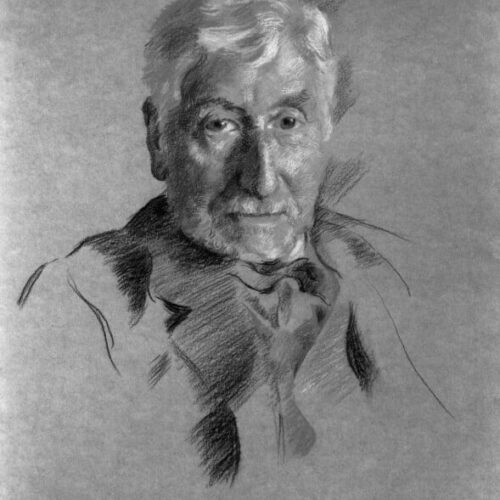
Main image: Edward Clodd by Helen Catherine Bedford (née Carter), chalk, 1928 NPG 2749 © National Portrait Gallery, London

Anna was not a religious person. As a humanist, she believed in the goodness of people and their ability to […]

While much of the Humanist Heritage website looks back to the earlier years of the organised humanist movement, recent decades […]
‘Being Rational About Being Gay’ was a talk given by activist Antony Grey (Anthony Edgar Gartside Wright) for the Gay […]
Humanists UK began as the Union of Ethical Societies in 1896, becoming the Ethical Union in 1920, the British Humanist […]