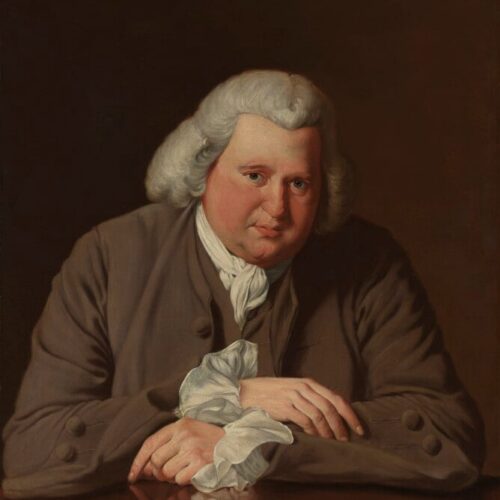
Would it be too bold to imagine, that in the great length of time, since the earth began to exist, perhaps millions of ages before the commencement of the history of mankind, would it be too bold to imagine, that all warm-blooded animals have arisen from one living filament…
Erasmus Darwin, Zoonomia, vol. 1 (1794)
Erasmus Darwin was a physician, inventor, poet, and natural philosopher, a founding member of the Lunar Society of Birmingham, and the author, 60 years before his famous grandson Charles Darwin, of an account of life as something that had developed over vast ages from simple beginnings. A deist who dismissed revealed religion and who was denounced as an atheist by his critics, Erasmus Darwin set out a picture of the world in which nature explained itself.
Darwin was born at Elston Hall, Nottinghamshire, on 12 December 1731, and studied at Cambridge and Edinburgh before setting up as a doctor in Lichfield in 1756. He became one of the most sought-after physicians in England, declining George III’s invitation to become his personal doctor. In Lichfield and later at Derby he was the centre of a remarkable circle: Matthew Boulton, James Watt, Josiah Wedgwood, Joseph Priestley, and others who met monthly at the full moon, for the light to ride home by, and who between them did much to make the Industrial Revolution. Darwin’s own inventions included a speaking machine, a copying machine, and designs for a steering mechanism later used in motor cars.
His scientific ideas came late and in verse. The Botanic Garden (1789–91) put Linnaean botany into rhyming couplets and was a bestseller. Zoonomia (1794–96), a prose treatise on medicine, contained his boldest speculation: that all warm-blooded animals might have arisen from ‘one living filament’, acquiring new parts and new habits across ‘millions of ages’ in response to their needs, and passing those improvements to their descendants. The posthumous Temple of Nature (1803) told the same story as an epic, from microscopic life in the seas to human society.
Darwin’s religious views were plain to those who knew him. He rejected the divinity of Christ and the doctrines of the churches, and once described Unitarianism as ‘a feather-bed to catch a falling Christian’ (oft quoted by his grandson). Government-backed satirists attacked him in the 1790s as a Jacobin sympathiser, an infidel, and a corrupter of the young, and Coleridge, who admired his mind, called him an atheist. He died at Breadsall Priory, near Derby, on 18 April 1802.
The evolutionary ideas in Zoonomia were speculative and lacked a mechanism, and Charles Darwin was later at pains to say how little they had influenced him. But the elder Darwin’s habit of mind — explaining the living world by the operation of natural causes over immense time, without appeal to special creation — was the habit that his more famous grandson took into his scientific work. His poetry, his medicine, his engineering, and his sociability were all of a piece: the conviction that knowledge, freely pursued and freely shared, improves human life.
Main image: Erasmus Darwin, after Joseph Wright, oil on canvas, based on a work of probably 1770s NPG 88 © National Portrait Gallery, London
Margaret Chappellsmith was a devotee of the socialist and secularist ideas of Robert Owen, becoming one of the Owenite movement’s […]
Dr Alice Vickery was a humanist, physician, and devoted champion of women’s reproductive rights. Her tombstone inscription remembers her as […]
The difference and variety of our human family more and more seems to me to be a wise provision that […]

Rochdale Pioneers Museum occupies the building at 31 Toad Lane where, in 1844, 28 working class people came together to […]