
‘The basic worship of the humanist is the worship of the free mind.’
Paul Kurtz, ‘The Humanist Ideal’ (1972)
Paul Kurtz (1925–2012) was an American philosopher and one of the great organisers of the modern humanist and sceptic movements. He taught philosophy at the State University of New York at Buffalo from 1965 to 1991, edited The Humanist, the magazine of the American Humanist Association, from 1967 to 1978, and went on to found Prometheus Books, the Committee for the Scientific Investigation of Claims of the Paranormal, Free Inquiry magazine, the Council for Secular Humanism, and the Center for Inquiry.
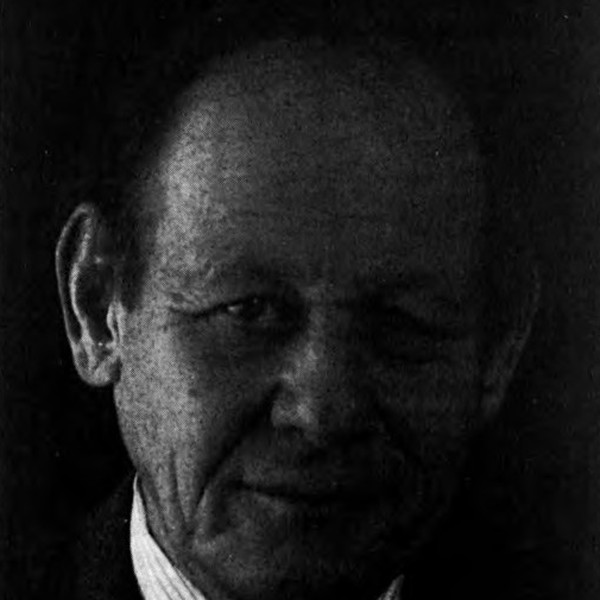
In January 1972 he wrote ‘The Humanist Ideal’ for Question, the Rationalist Press Association’s journal. Edited by Hector Hawton, Question had succeeded the Association’s Rationalist Annual and ran to thirteen issues between 1968 and 1980. Kurtz sat on its editorial advisory board, alongside A. J. Ayer, Antony Flew, and Barbara Wootton, and in this number shared the pages with Kathleen Nott, Ernest Gellner, and Kai Nielsen. That spring, the Association’s monthly, The Humanist, was relaunched as New Humanist.
Kurtz’s problem was that humanism had become fashionable. Pope Paul VI’s Christmas message of 1969 had insisted there was no true humanism without Christ; Soviet philosophers called communism the only real humanism; and in the West everyone from student radicals to advertising men was borrowing the word. A word that includes everyone, Kurtz argued, ends up meaning nothing. So he set out what humanism cannot be (belief in God, a party programme of left or right, or simple good intentions) and what it must be: above all, a commitment to free thought and critical intelligence. It followed that humanists could, and should, disagree with one another about politics.
He had tested these ideas in dialogues between humanists and Marxists organised by the International Humanist and Ethical Union in Vienna in 1968 and in Yugoslavia, where he defended tolerance against Herbert Marcuse’s critique of it. A year after this essay, he and Edwin H. Wilson drafted Humanist Manifesto II (1973), which repeats its warning that no group has a monopoly of wisdom or virtue. Kurtz became an honorary associate of the Rationalist Press Association in 1979 and one of its vice-presidents in 1982, the same year he returned to the argument in New Humanist, warning against identifying humanism with any one political camp.
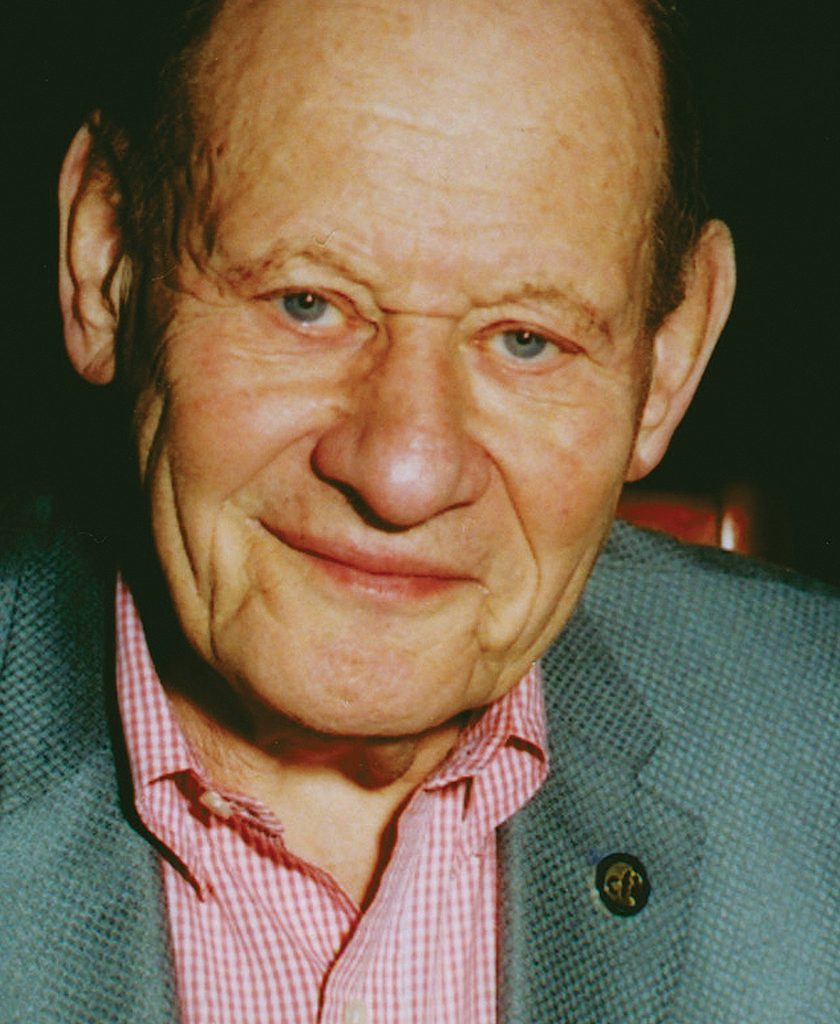
The line of attack Kurtz was answering came back into fashion in the late 2010s, as humanism became more visible. Once again, popular histories and lectures argued that humanism was Christianity in disguise: that values such as human equality and human rights are Christian in origin, and that humanism itself is best understood as a Christian heresy. The claim is no more accurate now than when Kurtz met the Vatican’s version of it. Humanist ideas have roots in many traditions, from ancient Greece, India, and China onwards, and what makes someone a humanist, as Kurtz insisted, is not where their values first came from but a commitment to free thought and to following the evidence wherever it leads.
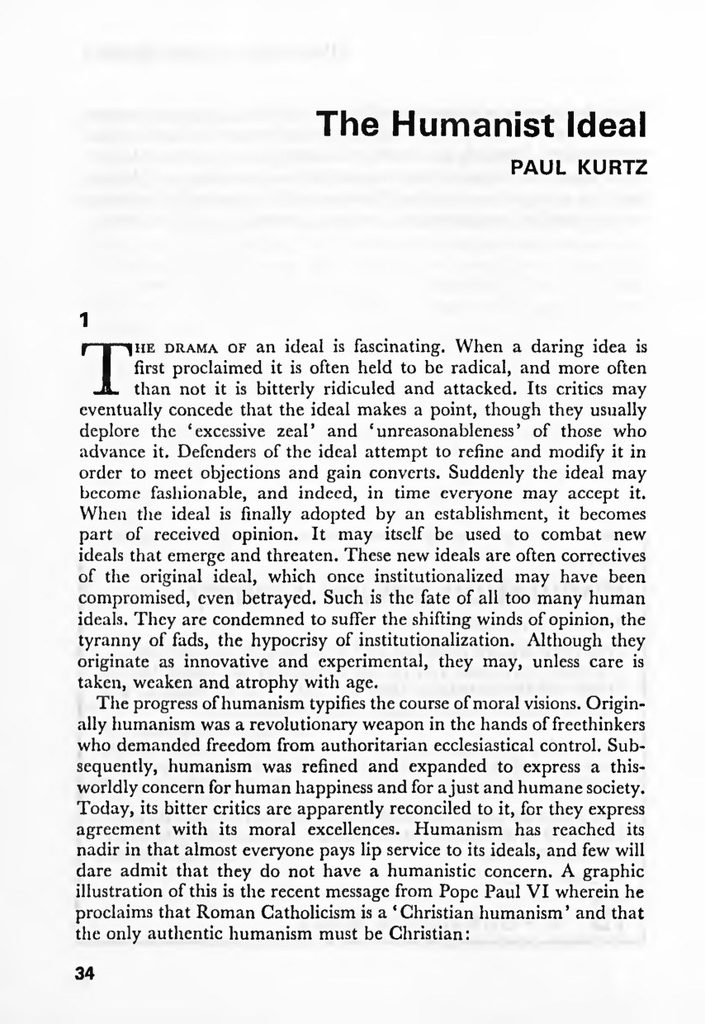
Paul Kurtz
The drama of an ideal is fascinating. When a daring idea is first proclaimed it is often held to be radical, and more often than not it is bitterly ridiculed and attacked. Its critics may eventually concede that the ideal makes a point, though they usually deplore the ‘excessive zeal’ and ‘unreasonableness’ of those who advance it. Defenders of the ideal attempt to refine and modify it in order to meet objections and gain converts. Suddenly the ideal may become fashionable, and indeed, in time everyone may accept it. When the ideal is finally adopted by an establishment, it becomes part of received opinion. It may itself be used to combat new ideals that emerge and threaten. These new ideals are often correctives of the original ideal, which once institutionalized may have been compromised, even betrayed. Such is the fate of all too many human ideals. They are condemned to suffer the shifting winds of opinion, the tyranny of fads, the hypocrisy of institutionalization. Although they originate as innovative and experimental, they may, unless care is taken, weaken and atrophy with age.
The progress of humanism typifies the course of moral visions. Originally humanism was a revolutionary weapon in the hands of freethinkers who demanded freedom from authoritarian ecclesiastical control. Subsequently, humanism was refined and expanded to express a this-worldly concern for human happiness and for a just and humane society. Today, its bitter critics are apparently reconciled to it, for they express agreement with its moral excellences. Humanism has reached its nadir in that almost everyone pays lip service to its ideals, and few will dare admit that they do not have a humanistic concern. A graphic illustration of this is the recent message from Pope Paul VI wherein he proclaims that Roman Catholicism is a ‘Christian humanism’ and that the only authentic humanism must be Christian:
People today talk of humanism . . . without Christ there is no true humanism. . . . True humanism must be Christian. As our first duty. As our supreme interest. . .¹
And the Second Vatican Council sets forth a humanism in which ‘man is defined first of all by his responsibility toward his brothers and toward history’. Father Vincenzo Miano, SDB, of the Vatican Secretariat for Non-Believers, maintains that:
Every form of humanism, by definition, wants man to develop all his possibilities and to build a truly human world. Christian humanism . . . can and must collaborate with all men for the promotion of genuine human values . . . Christianity is a humanism . . . based on God.²
The claim that Christianity, and in particular Roman Catholicism, is a humanism is ironic; for freethinkers, atheists, agnostics and sceptics adopted the name ‘humanism’ in opposition to a dogmatic church. It is a surprise, therefore, for atheistic humanists to discover that those whom they had most opposed now proclaim the very ideals that the humanists asserted in opposition! The irony is compounded when we see that even within the Roman Catholic Church, the so-called liberals who wish to reform and democratize the church bureaucracy and reinterpret its sterile dogmas, do so in the name of humanism, and that the Pope and Vatican Curia, who often resist such reforms, also insist that Christianity is a humanism!
The dialectical clash and fusion of moral ideals can be seen in other contexts: Marx maintained in his Economic and Philosophic Manuscripts that he was a humanist, and he attacked modern industrial capitalism for dehumanizing and alienating man. For him the communist revolution was basically a humanist revolution. Yet his disciples Lenin and Stalin created and institutionalized a new orthodoxy in which humanism was often betrayed. In Eastern European socialist countries in the past decade, intellectuals and students who have opposed Stalinism have done so in the name of a democratic and Marxist humanism and of freedom of the individual. Yet at the same time, P. N. Fedoseyev, head of the ideological Institute of Philosophy in the Soviet Union, maintains that communism, ie the Marxism-Leninism brand, is the only real humanism. Fedoseyev says:
Communists are undoubtedly the most consistent humanists. Communism is real humanism. The philosophy of Communism does not tolerate any forms of anti-humanism, it shall never conclude any ideological truce with them.³
And F. V. Konstantinov, another Soviet philosopher, in the same work declares:
Humanism is a characteristic feature of the consciousness of Soviet man. A man is a friend, brother and comrade to man. This is a principle of humanism that has asserted itself in Soviet society and in the life and minds of our people. This fact is closely related to the Soviet people’s love for peace, their hatred for war-mongers and champions of the arms race . . . Soviet man is bitterly opposed to conservatism, dogmatism, stagnation; he is imbued with the revolutionary spirit. . . .⁴
Both those who defend orthodoxy and those who oppose it profess the same humanist ideals!
In Western countries liberal democrats claim to be humanists, but so do their radical critics—the SDS Port Huron statement of 1962 was basically a humanist document. There are humanistic Protestants and Jews, humanistic Zen Buddhists; indeed, everyone deplores the dehumanizing consequences of modern industrial technology on the quality of human life. Even the most committed Madison Avenue technocratic hucksters emit humanistic slogans as they develop a new concern about ecology and pollution.
Words have a power to capture human imagination. We become the prisoners of rhetoric. Because ‘socialism’ has humanitarian and progressive connotations, many people insist that they are socialist—Lenin, Stalin, Brezhnev, Willy Brandt, Jules Moch, Harold Wilson, Mao, Ho and Castro all profess socialist ideals, while many of them accuse the others of having betrayed socialism. Even Hitler said that he was a ‘national socialist’, so as to co-opt a noble-sounding word. ‘Democracy’ is another example. The United States, China, the Soviet Union, Britain and France all claim to be ‘democratic’, but what do they mean by ‘democracy’? Words which mean all things to all men end up by meaning nothing.
‘Words which mean all things to all men end up by meaning nothing.’
Paul Kurtz
The term ‘humanism’ is now an ‘in’ word. But ‘humanism’ is so charged with levels of emotion and rhetoric its meaning is often vague and ambiguous. It is in danger of being inundated and destroyed by those who do not really believe in it.
Actually the term itself has no ‘fixed’ meaning. It does not have a Platonic essence in some subsistent realm that we merely need intuit to understand. ‘Humanism’ is not a descriptive word but a prescriptive word; that is, it expresses a normative ideal which is offered to guide and direct our conduct. It is not a description of what is the case but what ought to be the case, how we ought to treat human beings, or interpret social institutions, and what general model we ought to use for the future.
In a sense, the term ‘humanism’ can mean whatever we want it to. Yet the definition has a descriptive element in that it should enable us to classify those who may properly be called humanists in the past and in the present, and distinguish them from those who may not. But at root, any definition of humanism is an ideal definition, for it involves a proposal or recommendation of a normative goal.
We must recognize that ‘humanism’ exists in the language stock and that there is a rough body of rules guiding its proper usage. Any new definition that is proposed cannot begin entirely free of existing language patterns. We start with a term already commonly used, but we are not restricted by common usage, especially where common usage is unclear and vague, as in the case with ‘humanism’. Thus we may propose a set of distinctions and rules to clarify and refine the meaning of a term. We may even extend its meaning and stretch it. Terms and words are continually developing and changing, or being modified in the light of new connotations and uses. Since the term ‘humanism’ has been used so uncritically, we may redefine it by extending its meaning, and analysing what is implicit in it, or what ought to be. To refuse to redefine terms because we fear to commit the naturalistic fallacy is already to acquiesce normatively in existing usage. And we can be critical of the normative criteria assumed in ordinary language and extend the range of a word so as to include other criteria.
There is always danger in redefinition—particularly in regard to complex normative terms such as ‘justice’, ‘democracy’, ‘equality’, ‘liberty’, where new meanings are constantly being proposed. The danger is that we may become bogged down in ‘definitioneering’; that is, we may become advocates of special definitions that are arbitrarily stipulated. If we do so, others may oppose our definition and introduce their own. The open-question argument may emerge: Why should I accept your definition and not mine? The field is thus opened to persuasive definitions and definition-mongering.
Any proposed definition that we wish to introduce must be based at least initially upon common usage; but we can go beyond this, providing we give a rational justification for any shifts in application. On the other hand shifts in meaning which completely undermine the signification of a term are highly questionable. A note of caution: We especially have to avoid the fallacy of emotive mislabelling. We know the emotive effort that can be expended on the easy labelling of people as ‘liberal’, ‘conservative’, ‘progressive’. All such normative terms involve proposals about how we should appraise persons or actions in the future; they are not, we reiterate, simple descriptions of real entities in themselves. The battles for men’s moral allegiances often are won by affixing a label. It would be a cardinal mistake to allow the meaning of humanism to be polluted by its detractors.
Thus we may ask, Who is a ‘humanist’ and who is not? Surely the term should not be used so widely that it includes everyone, including the anti-humanist, and excludes no one. Perhaps we ought to begin by negative definition, ie by saying what ‘humanism’ ought not to be considered.
Humanism cannot by the wildest stretch of the imagination apply to one who still believes in God as the source and creator of the universe. Christian humanism would only be possible for those who are willing to admit that they are atheistic humanists. It surely does not apply to God-intoxicated believers. (This would not exclude a ‘religious humanism’, provided it is a naturalistic non-theism.)
Humanism cannot and should not be identified with a specific political programme, policy or platform. It is not and should not be identified with a particular ideology. It cannot, for example, be identified with the party of progress or revolution as distinct from the party of stability or of order. To define humanism thus is to restrict its usage too narrowly. If we were simply to identify humanism with left-wing liberalism or democratic socialism, as some today would have us do, then neither Aristotle, nor Hume, nor George Santayana could be considered humanists, for they were decidedly conservative.
Nor should humanism be equated with an emotional commitment to a vague humanitarianism or the sincere expression of a humane attitude towards other human beings. It is not equivalent to the sentiment of sympathy or benevolence. I have heard humanists describe an act, deed or person as ‘humanistic’ or negatively assert that ‘a humanist should surely not behave in this or that unhumanistic way’. Here there is an identification of humanism primarily with a purity or honesty of motive and intention. If we were to define humanism in this way, then Albert Schweitzer, Martin Luther King Jr, St Francis, Pope John, even Jesus Christ, might be considered to be ‘humanists’, even though they were believers. Humanism is not a secularized ‘Christian altruism’; and humanism is not simply ‘do-gooderism’ at large.
In denying that humanism and liberalism are the same thing, I am not defending conservatism; and in saying that humanism and humanitarianism are not necessarily the same thing I do not deny that one should be generous, altruistic or other-regarding. But the point is that humanism as a moral concept loses all meaning if no distinctions are made, and if its net is cast so widely that it encompasses virtually everyone.
What then should we consider ‘humanism’ to be? Under my normative definition I would begin with the following characteristics.
Humanism as a philosophy is opposed to all forms of mythological illusions (religious or ideological) about man and his place in the universe. This means that humanism involves some scientific view of nature and of man. Any theistic interpretation of the universe and any eschatological drama about divine beginnings and ends is rejected because it is logically meaningless and empirically unverified.
Although humanism presents a critique of transcendental supernaturalistic theories of the universe, it is not necessarily committed to a specific metaphysical doctrine, except in the broadest sense. It could incorporate, for example, scientific materialism, evolutionary naturalism, organicism or some other metaphysical account based upon science. The point is that it is opposed to metaphysical theories grounded solely on faith or mystery, but it is open to alternative metaphysical explanations.
What is fundamental for humanism, I submit, is that it be interpreted as a moral point of view, one expressing a generalized attitude towards nature and life. If man is a product of evolution, one species among others, in a universe without purpose, then man’s option is to live for himself and to discover new areas of significance and achievement. If it is anything, humanism is an effort at infusing life with meaning and hope. And the humanist says that if man is aware of what he is and what he is not, and is devoid of illusion about his ultimate destiny, then his chief option is to create an authentic life in which some measure of enjoyment and happiness are possible. Man’s natural power and resources make him capable of ameliorating his condition and perfecting his life.
This means that he will emphasize self-preservation, creative self-realization and happiness as his chief goals. It means that he will judge institutions and values, organizations and societies, by whether or not they deaden, denigrate, destroy or undermine life: He will be opposed to all anti-human and dehumanizing forces that threaten to intrude upon the quality of his experience. He will emphasize all that contributes to his creative self-realization.
Intrinsic to humanist morality is the desire to allow individuals as free agents to create and guide their own destinies as they see fit. Humanism is related to a doctrine of liberation and emancipation. It values the autonomy of free agents, not only in their intellectual beliefs but in their aesthetic experience, their romantic or sexual proclivities, their moral tastes and values. All men, as free persons, should be accorded some measure of respect, some dignity and value as individuals.
Of course, the humanist recognizes that man is basically a social agent, and that liberty means nothing unless there is a degree of equality. The demand for equal rights, then, has a claim upon conscience. The humanist is also committed to democracy, particularly in the present epoch, as an ideal and a method for maximizing happiness and achieving the good society.
However, the humanist is truly global in his concern for he realizes that no man is an island unto himself and that we are all part of the mainland of humanity. Thus the idea of mankind as a whole, and of one world, is a profound moral vision that sustains and nourishes the humanist morality. And this can only be achieved by some degree of rule of law, some measure of peace and economic well-being and cultural enrichment for all men, who may share experiences and a sense of brotherhood with others. This means that each man is responsible in some sense for what happens to all men, and for the greater community of men. Although we should allow the widest latitude of freedom to individuals to do what they like, we nevertheless recognize the human race needs to transform blind social forces into rational control, and to build a world community.
Thus the humanist is committed to certain moral ideals. I have only provided a partial list of what they are. Although these moral ideals provide some focus and direction, they are at best general, not specific in character. Humanism becomes mere empty rhetoric and glib generalizations, one might dissent, until it can particularize its principles in praxis (practice). However, in so far as it does, it is difficult to say what is the true or authentic ‘humanist’ position. For example, should one say that the humanist is a socialist or a believer in free enterprise, that he believes in student power or faculty control, in high or low tariffs, in welfare programmes or self-help, in the space programme or urban renewal, in the Israeli or Arab cause, etc? Humanists may honestly disagree about each of these complex issues. Thus it is difficult to say that this is humanistic and that is not. To so narrow humanism would be to destroy it, to make it into a political party or pressure group; yet to refuse to apply humanism to the great social questions of our time is to run the risk of making it irrelevant. I have no objection, indeed, I would encourage humanists to be social activists in common with humanist and non-humanist friends.
The point is, no one group has a monopoly of wisdom or virtue, nor do humanists have all the answers to all questions, and it would be presumptuous to claim that they did. Humanists do have some important basic points to make, and they hope that their fellowmen may listen; but humility is a Christian virtue that we ought not to forget, and we have much to learn from others. Some humanists apparently consider Republicans (in America) and Conservatives (in Great Britain) to be anti-humanistic almost by definition. But these humanists are surely narrow and unduly parochial in their outlook, the victims of the political fashions or shibboleths of their age. Humanists should guard against a moralistic sentimentalism that labels a particular plan or policy as ‘humanistic’ or ‘unhumanistic’. Experience teaches that the moral life is at best difficult and that often we have only to choose between the lesser of many evils or to adopt expedient means to achieve good ends. The most surprising lesson to those who assume power is to find that many problems do not lend themselves to the easy solutions that they believed feasible when they were out of power. That is why many supporters of a party or programme often bemoan the fact that their idealistic leaders ‘sold out’ or ‘betrayed them’ once they gained power. No, perhaps their leaders have only learned that with the responsibilities of power comes an awareness of the complexities of decision-making.
Like other men, humanists should be willing to abandon or modify programmes as new facts and social conditions warrant. Yet there are a number of liberal humanist clichés or myths to which we have succumbed, much the same as conservatives are often victims of their own mythological dogmas.
Most humanists have, for example, encouraged the growth of science and technology as the key to the improvement of mankind. Yet who would have thought that the consequences of an advanced technology would threaten to dehumanize and depersonalize man and destroy his natural ecology, so that the moral control of technology has become a vital social concern?
Most humanists have heralded democracy, believing it to be the hope of mankind. Yet in certain institutions, such as the university or high school, the uncritical application of participatory democracy can lead to the vulgarization of learning and the destruction of standards of excellence.
Humanists have for decades defended sexual liberation and the development of a tolerant attitude towards sexuality. Yet an uncritical interpretation of the new sexual revolution can lead to a bestialization and dehumanizing of sex, the economic exploitation of humans as sexual objects rather than as subjects, and extreme expressions of pornographic pandering.
Humanists have generally been sympathetic to socialism as the wave of the future and many have believed that in changing the conditions of ownership and the relationship of production many or most of the inequities of life can be ameliorated. Yet we have seen that even in socialist societies the oppression of the human spirit and the denial of basic human rights such as freedom of speech and artistic creation can continue, and that with socialism authoritarian and totalitarian control does not necessarily cease.
Many humanists have believed that every injustice has a cultural explanation and a social solution. But some inequities may have a biological and genetic explanation, though many humanists trapped by a sentimentalist doctrine refuse to examine the evidence.
Many humanists worship the myth of Progress and judge all programmes by whether they contribute to a progressive view of history. Humanists surely ought to work for progressive improvement, without personally believing that progress exists in the womb of nature or that there is an inevitable march of human history.
The moral lesson of all this is that we ought to be prepared to learn from experience not to cling to symbols or slogans (religious or ideological) of the past. We ought to be ready to change, to adapt and modify our point of view in the light of altered conditions and needs. But we face the same dilemma. Humanism, if it is too general, is empty sermon; if too concrete, it runs the risk of degenerating into a sect, or cult, or political ideology.
‘Humanism, if it is too general, is empty sermon.’
Paul Kurtz
A way out of the dilemma is possible, I submit, only if we add to the above listing of ideals another one which is really, in my judgment, the essential defining characteristic of humanism or of any point of view that claims to be humanistic—and what I have in mind here is the centrality of the ideal of free thought. For humanism has always been opposed to any and all forms of tyranny over the mind of man. This puts humanism squarely in opposition to all authoritarian, religious or totalitarian ideologies that attempt to suppress, limit or censor human intelligence or to impose an orthodoxy of belief or morality. It is opposed to any code of infallibility, official doctrine, church or party line that is offered as a substitute for free, independent and critical thought and does not permit heresy, dissent or deviation.
Therefore humanism, if it is anything, is committed to a method of free inquiry and to the use of critical intelligence. If this is the case then one cannot define the specific humanist position antecedent to investigation. Indeed, even then humanists may be expected to disagree vigorously among themselves about current policies and programmes, ends and methods, much as they do with other men. If they did not, we would have a new dogmatism to contend with. Rather we must allow for a diversity in humanist convictions and humanists should be willing to tolerate pluralistic political positions. Humanism cannot be expected to provide a specific economic or political theory, or a specific social or technological solution to every problem. Nor should it be expected to offer a total world view which will answer all the questions that people raise, or offer itself as the salvation of mankind. Humanists in the last analysis should be sceptical, and especially of their own pretensions. They are well aware that religions have promised salvation in the past and have failed, as have modern ideological guarantees of utopia. Alas, life is too complex to lend itself to easy solutions. And new problems appear as quickly as we solve old ones. A mature humanist wisdom, accordingly, would allow many flowers to bloom, many paths to be taken, many alternative styles of life. Thus humanism must be pluralistic about concrete issues.
Is there anything that all humanists share? Assuredly, as I have pointed out, a set of moral ideals which are committed to saving and enhancing the qualities of human experience, but primarily a commitment to the use of critical intelligence. And this means that where critical intelligence enters humanist tactics or programmes will vary in relationship to the social context and solutions. Most humanists emphasize the use of toleration, dialogue and negotiation as the chief methods for solving human problems. In principle, the humanist abhors the easy resort to violence. Yet he is not an absolutist. For the use of violence depends upon the particular context at hand. Sometimes the humanist will feel it necessary, on the basis of the evidence, to call for revolution and for the violent destruction of a corrupt society—if there are no other means available for social change or compromise. Moreover, he may be willing to use violence on the international level, as in the war against fascism, pending the development of a genuine world order. At other times humanists will feel convinced that certain essential values have to be preserved; though he may be called a ‘conservative’, he finds that he must stand against those who proclaim a New Order, and who are impervious to the claims of freedom of speech, free thought or the rights of man.
The humanist should not be fearful of being labelled: That is a trap for the timid. One can, I submit, be a liberal humanist, a Marxist humanist, a radical humanist, a conservative humanist, even a reactionary humanist—if the times demand. It all depends upon the context and the alternatives before us.
‘The humanist should not be fearful of being labelled.’
Paul Kurtz
The development of civilization is a slow and uphill battle in which intelligence—fused with compassion—comes to prevail. It is a long struggle in which blind sentiment and unreasoned custom are questioned and transformed by reason. Humanism, in the last analysis, has as its chief commitment, a commitment to the ethic of the free mind. For the freethinker in religion, politics, morality, art and science the only authority is the authority of intelligence, the only master is reason. If a man uses his moral ideals as guidelines, always modifying them by his intelligence, and if he cherishes and respects morally the dignity, worth and fulfilment of human beings, then he is a humanist—whether he is a liberal, radical or conservative. Humanists of different political persuasions can still share common moral values. At least that is the view that I wish to propose at a moment in history when liberalism and conservatism are being transformed and political allegiances and alliances questioned and altered. The basic worship of the humanist is the worship of the free mind; and his highest duty is to the truth as he sees it and the destruction of cant, fraud, deception, illusion or dogma. That is why I would exclude Pope Paul VI from a range of humanism, because for him faith has become a substitute for reason and piety for dependence upon human resources. And I would question the use of the term humanism by orthodox Marxists-Leninists, who although they share with humanists the rejection of supernaturalism and a wish to build a better world, nevertheless are willing to compromise their means to achieve their ends and to sacrifice the freedom of the individual and suppress civil liberties, including intellectual and artistic liberty—as Alexander Solzhenitzyn so vividly demonstrates. This indictment would not refer to Marxists who are thoroughgoing democratic socialists and who share humanist methods and ends. It would apply, I am sorry to say, to many so-called ‘radical’ youth in the West, who have been captured by a new passionate religiosity and have often, in the process, abandoned the use of critical intelligence, or the use of open and more democratic methods in solving social problems.
Humanism, in this sense, is always the most radical of moral positions for it involves an uncompromising and basic commitment to the use of evidence in all areas of life. I like to use the term critical radicalism, for it is a radicalism informed by intelligence. But I am talking about independence and heresy in thought; thus it is liberal, in the sense that it is willing and able to examine all sides of a question, to innovate and explore and, if need be, adopt new departures in belief and action. In one sense, this is also the proper meaning of liberalism at its best: liberalism as a method of enquiry, according to John Dewey, rather than a specific programme of action. If one is willing to accept this definition of liberalism, then liberalism and humanism are very close. But many liberals today wish to identify liberalism solely with a specific platform or programme of social reform. If one insists upon this definition of liberalism, then liberalism and humanism are not necessarily the same, though they need not be antithetical.
But humanism may also be labelled conservative in some contexts—such as in the universities today—where it is committed to the defence of academic freedom against those who are willing to sacrifice it at the altar of moral and ideological purism.
Thus the humanist ideal is neither liberal nor radical nor conservative, but can be any or all, depending upon the demands of the situation. For as I have said, if humanism in the final analysis is dedicated to respect for the principle of free enquiry, then we must follow the dictates of that enquiry wherever it may lead.
This definition of humanism, which relates humanism to free thought, does not exclude other important moral principles of humanism, as spelled out above. Emphasizing the centrality of free thought as a humanist ideal, however, accords in some sense with ordinary usage. It permits us to classify certain individuals or groups as ‘humanistic’ and to exclude others, without debasing the term entirely. And at the same time it is a proposal, governing how we shall use the term in the future. The co-option of the term ‘humanism’ by orthodox Catholics or totalitarian Marxists who do not recognize the demands of freedom of thought about fundamental religious or ideological questions is an untenable contradiction of what is essential to humanism.
We should, of course, applaud the humanization and liberalization of Catholicism and Marxism, and humanists should welcome continued dialogue with liberal Catholics and Marxist humanists. But it is a gross distortion to characterize those orthodox doctrines as humanistic which deny the fundamental commitment to the ideals of free thought. There are other important humanist principles besides free thought, and we do judge doctrines by the degree to which they believe in the fulfilment of human potentialities, have some confidence in human powers, are opposed to the dehumanization of man, and are concerned with the whole of humanity and so on. But surely we should insist that a theistic religion or totalitarian ideology cannot be considered humanistic in their essential nature, if one of the most basic of human rights—the right of individuals to the free use of knowledge—is ignored.
This is the constant message of humanism, in the classical Hellenistic period, in the Renaissance, during the Enlightenment and in the twentieth century. And it is a message that humanism should never be willing to compromise. For it is in essence the heart of the humanist ideal.
References
1 Pope Paul VI’s Christmas message, 25 December, 1969.
2 ‘A Catholic/Humanist Dialogue’, The Humanist (May/June 1971), p 33.
3 P. N. Fedoseyev, ‘Humanism and the Modern World’, in Philosophy, Science and Man. Moscow: The Soviet Delegation Reports for the XIII World Congress of Philosophy, The Academy of Sciences of the USSR (1963), p 27.
4 F. V. Konstantinov, ‘The Individual and Society’, ibid., p 67.
Paul Kurtz, ‘The Humanist Ideal’, Question 5 (Rationalist Press Association), January 1972, pp. 34–47. Transcribed from the original; spelling and punctuation as printed. The photographs of Paul Kurtz were originally published in New Humanist, March 1992 (with his article ‘The Limits of Tolerance’), and New Humanist, July–August 2009. The full issues can be read in New Humanist’s digital archive, available via Exact Editions. Subscribe at newhumanist.org.uk/subscribe.
About this republication: ‘The Humanist Ideal’ was first published in 1972 by the Rationalist Press Association, in Question, under a copyright notice in the name of the Association’s publisher, the Pemberton Publishing Company. Paul Kurtz served on Question’s editorial advisory board, and was later an honorary associate and a vice-president of the Association. In 2025 the Association merged with Humanists UK, which now holds its archive and publishing rights, and we share the essay here in that capacity, as part of the history Kurtz helped to make. If you hold rights in this work and would like to talk to us about it, please contact heritage@humanists.uk.
Rose Bush was a member of the South Place Ethical Society for over 50 years, and a driving force in […]
If he had ever worshipped at any shrine, it would have been one illumined with the flame of pure intellect. […]
All religious theories, schemes and systems, which embrace notions of cosmogony, or which otherwise reach into the domain of science, […]
Ruth Homan was an educationist, women’s welfare campaigner, and one of the founding members of the West London Ethical Society […]