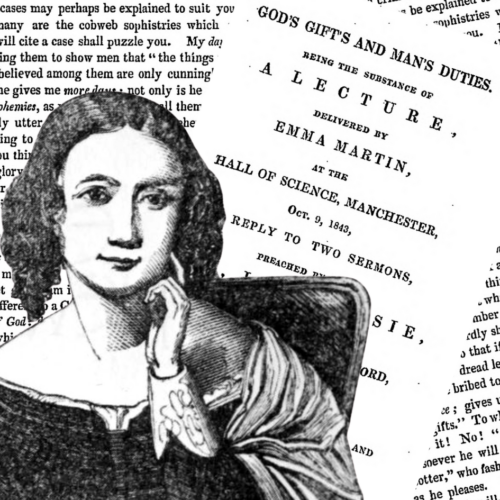
I have, perhaps, shocked some of you to-night: I cannot help it, I value the affection of my fellow-beings, but cannot sacrifice TRUTH to secure it.
Emma Martin, ‘God’s Gifts and Man’s Duties’ (1843)
Emma Martin was a writer, lecturer, and midwife, who moved from early religious piety to unapologetic atheism. She was a leading proponent of Owenite socialism, addressing crowds of thousands with calls for the reorganisation and reform of society. The pamphlet God’s Gifts and Man’s Duties contained the text of a lecture delivered by Martin at the Manchester Hall of Science on 9 October 1843—responding to two sermons preached eight days earlier in Salford’s Chapel Street Chapel by the Reverend James William Massie (1799–1869)—along with an address ‘to the ministers, members, and congregation of that chapel’, and an additional letter to Massie. In them, Martin argued for the absolute value of truth, pointed out the inconsistencies of the Bible, and urged listeners not to leave up to a god what they should take into their own hands.
I have seized the opportunity which the Rev. J. W. Massie’s announcement offered me of attracting your attention to questions which you and I consider of great importance: I have sent to that gentleman a most respectful invitation to attend this evening, I hope that he is present, I do not wish to be informed until the conclusion of my lecture, whether that be the case, or not, since otherwise it may be supposed that a knowledge of the fact may bias me in what I shall say.
I would have it distinctly understood that I am no enemy to Mr. Massie, or to the sect to which he is attached; nor even to Christianity itself, except in that proportion in which falsehood shall proceed from either; for I esteem truth to be of so much value to mankind as to be well worth any sacrifice which can be made for its purchase.
I esteem truth to be of so much value to mankind as to be well worth any sacrifice which can be made for its purchase.
I am sincere, when I tell you that I am not seeking present triumph in this matter, but the discovering of the pure truth on whichsoever side it may be found. Depend upon it, you have no interest in the propagation of falsehood, neither have I; let us then earnestly, but calmly proceed in its investigation, and I shall be as glad to be disabused of error, as any one of you can be.
The subject of my present lecture, will include an answer to both the sermons preached by Mr. Massie, not successively, but by a classification of the substance of both his discourses; and I shall now regard him only as an expounder of Christianity, who, in the propositions he has sought to elucidate, would be confirmed by the great majority of the Christian world. We are told then that “God is the giver of harvest. It is he who crowneth the year with his goodness, the labour of man is indeed necessary, in order that the grain may be sown, and the various processes of husbandry perfected; but useless were man’s labour, and skill, if God did not send the dew, and the rain, to moisten, and the sun to mature.”
Now, my friends, the Rationalist never doubted the necessity of these operations of nature, for the perfection of the harvest; and were it not for his knowledge of nature’s powers, and the expected recurrence of the seasons, which experience has shown him will in all probability ensue, he would not have gone forth to sow the grain; you say that the sunshine and the storm happen according to the will of God. I say they happen according to the laws of nature; do you then perceive that a name is all the difference between us?
You say that the sunshine and the storm happen according to the will of God. I say they happen according to the laws of nature; do you then perceive that a name is all the difference between us?
And what are these names?—God and Nature. What do you mean by one? What by the other? I will tell you what I mean when I use the word nature, and l think that the meaning you will attach to it will be the same, I include in the idea I express by this term, all organic beings; and all inorganic substance. All that, is in the universe, is nature. What is there besides this? You say God. Then what is God? Something beyond nature, above it, supernatural; or, in a shorter word, unnatural. You do not like that term. I cannot help it; ’tis very expressive of the idea it represents; and words are only valuable, when they are accurate in this respect.
Now I know nothing of any unnatural being, and therefore will not venture an opinion. What do you know of it? Nothing! Your bible tells you that you can know nothing: “none by searching can find out God,” he is incomprehensible in his nature, and in his attributes. Then why do you try to comprehend him? How do you dare to tell us to know that which you admit cannot be known?
You are then disputing about names, for patience sake, as rational creatures, leave such trifling, and set yourselves to work, that you may improve your own condition and that of the world. Your opinion respecting any unnatural, or supernatural being, would indeed be of no consequence, whether true or false, except from any other ideas which may be attached to it: let us then proceed in the examination of these. —I was pleased to find that Mr. Massie had discarded one of the errors into which the religious world had fallen. You will remember that in Genesis we are told that a woman persuaded her husband to partake with her of some forbidden fruit: I know what that fruit was; Mr. Massie does not; or if he does, he dare not tell you without forfeiting his present station: but no matter now, whatever was the fruit, it is affirmed by theologians, that the eating of it, condemned not only those who sinned, but all their posterity. To the two sexes different penalties for this sin was awarded, that of the male was labour: “In the sweat of thy brow shalt thou eat bread,” this was the curse, says the Bible. Mr. Massie says No, labour is no curse, it is a blessing; so also does reason. “Overwrought toil is indeed an evil, but it is only a mixed evil,” says he; and even here I suspect that he is right. Ask the luxurious and wealthy idler, who has no useful and honourable occupation, but who drags the heavy burden of palsied pleasure, whether I and Mr. Massie are right, and; if his understanding is not as enervated as his body, he will affirm we are.
You are then disputing about names, for patience sake, as rational creatures, leave such trifling, and set yourselves to work, that you may improve your own condition and that of the world.
Labour, should it never produce any other harvest, will assuredly reward, us by the health of body, and of mind, which it produces.
“God gives freely, not according to our desert; he makes the sun to shine upon the just and upon the unjust also.”
Is it so? It is. “Many a husbandman is there who rises up early, but not to pray, yet the sunshine and the rain prepare his harvest as well as it does that of his pious neighbour.” Well! we more than suspected as much before; but if this is admitted, of what value are your religious systems? If it is God who gives the harvests, and he gives to the rebellious also, it would appear that the rebellious are as well off as the faithful; strange assertions these to be made by believers in God’s special providence.
Does not the advocacy of such doctrines look something like holding out a premium to immorality? Go on, “let him that is unjust be unjust still, he that is filthy, let him be filthy still.” (Rev. xxii. 11) for though God regards the circumstances of earth, and dispenses the favours of his providence, the guilty and the innocent fare alike, if indeed the innocent does not often fare the worst.
“God gives freely, not only in answer to prayer, but whether you pray or not.”
Indeed! Some of you will recollect that I recently lectured on the inutility of Prayer; little did I then think that I should have met with so orthodox an assistant in my disputation, as the Rev. Mr. Massie; for it follows, if the blessings of God are distributed without reference to the prayer of the recipients, prayer is valueless; at least, it is so as a medium of supplication, since the blessing, or the curse, is neither hastened or retarded by its means. But we proceed.
“God gives generously. He gives to man an abundant supply of all that is necessary for his subsistence; nay, he gives a thousand times more than man can consume!” I know some men get a thousand times more than they can consume, and they consume much to their own injury, and waste or hoard the remainder; but how is it with others?
“God gives generously. He gives to man an abundant supply of all that is necessary for his subsistence; nay, he gives a thousand times more than man can consume!”
I know some men get a thousand times more than they can consume, and they consume much to their own injury, and waste or hoard the remainder; but how is it with others? Go into some of the lanes and alleys of this town, search out its squalid inmates, address yourself to the pale mother of those starving children, tell her, that God has given so generously, that man has a thousand times more than he can consume; what mockery of her wretchedness will it not appear! With what feelings will she hear of munificence which is not extended to her, although she and they are perishing for want of it. I know that nature has ample stores for all her children; but if an intelligent God presided over the things of earth, he would surely have enabled all men to avail themselves of these blessings. It is moreover affirmed by our spiritual teacher, that
“God gives justly, for the fruits of the earth are for all.”
Then how is it that all did not possess them? Did God design that they should be for all, but had not power properly to distribute them, in order to carry out his designs? How did Mr. Massie discover that God designed the fruits of the earth for all? From the Bible? it says that “the poor shall never cease out of the land,” and Christ, in the spirit of prophecy as it is thought, says “the poor ye have with ye always,” how can there be poor, if the fruits of the earth are for all? No! the spirit of another set of principles, very different from the superstitions of the world, has, by its advocates, and its writings, persuaded men of things, which they were formerly unwilling to acknowledge; might it not have been from these that the conviction was forced upon Mr. Massie’s mind, that the fruits of the earth are for all? But if he fully believes this, how is it that he does not enjoin his hearers to institute as soon as possible a state of society in which all the blessings of life may be equally bestowed upon all men? And I remember, he spoke of landed property as being the best kind of property.—Where is the consistency in talking of some men having a property in the soil, and of the fruits of the earth being for all? Mr. Massie is not alone however in his opinion, that the fruits of the earth are for all; some of us saw to-day a procession, most of the individuals forming which, were I suppose, of the same way of thinking. And those who looked upon the care-worn faces, and ill-dressed persons, of the honest artisans, and labourers, who formed the majority of that procession, were, or might have been, if they had used their reflective powers, converts to the same opinion. Alas for Christianity! It is any thing which suits the notions of its advocates. It is powerless to force them to the advocacy and practice of benevolence; yet when be priest is compelled, by the common-sense of mankind, to discuss the principle of justice, in place of religious dogmas, he immediately affirms that it was the Bible which thus urged him. We were told by Mr. Massie that
God gives opportunely, “Man’s extremity is God’s opportunity. By the seasonable interposition of his, providence, his goodness is calculated to affect the heart of man.”
I need not ask you, how often you have been in extremity without meeting with God’s opportunity? How often you have seen the pulse quickened by fever, and no relief arrived, except by death. How often famine has withered away the frame, and the opportunity of deliverance never been enjoyed. And suppose that deliverance came at last, would you not much more admire the divine providence which should prevent your need, than that which looks coolly on, and sees the accumulation of your distresses, the growth and concentration of human agonies, the successive steps of misery; and only appears for your release, just when the burden had grown so intolerable, that you were sinking under the deadly weight?
I need not ask you, how often you have been in extremity without meeting with God’s opportunity? How often you have seen the pulse quickened by fever, and no relief arrived, except by death. How often famine has withered away the frame, and the opportunity of deliverance never been enjoyed.
Was it necessary, in order to demonstrate the divine goodness, that Hagar, with a fond mother’s pangs, should have to conduct her son through the wilderness, whither the crimes of “the father of the faithful” had driven her, should see him fainting with thirst under the scorching sun, and at last should be compelled hopelessly to turn away from him, (whose gasping struggle with death, her heart and eyes were too unnerved to witness) before the angel should be sent to lead her to the well-spring, from which the life-draught could be drawn? I think the idea of a superintending providence would have been much better confirmed by preventing their wrongs and sufferings, than in bringing at last such tardy and such partial relief. It is said that
“God gives wisely, he supplies the defects of one department by another.”
The varied seasons each supply something which is necessary, in order “that the year may be crowned with its harvest.” I know that the cold and moisture of spring, and the winter seasons, and the glowing sun of the summer, and the autumn, are all means by which nature keeps up the balance of production and waste. I know too, that the internal heat, or motion of the Globe, is productive of the volcano, which prevents other catastrophes. I know that nature, in a thousand ways, struggles to keep a just equilibrium of her powers; and to carry of the excess of one of her operations by another, and thus supply the wants of every department. But I do not think that it can be truly said that there are defects in any department of nature; for, since all these varied operations occur in a continual and necessary succession, and stand in the relation of cause and effect, are not aberrations from the laws of nature, but portions of it,—I do not see how that which belongs to the very constitution of anything, and which is necessary to its existence, can be considered a defect. But however this may be, I grant you that there is in the dispensations of divine grace, if the Bible truly describes them, something which looks very much like defects, and efforts to supply those of one department by the provisions of another. It is said that one Moses went up into a mountain called Sinai, and that he was there forty days with God, and “God gave to Moses, when he had made an end of communing with him upon Mount Sinai, two tables of testimony, (tables of stone) written upon by the fingers of God.’’ (Ex. xxxi. 18.) I suppose there were no chisels in Mount Sinai, and that may account for forty days being spent over the matter. It was written with the fingers of God, was it? Moses knew better! for it it also told us that when he came down from the mount, and found that the children of Israel, who were always a “stiff-necked and rebellious nation,” (not a very good reason why they should be “God’s chosen and peculiar people,”) had fallen into idolatry, and set up a golden calf and worshipped it, then “Moses’ anger waxed hot, and he cast the tables out of his hands, and brake them beneath the mount.” (Ex. xxxii. 19.) Can you believe that Moses would have dared to have broken the tables of the law, if God had written them, and sent them by him to his people? Can you believe that God would send a message to man, by means so fragile as stone tablets, which an angry man could break and destroy? I have too high an opinion of what must be the disposition of a supreme being if there be any such intelligence than to credit such an account. But Moses, though he pettishly broke these tables of the law, took care to spend forty days more, in making, or getting, a second edition. Now this law was full of defects, “It was only a shadow of good things to come.” The religion of Moses was not adapted for man’s continual obedience, and therefore Christ was sent to overthrow it. God sent one dispensation, which was very explicit, and established by the destruction of nations, and by very “terrible judgements;” but he found out afterwards that it was not what was needed by man: so that, when the fulness of time was come, he sent a new messenger, Christ, to give a new law, to abrogate the old, and to be the mediator of a better covenant. Do you believe that there were defects in the Mosaic laws, and also that they came from God? Do you not perceive that you attribute to a perfect God the creation of imperfections?—that you attribute to a wise being the manufacture of such an inefficient religion, that nothing short of its complete annihilation, and the substitution of another, would carry out its original designs? Oh what a tissue of inconsistencies are the dogmas in which we have been reared!
Oh what a tissue of inconsistencies are the dogmas in which we have been reared!
“God gives in his own time.” Now if this time happened to be our time, it might be very well; but if his time does not come until “time with us is no longer,” it will not be of much service to us. “Though the wicked flourish like the green bay tree,” the time shall come when “the oppressor shall perish out of the way, and the oppressed go free.” Ay, but when? In God’s time, to be sure! Do you not know that “one day is with the Lord as a thousand years, and a thousand years as one day?” Go, Christian, pour the balm of consolation into the ears of the worn out mother, who wends her way to the factory or washing tub,—tell her, as her neglected and half-nurtured child strives to drag the scanty nutriment from her bosom, which want and toil have shrivelled,—go tell her that her wrongs shall be all redressed, that there shall be peace, and plenty, and happiness for all, for “God doeth as he will among the armies of heaven and also among the inhabitants of the earth.” Then, when she anxiously cries, “When?’’ tell her, Oh! “one day is with the Lord as a thousand years and a thousand years as one day.” Away with your folly! Talk thus when a thousand years and a day are the same thing to us.
We were reminded by Mr. Massie of the occasional interposition of angelic influences; who, to give one instance out of many, produced the destruction of Sennacherib’s army, and thus effected the deliverance of the Israelites. If there are any such beings in the universe as angels, (and I confess myself by no means credulous on the subject), they surely might be more happily employed than in deeds of murder. That armies have been destroyed by plague, and pestilence, and famine, we of course do not doubt; that many a fine army has been sacrificed to the murderous ambition of their leaders, the history of past and present times sufficiently confirms; but we more than question whether human demons had not more hand in their death than angels of life could have. Those of you who saw the procession of to-day, perhaps noticed one of the banners, which I beheld with very great pleasure; the motto of which I would have “engraven with an iron pen upon the rock for ever,” that all nations may read the truthful sentence,—
‘War is a game, which, were their subjects wise, kings would not play at.’
“God gives us our days, our times are in his hands.” “It is of the Lord’s mercy we are not consumed, and because his compassion fails not.” “It is by him that kings reign and princes decree justice.” Nero, that “name familiar in our mouths as household words,” whose “days” were the gift of God, used them for the perpetration of innumerable crimes, enjoyed them by firing, and then gloating over the ashes of the metropolis of the world; used faithful Christians for the torches which should illuminate his horrid joys; and God looked down from his heaven of purity, and saw the agonies and death of his faithful worshippers, but, regardless of their wrongs, gave the tyrant more days, to enable him to perpetrate new villainies, Napoleon Bonaparte, and Wellington, each in his respective sphere sought only power, and a name, no matter at what expense; and Europe was drained of, drenched with blood. “Their days were in his hands!” Did he approve their deeds, that he gave them more days for added crimes?
My days are his gift, I am using them to show men that “the things which are most surely believed among them are only cunningly devised fables,” yet he gives me more days… either there is no such being; or he does not know what happens here; or he is willing things should be so; or he cannot prevent it; Which is it?
But these cases may perhaps be explained to suit your doctrines, so many are the cobweb sophistries which religion weaves. I will cite a case shall puzzle you. My days are his gift, I am using them to show men that “the things which are most surely believed among them are only cunningly devised fables,” yet he gives me more days; not only is he not wearied with the blasphemies, as you may perhaps call them, which I so unhesitatingly utter, but neither is he apprehensive of any injury accruing to those who become converts to my propositions. Do you think that priests are more anxious about God’s honour and glory than he is himself? God’s honour is the excuse, but their own interest is the moving principle; either there is no such being; or he does not know what happens here; or he is willing things should be so; or he cannot prevent it; Which is it?
“God gives us riches, we cannot command them by the utmost diligence we may use.” When I look at the means by which some men get gold I am inclined to think it comes from something very different to a God. But what if it be true that riches are the gift of God: do you remember a passage in the New Testament which says, how hardly shall they who have riches enter the kingdom of God,” so that if he gives riches to men, it would seem out of a sort of dread lest heaven should be overpopulated, and so they are bribed to stay out.
When I look at the means by which some men get gold I am inclined to think it comes from something very different to a God.
“God also gives us grace; gives us the grace which enables us to enjoy his other gifts.” To whom does he give this? Not to those who desire it! No! “He giveth it to whomsoever he will, and whomsoever he will he hardeneth.” “We are the clay, and he our potter,” who fashions us into beings “of honour or dishonour,” as he pleases. What would you think of an earthly potter who formed an ill-shaped vessel, and then became enraged with it because it was not better? If there be an intelligent ruler of the universe, he may undoubtedly bestow gifts upon his creatures according to his own will or power; but it is a little absurd to talk of the justice of his being angry with those whom he has left unprovided; thus inflicting on them a double injury, first witholding his blessing, and then condemning them because they have it not. Does he give charity as one of his gifts? if so, the adherents of the Christian religion seem but scantily supplied,
“God has given us his son.” My friends it is not the Infidel who blasphemously asserts, that God could not pardon, or improve the condition of man, without causing his own son to be born into the world, and offered up a sacrifice. A sacrifice! to whom? to himself? that were indeed a piece of gratuitous cruelty! To the Devil then? It would appear to have been to him, if to any.
“God has given us his word, as an exposition of his moral government.” Let us glance a little at this word; “God shall send them strong delusions that they shall believe a lie—that they all might be damned who believed not the truth,” &c. (2 Thess. ii. 11—12.) This word, too, further informs me, that “Israel hath not obtained that which he seeketh for; but the election hath obtained it, and the rest were blinded,’’ (read the eleventh chapter of Romans.) This is an exposition of God’s moral government, “the Lord hath made all things for himself; yea, even the wicked for the day of evil.” (Prov.xvi.4.) This exposition of God’s moral government tells us, that the effectual fervent prayer of a righteous man availeth much,” (James v. 16), and then shows you how it has mocked you with the promise, by telling you, that “there is none righteous, no not one,” (Rom. iii. 10.) Paul, under divine inspiration, in order to instruct us in God’s moral government, tells us, “that a man is justified by faith, without the deeds of the law,” (Rom.iii. 23.) and James for the same purpose, tells us, “that by works a man is justified, and not by faith only, (James ii. 24.) No doubt these contradictory assertions have illuminated your minds with the glorious sun of Gospel Truth! This exposition tells us, that “God hardened Pharaoh’s heart, that he should not let the children of Israel go,” and then drowned him in the red sea on account of it. These are all God’s gifts! Believe it if you can! I cannot.
I suppose I cannot, because he has not given me his grace. Then why did he not? Because I was not willing to receive it? For years I prayed most earnestly for it, nay more, believed that I had received it. But even suppose unwillingness, “the Lord maketh us willing in the day of his power.” that is, when he chooses.
Friend, what has God given thee, and what are thy duties in consequence? Your first duty is thankfulness, “not only,’’ says Mr. Massie, “when things prosper, but even when you have not all you think you ought to have.” Honest, industrious artizan! whose ill-requited or half-employed labour dooms thee to hopeless misery!—who seest thy wife and little ones perishing for want. Be thankful for God’s gifts! Poor houseless mendicant! what has God given to thee?—The cold scanty charity of thy fellows, or workhouse blessings?—thank Him.
Oh for God’s sake!—for man’s sake!—for woman’s sake! leave such mockery of human wrongs. Show us how to remove vice and misery, and to better the condition of man, before we ask him to be thankful.
Scorned, miserable prostitute! what has God given to thee? Thou art in utter hopelessness; man’s love or woman’s pity awaits not thee! Thou hast no escape from starvation but by the lowest—the most degrading vice! Thou hast lost all human sympathies, all respect of men, all health and happiness! The recollections of the past maddens,—the anticipations of the future appals thee. Thou hast, last and worst of all, lost thy own self-respect. Poor victim of a bad world! what hast thou left? Life! only life! Be thankful! Thou can’st not! Life is the bitterest of all gifts to thee, and thou drainest the poisoned cup, or plungest into the waters, to be rid of the offensive burden. Why didst thou not thank God for it? Oh for God’s sake!—for man’s sake!—for woman’s sake! leave such mockery of human wrongs. Show us how to remove vice and misery, and to better the condition of man, before we ask him to be thankful.
“It is our Duty, secondly, to live in mutual dependance upon each other and upon God.” The king and the peasant are fed of the field. Is it so? We almost thought that kings required very different food from common mortals, since £700,000 a year is awarded in this country to support the bauble, royalty. We might have thought sovereigns lived on ambrosia, and that it was often necessary for men to send by a railway to heaven for fresh supplies. Let Mr. Massie’s proposition receive your assent and it will be necessary materially to alter the present organization of society.
Thirdly. “It is our duty rightly to enjoy his gifts; not hoard, but procure if we have wealth, domestic comforts.” You see we have introduced rationality into Christian pulpits; and self-denying tenets are no longer to be taught in them. The comforts of home are no more to be considered vanity. I have no objection to it, only I would have you seek to institute such laws, as would provide these blessings for every human being.
You are told that, with your wealth which is the gift of God, you must support his cause. What, God’s cause want gold for its support? It does. “This gold must, however,” we are assured,“ be given voluntarily; there must be no compulsory rates, no exaction or distraint.” We breathe again!—church-rates and tithes cause the “Infidel righteously to blaspheme.” Forget not Christians, that there may be righteous blasphemy! and that tithes, or other compulsory charges, are anti-christian; at least so affirms MASSIE versus MOSES.
Friends, let us endeavour to provide for the to-day of this world, and leave the to-morrow of eternity to provide for the things of itself.
I now conclude this rapid survey with one observation, which refers to the grand object which all religious teachers have in view, the answer they give to all our proposals for human improvement by any other means than the BOOK:
“I cannot buy your bliss so dear, Nor part with heaven for you.”
There is the pith of the whole. The gleanings of your immortal souls takes their attention from the harvests of earth. Friends, let us endeavour to provide for the to-day of this world, and leave the to-morrow of eternity to provide for the things of itself. If God be good, wise and powerful, and needed our worship, he would surely have taught all mankind his will.
Common sense, reason, and philosophy, forbid us to believe that there is a being who requires man’s homage, or listens to his prayers, or that this book can be a message from God. Mistake me not then: it is not Christian differences with which I war, but the system itself; not translations or commentaries, but the BOOK. Who will confront me?
Oh! disentangle yourself from the sophistries of religion! Then you will be able to use your understandings in the investigation of truth, which alone can make you wise and happy. Go into the wide fields of nature, and by the process of an inductive philosophy, collect data which will teach you how to banish crime and poverty, and cause you no longer to be the victims of kings and priests.
Oh! disentangle yourself from the sophistries of religion! Then you will be able to use your understandings in the investigation of truth, which alone can make you wise and happy. Go into the wide fields of nature, and by the process of an inductive philosophy, collect data which will teach you how to banish crime and poverty, and cause you no longer to be the victims of kings and priests.
I have, perhaps, shocked some of you to-night: I cannot help it, I value the affection of my fellow-beings, but cannot sacrifice TRUTH to secure it. I have been myself shocked, or I should now have been a Christian. If what I have said be true, let the advocates of Christianity admit it:—if not, let them point out my error, and I will acknowledge it.
TO THE
REV. J. W. MASSIE,
AND THE
Members and Congregation of the
CHAPEL STREET CHAPEL, SALFORD.
Friends,
Has God granted you an abundant harvest in answer to your prayers? Or has human industry, directed by skill, and knowledge of nature’s powers, produced the fruitful stores? If you should answer this question truly, you will pray less and work more.
Has the harvest been as abundant as it should have been? No! for large tracts of land in this country lie uncultivated, yet the willing and starving pauper must not put a spade into it, to call forth its latent prolific powers; there is also an immense proportion of this country devoted to forests, and preserves, and pleasure grounds, which furnish no food save some scanty morsels for pampered luxury; how will you dare to thank God for plenty, while you do so little to remove the laws which prevent the yellow corn-field from waving over land now sacred to tyranny, luxury, and idleness?
Has the harvest been sufficiently abundant! No! for thousands are now dying by the lingering process of famine, although, if justice were done, all might be fed. If your Bible had not said that “The poor shall never cease out of the land,” you would have perceived at once how inconsistent it is that you should mock the idea of divine goodness which you hold, by solemn thanks for benefits you so improperly distribute.
Yet I should unjustly censure the masses of the people, if I asserted that the apathy respecting the present welfare originated with them. The grand cause, my friends—hear it with patience—is superstition. Priests amuse and fright, and in either case, interest you so deeply with their so-called “Preparation to meet your God,” that attention is drawn from the sorrows of your brethren. They talk so much of the soul, that the body seems to be forgotten. They point you so often to the “Fields of living green,” on the other side of the Jordan of death, that you neglect to produce the fields of waving corn which should grow on this; and you tremble so long in sight of an imaginary hell, that the result is the creation of a real one; and haggard want is the arch-fiend whose reign of torture is every year increasing.
Since the fruit is so bitter, what must be the tree? It resembles it, depend upon it.
The fables and falsehoods of your faith direct your practice; and the offspring is well worthy of its parentage.
I have often endeavoured to show the public of Manchester the the light in which they should regard “the things which are most surely believed among them;” and, as a proof of the sincerity of myself and friends, I hereby respectfully invite you to our Hall, that we may point you the way to truth, plenty, and happiness. On any Sunday morning, your minister shall have the use of our capacious and respectable lecture room, without charge or conditions of any kind. He shall admit or refuse discussion, and we will listen patiently to his arguments in favour of the “Faith which is within him.” I shall attend the services of to-day; I shall take notes of all important remarks which may be made in your chapel; and on Monday evening, October 9th, I shall address as many of the public as may attend the Hall of Science, on the subject of your present services. On that occasion I shall invite discussion, your own minister to have the preference of all others, for we are of opinion, that, “Let truth and falsehood fairly grapple,” and there is no need to fear that truth can ever be worsted in the encounter; and having no object but the triumph of TRUTH, I may subscribe myself: the friend of the whole human race.
EMMA MARTIN.
Hall of Science, Camp Field, Manchester,
October 1st. 1843.
LETTER TO THE REV. J. W. MASSIE.
Hall of Science, Oct. 6, 1844
Sir,—I have to acknowledge the receipt of “The Sinner’s Friend,” which you kindly sent me. You, no doubt, thought that this little work might be really useful to me at some future tine if not at present. Permit me to disabuse your mind of the mistake, as to my seal character and circumstances, which led you to this conclusion. The “Sinner’s Friend” is not new to me; nor yet a multitude of other publications of a similar character; since I was, during the earlier part of my life, a sincere, and consequently zealous disciple of Jesus; for four years a collector for the Bible Society; both then and subsequently a tract distributor; one too, who can point to that era of my life as well as the present, as a period of consistency. It was not until I had passed twelve years of thoughtful profession, and I may add of possession of Christian principles, that I became an unbeliever, that is, in plain terms, an INFIDEL. Now, Sir, I have proved to the world that I am no more ashamed of my infidelity than I was formerly of my Christianity. Is it firmness in the one case, and effrontery in the other? I cannot think that you will say so.
It was not until I had passed twelve years of thoughtful profession, and I may add of possession of Christian principles, that I became an unbeliever, that is, in plain terms, an INFIDEL.
Do me then the justice to believe, (truth is the same whether it be believed or not), that this change in my sentiments was the result of calm investigation. It was only by a long and laborious process that my mind was emancipated from the thraldom of religion. I speak of its thraldom, not because it placed limits on the passions, for it possessed charms to me on that account, which it has lost only because I see a nobler way by which a purer morality can be secured; but I apply this term to religion because it fetters reason, because it would subjugate instead of improve the understanding. Permit me further, even at the risk of being accused of egotism, to inform you, that I have had the good fortune to have been placed, through great part of my life, (I am now thirty two), in circumstances favourable to the development of my mind, and neither passion or idleness have prevented me from using my opportunities. Tis true that wealth and a difference of sex might have increased the facilities for the acquisition of knowledge, I must plead guilty to defects in both these particulars, which, however they may have lessened my learning, have not I hope, reduced my capacity for judging correctly on any matter connected with the real welfare of man. This time, these opportunities, this energy, has been chiefly devoted to the question of religion, and consequently rendered me, as I believe, competent to its discussion.
I have sir, children, whose happiness is dearer to me than my own, for they have, I hope, a longer term of existence before them, than I can look for; the possession therefore of principles, which if they are false, must be so detrimental to their interests, must have been to me, a matter of deep solicitude, not only because they must necessarily share in any odium which attaches to the name of their mother, but also, because their education must be erroneous, and eternal happiness be risked by unbelief. Allow me then to ask you, whether I, who became an infidel after twelve years of study and practice of christian principles, after seriously investigating the internal and external evidences of christianity after searching, as I have done, into the origin and principles of all religions, after making public profession of my disbelief, having so important a thing at stake as the welfare and happiness of my children, think you sir, that the “Sinner’s Friend” can overthrow the reasoning of years, or present stronger motives to my mind than those which now sway it: You cannot think so. You will now know that neither declamations, or promises, or threats, can have any influence over a mind which has been long regardless of either—a mind which considers one fact as of more value than a thousand brilliant sentences, one proof as more conclusive than a volume of hopes and fears. I equally disdain to receive or to offer flattery. I am “too serious in a serious cause” for either; but I tell you sincerely, that my appreciation of your talents is, that they are of too high an order for their present sphere; that they are too great, not to make it a matter of painful reflection to the philosopher, that they should be so “cabined, cribbed, confined,” when they might be employed to such advantage in the reformation of the world. And (forgive me for the suspicion) I almost think that you had considerable doubt, whether it might not be more effectual to endeavour to prove to me by arguments, that “Christ died to save Sinners,” than taking that for granted, to urge me to “come to Jesus.”
You will now know that neither declamations, or promises, or threats, can have any influence over a mind which has been long regardless of either—a mind which considers one fact as of more value than a thousand brilliant sentences, one proof as more conclusive than a volume of hopes and fears.
However that may be, you will now perceive, that telling me to believe will not be so useful as furnishing me with some evidence not yet presented, or that evidence in some new fight, so that conviction of the truth may be thus produced, I have taken the pains to make these communications to you because I think prejudices may thus be removed, which might have been preventive of such a discussion of our principles as would, I think be productive of public benefit. If you have full faith in christianity, you will remember that the waves of error can never prevail against the rock of truth. I accept this as a truth, and therefore, am always prepared to submit my opinions to the fullest investigation; and think also, it is a duty we owe to society at large, to be ever ready to give an answer for the “faith that is within us.”
I can scarcely believe, that a mind, such as yours, can retain prejudices against my sex, or can believe the office of moral teacher incompatible with it, and unless you do, (and I hope better things of you), I do not see on what grounds you would decline a discussion with me. Recollect that there is this grand consideration which should be paramount to all others, that there are thousands of persons who are regularly listening, in this town, to principles, which if they are false, are eminently injurious; and it is the duty of christian ministers to prove them false if they are so, without waiting until college trained male disputants form the majority of its teachers; for if poison is administered, either physical or moral, its operation is the same from whatever hands it shall proceed.
I can scarcely believe, that a mind, such as yours, can retain prejudices against my sex, or can believe the office of moral teacher incompatible with it, and unless you do, (and I hope better things of you), I do not see on what grounds you would decline a discussion with me.
I beg your acceptance of the enclosed,* as further illustrative of my sentiments; and hoping that your mind may soon be so much further liberated, as to lead you to exchange the sermon for the moral lesson, and that your pews may be filled with students of philosophy, who shall look up to you for texts of the sublimest virtue, drawn from the living book of nature, and divested of the cankerworm of faith.
I am yours respectfully.
EMMA MARTIN.
It will surprise those only who are unacquainted with the general conduct of christian ministers, when they are informed that Mr. Massie neither attended the lecture, or answered the letter; but a large number of that gentleman’s hearers did attend the lecture, of which this pamphlet presents but a faint outline. I have given the letter to the public, that each person may form his own opinion as to why it was not answered.
* A copy of Mrs. M’s funeral sermon for Richard Carlile.
Read the pamphlet at HathiTrust.

What the sciences discover about the natural world and about the origins, nature and destiny of man is the truth […]
Thomas Henry Huxley was a man of science, a biologist, and educator. He helped to transform scientific study into a […]
How strange is the lot of us mortals! Each of us is here for a brief sojourn; for what purpose […]

I am a humanist, a rationalist. My mother said to me, some weeks before she died, that she would die ‘an unrepentant […]