Those clouds called creeds are destined all to fade away, but the sky will remain—humanity; and in the sky will shine the constellations of human virtues. In other words, we want to outgrow the supernatural in these affairs. Thomas Paine helped take the first great step.
Robert G. Ingersoll
Writer and revolutionary Thomas Paine exerted huge influence on the freethinkers and radicals who came after him, many of whom fought hard to keep his legacy alive (and defend his reputation) through events and in print. One significant biographer of Paine was American-born humanist Moncure Conway, whose biography of his hero was published in the same year as the address reproduced below. The speaker, Robert G. Ingersoll, was known as ‘the Great Agnostic’, and while he acknowledged Paine’s enduring religiosity, he highlighted his transformative calls for freedom of belief, self-determination, and the separation of Church and State.
You can see the original pamphlet in the digital collections of Conway Hall.
The Manhattan Liberal Club, on January 29, 1892, celebrated the 155th anniversary of the birth of Thomas Paine. Chickering Hall was crowded to the doors. Mr. Moncure D. Conway, whose Life of Thomas Paine was on the point of publication, delivered an interesting address on the great heretic’s services to intellectual and political progress. Colonel Ingersoll then made a brilliant speech, which is here reprinted from the verbatim report in the American press.
We must remember that for many, many ages, mankind was governed by two ideas; one, that all power to govern came from the clouds—came from some King of Kings, and that all who ruled occupied their thrones because it was the will of him who sat in sovereignty above all.
Mr. Chairman, Ladies, and Gentlemen, It is not simply a duty, but it is a privilege to help rescue the reputation of a great and noble man from the slanders of ignorance and hypocrisy. (Applause.) We have listened to a very noble eulogium upon Thomas Paine, and the reason it was so noble is that it is true. We have been told what he did, something of what he accomplished in this world, and a little of what he suffered. We must remember that for many, many ages, mankind was governed by two ideas; one, that all power to govern came from the clouds—came from some King of Kings, and that all who ruled occupied their thrones because it was the will of him who sat in sovereignty above all. This was the belief; and this power from on high, coming to the king, going on down from him to the lowest one in authority, finally reached the poor, wretched peasants. Thus it was for many, many generations, and the result of it was that the many toiled in vain, with little to eat and with little to wear, living in huts and dens, that the few might live in idleness—might be clad in robes of purple. That was the scheme of the divine government believed in by our ancestors—honestly believed in at least by those who submitted; and they were to be rewarded for all the pains suffered in this world by having harps when they should go to another. (Laughter and applause.) And they consoled themselves with the thought, “While the kings and the queens and the lords and the ladies have their good times here, we will have our good times after we die; and possibly we will have the happiness of seeing all these ladies and gentlemen in hell.” (Laughter.) The latter reflection undoubtedly was a great consolation. (Laughter.)
That, I say, was the first idea; but the man of whom you have heard so much, which has been so well said, took the other ground, and said, “This power to govern does not come from God. God must be retired from politics.”
That, I say, was the first idea; but the man of whom you have heard so much, which has been so well said, took the other ground, and said, “This power to govern does not come from God. God must be retired from politics. (Laughter and applause.) This power to govern comes from the consent of the governed. The basis of this authority must be the people themselves.” (Applause.) Well, nothing could be more laughable at that time than the idea of having a government administered by shoemakers, and carpenters, and farmers, and simple buyers and sellers, and traders. It was thought impossible that such people should have brain enough to really administer a government. This governing power—this governing sense—was confined to the few—the few that had been chosen by the King of Kings; but finally, through the efforts of Thomas Paine, more than through the efforts of any other man who ever trod the western world—(applause)—that experiment was tried here on our soil; and the question was, whether ordinary human beings, with ordinary intelligence, even though they were mechanics and farmers and merchants—and lawyers—(laughter)—whether they had the sense and the honesty to form a government, and patriotism enough to administer it. It was tried here; and I need not say it has been an amazing success. (Applause.) In all these other governments the church and state existed together. They were united. But a few people in the days of Thomas Paine said, “Let us separate church and state”; and our forefathers agreed to it. Very few, however, were in favor of it. And I will tell you to-night the reason they agreed to it. A few, like Thomas Paine, like Benjamin Franklin, like Thomas Jefferson—a few knew there should be no such marriage. But the question came up before the many—the average multitude—and then the question took a different form. It was not with them, Shall there be a church and state?—but, Shall it be our church? (Applause.) The Puritans would have had their church united to the state, if they had had the power; the Episcopalians the same; and so of every sect in the thirteen colonies. But there is a little human nature even in a church;—(laughter)—and a church that could not be the bride, was willing the state should remain a bachelor, rather than marry a rival. (Great laughter and applause.) In that way, and in that way only, we got rid of the church in this country. Now then, that was the first great step. Political power does not come from God; or if there be an infinite being, he allows human beings to govern themselves. He refused longer to be accountable for the blunders of any administration;—(laughter and applause)—and that was an excellent thing for him too. (Renewed laughter.) So, since that time, in this country, and in some other lands, the people endeavored to manage their own affairs, without the interference of any gentleman pretending to be the agent of some power above the clouds. (Laughter and applause.) That was the first step.
Political power does not come from God; or if there be an infinite being, he allows human beings to govern themselves. He refused longer to be accountable for the blunders of any administration; and that was an excellent thing for him too.
Then there is another thing. For many, many generations it has been believed—is believed by a great many good people to-night—that religion comes from the clouds. We have now got to the point that we know that political power comes from the people, and that every government should rest on the consent of the governed. We know that. We have found out that the people themselves make and create and administer better government than they ever got from the clouds. (Applause.) I say, then, the belief was that religion came from that same country; and that if some being, somewhere in the midst of the constellations, had not written some Ten Commandments, we would never have known right from wrong. Now, it has always seemed to me—and I think I can make it clear to you—that no such information is necessary. In this world, for a great many years people have had to work to get an honest living, and wherever man has worked to get an honest living, he has always objected to some fellow who did not work taking the result of his labors. (Applause.) If a man that planted a few acres of potatoes, and hoed them all summer, and dug them in the fall, and picked them up—using his own back—(laughter)—it never would have occurred to him that a gentleman who had sat on the fence and watched him—I say, it never would have occurred to him that that fence-sitter, even if no Ten Commandments had ever been given, had a better right to the potatoes than the man who raised them. (Laughter and applause.) So, it seems to me that in every country where the people, or a majority of the people, objected to being murdered, there would probably have been a law against murder, whether they had ever heard from Mount Sinai or not. And so we might go through the Decalogue.
Human affection is the foundation of all that is holy in religion. Human intelligence, applied to human conduct, is what we call morality; and you add to simple morality kindness, charity, love—and there can be no more perfect religion imagined by the brain of man.
I say, then, we had to take another step and that was that religion does not come from the clouds. Religion comes from the heart of man. (Applause.) Human affection is the foundation of all that is holy in religion. Human intelligence, applied to human conduct, is what we call morality; and you add to simple morality kindness, charity, love—and there can be no more perfect religion imagined by the brain of man. (Great applause.) Now, then, as we succeeded so well in politics, by getting out of our minds the idea that power and authority came from beyond the stars, so I hope that we shall make the greatest possible advance in religion, when we get it out of our minds that religion comes from another world than this. There is no religion except humanity. There cannot be. Those clouds called creeds are destined all to fade away, but the sky will remain—humanity; and in the sky will shine the constellations of human virtues. In other words, we want to outgrow the supernatural in these affairs. Thomas Paine helped take the first great step. He dug down under the throne, searching for the bed-rock, and he found nothing but lies, mistakes, assumptions—everything that is infamous. And when he got through with that work, it occurred to him one day, to dig under the altar and see what was there; and it was worse there than under the throne. (Laughter and applause.) Now, Thomas Paine was not what would be called to-day much of an Infidel. I think he would cut me dead. (Great laughter.) If he were alive to-night, he would be off with the Unitarians—and with the conservative wing of the Unitarians. That is to say, he believed absolutely in the existence of an infinite God; and in some way he excused that God for making this world—for giving power to the Catholic church. How he did it, I don’t know; but he did it. In some way, he excused that deity for all the volcanoes and plagues and famines of the world. How, I don’t know; but he did. And he may be right. I am not saying that he was wrong. All I am saying is that I do not believe he was right. As I have said a hundred times, you have no idea how little I know on this subject —(laughter); — and you never will know how little I know until you appreciate the state of your own knowledge. (Great laughter.) Paine, I say not only believed in it, but he believed in a special providence, exactly as Mr. Conway has told you. Well, so did Voltaire; he wrote essay after essay, not simply to prove the existence of God, but that he in some way ruled this world. Well, I don’t deny it; but there are two facts inconsistent in my mind —that is to say, one fact is inconsistent with the alleged fact. I cannot harmonise God and Siberia. Still, I don’t say that I know; because you know that I don’t, and I know that I don’t. (Laughter.) But Paine wanted to do one thing. He wanted, in religion, to get rid of middlemen. (Laughter.) He wanted the citizens of the United States to transact what little business they might have with the deity, without paying any commissions to gentlemen who were in the guessing business for a living. (Laughter.) And whoever steps between a priest and his salary will find that he has committed all the crimes in the statutes; and if he does not find it out, others will find it out—when he is dead. That is all he tried to do. He taught pure morality. He taught that we should worship God simply by expressing and feeling our gratitude, and that gratitude should rise from the heart for favors received, like perfume from a flower; that there need be no form, no ceremony, no costly cathedrals for this business—no hired clergy; that man could worship God for himself. (Applause.) Then he made enemies. Then they began to look, as Mr. Conway has said, for special providence. And I remember, when there was something the matter with my throat, I got a letter from a Presbyterian minister, who took the pains to tell me that he had read in a paper that I had cancer of the throat; he then called my attention to the fact that it was probably a judgment of God for the blasphemies I had uttered. And I wrote back to him, good-naturedly—I always feel that way towards clergymen—(laughter)—I have the feeling that they are doing the best they know. So I wrote back to him that I shouldn’t wonder if he were right; and if it turned out that it was the judgment of God, I should never blame him—never—(laughter)—that if I were in God’s place, probably, I should kill any man that I could not answer. (Laughter and applause.) In justice to that man, I suppose I ought to add that he wrote me another letter taking the first one all back. But such was the belief; and if the church could have answered the Age of Reason, it would have satisfied itself simply by attacking the book—that would have been enough. It was because it could not answer the book that it attacked the man. (Applause.) And that is what the church has always done. I do not say it has been dishonest. I don’t know how it will account for its acts. But it has always done that way. And there is something to me remarkable in the constitution of a religious falsehood. What health it has! How hard it is to kill! After you think it is dead, the roses of health will bloom in its cheeks again. (Laughter.) It will lie in a comatose condition, like a frozen serpent, and all at once, in the sunshine of opportunity, it crawls. It will lie hidden for years, waiting for the mouth of resurrection—waiting for lips, that it may be born once again. And it is always born again—(laughter)—yes, sir. I have never known a religious lie to die. Only the other day, in a paper in this city, appeared the old story that when Thomas Paine died he was in agony and terror; that he called upon Christ to have pity upon his soul; that he confessed to some girl that the devil must have had a hand in writing the Age of Reason—that he wished the books had all been burned. Now that was told only the other day ; written—published—by a minister of the gospel—one who has been duly ordained—(laughter);—and I have no doubt he believes every word of it—undoubtedly he believes it, because he wants it that way. (Laughter and applause.) But the facts are exactly the other way. And is it not wonderful that all these gentlemen rely so much on what they call the evidence of death? Hundreds of murderers die in this country on the gallows without a quiver—with the utmost courage; and I have never known one of those deaths to be quoted in favor of murder—never; and yet it would be just as sensible. A man goes to the stake and dies for his opinion. This is not the slightest evidence that his opinion was correct. It simply demonstrates the sincerity of the man and the courage of his heart—not the correctness of his opinion. And if every Christian in the world was frightened at death when he dies, it would not tend to prove the truth of any miracle in the Bible or the falsity of any miracle in the Bible. The thing is not evidence in that case. So the same story was told of Voltaire in the same paper here the other day—that he had died in the utmost terror. Now, it has been denied—not only that, but it has been demonstrated a thousand times—that it is utterly false. But it will come up again next spring—(laughter)—along with the grass. (Renewed laughter.) The intelligent ministers, however, won’t use it—that is, not when they are preaching in their own pulpit; if they go out in the country they may. (Laughter.) And it is a very curious thing the way that is done. When a thing gets too idiotic to be preached in the pulpit it is handed down to the Sunday-school superintendent and taught to the children. When it is too absurd for the children we give it to the missionaries—(laughter)—or send it down South for the colored brethren. In other words, we do with our theories—with our religions—as we do with our clothes; when they get out at the elbows and knees, and when we cannot get them cleaned and revamped, or mended, to look decent, why then we have charity enough to give them to some other fellow. So we find the religious teachings of the day charitably distributed—going from the highest, as they
call themselves, down, down, down, until they strike those who for the first time hear “glad tidings of great joy.” (Laughter.)
Now, all that Thomas Paine endeavored to do—and it seems like a small matter—was to make this world fit to live in.
Now, all that Thomas Paine endeavored to do—and it seems like a small matter—was to make this world fit to live in. That is what he was trying to do. He was trying to keep the organised few from living upon the agony and toil of the unorganised many. (Applause.) He did his very best to exalt in the bosom of every man his idea of the dignity of man—his idea of the value of liberty and opportunity; his idea of culture, of education; raising day by day the standard of human endeavor. That is what he tried to do. He tried to change kings and lords and dukes into the servants of the sovereign people. (Applause.) That is what he endeavored to do. And in the world of religion he tried to do, if possible, still more. In the one case he wished to preserve the individual rights of the man by the preservation of a republican government—of real, pure democracy, as nearly pure in form as the number of people would permit. But in the world of religion he knew that each man was a sovereign; that in that world there should be no government except the government of reason, of persuasion, of logic. He knew that in the world of thought each brain should wear the crown and tiara of sovereignty and the robe of purple. He knew that in that world only the man was a good citizen who gave every right that he claimed for himself to every other human being. (Applause.) He also knew that in that great republic of mind only those were traitors who resorted to brute force. And so Thomas Paine said, “Let every man think for himself; let him have his own idea of the divine being; let him worship as his heart prompts.” Upon that subject he said as great a thing as man has ever said—“When you say that man shall only worship God in one way, by that law you say that God shall receive worship only in one way.” (Applause.) No greater utterance ever fell from lips upon that subject than that. You have no right, if there be a God, to say what worship he shall receive; and Thomas Paine said, “If there be a God, his heart goes out to all his children in this world, and consequently it is his will that they should all be free, that they should all be happy.” And all I contend for in this world is that every man is entitled to the work of his hands; every man is entitled to the harvest of his acre; and it is the duty of every man to give his honest thought to every being who has the right to ask it. That is all. That is all. That is all the religion we need in this world, or any other. And if there be another—and everybody who is now living wishes to keep on living. Hope is not based on evidence. There is a vast deal of hope where there is no evidence. There has been a good deal of hope when the evidence was the other way on a great many questions in this world. And I suppose it can truthfully be said that hope is the only universal liar who never loses his reputation for veracity. Hope always tells a good story—always paints on the canvas of the future a beautiful picture. And I would do nothing by word or act—I would do nothing in any way—to take from the sky the smallest hope that ever shed a ray of light in the human heart—(applause)—not one. If this universe only could be as I wish it were—and maybe it is—I would like to know—nothing could fill me with greater joy than to know that for every sorrow suffered here there is to be a joy somewhere. Nothing would give me greater delight than to know that every tear that sorrow has ever shed will at last become prismatic, and that we will see the beautiful bow upon the dark cloud of death. Nothing would give me greater joy than to know that there is some world .where innocence will always be a perfect shield—some world where justice will triumph—some world where truth can enter the ring naked and conquer all comers—some world in which the good man cannot be slandered and maligned—some world in which every heart can be known as it absolutely is. (Great applause.) And if there be such a world, in its shining streets, or by its winding streams of joy, you will never meet a grander soul, a braver soul, than once inhabited the clay of Thomas Paine. (Great applause.)
While I live, I want to be free. That is what Thomas Paine wanted to be—not only free, but he wanted to be free to do good; because the more liberty you have, the more obligation there is upon you.
And so I say, let us do what we can to destroy the phantoms of ignorance and superstition. Let us do what we can to take from the heart these weeds and thorns; and let us be happy here, and be happy here by making others so. Let us enjoy to-day without regretting having lost yesterday, and without fearing that we may lose to-morrow. (Applause.) Let us enjoy this green strip of flowering earth, called the present, stretching between the two great eternal deserts—the past and the future. Let us enjoy that strip of verdure. Let us enjoy the flowers that bloom upon it. And if there be another world, I will be just as happy when we get there as any fellow in this world or in that; and if there be no such, we will have enjoyed this. (Applause.) While I live, I want to be free. That is what Thomas Paine wanted to be—not only free, but he wanted to be free to do good; because the more liberty you have, the more obligation there is upon you.
And this same man made a creed for himself: “The world is my country; to do good my religion.”
And this man (I can hardly stop speaking about him) said another thing: “Any system of religion that shocks the mind of a child, cannot be a true system.” (Applause.) Nothing was ever said better than that. And this same man made a creed for himself: “The world is my country; to do good my religion.” That man was brave enough to write and fight for liberty here—brave enough in the shadow of the guillotine, to say in the French Chamber, “Let us destroy monarchy, not the man”—great enough to say, “It was his misfortune to be a king.” I want you just to think of the diameter and of the circumference of that splendid expression, made under those circumstances. I want you to see just how splendid and noble this man was; and then I want you to know that all the men who have ever maligned and slandered him, from that day to this, compared with him are vermin. (Applause.) And yet I don’t blame them; they have done the best they know. It is our duty to tell them who Thomas Paine was. That man, after having done all that he did, received nothing from the United States, for many, many years, except scorn—derision—contempt—falsehood—slander. And the church has been like a coiled viper on the grave of Thomas Paine since 1809—like a coiled viper; and whoever has attempted to defend him, it has attacked.
There is another little thing connected with this—and I am going to say a word about myself. The first speech I ever made in public was an address at a Sunday-school celebration, when the other man didn’t come; and in that speech I defended the memory of Thomas Paine. (Applause.) I made use of the first chance I had. (Laughter.) I am the friend of every human being who has been the friend of man—no matter where he lived—in what age or time. Every man who has lifted his voice for human rights—I am his friend. (Applause.) Every man who has defended freedom of thought, I am his admirer to-night. And every man who has endeavored to enslave his fellows, and every man who has persecuted his fellow-men, I hate with all my heart and soul; and yet, if they were alive, the only injury I would do them would be to enlighten them. (Applause.) What would the world have been without these men ?—without such men as Voltaire, one of the noblest men who ever lived—(applause)—and whose name I never see and never repeat without a thrill—never. I think of a soldier, with a plume over his helmet, riding to a walled city, demanding surrender ; and I see the hosts of superstition on the beleagured walls, and I see them with a white flag in their trembling hands. Voltaire—Thomas Paine—take the two, and they did more for human liberty than any other two men who ever lived and died. (Applause.)
I want everyone who hears me to-night to make up his and her mind—especially her mind—that from this night forth you will always have the womanhood and the manhood to defend the memory of the friend of man, Thomas Paine.
Now, all I want is for you to know the truth—and in a little while it will be published—about Thomas Paine; and after that book has been published by Mr. Conway, and sufficient time has elapsed for intelligent people to read it, and then any occupant of a pulpit tells the old lies again, I intend to hold him responsible—at least, by calling his attention to the fact; and I want everyone who hears me to-night to make up his and her mind—especially her mind—(laughter) — that from this night forth you will always have the womanhood and the manhood to defend the memory of the friend of man, Thomas Paine. (Long-continued applause.)
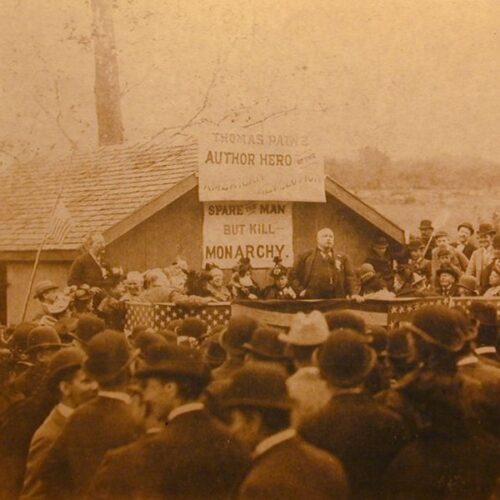
Main image: Robert G. Ingersoll lecturing, 30 May 1894
I cannot pretend to throw the least light on such abstruse problems. The mystery of the beginning of all things […]
These thinges, with many other shall by good & honest men be proved to be his opinions and common speeches, […]
We have the faculties for gaining knowledge; and Rationalism will always maintain that we are at liberty to use them […]
Harry Stopes-Roe was one of the most tireless and dedicated humanist campaigners of the 20th century. Son of the influential […]