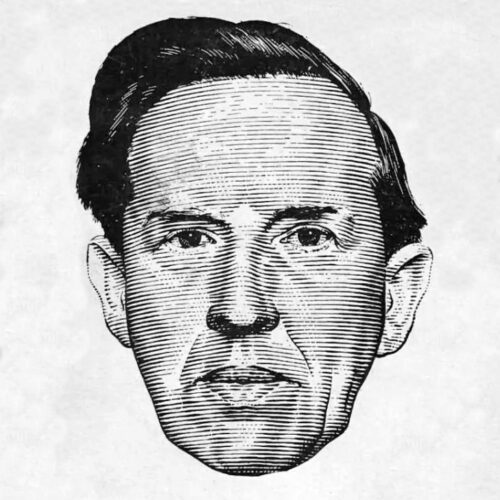
Science should be taught not merely as a subject but should come into all subjects. Its importance in history and in modern life should be pointed out and illustrated. The old contrast, often amounting to hostility, between scientific and humane subjects needs to be broken down and replaced by a scientific humanism.
J. D. Bernal, The Social Function of Science (1939)
John Desmond Bernal was an Irish-born scientist and writer, whose lifelong concern was how science could be used for the benefit of humanity. An Honorary Associate of the Rationalist Press Association from 1947 until his death in 1971, he was also an activist for peace, and a devoted Marxist. In a memoir of Bernal written for the Royal Society, fellow scientist Dorothy Crowfoot Hodgkin described his belief that:
…a good act is one which contributes to the realisation of a society in which harmonious relations exist between human beings, in which ‘the free development of all is the condition of the free development of each’, in which the alienation that individuals experience in the various forms of class society is overcome. Marxist ethics thus implies a commitment both to work towards a perfected community and to try to live according to its principles within the present very imperfect one. Bernal’s life and work reflect this twofold revolutionary ethic and the problems which it raises.
The tribute reproduced below was written by mathematician and activist Hyman Levy and published in The Humanist (now New Humanist) in November 1971.
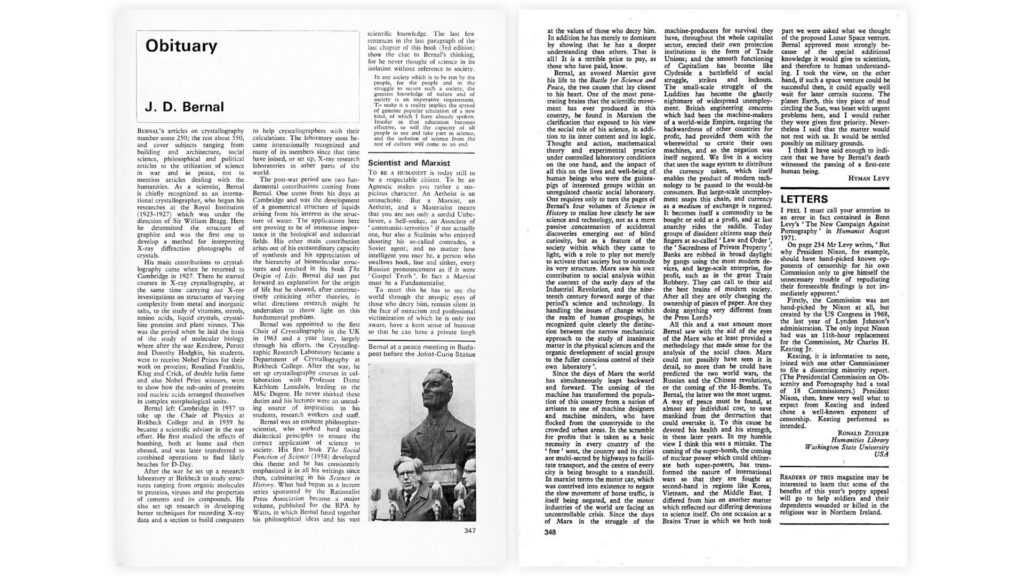
BERNAL’S articles on crystallography number some 250; the rest about 550, and cover subjects ranging from building and architecture, social science, philosophical and political articles to the utilization of science in war and in peace, not to mention articles dealing with the humanities. As a scientist, Bernal is chiefly recognized as an international crystallographer, who began his researches at the Royal Institution (1923-1927) which was under the direction of Sir William Bragg. Here he determined the structure of graphite and was the first one to develop a method for interpreting X-ray diffraction photographs of crystals.
His main contributions to crystallography came when he returned to Cambridge in 1927. There he started courses in X-ray crystallography, at the same time carrying out X-ray investigations on structures of varying complexity from metal and inorganic salts, to the study of vitamins, sterols, amino acids, liquid crystals, crystalline proteins and plant viruses. This was the period when he laid the basis of the study of molecular biology where after the war Kendrew, Perutz and Dorothy Hodgkin, his students, were to receive Nobel Prizes for their work on proteins; Rosalind Franklin, Klug and Crick, of double helix fame and also Nobel Prize winners, were to show how the sub-units of proteins and nucleic acids arranged themselves in complex morphological units.
Bernal left Cambridge in 1937 to take up the Chair of Physics at Birkbeck College and in 1939 he became a scientific advisor in the war effort. He first studied the effects of bombing, both at home and then abroad, and was later transferred to combined operations to find likely beaches for D-Day.
After the war he set up a research laboratory at Birkbeck to study structures ranging from organic molecules to proteins, viruses and the properties of cements and its compounds… The laboratory soon became internationally recognized and many of its members since that time have joined, or set up, X-ray research laboratories in other parts of the world.
After the war he set up a research laboratory at Birkbeck to study structures ranging from organic molecules to proteins, viruses and the properties of cements and its compounds. He also set up research in developing better techniques for recording X-ray data and a section to build computers to help crystallographers with their calculations. The laboratory soon became internationally recognized and many of its members since that time have joined, or set up, X-ray research laboratories in other parts of the world.
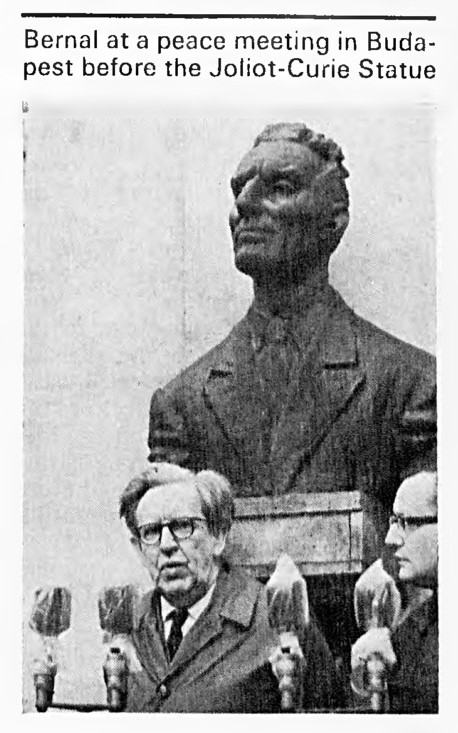
The post-war period saw two fundamental contributions coming from Bernal. One stems from his days at Cambridge and was the development of a geometrical structure of liquids arising from his interest in the structure of water. The applications here are proving to be of immense importance in the biological and industrial fields. His other main contribution arises out of his extraordinary capacity of synthesis and his appreciation of the hierarchy of biomolecular structures and resulted in his book The Origin of Life. Bernal did not put forward an explanation for the origin of life but he showed, after constructively criticizing other theories, in what directions research might be undertaken to throw light on this fundamental problem.
Bernal was appointed to the first Chair of Crystallography in the UK in 1963 and a year later, largely through his efforts, the Crystallographic Research Laboratory became a Department of Crystallography at Birkbeck College. After the war, he set up crystallography courses in collaboration with Professor Dame Kathleen Lonsdale, leading to the MSc Degree. He never shirked these duties and his lectures were an unending source of inspiration to his students, research workers and staff.
Bernal was an eminent philosopher-scientist, who worked hard using dialectical principles to ensure the correct application of science to society.
Bernal was an eminent philosopher-scientist, who worked hard using dialectical principles to ensure the correct application of science to society. His first book The Social Function of Science (1938) developed this theme and he has consistently emphasized it in all his writings since then, culminating in his Science in History. What had begun as a lecture series sponsored by the Rationalist Press Association became a major volume, published for the RPA by Watts, in which Bernal fused together his philosophical ideas and his vast scientific knowledge. The last few sentences in the last paragraph of the last chapter of this book (3rd edition) show the clue to Bernal’s thinking, for he never thought of science in its isolation without reference to society.
To any society which is to be run by the people, for the people and in the struggle to secure such a society, the greatest knowledge of nature and of society is an imperative requirement. To make it a reality implies the spread of genuine popular education of a new kind, of which I have already spoken. Insofar as that education becomes effective, so will the capacity of all people to use and take part in science, and the isolation of science from the rest of culture will come to an end.
Scientist and Marxist
TO BE A HUMANIST is today still to be a respectable citizen. To be an Agnostic makes you rather a suspicious character. An Atheist is an untouchable. But a Marxist, an Atheist, and a Materialist means that you are not only a sordid Unbeliever, a Self-seeker, an Associate of “communist-terrorists” if not actually one, but also a Stalinist who enjoyed shooting his so-called comrades, a Soviet agent; and no matter how intelligent you may be, a person who swallows hook, line and sinker, every Russian pronouncement as if it were ‘Gospel Truth’. In fact a Marxist must be a Fundamentalist.
To meet this he has to see the world through the myopic eyes of those who decry him, remain silent in the face of ostracism and professional victimization of which he is only too aware, have a keen sense of humour so that he can have a private laugh at the values of those who decry him. In addition he has merely to dominate by showing that he has a deeper understanding than others. That is all! It is a terrible price to pay, as those who have paid, know.
Bernal, an avowed Marxist gave his life to the Battle for Science and Peace, the two causes that lay closest to his heart.
Bernal, an avowed Marxist gave his life to the Battle for Science and Peace, the two causes that lay closest to his heart. One of the most penetrating brains that the scientific movement has ever produced in this country, he found in Marxism the clarification that exposed to his view the social role of his science, in addition to its inner content and its logic. Thought and action, mathematical theory and experimental practice under controlled laboratory conditions on the one hand, and the impact of all this on the lives and well-being of human beings who were the guinea-pigs of interested groups within an unregulated chaotic social laboratory. One requires only to turn the pages of Bernal’s four volumes of Science in History to realize how clearly he saw science and technology, not as a mere passive concatenation of accidental discoveries emerging out of blind curiosity, but as a feature of the society within which they came to light, with a role to play not merely to activate that society but to outmode its very structure. Marx saw his own contribution to social analysis within the context of the early days of the Industrial Revolution, and the nineteenth century forward surge of that period’s science and technology. In handling the issues of change within the realm of human groupings, he recognized quite clearly the distinction between the narrow mechanistic approach to the study of inanimate matter in the physical sciences and the organic development of social groups to the fuller conscious control of their own laboratory’.
Since the days of Marx the world has simultaneously leapt backward and forward. The coming of the machine has transformed the population of this country from a nation of artisans to one of machine designers and machine minders, who have flocked from the countryside to the crowded urban areas. In the scramble for profits that is taken as a basic necessity in every country of the ‘free’ west, the country and its cities are multi-sected by highways to facilitate transport, and the centre of every city is being brought to a standstill. In marxist terms the motor car, which was contrived into existence to negate the slow movement of horse traffic, is itself being negated, and the motor industries of the world are facing an uncontrollable crisis. Since the days of Marx in the struggle of the machine-producers for survival they have, throughout the whole capitalist sector, erected their own protection institutions in the form of Trade Unions; and the smooth functioning of Capitalism has become like Clydeside a battlefield of social struggle, strikes and lockouts. The small-scale struggle of the Luddites has become the ghastly nightmare of widespread unemployment. British engineering concerns which had been the machine-makers of a world-wide Empire, negating the backwardness of other countries for profit, had provided them with the wherewithal to create their own machines, and so the negation was itself negated. We live in a society that uses the wage system to distribute the currency token, which itself enables the product of modern technology to be passed to the would-be consumers. But large-scale unemployment snaps this chain, and currency as a medium of exchange is negated. It becomes itself a commodity to be bought or sold at a profit, and at last anarchy rides the saddle. Today groups of dissident citizens snap their fingers at so- called ‘Law and Order’, the ‘Sacredness of Private Property’. Banks are robbed in broad daylight by gangs using the most modern devices, and large-scale enterprise, for profit, such as in the great Train Robbery. They can call to their aid the best brains of modern society. After all they are only changing the ownership of pieces of paper. Are they doing anything very different from the Press Lords?
A way of peace must be found, at almost any individual cost, to save mankind from the destruction that could overtake it. To this cause he devoted his health and his strength, in these later years… I think I have said enough to indicate that we have by Bernal’s death witnessed the passing of a first-rate human being.
All this and a vast amount more Bernal saw with the aid of the eyes of the Marx who at least provided a methodology that made sense for the analysis of the social chaos. Marx could not possibly have seen it in detail, no more than he could have predicted the two world wars, the Russian and the Chinese revolutions, or the coming of the H-Bombs. To Bernal, the latter was the most urgent. A way of peace must be found, at almost any individual cost, to save mankind from the destruction that could overtake it. To this cause he devoted his health and his strength, in these later years. In my humble view I think this was a mistake. The coming of the super-bomb, the coming of nuclear power which could obliterate both super-powers, has transformed the nature of international wars so that they are fought at second-hand in regions like Korea, Vietnam, and the Middle East. I differed from him on another matter which reflected our differing devotions to science itself. On one occasion at a Brains Trust in which we both took part we were asked what we thought of the proposed Lunar Space venture. Bernal approved most strongly because of the special additional knowledge it would give to scientists, and therefore to human understanding. I took the view, on the other hand, if such a space venture could be successful then, it could equally well wait for later certain success. The planet Earth, this tiny piece of mud circling the Sun, was beset with urgent problems here, and I would rather they were given first priority. Nevertheless I said that the matter would not rest with us. It would be settled possibly on military grounds.
I think I have said enough to indicate that we have by Bernal’s death witnessed the passing of a first-rate human being.
Hyman Levy
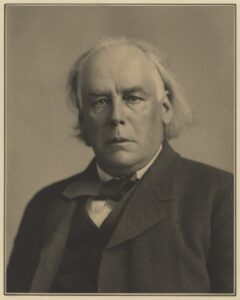
Main image: J.D. Bernal on the cover of Science in History (1954; Watts & Co.)
John Desmond Bernal by Dorothy Mary Crowfoot Hodgkin | Biographical Memoirs of Fellows of the Royal Society

What is tolerance? It is the consequence of humanity. We are all formed of frailty and error; let us pardon […]
To all those who have established and who are maintaining the right to refuse to kill. Their foresight and courage […]
The National Secular Society is a campaigning organisation, founded in 1866 to champion the principles of secularism and the separation […]

…for the Promotion and Advancement of Science, Literature and Art Trust deed of the Bath Royal Literary and Scientific Institute […]