Joseph Chamberlain (1836–1914)
( 08 July 1836 - 02 July 1914 )
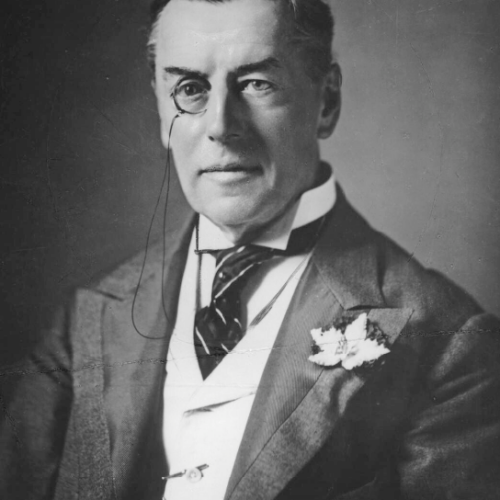
( 08 July 1836 - 02 July 1914 )
‘I have too much reverence for what lies at the bottom of all religion to use its language as a mere instrument of political controversy.’
Joseph Chamberlain, in a letter to Edward Russell, quoted in The Literary Guide, May 1933
Joseph Chamberlain was one of the most powerful politicians of Victorian and Edwardian Britain: a radical Mayor of Birmingham, a Cabinet minister under both Liberals and Conservatives, and the father of two leading statesmen, Austen and Neville Chamberlain. Raised a Unitarian, he lost his religious faith in middle age and described himself to his son as ‘a very reverent agnostic’.
Before he entered Parliament, he was a leading campaigner against what we would now call faith schools, demanding a national system of free, compulsory and non-sectarian schools, and the rationalists of the next generation remembered him as an ally in the long fight to free education from the churches. His later career as an imperialist, above all his part in the Boer War, is remembered far less fondly.
Chamberlain was born in London in 1836 into a Unitarian family and moved to Birmingham as a young man to join the family’s screw-making business. Birmingham suited him: its public life was dominated by Quakers and Unitarians, and at the Unitarian Church of the Messiah he met the Kenrick family, who supplied him with two wives. What drew him to Unitarianism, according to the historian Mark Vickers, was less its liturgy than its commitment to education and social reform; he and his second wife, Florence, taught in the church’s Sunday schools, giving secular rather than religious lessons to the city’s poor.
Both his first two wives died in childbirth, Harriet in 1863 and Florence in 1875, and after Florence’s death what faith he had left him. He never mocked believers. As his son Neville’s biographer David Dilks puts it, although his belief in religion ‘as a source of comfort or salvation had faded, he never scoffed at the churches or sneered at people who felt differently’. ‘I am,’ he told Neville one evening, ‘a very reverent agnostic.’ He bore his own losses ‘with philosophical resignation’, and held that it was ‘a waste of time discussing questions as to which we did not and could not know the answer’.
He also refused to fake piety for political gain. When the Liberal editor Edward Russell warned him that he was thought ‘brusque and cynically disrespectful about religion’, and could not ‘use its dialect or awaken its emotions’ as Gladstone could, Chamberlain replied that his religious opinions were ‘a matter for my own conscience’, that no one had ever heard him speak disrespectfully of any faith, and that he would rather be without influence than win it by using religious language as a political tool. Reading the letter in May 1933, The Literary Guide judged that he had moved, ‘as many Unitarians do, so close to Rationalism that he may have been over the frontier without being aware of it’.
Chamberlain made his name not in Parliament but in the campaign for national education. In 1869, with the Birmingham radicals, he launched the National Education League, which demanded schools paid for from local rates that would be free, compulsory, and unsectarian. Nominally its vice-chairman, he was its driving force from the start. At its first annual meeting, where the speakers included George Jacob Holyoake, he warned that extending the church-run system would make people ‘swallow the poison and the antidote’ and ‘pay the bill for both’.
‘Our choice is between the education of the people and the interests of the Church.’
Joseph Chamberlain, National Education League, 1869–70, quoted by Ernest Thurtle in The Literary Guide, September 1936
Gladstone’s Education Act of 1870 disappointed him: it left the church schools in place and even funded them from public money. Chamberlain led a deputation to Downing Street, and the League fought on. By 1872 it was calling openly for ‘secularism’: board schools giving secular instruction only, with every denomination free to teach its own doctrines separately and at its own cost.
‘We propose to teach the three R’s to all and for all. We propose to leave the teaching of the fourth R — that is, religion — to be taught by the Churches in their own time, in their own way.’
Joseph Chamberlain, speaking in Newcastle, quoted by Ernest Thurtle in The Literary Guide, September 1936
The campaign split the Liberal Party and helped bring down Gladstone’s government in 1874, but it did not win. Writing on the centenary of Chamberlain’s birth in 1936, the rationalist MP Ernest Thurtle noted that of the four principles Chamberlain had fought for, three had since been achieved: English education was now universal, compulsory and free, ‘even if it is still not unsectarian’.
As Mayor of Birmingham from 1873 to 1876, Chamberlain brought the city’s gas and water supplies into public ownership, cleared slums and rebuilt its centre, a programme that became known as ‘gas and water socialism’ and made Birmingham a model of municipal reform. Elected to Parliament in 1876, he became the leader of Liberal radicalism, campaigning for, among other things, the disestablishment of the Church of England.
His later career took a very different turn. He broke with Gladstone over Irish Home Rule in 1886, led the Liberal Unionists into alliance with the Conservatives, and as Colonial Secretary from 1895 to 1903 became the foremost champion of the British Empire. He saw it as a force for progress, believing the British to be ‘the greatest of governing races that the world has ever seen’ and the colonies to be ‘undeveloped estates’ that British investment could bring to prosperity.
His part in bringing about the Second Boer War, during which tens of thousands of Boer and Black African civilians died in British concentration camps, has left a lasting stain on his reputation. The episode illuminates much of the patronisingly cavalier racism at the heart of British imperialism in this era: his belief in a British ‘governing race’, common among imperialists of his generation, rested on an assumption of white racial superiority over the peoples the Empire ruled. His last great cause, tariff reform, split the Conservative Party in turn.
A stroke in 1906 ended Chamberlain’s active career, and he died on 2 July 1914. The family turned down the offer of a grave in Westminster Abbey and buried him instead at Birmingham’s Key Hill Cemetery, the city’s old Nonconformist burial ground, which he shares with freethinkers such as the poet Constance Naden.
His agnosticism passed to the next generation. His son, Prime Minister Neville Chamberlain, shared his distaste for organised religion and found his own sense of wonder in Darwin, and his daughter Hilda could still describe a baptism in 1936 as ‘a barbarous ceremony’.
The New Humanist archive, including The Literary Guide, is available via Exact Editions. Subscribe at newhumanist.org.uk/subscribe.
Charles Albert Watts was a lifelong promoter of rationalism, and the founder in 1885 of Watts’s Literary Guide, still published […]

Auguste Comte was a French writer, philosopher, and social scientist, whose theory of positivism was a significant influence on the […]
I cannot pretend to throw the least light on such abstruse problems. The mystery of the beginning of all things […]
We must grow out of the crude and unreal ideas of immortality and content ourselves with the only kind of […]