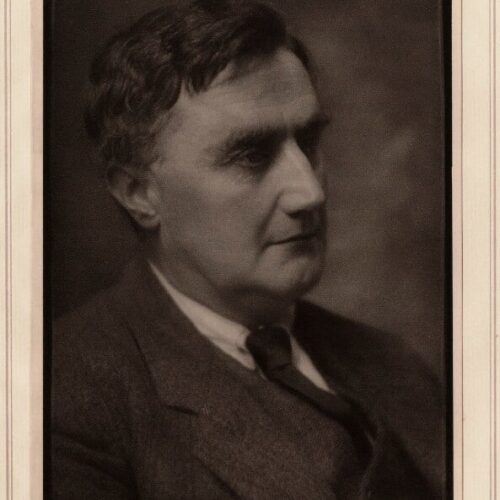
I am myself a musician, and I believe that all the arts, and especially music, are necessary to a full life. The practical side of living of course is important… such things teach you how to make your living. But music will enable you to see past facts to the very essence of things in a way science cannot do.
Ralph Vaughan Williams in a letter to a school in Norfolk, quoted in R. V. W.: A Biography of Ralph Vaughan Williams by Ursula Vaughan Williams (1964)
This tribute was written by Jonathan Burgess and published as ‘Ralph Vaughan Williams: 1872–1958’ in New Humanist, December 1972.
The ‘other’ great centenary for Humanists in 1972, has been that of the birth of Ralph Vaughan Williams. Of course the days of strong partisanship over the beliefs of writers and artists are gone, largely, although it is still possible for a leading woman’s page writer to ask how an atheist can appreciate the beauty and meaning of The Messiah or Bach’s Christmas Oratorio. It was, even in its own terms, a singularly foolish question. Vaughan Williams could not only appreciate ‘religious’ music, he wrote masses, (if that is the word), of the stuff, and yet he was an atheist. In the biography of him by his second wife, Ursula (OUP), she writes: ‘He was far too absorbed by music to feel any need of religious observance. He was an atheist during his later years at Charterhouse and at Cambridge, though he later drifted into a cheerful agnosticism: he was never a professing Christian.’ Bertrand Russell describes how, entering Chapel at Cambridge one evening, Vaughan Williams exclaimed in a loud voice, ‘Who believes in the holy trinity now, I should like to know?’
Chapel at Cambridge was still compulsory, and when one morning his absence was noted he was sent for by authority. His wife records the following conversation:
‘I did not see you in Chapel this morning, Mr Vaughan Williams.’
‘No, Sir.’
‘Perhaps you were in the organ loft?’
‘Yes, Sir, I was.’
‘Well, you can pray as well in the organ loft as in any other part of the Chapel.’
‘Yes, Sir — but I didn’t.’
At Cambridge, too, Vaughan Williams came under the influence of G. E. Moore, just as Russell did, and went on reading-party holidays with Moore and G. M. Trevelyan.
When Vaughan Williams left one such holiday early, Moore wrote a mock epitaph:
In memory of
Ralph Vaughan Williams
Who passed away with the utmost complaisance
March 29th 1895
When Moore’s Principia Ethica, which had such an enormous influence on Bertrand Russell and on the Bloomsbury set, was published, Moore sent Vaughan Williams a copy. RVW found it ‘difficult but wonderful’.
It certainly may seem odd to many that this was the man who wrote so much religious music, both liturgical, such as the Benedicite, the Mass in G Minor, anthems like O Taste and See and The Old Hundredth, and other works such as Job; a Masque for Dancing and the opera, Pilgrims Progress. Vaughan Williams was also the musical editor of the English Hymnal, which in 1904 was a vast improvement on the other hymn books available, and is still the best. But he himself said, ‘There is no reason why an atheist should not write a good mass.’ In this respect, as in all others, his actions were determined by a dignified, broadminded, eclectic hedonism. He wrote in a letter to Rutland Boughton, ‘I assure you that my spirit remains what you call “generous”.’ In a letter to a school in Norfolk, where one of the houses was named after him he wrote:
I am myself a musician, and I believe that all the arts, and especially music, are necessary to a full life. The practical side of living of course is important… such things teach you how to make your living. But music will enable you to see past facts to the very essence of things in a way science cannot do. The arts are the means by which we look through the magic casements and see what lies beyond.
Whether music can mean anything is always the subject of great debate, and Vaughan Williams’ work has always been the focus of argument quite apart from the basis of his own beliefs. Nothing will ever, it is sure, expunge from the average music lover’s mind (and probably not from the cricket’s either) the notion that the fourth and sixth symphonies are ‘war’ symphonies, and that the fifth is a ‘peace’ symphony. The violent energy and strident dissonance of the other two contrast markedly with the smooth restful tranquillity of the fifth. The last movement of the sixth in particular, coming after all that musical imagery of mad militarism, is the most extraordinary portrayal for many of the complete and utter desolation, an image now even more telling in an age when that is exactly what another world war will lead to. Various sections of this symphony were used with great effectiveness some years ago by the BBC as incidental music to a serialization of H. G. Wells’ War in the Air.
Vaughan Williams himself would have none of this. He would have liked to print Mendelssohn’s saying that ‘the meaning of music is too precise for words’ on the programme of every concert at which his works were played. According to his widow, the real answer to the riddle of the last movement is:
And, like the baseless fabric of the vision,
The cloud capp’d towers, the gorgeous palaces,
The solemn temples, the great globe itself,
Yea, all which inherit it, shall dissolve
And, like this insubstantial pageant faded,
Leave not a wrack behind. We are such stuff
As dreams are made on, and our little life
Is rounded with a sleep…
Rutland Boughton, with whom Vaughan Williams quarrelled over the Russian Peace manifesto in 1950, said that the finale sounded to him ‘like an agnostic’s paradiso, while… No 4… sounded at times as if you had outdone Virgil by positively rollicking on the verge of hell’.
Whatever its meaning, if any, in external terms, the sixth symphony certainly has a meaning ‘too precise for words’. When heard on a record in solitude and in darkness, it evokes an emotional experience which is pure catharsis.
It was not the notion that these symphonies embodied or contained ideas that annoyed Vaughan Williams so much as the suggestion that he had any specific intention when he wrote them, or that he had used them as a vehicle. He felt, one infers, that to use music thus is to demean it. He did, on the other hand, allow that a composer might be influenced by his frame of mind or by the prevailing social atmosphere when writing. In this light their dates are telling, 1932, 1943 and 1945-6.
Musical painting
Of the earlier symphonies the interpretation is more clear and straightforward, although even here Vaughan Williams confused matters by writing of the Pastoral Symphony, which he sketched in the trenches in 1916, ‘It’s really war time music… it’s not really lambkins frisking at all as most people take for granted.’ Nevertheless the pastoral image is inescapable, as clear as the portrayal, for instance, of the sea in his own Sea Symphony or in Debussy’s sea pictures. In the London Symphony the imagery is quite specific, including the Westminster chimes and what could well be an errand boy whistling on his bicycle. Vaughan Williams avoided any feeling of restriction imposed by the label by describing it as ‘a symphony by a Londoner’.
Such is the skill and scope of the musical painting that not only have we a portrait of the hustle and bustle of urban life, but the image of a great city built upon a prehistoric landscape, and ever at war with and devouring the land it loves. It is a very English image.
Among the symphonies the clearest musical pictures are in the Sea Symphony and in Sinfonia Antarctica, which arose out of the film score for Scott of the Antarctic. The actual history of the expedition drove Vaughan Williams to a fury; the tale of bungled management and wasted heroism. But he met superbly the demands of portraying musically ice, cold, and wind; the bleak desolate impassable black and ice covered rock; and above all man’s endeavour against such conditions, and the pitting of mortal spirit and resources against conditions almost immortal in their impossibility.
The achievement of Sinfonia Antarctica is spectacular. Each movement is prefixed by a motto to be read in performance. The two which together encapsulate the spirit of the symphony are by Coleridge* and Shelley:
Ye Ice-falls! Ye that from the mountain’s brow
Adown enormous ravines slope amain—
Torrents, methinks, that heard a mighty voice,
And stopped at once amid their maddest plunge!
Motionless torrents! silent cataracts!
And
To suffer woes which hope thinks infinite;
To forgive wrongs darker than death or night;
To defy power, which seems omnipotent,
Neither to change, nor falter, nor repent;
This… is to be
Good, great and joyous, beautiful and free;
This is alone Life, Joy, Empire, and Victory.
The same descriptive powers had already appeared in the Sea Symphony, Vaughan Williams’ first. Here the subject is the sea and the same joyous pride in the physical and spiritual endeavour of man, as described in the poetry of Walt Whitman.
Behold, the sea itself,
And on its limitless, heaving breast, the ships;
See, where their white sails, bellying in the wind, speckle the green and blue…
Of dashing spray, and the winds piping and blowing,
And out of these a chant for the sailors of all nations,
Fitful like a surge…
A spiritual woven signal for all nations, emblem of man, elate above death.
Comparisons are odious, but of all the modern English composers we remember and celebrate, there can be no doubt that Ralph Vaughan Williams stands head and shoulders above the rest. If he had been killed in the First World War, as so many artists and composers were, he would have left the Sea Symphony, the London Symphony, perhaps the Pastoral, the Tallis fantasia, his first opera Hugh the Drover, many songs and chamber works, and his vital contribution to the rescuing and recording of English folk song. This last was a task which keeps his memory alive even in the mouths of many who probably have little idea of the debt they owe him. All these would have ensured him a firm place in history and in the repertoire. But when he died suddenly in 1958 he left behind a huge and magnificent opus, including nine symphonies (the magical musical number).
His best epitaph is perhaps taken from one of the poems by Robert Louis Stephenson which he set as the song cycle Songs of Travel in 1905:
Bright is the ring of words
When the right man rings them,
Fair the fall of songs
When the singer sings them.
Still they are carolled and said
On wings they are carried
After the singer is dead
And the maker buried.
* In the original version of this article, Burgess ascribed both prefaces quoted from Sinfonia Antarctica to Shelley. He later issued a correction, noting that the first of the two was by Coleridge. The article as republished here has been amended to reflect this.
Main image: Ralph Vaughan Williams by Herbert Lambert, photogravure, early 1920s NPG Ax7744 © National Portrait Gallery, London
There is no hope but us. There is no mercy but us. There is no justice. There is just us… […]
Prior’s Field School was founded in 1902 by Julia Arnold Huxley. Born in 1862, Julia grew up in an intellectual […]
Thomas Hardy was an English novelist and poet, renowned for his apparently bleak outlook, but finely tuned to life and […]
Thomas Hill Green was a philosopher, educator, and a Liberal, whose idealist philosophy (with its practical implications) was a significant […]