The human species so deeply loved by Bertrand Russell and so much enriched by his life’s work is now in danger of becoming extinct…
From a series of tributes to Bertrand Russell published as ‘Russell Remembered’ in the December 1972 issue of New Humanist.
THE HUMAN SPECIES so deeply loved by Bertrand Russell and so much enriched by his life’s work is now in danger of becoming extinct. It has happened for the first time in history during our generation that man has acquired the capability of destroying his own kind, as well as of playing havoc with other forms of life on this planet. This tremendous power was delivered into man’s hands by a small group of people — the scientists. This end product of scientific endeavour was not something planned deliberately from the beginning. Rather it was the unintentional result of pure, scientific research which started off with the aim of learning to understand the processes of nature, of increasing knowledge. This is the great tragedy of science.
Every scientific advance, every discovery for the benefit of man, can also be applied to his peril.
Russell held the view that science should be dedicated to serving mankind. The great majority of scientists agree with this view. However, in the complex society in which we live, where the interests and aspirations of different groups are often at variance, the achievements of science can be either used or misused. Every scientific advance, every discovery for the benefit of man, can also be applied to his peril. Governments have realized the tremendous importance of science in providing not only greater wealth and better health, but also more security and high prestige for a nation, and scientists are being pressed more and more to apply their work in certain directions. Along with great intellectual achievement and enormous benefits to man for his material needs, science has brought about the production of more terrible and cheaper means of destruction.
Every one of us has the duty to preserve our inheritance, and to ensure the continuing existence of the human species. The scientist as a citizen shares this duty with other members of the community.
Only the ignorant and the short-sighted will put the blame for this dangerous situation on the scientists and seek a remedy in the suppression of scientific research, or perhaps even in the elimination of the scientist. The scientist is servant of the community; he does what the community demands of him. If his work has such dangerous consequences we are all to blame for it and it is up to all of us to prevent a catastrophe. Every one of us has the duty to preserve our inheritance, and to ensure the continuing existence of the human species. The scientist as a citizen shares this duty with other members of the community.
However, the scientific revolution has imposed additional responsibilities on him. These responsibilities arise from the special role played by science in modern society and the high standing acquired by the scientist. They arise from the specialized knowledge of the scientist, which enables him to foresee well ahead of others the dangers inherent in any new scientific discovery and which gives him the competence to warn society about these dangers. A great responsibility also arises from the possession by the scientist of the powerful tool of the scientific method. It is this tool that is responsible for the rapid advance of physical science. If this scientific method could be applied to the solution of social and political problems there might be faster progress in these fields too. The scientist must learn how to apply this tool to the problems which science itself has created and so find means to avert the dangers to mankind.
Bertrand Russell did more than anyone else to alert the scientists to their new responsibilities… With prophetic insight he assessed the dangers inherent in the changed world.
Bertrand Russell did more than anyone else to alert the scientists to their new responsibilities. He was one of the first to realize the far-reaching consequences of the development of nuclear weapons. Only a few months after the Hiroshima bomb, in a speech to the House of Lords in November 1945, he forecast the hydrogen bomb and its tremendous destructive power. With prophetic insight he assessed the dangers inherent in the changed world. In that speech he suggested that a meeting between Western and Soviet scientists might provide the best opening for genuine cooperation and the establishment of a system of international control. But as usual, very little attention was given to his warnings. In his autobiography Russell says ‘everybody applauded my speech. Not a single peer suggested that my fears were excessive. But all my hearers agreed that this was a question for their grandchildren’.
Only a few years later the menace of hydrogen bombs became as great as he predicted, and Russell decided that the time for action had come. In December 1954 he broadcast on the BBC a speech under the title ‘Man’s Peril’ in which he made a remarkable evaluation of the dangerous situation which had arisen from the development of nuclear weapons and of the catastrophic consequences of another war. He used this broadcast as the basis for a statement to be issued to the world’s scientific community and to the public in general over the signatures of a number of eminent scientists.
The [Russell-Einstein] manifesto draws attention to the new dangers to mankind and calls for a conference of scientists representing a wide range of opinion to assess the situation.
This statement is now known as the Russell-Einstein Manifesto, because of Einstein’s special role as a signatory. He actually signed it two days before his death. The manifesto draws attention to the new dangers to mankind and calls for a conference of scientists representing a wide range of opinion to assess the situation. The manifesto reads:
We are speaking on this occasion not as members of this or that nation, continent or creed, but as human beings, members of the species man, whose continued existence is in doubt. We shall try to say no single word which would appeal to one group rather than to another. All equally are in peril and, if the peril is understood, there is hope that they may collectively avert it.
The statement ends with the following paragraph.
There lies before us, if we choose, continual progress and happiness, knowledge and wisdom. Shall we instead choose death because we cannot forget our quarrels? We appeal as human beings to human beings, remember your humanity and forget the rest. If you can do so the way lies open to a new Paradise. If you cannot there lies before you the risk of universal death.
This speech and statement summarize Russell’s basic attitudes towards the potentialities of science and became the foundation of an important movement of scientists, the ‘Pugwash’ movement. It was Russell who founded the movement and organized the conference. He was the chairman from the first meeting in 1957 until 1967.
This first [Pugwash] conference turned out to be a great success… Above all, it proved that scientists have a common purpose which can transcend national frontiers and political ideologies.
In those days, when talking with Russians about peace and disarmament was considered a subversive activity, it required some courage for scientists to agree to take part in such a conference. Indeed, the conference in Pugwash was the first occasion on which eminent scientists from East and West came together to discuss, not science itself, but the social and political implication of science. It was the great influence which Russell had on the scientific community, the magic of his name, the respect for his judgement, that made scientists heed to his call and assemble in this conference.
This first conference turned out to be a great success. Everything that Russell expected of it was fulfilled. Above all, it proved that scientists have a common purpose which can transcend national frontiers and political ideologies. It has shown that by virtue of their training and their knowledge scientists are capable of discussing objectively and of contributing significantly to the solution of the complex problems of modern society.
Russell himself assessed the influence of Pugwash on governments in his last address to the Pugwash conference. He said ‘when men of science speak publicly about their findings as they have done within the Pugwash movement, governments will no longer so easily continue conflicts for which there is no basis’.
Since that meeting in 1957 Pugwash has held many conferences. The movement became recognized as one of the most important channels of communication between East and West for constructive thought and pursuance of peace. One cannot determine with scientific precision the effect which Pugwash has on world security, but in the view of many knowledgeable persons the Pugwash conferences have made a significant contribution to the lessening of tension in the world. It is quite likely that the fact that we have survived so far and avoided a nuclear holocaust, despite the ever accelerating arms race, is a result of this lessening of tension.
Russell himself assessed the influence of Pugwash on governments in his last address to the Pugwash conference. He said ‘when men of science speak publicly about their findings as they have done within the Pugwash movement, governments will no longer so easily continue conflicts for which there is no basis’.
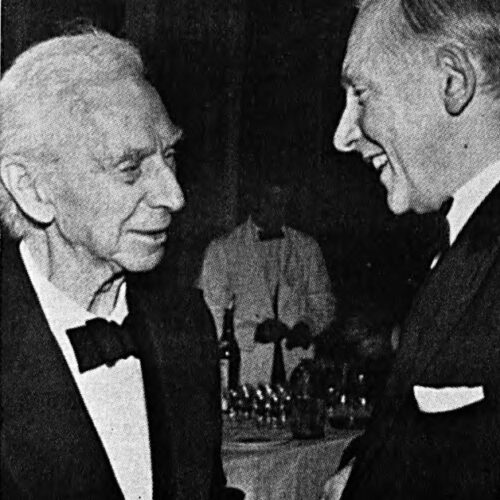
Main image: Bertrand Russell and Joseph Rotblat, pictured in New Humanist, December 1972
It was early in the war, and we were stationed at a pleasant village in Sussex. One evening a sergeant […]
Ethics really ought to have something to do with life. Ethics ought to tell you how to be good or […]
Rupert Brooke’s 1914 sonnets made him a national symbol of patriotic sacrifice, but the man behind the legend was a sceptic and a socialist, at home among the freethinkers of pre-war Cambridge, who left religion behind before he left school and never returned to it.
In 1983 Nigel Bruce, chairman of the Scottish Humanist Council, explained to readers of the BHA’s Humanist News why Scotland needed a humanist body of its own. His article, reproduced here, is the clearest statement of the case made six years before the Humanist Society of Scotland was founded.