Rupert Brooke (1887–1915)
( 12 October 1887 - 12 October 2026 )
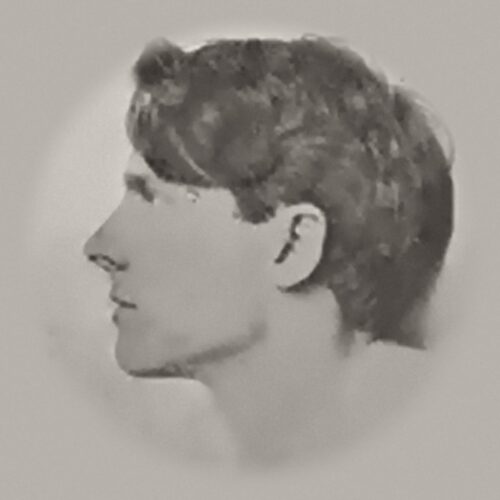
( 12 October 1887 - 12 October 2026 )
‘For 1,800 years, religion, when it has been strong enough, has persecuted or starved the arts.’
Rupert Brooke
Rupert Brooke was an English poet whose sonnets of 1914, above all the one beginning ‘If I should die, think only this of me’, made him the most famous young poet in England at the moment of his death. Within weeks he had become a national symbol of patriotic sacrifice. Yet the man behind the legend was a sceptic and a socialist, at home among the freethinkers of pre-war Cambridge, who had left religion behind before he left school and never returned to it.
The rationalist and humanist press, particularly the publications of the Rationalist Press Association, kept coming back to him for more than a century, from a tribute in The Literary Guide weeks after his death, and through through decades of quoting his satire ‘Heaven’ as a parable of people making gods in their own image, to reviews in The Humanist and New Humanist that set out to recover the ‘consciously and defiantly pagan’ Brooke his friends had known.
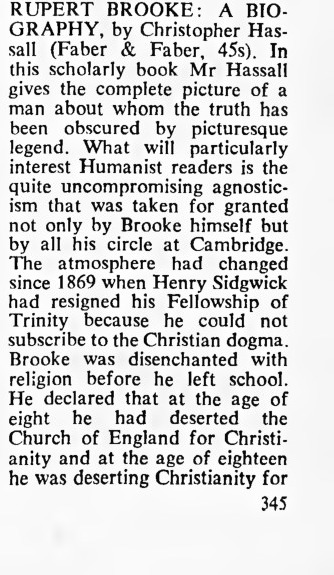
Brooke was born in Rugby on 3 August 1887, the son of William Parker Brooke, a master at Rugby School, where Rupert himself excelled at both scholarship and sport. He was, as The Humanist later put it, ‘disenchanted with religion before he left school’. He liked to say that he had deserted the Church of England for Christianity at the age of eight, and Christianity for the teaching of Christ at eighteen.
In 1906 he went up to King’s College, Cambridge, to read classics, and found the intellectual atmosphere agnostic, sceptical, and very much to his liking. He came under the influence of the philosopher G.E. Moore, was elected to the Apostles, and counted Hugh Dalton, James and Lytton Strachey, and Geoffrey and Maynard Keynes among his friends. The ‘quite uncompromising agnosticism’ of this elite circle, The Humanist observed, was simply taken for granted: a world away from 1869, when Henry Sidgwick had resigned his fellowship at Trinity because he could not subscribe to Christian doctrine.
Moore’s humanist philosophical work Principia Ethica (1903) had a profound influence on Brooke’s thinking and religion and morality. It had already become a touchstone for the Cambridge Apostles, the secretive, hand-picked discussion society to which Brooke was elected. Moore argued that the most valuable things we know are ‘the pleasures of human intercourse and the enjoyment of beautiful objects’: an ethics of friendship and art with no need of God, which shaped the Apostles of Brooke’s generation and the Bloomsbury Group that grew out of them. Its imprint is plain in Brooke’s own dissertation on John Webster, which judges a play by the ‘states of mind’ it produces in its audience: ‘A play is good in proportion as the states of mind during the witnessing of it are, in sum, good.’
Philosophy and talk were not enough for Brooke. He joined the Cambridge University Fabian Society, later becoming its president, and threw himself into Beatrice Webb’s campaign for the Minority Report on the Poor Law, touring the countryside in a caravan to hold meetings and hand out leaflets against the workhouse system. Philip Sargant Florence, later President of the Cambridge Heretics and a longtime Vice President of the Ethical Union (now Humanists UK), remembered a Fabian summer school in Wales run by the Webbs:
‘We had a queer sort of socialism, with Rupert Brooke as President, but I was particularly concerned to attack the Sabbitarianism which seemed to us a class measure, depriving the working class of legitimate fun.’
Philip Sargant Florence, speaking at the Rationalist Press Association’s seventieth anniversary dinner, reported in The Humanist, August 1969
Brooke also spoke to the Cambridge Heretics himself, the society founded in 1909 in opposition to compulsory chapel, giving a paper on ‘The Drama: Present and Future’ in 1913. In an academic essay on the dramatist John Webster he paraphrased Gibbon on the ‘double night of barbarism and Christianity’ that had settled over Europe.
‘Consciously and defiantly pagan.’
Virginia Woolf, on Rupert Brooke
Brooke’s dissertation on Webster, written in 1911–12, sets out his views at length. Christianity, he argued, had ended the classical theatre ‘when the double night of barbarism and Christianity settled down over Europe’, in a phrase borrowed from Gibbon, and drama had revived only ‘when religion has slept’, or through ‘such splendid bursts of irreligion as produced the Elizabethan drama in England’. But he was too good a critic to leave it there:
‘Any emotional and absorbing view of the universe that throws the value of life over into the next world, naturally regards things of this world as means rather than ends.’
Rupert Brooke, John Webster and the Elizabethan Drama (1916)
It seems to have been Virginia Woolf, or her sister Vanessa Bell, who first called Brooke and his friends the ‘Neo-Pagans’, for their unconventional lives and their wish to turn their backs on the standards they had been brought up with.
Brooke’s private life was as unconventional as his beliefs. At Rugby he formed romantic attachments to other boys, and at Cambridge James Strachey, Lytton’s younger brother and later Freud’s English translator, fell hopelessly in love with him. In 1909 Brooke lost his virginity to Denham Russell-Smith, a friend from Rugby, and later described the encounter in frank detail in a letter to Strachey. He went on to fall in love with a succession of women, among them Noel Olivier, Ka Cox, and the actress Cathleen Nesbitt. After his death his literary executors worked to keep this side of his life out of view: the letter about Russell-Smith was not published in full until 1987, and his correspondence with Strachey not until 1998. Reviewing the 1987 book for New Humanist, T.F. Evans saw Brooke’s attraction to ‘his own sex as well as to women’ as ‘a very common human trait’. More recent scholarship describes Brooke as bisexual.
Brooke’s irreligion runs through his poetry, often as satire. In ‘On the Death of Smet-Smet, the Hippopotamus-Goddess’, one of his early poems, the priests and people of an imagined ancient Egyptian tribe mourn a monstrous goddess who ‘fed us, protected us, loved us, and killed us; now She has died’. The people’s refrain ends:
She was so strong;
Rupert Brooke, ‘On the Death of Smet-Smet, the Hippopotamus-Goddess’
But Death is stronger.
She ruled us long;
But Time is longer.
She solaced our woe
And soothed our sighing;
And what shall we do
Now God is dying?
In ‘The Funeral of Youth: Threnody’, written in 1913, Youth is buried by his old companions while ‘Old Wisdom read, / In mumbling tone, the Service for the Dead.’ His biographer Paul Delany has suggested the poem was inspired by Thomas Hardy’s ‘God’s Funeral’, a meditation on the death of belief published in the Fortnightly Review in 1911.
His best-known satire is ‘Heaven’, which turns the ancient argument of the Greek philosopher Xenophanes, that people make gods in their own image, onto the Christian afterlife. Brooke’s fish imagine not only a god ‘of fishy form and mind, / Squamous, omnipotent, and kind’, but a paradise that is simply their own world perfected, with ‘wetter water, slimier slime’:
Fish (fly-replete, in depth of June,
Rupert Brooke, ‘Heaven’
Dawdling away their wat’ry noon)
Ponder deep wisdom, dark or clear,
Each secret fishy hope or fear.
Fish say, they have their Stream and Pond;
But is there anything Beyond?
This life cannot be All, they swear,
For how unpleasant, if it were!
Much of the poem’s comedy comes from putting solemn words into the mouths of fish. ‘Mud unto mud!’ echoes the ‘dust to dust’ of the burial service; ‘We darkly know’ borrows St Paul’s ‘through a glass, darkly’; and the worm ‘that never dies’, a torment of hell in St Mark’s Gospel, becomes one of paradise’s delicacies. The fish’s hope that ‘somehow, Good / Shall come of Water and of Mud’ sends up Tennyson’s ‘Oh yet we trust that somehow good / Will be the final goal of ill’ from In Memoriam, while ‘A Purpose in Liquidity’ mocks the argument from design. The poem ends by turning the Book of Revelation’s promise that ‘there was no more sea’ on its head: ‘There shall be no more land, say fish.’
Rationalist writers took to the poem at once as a parable of people making God in their own image. The Literary Guide quoted it in 1943, 1951, and 1955, and New Humanist was still quoting it in 1999.
Brooke’s most humanist poem may be ‘The Hill’. Two young lovers on a hilltop face the knowledge that death is the end, and find their meaning in the life they have rather than in the hope of another:
Breathless, we flung us on the windy hill,
Rupert Brooke, ‘The Hill’
Laughed in the sun, and kissed the lovely grass.
You said, “Through glory and ecstasy we pass;
Wind, sun, and earth remain, the birds sing still,
When we are old, are old. . . .” “And when we die
All’s over that is ours; and life burns on
Through other lovers, other lips,” said I,
— “Heart of my heart, our heaven is now, is won!”
“We are Earth’s best, that learnt her lesson here.
Life is our cry. We have kept the faith!” we said;
“We shall go down with unreluctant tread
Rose-crowned into the darkness!” . . . Proud we were,
And laughed, that had such brave true things to say.
— And then you suddenly cried, and turned away.
The bravado does not quite hold, and the poem ends in grief rather than consolation: an honest picture of facing death without the promise of heaven.
Brooke lived with an intensity that brought on a breakdown in 1912, and his friends noticed a change in him afterwards. He travelled through the United States, Canada, and the South Seas, sending back newspaper pieces later collected as Letters from America. When war broke out in 1914 he joined up, served with the Royal Naval Division at Antwerp, and in 1915 sailed for the Dardanelles. He died of septicaemia on 23 April 1915 aboard a French hospital ship off the Greek island of Skyros, on his way to Gallipoli, and was buried on the island.
The sonnets made him a national hero almost overnight. Winston Churchill, then First Lord of the Admiralty, published a tribute in The Times presenting him as all that one would wish England’s noblest sons to be. Friends who had known him saw a different man. E.M. Forster wrote a few weeks later:
‘He goes down to posterity as a sort of St Sebastian, haloed by the Dean of St Paul’s, and hymned by the Morning Post as the Evangelist of anti-Germanism. As far as I dare speak for Rupert, how he would hate it, or rather laugh at it.’
E.M. Forster, letter of 1915, quoted in New Humanist, September 1987
Writing in The Humanist in 1969, Merle Tolfree called Brooke’s adoption by the Establishment ‘an ironical twist to a career that had been notably iconoclastic, sceptical and anticonformist’. Tolfree acknowledged that Brooke had moved to the right in his last years and had supported the war, unlike Bertrand Russell, but concluded that ‘he always remained free from religious beliefs’.
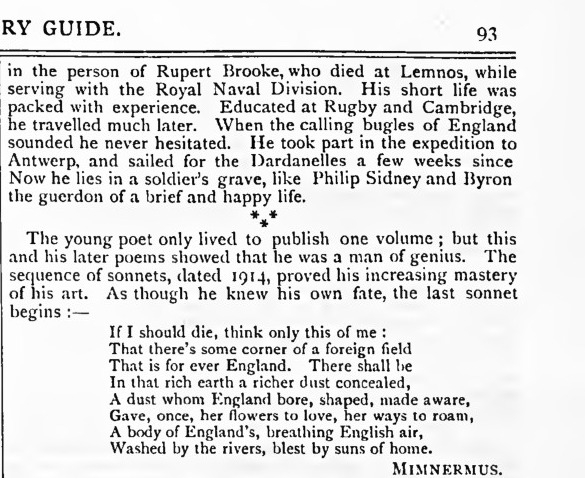
The Literary Guide marked his death in June 1915, calling him ‘the most distinctive of the younger English poets’. In 1964 The Humanist welcomed Christopher Hassall’s biography for showing the agnosticism of Brooke’s circle, and concluded that ‘Brooke the man seems in many ways more important than Brooke the poet’.
‘We had best cultivate our gardens of the arts. Then we may turn round one day to discover Beauty at our elbow—if she exists at all. If she doesn’t, we shall at least have learnt horticulture.’
Rupert Brooke, John Webster and the Elizabethan Drama (1916)
In 1987, T.F. Evans reviewed Paul Delany’s The Neo-Pagans for New Humanist under the title ‘Pagan Poet’. He found much of Brooke’s verse merely elegant and thought the war sonnets ‘wrongly admired’, but praised the lightness and freshness of his best work, singling out the ‘delightfully ironic and satiric’ ‘Heaven’.
The full issues of The Literary Guide, The Humanist, and New Humanist can be read in New Humanist’s digital archive, available via Exact Editions. Subscribe at newhumanist.org.uk/subscribe.

William Pirrie Barbour was a classicist, codebreaker, teacher, and activist. A rationalist and humanist, Barbour championed integrated education in his […]

He was the people’s First Minister, and this is a people’s ceremony. He wouldn’t want heavy mourning. This is a […]
The attainment of the greatest possible amount of social happiness I take to be the noblest of human aims; the […]
Nina Spiller was a lifelong worker for women’s rights, who played an active role in the humanist movement for more […]