As war is far too important to be left to the generals, so morality is far too important to be left to the theologians.
Maureen Duffy, ‘Separate Development? Out of the closet, into the ghetto’ (1980)
Maureen Duffy was a novelist, poet, playwright, and campaigner, and a humanist for the whole of her adult life. One of the first women in British public life to be open about being a lesbian, she was the first President of the Gay Humanist Group (now LGBT+ Humanists), founded in 1979, and a patron of Humanists UK from 2012 until her death.
She wrote more than 30 books, from the first openly lesbian novel published in Britain to a science fiction fable about a child born half gorilla, and campaigned with equal energy for LGBT rights, the rights of other animals, and the right of authors to be paid for their work. Her humanism, which she called ‘the ethics of compassion’, ran through all of it.
Maureen Patricia Duffy was born in Worthing, Sussex, on 21 October 1933. Her Irish father left when she was two months old, and she was raised by her mother, Grace, in poverty and poor health, moving between Worthing, Trowbridge, and the East End of London. Grace died of tuberculosis when Maureen was 15. Duffy later drew on this childhood for her first novel, That’s How It Was (1962), and credited her mother with the conviction that the one thing nobody could take from you was an education. She won a scholarship to grammar school, supported herself by teaching in junior schools, and took a degree in English at King’s College London in 1956, after which she taught in Naples and in London secondary schools until 1961.
Her first ambition was poetry, and she had her first poem printed at 17, but it was drama that opened the door. A play written at King’s brought an invitation to join the Royal Court Writers’ Group in 1958, alongside Edward Bond, Ann Jellicoe, and Arnold Wesker, and a commission from Granada Television in 1961 gave her the advance she needed to buy a houseboat and write full time. From then on she never stopped. Her output ran to 20 novels, nine volumes of poetry, some 30 plays for stage, radio, and television, and a shelf of non-fiction that included a biography of Aphra Behn (1977), credited with reviving interest in the first English woman to earn her living by writing, a life of Henry Purcell (1994), and England: The Making of the Myth (2001).
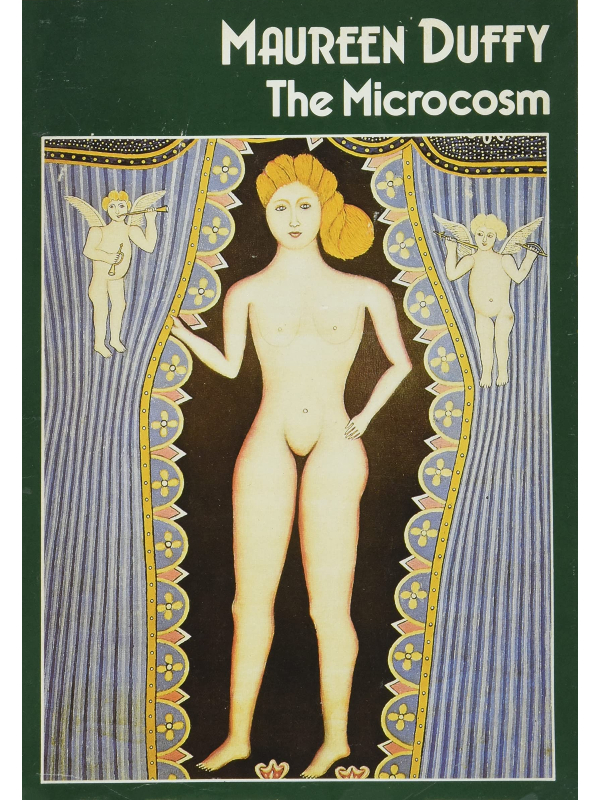
The Microcosm (1966), her third novel, was the book that made her name and changed British culture. Set in and around the Gateways Club in Chelsea, the best-known lesbian bar in London, it was written after a publisher declined a non-fiction account of lesbian life and suggested she make it a novel instead. It was the first British novel to depict a whole community of gay women, of different ages, classes, and backgrounds, and it made the case for their place in the world without apology. The book was banned in Ireland, South Africa, and the Vatican. Its final pages, in which the central character Matt decides to leave the ‘rock pool’ of the gay world for the open sea, are the closest thing to a manifesto Duffy ever wrote:
We’re part of society, part of the world whether we or society like it or not, and we have to learn to live in the world and the world has to live with us.
Duffy had come out publicly in her work in the early 1960s, and in June 1967, weeks before the Sexual Offences Act partially decriminalised homosexual acts between men, she appeared on BBC television to talk about what it took to be open. She is usually described as the first lesbian in British public life to have done so. In 1968 she published Lyrics for the Dog Hour, which included what Alison Hennegan has called the first modern lesbian love poems, and a humanist mass, ‘Missa Hermana’, later set to music by Dolly Collins and given its first performance at Conway Hall in 2023. Her play Rites (1969), commissioned by Joan Plowright for the National Theatre with an all-female cast, transplanted Euripides’ Bacchae to a ladies’ public lavatory.
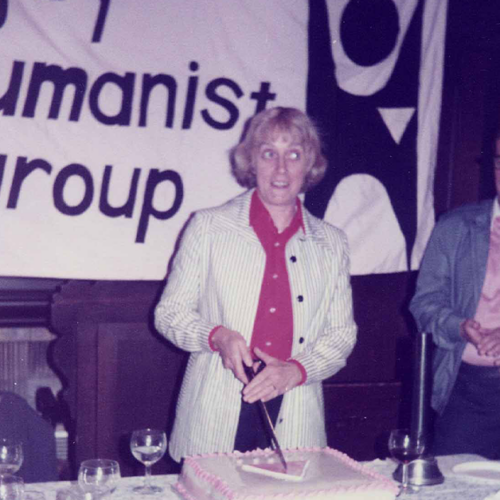
Duffy’s humanism was not a private matter. In 1976 Mary Whitehouse brought a private prosecution for blasphemous libel against Gay News, the first such case in half a century, and won. Duffy’s response was The Ballad of the Blasphemy Trial, a broadside in verse published the same year. The trial, and Whitehouse’s warnings about the influence of a ‘homosexual humanist lobby’, prompted the formation in 1979 of the Gay Humanist Group, which reasoned that if such a lobby was so feared it had better exist. Duffy became its first President the following year.
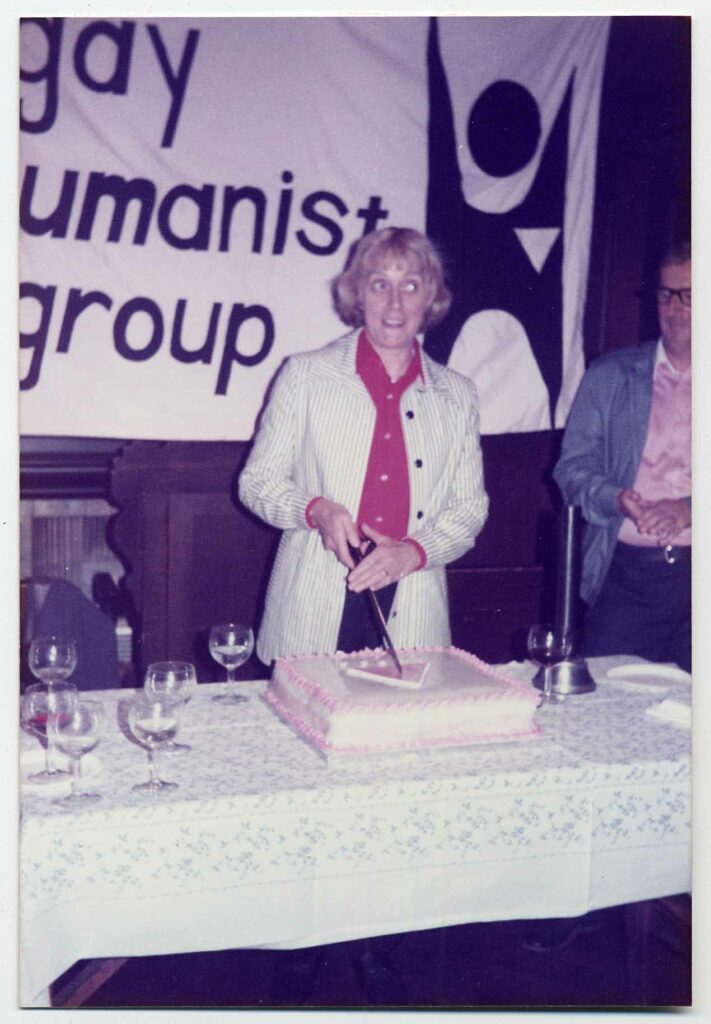
Her inaugural address to the group, given at Conway Hall on 17 March 1980 and later published as Separate Development? Out of the closet, into the ghetto, remains one of the clearest statements of what a humanist ethics might look like. The group’s purpose, she said, was not ‘simple church bashing’ but to ‘speak up wherever necessary from the rationalist stance’, and to contribute to what she called the ethics of compassion:
a fluid morality, based on a perception of fellowness, fellow feeling, fellow suffering. It is immensely appealing to a writer because it requires a continuing act of the imagination in order to identify with others and it also needs the continuing exercise of the reason if there is to be some bony structure to it.
The true humanist, she argued, was an existentialist, who ‘believes nothing is given except oneself and that every decision has to be lived and relived’. She extended that ethic explicitly to other animals, and warned her audience against the comforts of the ghetto: gay people had to be visible in the whole of society, she said, ‘to leaven the lump’, because separate development, whether in Warsaw or Soweto, had never ended well.
She remained President as the group became the Gay and Lesbian Humanist Association (GALHA) in 1987, speaking out on the rights of people with HIV and AIDS, and in 1988, as President of the Writers’ Guild of Great Britain, she carried a motion at the Trades Union Congress condemning Section 28 as an attack on free expression. When GALHA became part of Humanists UK in 2012, Duffy became a patron. She had long worked closely with Humanists UK in a similar capacity as GALHA President. In 2001 she joined Humanists UK patrons in a public letter urging the government to reconsider its expansion of faith schools.
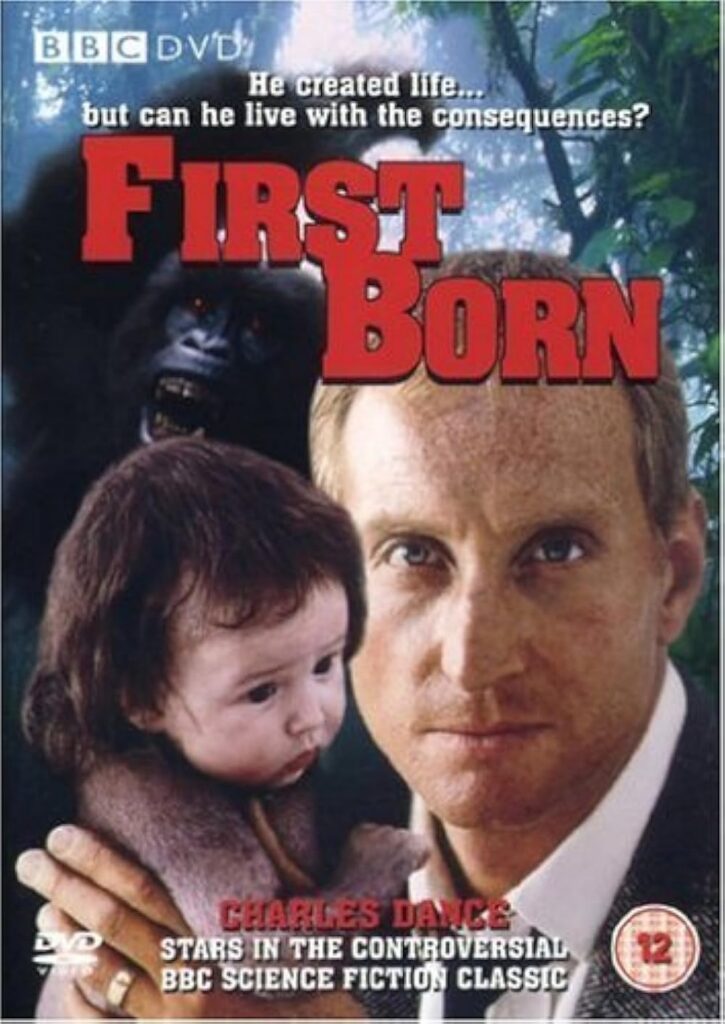
Duffy’s compassion did not stop at the species line. A vegetarian and a campaigner for animal rights from 1967, she signed a public promise never to wear fur in 1970, became Vice President of Beauty Without Cruelty in 1975, opposed vivisection throughout her life, and set out her thinking in Men and Beasts: An Animal Rights Handbook (1984). The subject runs through her fiction. I Want to Go to Moscow (1973) is a thriller about animal liberation; Change (1987) gives a group of apes one of its narrative voices; and Gor Saga (1981), her best-known work of science fiction, tells the story of a child bred by a scientist from a gorilla and a human woman and raised as a boy, who must discover what he is. Filmed by the BBC in 1988 as First Born, with Charles Dance as the scientist, it asks what we owe to the creatures we make and the animals we use, and sets out to dissolve the comfortable distinction between them.
With Brigid Brophy, her partner in the late 1960s and a lifelong friend and ally, Duffy founded the Writers’ Action Group in 1972 to campaign for a Public Lending Right, so that authors would be paid when their books were borrowed from libraries. Seven years of lobbying, including a delegation to the Prime Minister in 1977, brought the Public Lending Right Act in 1979. She went on to help found the Authors’ Licensing and Collecting Society, chairing it for fifteen years and remaining its Honorary President, and represented authors for decades at the British Copyright Council, the European Writers’ Council, and the World Intellectual Property Organization. Few writers have done more to secure a living for other writers.
Duffy was elected a Fellow of the Royal Society of Literature in 1985 and awarded its Benson Medal in 2004. In 2025, at 91, she was named the first winner of the RSL Pioneer Prize, founded by Bernardine Evaristo for women writers over sixty. She died on 27 May 2026, aged 92.
Maureen was a brilliant writer and an irreplaceable pioneer of our movement… She embodied the very best of humanist values – using reason, creativity, and empathy to build a fairer world. Everyone should know her name.
Andrew Copson, Chief Executive of Humanists UK, May 2026
Duffy’s influence has run along several channels at once. As a novelist she showed, in Maggie Gee’s words, that the English novel need not be domestic and realistic but could be experimental and political. As a lesbian she was visible when visibility carried real cost, and her example gave others, among them the poet U. A. Fanthorpe, the confidence to follow. As a campaigner she changed the law twice over, on lending rights and on the funding of British writing, and helped to make the case, long before it was fashionable, that the moral circle extends beyond our own species. And as a humanist she gave the movement one of its best short definitions of what it is for: an ethics of compassion, requiring both imagination and reason, and practised in the open rather than behind a bolted door.
The National Portrait Gallery is an art gallery primarily located in London but with various satellite outstations located elsewhere in […]
…for a long time, like the philosophers of old, I was trying to find indisputable foundations. How long it took […]
I hold that a writer should not in any circumstances or for any cause surrender his duty to criticise and […]
Harford Montgomery Hyde was a Belfast-born barrister, politician, author, and humanist, who championed humane legal reforms and progressive social attitudes. […]