Graham Wallas (1858–1932)
( 09 October 2026 - 09 August 1932 )
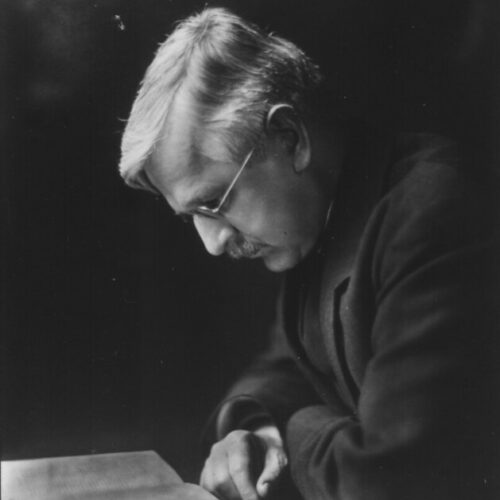
( 09 October 2026 - 09 August 1932 )
‘Graham Wallas was a happy man because he passed his life in service at the altar of Reason.’
Harold J. Laski, The Literary Guide, September 1932
Graham Wallas was a political psychologist, educationist, and Fabian, one of the founders of the London School of Economics, President of the Ethical Union (today’s Humanists UK) in 1924, and the first President of the Rationalist Press Association, from 1926 to 1929. His books Human Nature in Politics (1908) and The Art of Thought (1926) asked how people actually come to their beliefs, and his answer, that reason and feeling work together rather than against each other, shaped how the RPA came to think about its own work.
Wallas was born in Sunderland in 1858, the son of a clergyman, the Rev. G. T. Wallas. Speaking at the RPA’s annual dinner in 1921, he said he had accepted the Association’s founding principle, that it was a sane person’s duty to deny publicly what was plainly incredible, more than forty years earlier, as an Oxford undergraduate thrilling to the essays of W. K. Clifford, from whom he learned to listen for ‘the still small voice that whispered “fiddlesticks”’. He recalled asking a cabby in the Strand to drive him to the Hall of Science, the secularists’ meeting place, and the cabby being shocked beyond words. Harold Laski, his successor as the RPA’s President, later wrote that as a young schoolmaster Wallas had chosen dismissal rather than lead religious devotions he did not believe in.
He became one of the leading Fabians, alongside George Bernard Shaw and Sidney and Beatrice Webb, served for ten years on the London School Board and later with the London County Council, and taught at the LSE, where he was Professor of Political Science from 1914 to 1923. In 1924 he gave the Conway Memorial Lecture at South Place, on its first minister, William Johnson Fox.
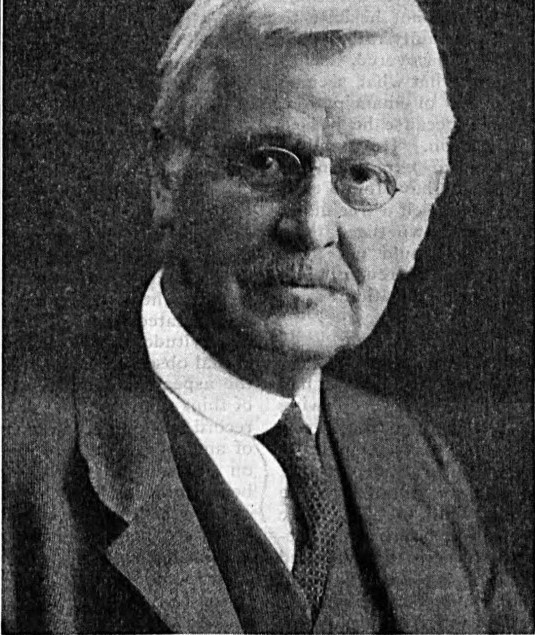
At that 1921 dinner Wallas urged the RPA to ask not only whether people should follow reason, but what reasoning actually is, in the light of new knowledge about conscious and unconscious thought. He quoted Shelley, whom he called the saint of rationalism: reason is ‘an assemblage of our better feelings, passion considered under a peculiar mode of its operation’. He asked the Association’s directors to add psychology to their list. His own The Art of Thought set out four stages of creative thinking, preparation, incubation, illumination, and verification, which J. M. Robertson reviewed at length in The Literary Guide.
‘Reason was a matter of the whole man—mind and body and passion alike.’
Graham Wallas, RPA annual dinner, reported in The Literary Guide, July 1921
The RPA’s directors appointed Wallas as the Association’s first President in 1926. He chaired its annual dinners, where he attacked the ‘dead hand’ of endowed institutions that kept old beliefs in place, presided at the dinner for J. M. Robertson’s seventieth birthday, and in 1929 led the RPA’s deputation to the Home Secretary in support of a bill to reform the blasphemy laws. He handed the presidency to Laski in 1929.
Wallas died suddenly on 9 August 1932, while on holiday at Portloe in Cornwall. Friends at the LSE set out to mark his memory there with a Wallas Room, a prize, and an annual lecture. The Literary Guide published the obituary and tributes below the following month.
We record with much regret the sudden death on August 9, while on holiday at Portloe, in Cornwall, of Professor Graham Wallas, the first President of the Rationalist Press Association (1926–1929) and a foremost member of many other advanced organizations. He was a son of the late Rev. G. T. Wallas, and was born at Sunderland in 1858. He had only recently completed his seventy-fourth year. At the R. P. A. Dinner in May, the last time we saw him, he seemed in good health and was full of his natural buoyancy—a characteristic of his which captivated all who had the privilege to know him. Our revered friend was an ideal chairman. He kept control of every speaker, and his audiences were always responsive to his rulings. The R. P. A. will never have a more inspiring and enthusiastic champion. For three years he worked zealously in its behalf, and it was with sincere regret that he vacated his office as President, notwithstanding that he was transferring his duties to a colleague for whom he had profound admiration.
Wallas was throughout the greater part of his life identified with the Fabian school of Socialism, though latterly he inclined more and more to the Labour view of practical politics. For ten years he was a member of the London School Board, and later he was associated with the London County Council. For a considerable period he was a lecturer in connection with the London School of Economics. In 1914 he was appointed University Professor of Political Science, a chair which he occupied until 1923; and as recently as November last Oxford conferred upon him the Honorary degree of D.Litt.
Wallas’s literary output was not extensive. One of his earliest books was Human Nature in Politics, published in 1908. In 1914 he wrote The Great Society, an effort to explain and analyse the organization of the modern state. There followed in 1921 Our Social Heritage, and in 1926 The Art of Thought. His latest work was a biography of Francis Place, a striking vindication of that friend of freedom. Wallas was a slow writer, and it was not at any time easy to induce him to contribute an article to a periodical.
The final farewell took place at Golders Green Crematorium, in the presence of a large number of the deceased’s associates and admirers, including Lord Snell, Professor H. J. Laski, Mr. John Burns, Sir Harry Samuel, Mrs. George Whale, Mr. and Mrs. J. P. Gilmour, Mrs. H. Bradlaugh Bonner, Mr. Arthur Bonner, Mr. S. K. Ratcliffe, Professor J. H. Muirhead, Sir Henry A. Miers, and Mr. and Mrs. Charles A. Watts. The burial was a silent one—not a word, not a sound. To some it was impressive; but many regretted the absence of music and the usual address.
We have pleasure in publishing the following tributes to Professor Graham Wallas. Pressure of space compels us to exclude several others. We may publish some of them next month:—
Quite recently I was talking to Graham Wallas, and now he too has passed out from the dwindling circle of old friends with whom I started adventures in the world of ideas and projects. That big, unathletic, rather slouching man, with his fine head and brow, and the boyish zest on his handsome face as he talked of the things that interested him and lit him up, becomes no more than a memory. I saw him first at a meeting in that old greenhouse place of William Morris’s at Hammersmith some forty years ago, and I remember he was speaking upon the question of what had to be done after the revolution. He said the Marxists had a formula for a revolution, but no formula for afterwards; and the history of Russia, with its past fourteen years of hectic improvisations, confirms all that he said on that occasion. Later I came to know him well. We argued and tramped for a fortnight among the Swiss mountains, discussing our common doubts of contemporary democracy (he was planning his Human Nature in Politics then), and in spite of all sorts of incidental disputes and differences we continued to the end to poke about, he upon his academic level and I in my journalistic way, with the problems of mental and social organization that open upon one directly one abandons a mystical faith in the mind of the masses. He was a Liberal first and last (a liberal thinker I mean), and he came to Fabianism by the way of liberal inquiry. His published work is a mere fraction of his fruitfulness. He was, if I may say it, rather a lazy writer; but he lectured, talked, suggested, and inspired, and a large part of his consequences is to be found in the work of others to whom he gave himself. He shared a common helpfulness with the Webbs and Shaw. It was the excellent tradition of the central Fabian group to read and comment upon each other’s work before publication. The hottest public recriminations did little to affect that private intellectual intercourse. Always and particularly I liked to check up with Wallas, and among my final memories of him I have him in the armchair in my study turning over a list he had prepared of comments, emendations, and criticisms of my last book, tapping the typescript with a pencil, and arguing in his high-pitched, deliberating voice. “I shouldn’t say that, you know. I don’t think it is quite fair to say that.” For the last time. Death, when it touches me, will not trouble me, for I shall not know of it; but I hate more and more this plucking away of my friends.
‘He said the Marxists had a formula for a revolution, but no formula for afterwards.’
H. G. Wells, The Literary Guide, September 1932
As he wished, he died working and in the full heyday of his powers. No one who ever met Graham Wallas but must have been impressed by him. A great teacher, a thinker of real importance, one of the most gifted talkers I have ever known, he exercised an abiding influence upon his generation. He had courage, a passion for ideas, a willingness to follow truth as he had found it wherever it might lead. Few men of our time have been so amply Rationalist as Graham Wallas.
A son of the Church, he did not hesitate to reject its dogmas when he found them intellectually inadequate. As a young schoolmaster, ordered to perform devotions in which he did not believe, he did not hesitate to choose dismissal and economic uncertainty rather than hypocrisy and comfort. And he discovered, as so many in our movement have done, that what seemed to be the hard way was in fact the way of emancipation. Graham Wallas was a happy man because he passed his life in service at the altar of Reason. He found in its causes an emotional exhilaration, an expression for his abounding energy, he could hardly have found elsewhere. He learned in it how to be himself a free man; his example and his teaching have shown the path to liberation to many who, otherwise, would not have known the road. To know him was to revere him; and to revere him was indeed a liberal education.
The death of Graham Wallas came as a heavy personal blow to me. For more than fifty years I had known him, and had come to value with an ever-growing appreciation his great gifts of intellect and the sweetness and freedom of his character. A freethinker in the largest sense of that word and in every department of thought, he made his special contribution to the psychology of politics, where his width of knowledge and his brilliant power of exposition brought the elements of scientific order into a hitherto ill-cultivated field. His Human Nature in Politics and his The Great Society have exercised a remarkable influence in liberating English thought from olden conventions and taboos, and in laying the foundations of what he preferred to call The Art of Politics.
Graham Wallas was, I think, one of the great University teachers of his time. His books will tell the future a good deal about the chequered hopefulness of our generation, its breakaway from sharp-cut generalizations in radical politics, in economic argument, and in self-examination about what we really believe. But his living self taught us more than we have learnt from his books. In his unorthodox way he was a confessor. Only a man who always told himself the truth about near things and last things could have influenced us as he did, often against our will. And he always did it with a smile, half sceptical, half happy: never pompous, rather wistful sometimes, but yet imperative. You felt that, while he was young, he had lost something that mattered, and had spent his life trying to find a working substitute and nearly finding it. His bearing and presence were significant: tall, with a tuss of hair over his forehead, eyes half-closing with a painter’s look at his subject, and a voice which gave one complete confidence in him as knowing far more about his subject than he had time to tell, but which also suggested a touch of irony when he reviewed his own provisional conclusions.
Reproduced from the Times, August 13.
The unexpected news of the death, while on holiday, of Emeritus Professor Graham Wallas will be received with profound regret and a keen sense of personal loss not only by his intimate friends, but by the wide circle of a public in all parts of the world who knew him only by reputation or as readers of his published works. To those of us who are declining in the vale of years Lowell’s lines are apt to recur:—
As life runs on the road grows strange,
With faces new, and near the end
The milestones into headstones change,
’Neath every one a friend.
Graham Wallas was a man who, in the course of a long and fruitful career, had touched life at many points and set in salutary motion countless currents of intellectually and morally health-giving forces.
As Chairman of the Board of Directors of the Rationalist Press Association it was my good fortune to be officially associated with him during his Presidency, and so to learn something of the glowing ardour and intensity of his loyalty to the great cause for which it stands. There were no bounds to the goodwill and devotion of his service to its activities, and he never grudged any effort on its behalf.
It has been well said that personality is one of the many elusive realities in life that cannot be reproduced. The term “bonhomie” as a cliché of character is often misapplied, but, while not distinctively descriptive, it denotes, with a high degree of verisimilitude, the prevailing cast of Graham Wallas’s disposition and attitude towards life. He was essentially a loving and lovable man; a lover of humanity in the only possible way in which it can be loved in the mass—that is, by working with might and main for its emancipation from the accumulated errors of belief and conduct which keep it in servitude to arbitrary authority and tradition. To the casual observer Graham Wallas’s chivalry might have the aspect of complaisance with the established order of things, but in every sphere of thought and action his record was one of strenuous and systematic challenge of and protest against obscurantism and injustice, and on occasion he was outspoken, intrepid, and, if need be, uncompromising in his exposition and vindication of the principles and propaganda of Freethought.
Of the many signal services that he rendered to Rationalism none so well became him, or was more valuable to Liberty, than his leadership of the deputation to the Home Secretary in 1929, in support of the miscarried Blasphemy Law Bill, the case for which, in accordance with the views of the deputation, was put by him with admirable clearness and force.
It has been said that Graham Wallas’s chief claim to remembrance is his pioneer work and example as a teacher, and the pervasive influence that he exerted in that capacity. Others who knew him better on that side will be more competent to bear testimony to his achievement in it. For those of us who knew and loved him the feeling uppermost is best expressed in York Powell’s phrase: “These gaps in the ring of our lives are too many.” As for Graham Wallas, what more fitting epitaph can we find than the following verse. He
Took his full of music, joy of thought and seeing;
Came, and stayed and went,
Nor ever ceased to smile.
The news of the death of Graham Wallas has been a painful shock to me. I had known him for over forty years, and, whether we were agreeing or partially dissenting, always found him a faithfully reasoning mind that felt itself bound to take the course which reason and justice indicated. Always actively thinking on the problems of life, he was unfailingly a quiet stimulus to thought in others. And with it all he maintained his loyalties as warmly and steadfastly as any enthusiast. He was indeed the best kind of enthusiast. I feel the poorer to know that he is gone.
‘Professor Graham Wallas: In Memoriam’, The Literary Guide, September 1932, pp. 165–166, with tributes by H. G. Wells, Harold J. Laski, J. A. Hobson, Sir Michael Sadler (from The Times, 13 August 1932), J. P. Gilmour, and J. M. Robertson. Transcribed from the original; spelling and punctuation as printed. The full issue can be read in New Humanist’s digital archive, available via Exact Editions. Subscribe at newhumanist.org.uk/subscribe.
Mary Edith Durham was a writer, artist, and anthropologist, who became well known for her work on Albania. She was […]

Anna was not a religious person. As a humanist, she believed in the goodness of people and their ability to […]
I think I was born a humanist. John D. Stewart, The Honest Ulsterman, May 1968 John D. Stewart was a […]
We are (of all the synonyms I most prefer to ‘humanist’) freethinkers. We are deprived of nothing. We have lost […]