Neville Chamberlain (1869–1940)
( 18 March 1869 - 09 November 1940 )
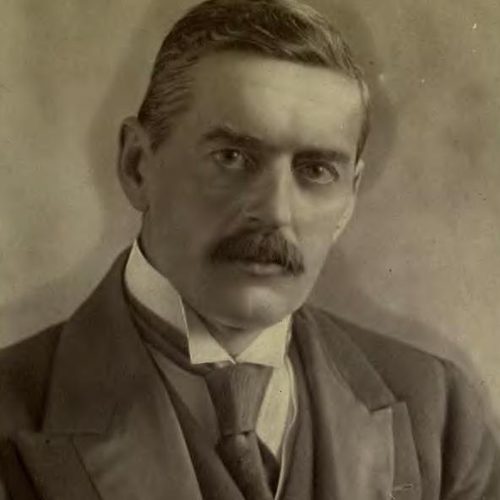
( 18 March 1869 - 09 November 1940 )
‘I am myself a man of peace to the depths of my soul.’
Neville Chamberlain, 1938, quoted by Ernest Thurtle in The Literary Guide, December 1940
Neville Chamberlain was a Conservative politician who served as Prime Minister from 1937 to 1940. He is remembered above all for the Munich Agreement of 1938 and the policy of appeasement towards Nazi Germany, which most historians of the war judge a grave failure: he badly misread Hitler, and his reputation has never recovered. It fell to him to declare war on Germany in September 1939, and he was forced from office eight months later.
Raised in a Unitarian family by a father who called himself ‘a very reverent agnostic’, he took no interest in organised religion at any point in his life, and found his own sense of wonder in the writing of Charles Darwin. Like David Lloyd George before him and Winston Churchill after him, he was one of Britain’s non-religious wartime Prime Ministers, and the humanist and rationalist movement of the day watched him with interest.
Chamberlain was born in Birmingham in 1869, the son of the radical politician Joseph Chamberlain. The family were Unitarians, who rejected the Trinity, original sin and the need for baptism, and in Birmingham their chapel was as much about education and social reform as worship. Joseph’s own faith faded early. He never scoffed at the churches, but one evening he told his son: ‘I am a very reverent agnostic.’ The phrase is often attributed to Neville himself, but it was his father’s. Neville did however inherit his father’s distaste for organised religion; he later recalled being brought up ‘to hate’ the Church of England and the privileges that had long shut Unitarians out of public life. Meeting the Archbishops of Canterbury and York as Director of National Service in 1917, he admitted: ‘It does make me smile when I think how I used to hate the Church.’
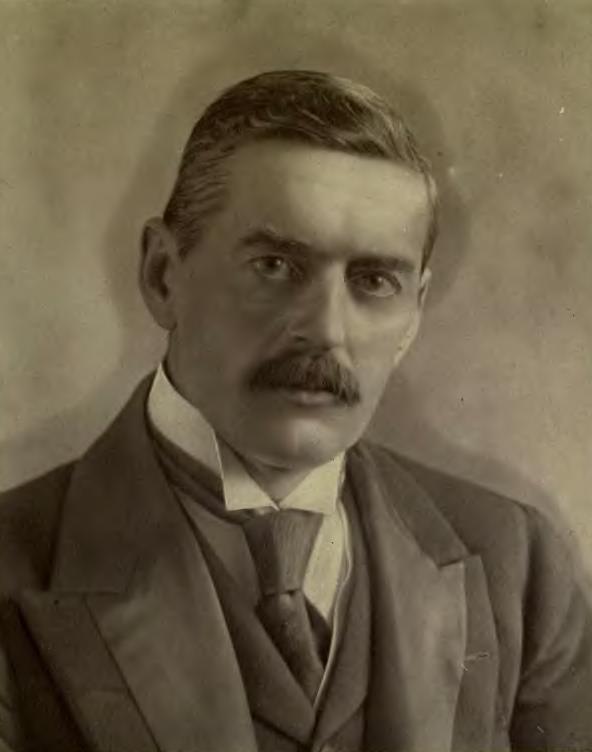
When Joseph died in 1914, the family turned down a grave in Westminster Abbey and buried him instead at Birmingham’s Key Hill Cemetery, the city’s old Nonconformist burial ground and the resting place of freethinkers such as the poet Constance Naden. Neville’s own ashes, by contrast, would be laid in the Abbey.
His Unitarian label was still enough to mark him out. In a 1946 Commons debate on the BBC’s charter, reported in The Literary Guide, one MP pointed out that while Chamberlain was Prime Minister his Unitarianism would have barred him from giving a talk on the BBC about his own religious outlook, so narrow was the range of belief the corporation allowed on air. (Not much has changed: non-religious speakers are still barred from Radio 4’s Thought for the Day.)
Darwin became the passion of his life. Neville began reading him as a student at Mason College in Birmingham, and came to judge him the greatest Englishman who ever lived, alongside Shakespeare and his own father. Joseph thought it a waste of time to discuss questions ‘to which we did not and could not know the answer’, but Neville read and argued over Darwin and his successors with his sisters, and later his wife, finding in them ‘the most thrilling possibilities’. He kept Darwin’s photograph in his study, taught Darwinism to the Sunday school at Birmingham’s Unitarian Church of the Messiah, and as president of the Birmingham and Edgbaston Debating Society chose ‘Human Development under Natural Selection’ as the subject of his address.
‘[He was] the most ultra-modern of all great men.’
Neville Chamberlain on Charles Darwin
Sent to the Bahamas at twenty-two to run his father’s ill-fated sisal plantation, he spent six years reading Darwin and Shakespeare, and wished ‘all the reverends in the Bahamas were at the bottom of the sea’. When an Anglo-Catholic priest there picked up his copy of On the Origin of Species and joked that Darwin had hunted the missing link because he looked so like a monkey himself, Chamberlain was incensed: ‘I could have kicked him or knocked him down. Such a mixture of ignorance, conceit and profanity is contemptible to the last degree.’ He never lost his contempt for churchmen ‘defending dogmatic assertions of creation’.
His biographer Mark Vickers concludes that this veneration of Darwin ‘was the closest Chamberlain came to a sense of the sacred’. Like many of his generation, he also took from it some uglier ideas: he opposed the ‘feeble-minded’ having children, a view Vickers places in the company of Balfour and Churchill as ‘the gospel of Charles Darwin, or at least of the social Darwinists’.
The devotion lasted. In January 1939, with Chamberlain now Prime Minister, The Literary Guide noted with pleasure that he had twice visited Down House, Darwin’s home in Kent, had greatly admired its contents, and hoped to go again.
In office he kept his own counsel. When a Nottinghamshire clergyman protested in 1940 that the Prime Minister had stood godfather to the children of two colleagues, the Archbishop of Canterbury’s chaplain replied, without any attempt at theological justification, that whether Chamberlain could undertake a godparent’s duties was ‘a matter which must be left to his own conscience’. Even his wartime appeals to ‘the blessing of Almighty God’, historian Mark Vickers notes, were never explicitly Christian.
‘A matter which must be left to his own conscience.’
The Archbishop of Canterbury’s chaplain, on the Prime Minister as godparent, 1940
In early 1940, during the ‘phoney war’, an MP asked the Prime Minister to approach the churches about a national day of prayer, beseeching God to bring the war to a speedy end. Chamberlain replied that the suggestion would be considered at the appropriate time: ‘I do not think that time has yet arrived.’ The Labour MP Ernest Thurtle, a rationalist, asked whether the Prime Minister might first consult the heads of the fighting services on the efficacy of the proposal. The House laughed.
Others tried to put religious words in his mouth. When the Conservative MP Beverley Baxter claimed in 1938 that appeasement followed the Sermon on the Mount, the journalist Hannen Swaffer retorted, ‘Turn the other cheek to Tyranny and kiss Hitler, I suppose’; The Literary Guide, in July 1938, took the exchange as proof that ‘Scripture can be used to prove almost anything’.
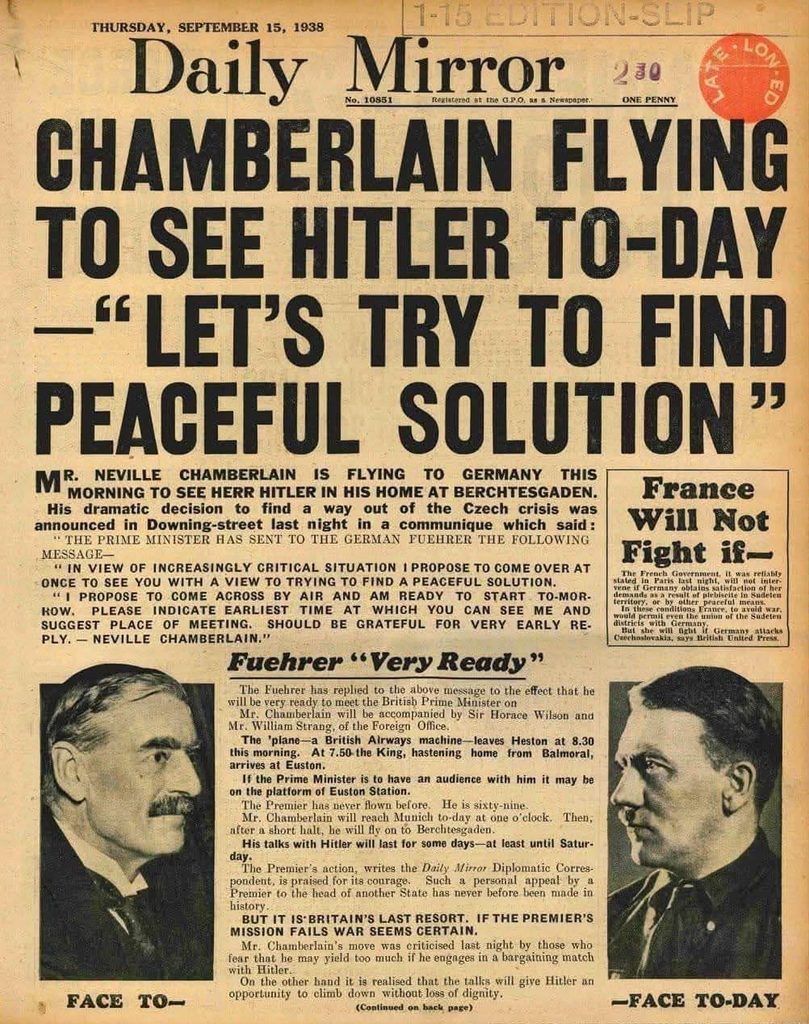
As Prime Minister, Chamberlain made appeasement of Nazi Germany his central policy. He took no action when Hitler annexed Austria in March 1938, and in September flew three times to meet him, ending with the Munich Agreement, which handed the Sudetenland to Germany without Czechoslovakia at the table. He returned promising ‘peace for our time’. Six months later Hitler seized the rest of Czechoslovakia, and in September 1939 Chamberlain had to announce that Britain was at war.
His war leadership fared little better. After the failed Norway campaign, his own backbenchers turned on him in May 1940, the Conservative Leo Amery telling him, in Cromwell’s words, ‘In the name of God, go’.
He resigned on 10 May. That summer Guilty Men, written under a pseudonym by three journalists including the future Labour leader and humanist Michael Foot, fixed him in the public mind as the chief author of Britain’s unpreparedness. Some historians have since argued that Munich bought time for rearmament, but the prevailing judgement remains that he badly misread Hitler and left Britain and its allies weaker for it.
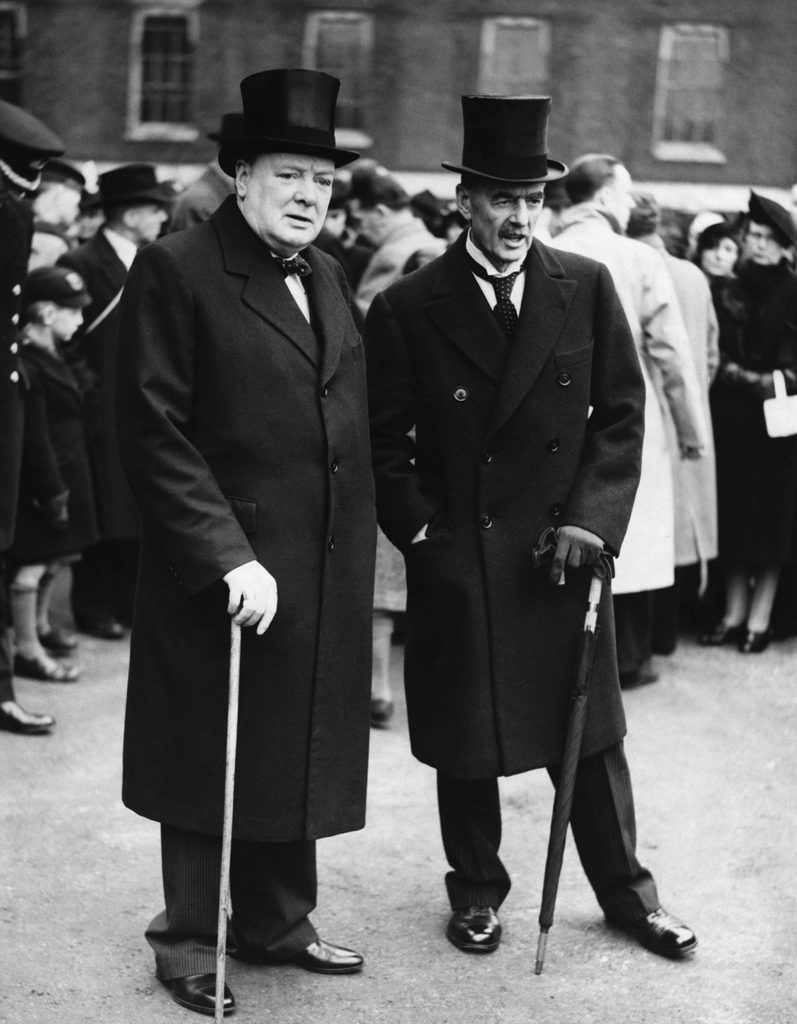
Chamberlain stayed on in Churchill’s War Cabinet until illness forced him out that autumn, and died of cancer on 9 November 1940. Thurtle wrote his tribute for The Literary Guide. A Labour opponent and no defender of Munich, Thurtle nonetheless presented Chamberlain as a man who had placed his ‘faith in the efficacy of negotiation and reason’, believing that wars came from misunderstandings that frank, direct talk could remove, and who had ‘rated war as almost the worst of all evils which could befall modern civilization’. Where he went wrong, Thurtle thought, was in assuming that the dictators shared that view.
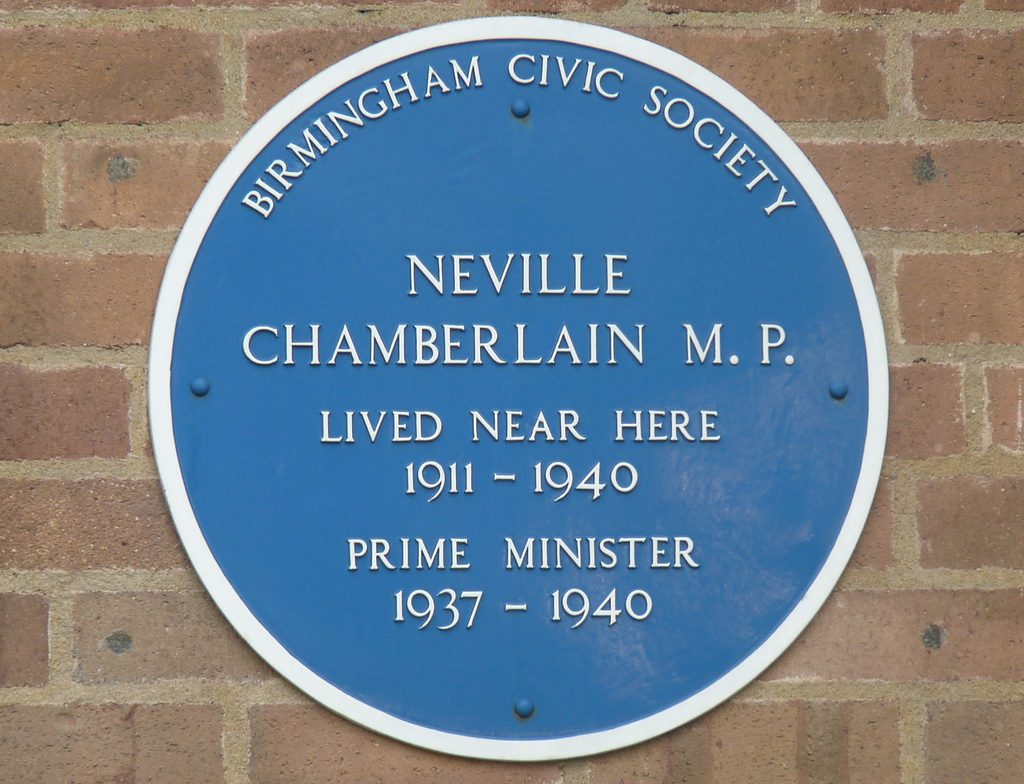
Chamberlain was cremated at Golders Green on 13 November with no ceremony and only two mourners present, before a service for his ashes at Westminster Abbey the next day.
Thurtle chose a secular epitaph, from Shakespeare rather than scripture: ‘After life’s fitful fever he sleeps well.’ History’s verdict on appeasement was still to come, he wrote, but it would not ‘cast doubts on the deep sincerity of his desire that the world should be spared the calamity of the present war’.
Chamberlain’s reputation has not recovered from Munich, and this entry makes no case for his statecraft. But his life is a reminder that, a century ago, a Prime Minister could be a lifelong unbeliever without much remark, and that for much of both world wars Britain was led by men who did not share the faith of the established church. In 2024 Humanists UK included him in its history of non-religious Prime Ministers.
The New Humanist archive, including The Literary Guide, is available via Exact Editions. Subscribe at newhumanist.org.uk/subscribe.
Conservation… draws us towards not only a scientific but a philosophical and historical approach to the problems of the earth […]
I have no view but public good; certainly no desire to injure any one, but a passionate desire to do […]
Free thought means fearless thought. It is not deterred by legal penalties, nor by spiritual consequences. Dissent from the Bible […]
Without denying or affirming a life after death, or reality beyond experience… we can (without injury to our moral life) […]