How much of thankfulness we owe to the goodness, the intelligence and the untiring energy of men and women who are now dead, but who toiled in patience and sincerity for those of their day and for us who followed, many of whom they were never to see or know.
A. C. Brooks, graveside oration for John Cattell Hudson
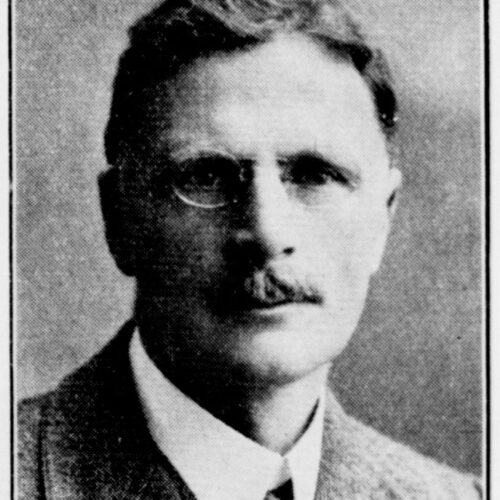
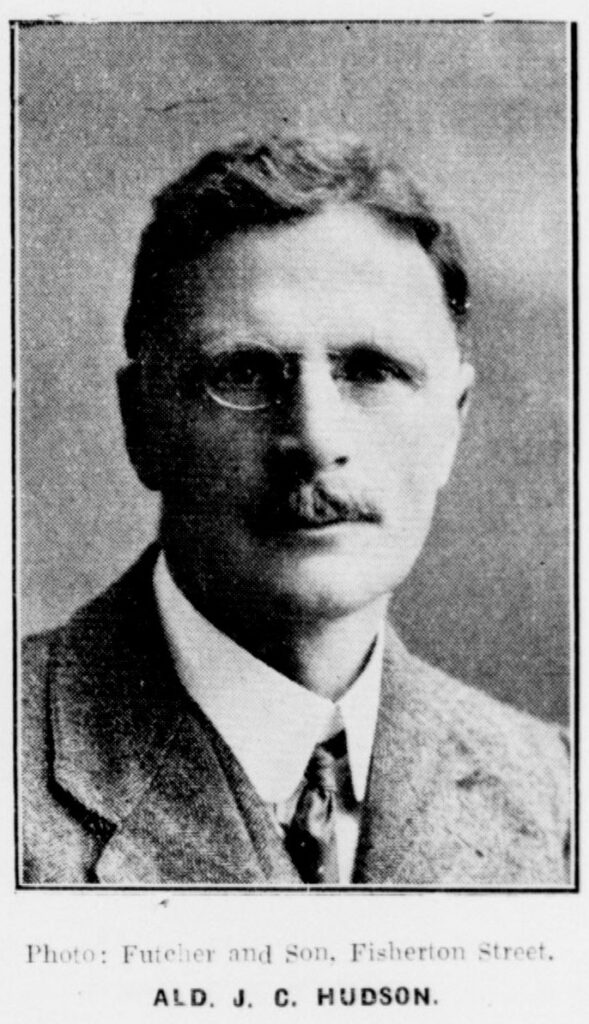
John Cattell Hudson was a journalist, editor, and rationalist. He was Mayor of Salisbury 1926-7, and subsequently an Alderman and chairman of the Ancient Buildings Committee. His death in 1935 prompted a notice in The Literary Guide (now New Humanist), as well as extensive coverage in the Salisbury Times, which reported various tributes as well as his rationalist funeral, conducted by A. C. Brooks on behalf of the Rationalist Press Association, and attended by innumerable friends and colleagues from across the City Council and the many organisations of which he was a part.
Hudson was one of the founders of the Wiltshire branch of the Council for the Preservation of Rural England, and his will left provision for the purchase and development of open space within or near to Salisbury, and for the city’s beautification through planting. Hudson’s Field, aquired thanks to his legacy and named for him, is an area of open grassland and recreational space in Salisbury still much used today.
He was a man of untiring energy, and was a hard worker not only on Committees connected with the Corporation, but in many causes for the welfare of the people of Salisbury.
On January 28 John Cattell Hudson died at his home in Salisbury at the age of sixty-seven. He had been in failing health for a long time, but had kept at work till the day of his death. For the past thirty-four years he had been editor of the Salisbury Times. In 1926 he was elected Mayor of Salisbury, and last year was made an Alderman.
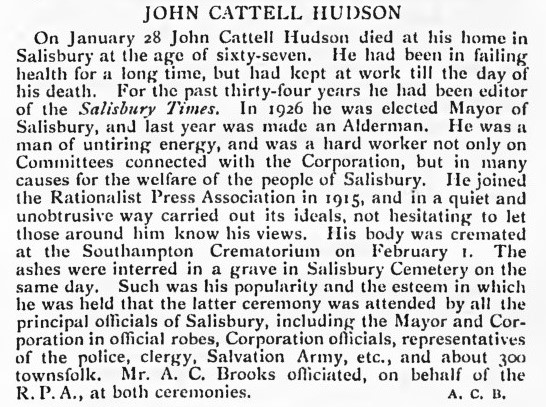
He was a man of untiring energy, and was a hard worker not only on Committees connected with the Corporation, but in many causes for the welfare of the people of Salisbury. He joined the Rationalist Press Association in 1915, and in a quiet and unobtrusive way carried out its ideals, not hesitating to let those around him know his views. His body was cremated at the Southampton Crematorium on February 1. The ashes were interred in a grave in Salisbury Cemetery on the same day. Such was his popularity and the esteem in which he was held that the latter ceremony was attended by all the principal officials of Salisbury, including the Mayor and Corporation in official robes, Corporation officials, representatives of the police, clergy, Salvation Army, etc., and about 300 townsfolk. Mr. A. C. Brooks officiated, on behalf of the R. P. A., at both ceremonies.
A. C. B.
The funeral of Ald. J. C. Hudson, editor of The Salisbury Times, whose death was recorded last week, took place at the Devizes Road Cemetery on Friday afternoon, after the remains had been cremated at Southampton earlier in the day. The Mayor and members of the City Council attended in state, preceded by the mace bearers whose insignia were draped. Despite the cold blustery weather there was a large assembly at the cemetery, including many of the poorer inhabitants of the city who had frequently benefited by Ald. Hudson’s generosity and kindness.
In accordance with instructions left by him, there was no religious service, and the simplicity of the final rites was striking. There were no hymns or prayers. Mr. A. C. Brooks, a member of the Rationalist Press Association, officiated at the graveside and delivered an address.
In accordance with instructions left by him, there was no religious service, and the simplicity of the final rites was striking. There were no hymns or prayers. Mr. A. C. Brooks, a member of the Rationalist Press Association, officiated at the graveside and delivered an address. As he uttered the words “Farewell brother,” the ashes, which were in an oaken casket, were lowered into Mrs. Hudson’s grave by white silken ribbon. The bunch of snowdrops on the casket was placed there by Mr. Hudson’s godchild, Michael. The grave was lined with moss and laurustinus.
The immediate friends present were Mr. Charles Hudson (cousin), Mrs. Hampton, Mr. and Mrs. Prudence, Miss Prudence, Mrs. Lovelace, Mr. R. Watson, the Rev. J. H. Litten (Principal of the National Children’s Home and Orphanage, who was chaplain when Mr. Hudson was Mayor), Miss Edith Adlam (housekeeper), Mrs. G. Hancock, Mr. and Mrs. Frank Hancock, Mr. and Mrs. Norman Hancock, Mr. M. F. Batts (managing director, Salisbury Times Co., Ltd.), Messrs. W. T. Best and G. Hancock (executors).
The members of the city council were preceded by a posse of police under the Chief Constable (Mr. R. F. Nixon). The Mayor (Clr. E. H. Major) walked with the Town Clerk (Mr. Arthur Smart)…
The members of the city council were preceded by a posse of police under the Chief Constable (Mr. R. F. Nixon). The Mayor (Clr. E. H. Major) walked with the Town Clerk (Mr. Arthur Smart), and those also present were the Deputy Mayor (Clr. E. J. Case), Ald. Sir James Macklin, H. Lapham, H. B. Medway, F. H. Wort, R. Bracher and R. Bousie, Clrs. H. Medway, A. Hinxman, J. S. Rambridge, C. Scamell, G. E. Thornton, B. Bowditch, W. C. Bridge, A. Courtney, H. H. Bates, G. A. Berry, E. A. Batt, E. R. Grant, H. Barber, F. Sanders, B. G. Gordon, H. W. Hall and S. N. Bigwood, with the Assistant Town Clerk (Mr. W. J. Carey), the City Engineer (Mr. H. V. Overfield), the Assistant City Treasurer (Mr. C. P. Denny), the City Librarian (Mr. W. Hughes); Mr. C. J. Woodrow and Mrs. J. L. Lovibond (city magistrates), Mr. W. E. Lisle Bentham (magistrates’ clerk), Mrs. E. Scamell (Wilts County Council) and Mr. J. L. Lovibond (a member of the Ancient Buildings Committee).
Mr. H. C. Moody and Mr. E. F. Bailey attended as directors of the Salisbury Times Co., Ltd., and the members of the staff present were Messrs. E. T. Waite, R. M. Williams, R. A. Howell and R. J. E. Long (editorial), Mr. A. P. Dunning, Miss W. Jewell and Miss L. Whitlock (office), Messrs. J. H. Witt, F. J. Hart, F. W. Bailey, P. Hurn, H. Griffin, S. Steer, R. J. Way, S. Williamson, W. Hibberd, B. Palmer, H. Hughes, W. Gamblin, H. Vann, G. Fowler, J. Topham, A. Horder and M. Tasker (works).
Mr. B. A. Pook, of the “Southern Daily Echo” (hon. secretary of the Salisbury branch of the National Union of Journalists), and Mr. R. W. Eason, of the “Evening World” (hon. treasurer of the branch), attended, also Mr. A. J. Lowe and Mr. D. H. P. Toogood (“Salisbury and Winchester Journal”), Mrs. W. C. Stacey and Mr. E. G. Pike (“Western Gazette”).
Mr. W. Cutler (chairman), Mr. A. F. Lawrence (hon. secretary) and Mr. L. Lawrence represented the Salisbury Divisional Liberal Association; Miss Smith (chairman), Mrs. K. Notley (secretary) and Mrs. Cutler, Salisbury Women’s Liberal Association; and Mr. A. Reid (chairman), Salisbury Branch of the League of Young Liberals; while Mr. W. A. Edwards (secretary of the Western Counties Liberal Federation) was also present.
The Salisbury Education Committee was represented by the Rev. Father Hyland and Mr. H. G. Sainsbury, the Council School by the head teachers of the three departments, Mr. E. L. Warren, Miss Grosvenor and Miss John.
Others present included the Rev. W. Mauleverer (priest-in-charge of St. Francis’), the Rev. E. T. Bowles (Methodist minister of Calne), the Rev. Henry James (Milford Street Methodist Church), the Rev. Charles Davis (Congregational Church), Mr. G. Harrison (representing the rector of St. Paul’s, who was away, and the school managers), Mr. A. Sainsbury (St. Paul’s School), Mr. T. Herbert Gray (Salisbury Infirmary League, Dr. L. S. Luckham being out of Salisbury), Cmdr. J. G. Elgar (Salisbury Infirmary Committee of Management), Mr. C. Thomas (representing the Society of Wiltshiremen in London), Mr. W. Cawthorne and Mr. W. F. Jay (Salisbury Branch of the National Federation of Newsagents), Mr. L. E. Harris (Brown Street Literary Society), Mr. C. J. A. Boorman (who received his journalistic training under Mr. Hudson and is now editor of the “Ilford Recorder”) and Mrs. Boorman, Mr. J. Bull (Salisbury Market Traders Association), Mr. W. Tipton (Co-operative Holidays Association), Mrs. Snook (representing Mr. A. Craven and the staff of the Picture House), Mr. T. Cook (chairman of the South Wilts Branch of the National Farmers’ Union), Mr. E. R. Campbell (Y.M.C.A. Vocational Club), Mr. S. Fawcett (Salisbury Chamber of Commerce), Mr. T. B. Bennett (Salisbury Municipal Charities), Quartermaster A. Grant and Treasurer S. Chalk (Salvation Army), Mr. S. G. Hughes (Salisbury Silver Band), Mr. and Mrs. J. A. Scholefield, Mr. and Mrs. G. Hawkins, Mr. and Mrs. G. Batten, Mr. and Mrs. W. Vallins, Mr. and Mrs. W. Uphill, Messrs. P. G. Masters, W. Bath, G. Billett, J. Long, H. T. Witt, R. F. Lancaster, C. C. Sherlock, T. G. Moore, C. Cuff, H. Phillips, C. Fanner, T. E. Davis, A. Hammond, J. Richardson (former Chief Constable), F. Nicholas, E. H. Cooke, E. Pope, H. Messenger, W. H. Dismore, F. D. Trapnell, W. K. Gullick, Ernest Mould, P. S. Eastman, A. B. Lemon, H. Waite, J. Adlam, E. Usher, E. J. Gates, T. Nelmes, M. F. Dibben, F. C. Beer, E. Tabor, J. Bowles, R. Offer, J. J. Gater and G. Barrett, Nurse Bourne and Mesdames A. V. Akers, W. Gamblin, P. Elkins, E. Arnold, F. Cox, E. Hooper, M. D. Loder, A. Sheppard, W. Holton, K. Jenvey, P. W. Bailey, W. Jeanes, A. P. Dunning, C. Grey, A. W. Pistell, W. Price, R. Rooke, Sheppard, Vann, Mundy, Bast, Reeves, B. Underhill, F. J. Hart, A. J. Lowe, Courtney, Say, W. Manns, R. H. Cossor, H. Medway, F. Smith, E. Russell, the Misses Vowles, Dash, M. Arnold and Ball.
Mr. A. C. Brooks prefaced his remarks with the familiar quotation which runs: “I expect to pass through this world but once. Any good work, therefore, I can show to any fellow creature, let me do it now. Let me not neglect or defer it.”
Mr. A. C. Brooks prefaced his remarks with the familiar quotation which runs: “I expect to pass through this world but once. Any good work, therefore, I can show to any fellow creature, let me do it now. Let me not neglect or defer it.” Proceeding, he said:—
“We have assembled to say a kind and solemn farewell in the cause of humanity to John Cattell Hudson. We come as mourners; we have not come to discuss death or life, living or dying, we come to pay a tribute of affection to one who, throughout his life, commanded our respect and our love. To live in the hearts of those we love is not to die. The act of mourning is no strange event in human life. We may often have to grieve over lost opportunities, over lost health, over lost means of livelihood, over lost friends. Whenever a loss brings sorrow, it is our part, not simply to stand by and mourn, but to turn the affliction to some wise purpose in our life’s experience. In death—the inevitable—we seek to find a meaning that will bring consolation, and enable us to feel comfort and satisfaction. We are impressed with the thought that our beloved one has been one with us of the great family of the living, and remains so in our memories. Love and memory unite us to the departed in faithful ties.
Come love, sweet human love, oh come,
This is thy part.
‘Tis thou must till the mourning home,
The mourner’s heart.
We come as mourners; we have not come to discuss death or life, living or dying, we come to pay a tribute of affection to one who, throughout his life, commanded our respect and our love. To live in the hearts of those we love is not to die.
We who live in the light of the sun and stars are yet comrades of the dead, bearing their image in our thought, their name on our lips, their influence in our very blood and habits. The whole succession of man through the ages should be considered as one man, living and always living. Life is but a note in a music that began with the birth of humanity itself. The music is a song of communities, knit in the bond of mutual friendship; of cities and states built up by courage and devotion; of benefits bestowed by wit and labour for the help of the weak and helpless; of knowledge won by Nature—Nature in its widest meaning. How much of thankfulness we owe to the goodness, the intelligence and the untiring energy of men and women who are now dead, but who toiled in patience and sincerity for those of their day and for us who followed, many of whom they were never to see or know. How few of these forefathers and foremothers can we know even as we know our brother to whom we offer our parting words to-day. We derive from these forebears our life, our health, our stores of sustenance, our learning, our all. It is one of our profoundest joys to know that we are united in that great past. We say with the great Comte, ‘To live with the dead is one of the most precious privileges of humanity.’
Life is but a note in a music that began with the birth of humanity itself. The music is a song of communities, knit in the bond of mutual friendship; of cities and states built up by courage and devotion; of benefits bestowed by wit and labour for the help of the weak and helpless; of knowledge won by Nature—Nature in its widest meaning.
Our respected brother belonged to The Religion—the Brotherhood of Humanity. Alderman John Cattell Hudson died at the age of 66. In 1900 he became the editor of The Salisbury Times, a paper he conducted till his death. He was also secretary and a director of the Salisbury Times Co. In 1917 he was co-opted a member of the Salisbury City Council. In 1925 his beloved wife died, a severe and terrible blow to him, from which he never fully recovered. He was Mayor of the city in the following year, 1926, and during the year the 700th anniversary of the granting of the Charter to Salisbury was celebrated. Last year he was elected an alderman. He was interested in, encouraged and worked for, every cause that had the welfare of the public as its aim. He joined the Rationalist Press Association in 1915, and remained a member till his death. It is particularly noteworthy that such was the largeness of his heart, his catholicity, and his love of doing good for all with whom he came in contact, that he assisted many young people’s societies connected with local churches by giving addresses and gramophone recitals, and subscribing to funds that had practical service as their object.
He was interested in, encouraged and worked for, every cause that had the welfare of the public as its aim. He joined the Rationalist Press Association in 1915, and remained a member till his death.
George Eliot wrote:—
‘Oh may I join the choir invisible
Of those immortal dead who live again
In minds made better by their presence,
In pulses stirred to generosity,
In deeds of daring rectitude,
In scorn for miserable aims that end with self,
In thoughts sublime that pierce the night like stars,
And with their mild persistence urge men’s search
To vaster issues.
So to live is heaven,
To make undying music in the world.’
There is the strongest comfort in the belief of the immortality of goodness:—
‘We shall be notes in that great symphony,
Whose cadence circles through the rhythmic spheres,
And all the live world’s throbbing heart shall be
One with our heart; the stealthy creeping years
Have lost their terrors now.
We shall not die,
The universe itself shall be our immortality.’
In strict and unerring consequence one act of kindness, of sincerity, of self-denial at any moment of our experience, will have its gracious effect on the general welfare.
In the spirit of fellowship with the past, and the future, the departed who rest and those who are yet to live and labour, let us go forth that our departed brother’s memory may be consecrated by our tender regard.
If we ask, then, what does our brother, John Cattell Hudson’s life count, shall we not answer that it counts above all for what the sage of old called benevolence and righteousness. Benevolence and righteousness—to be in one’s inmost heart in kindly sympathy with all things, to love all men, to harbour no selfish thought. Rest. The king said to Confucius, ‘Master, I am weary and fain would rest.’ ‘In life,’ replied the sage, ‘there is no rest.’ ‘Shall I never have rest,’ asked the disciple. ‘You will,’ said Confucius. ‘Behold, the tombs which lie around; some mean, some magnificent. In one of these you will find rest.’ ‘How wonderful is death,’ rejoined the king. ‘In it the virtuous find rest and the wicked oblivion.’ In the spirit of fellowship with the past, and the future, the departed who rest and those who are yet to live and labour, let us go forth that our departed brother’s memory may be consecrated by our tender regard.”
Pronouncing the words, “Farewell, brother,” the speaker gave a signal, and the casket was lowered into the grave. Then Mr. Brooks said:
“Farewell, brother, we leave the remains of the form we loved to the safe keeping of Mother Earth. One more is added to the memories which people the past. We are glad that you lived, we are glad that we saw your face and felt the pressure of your hand. We cherish the memory of your deeds, your words, your character. Beyond the gloom of the moment we see the glorious oneness of humanity. May faith in humanity teach us how to live; may hope in humanity strengthen us in need, may love for humanity fill our hearts, giving peace within us and with all men.”
We are glad that you lived, we are glad that we saw your face and felt the pressure of your hand… May faith in humanity teach us how to live; may hope in humanity strengthen us in need, may love for humanity fill our hearts, giving peace within us and with all men.
The ladies who were personal friends of Mr. Hudson, reverently dropped into the grave posies of snowdrops and violets.
The numerous beautiful floral tributes included those from the Mayor and Corporation of Salisbury; Directors of the Salisbury Times Co. Ltd. Editorial, Office and Works Staffs of The Salisbury Times; the Directors of the Gaumont-British Picture Corporation; Chairman and Members of the Salisbury Education Committee; Salisbury Journalists; Arthur Craven and the Staff of the Picture House; Mr. and Mrs. Victor Haydn; the Staff of the Council School; the Chief Constable and Members of the Salisbury City Police; the Trustees of the Salisbury Municipal Charities; the Salisbury City Silver Band; the Salisbury Division Liberal Association; C. and L. Stacey (“Western Gazette,” Salisbury); the Salisbury Women’s Liberal Association; Mr. and Mrs. R. F. Hancock and Barbara; Mr. and Mrs. Fanner; Edith Adlam; Mrs. Arthur Jacques; P. G. Masters; Mr. and Mrs. C. A. Prudence and Doris; Mr. R. Watson and Miss Watson; Mr. and Mrs. Lovelace; C. J. A. Boorman; Mr. and Mrs. G. Hancock; Mr. and Mrs. A. B. Lemon; Anthony and Edith; Mr. and Mrs. R. M. Hall; Mr. and Mrs. G. Nicholson and J. F. Jarvis; Mr. and Mrs. N. Hancock; Major and the Misses Jones; J. A. and Mrs. Scholefield; Mr. and Mrs. J. Locke Lovibond; “Phyllis”; Mr. W. T. Best and Miss Best; Mrs. W. M. Thornley; Mr. and Mrs. Harold Thornley; Mr. and Mrs. O. E. Lloyd (Darlington), and L. Hampton.
The funeral arrangements were carried out by Messrs. Style and Gerrish.
Since last week’s Salisbury Times was published the following additional appreciations have been received. The first is from Mr. H. G. Griffin, of London, hon. secretary of the Council for the Preservation of Rural England:—
“It is with very great regret that I have seen in the Press the announcement of the death of Mr. J. C. Hudson. Amongst his long record of services rendered to the public, Mr. Hudson took an active part in helping to safeguard the beauties and historic features of Salisbury and its surroundings. He was one of those who helped to inaugurate the Wiltshire branch of the Council for the Preservation of Rural England, and was a member of the executive committee of the branch from the outset.
Amongst his long record of services rendered to the public, Mr. Hudson took an active part in helping to safeguard the beauties and historic features of Salisbury and its surroundings. He was one of those who helped to inaugurate the Wiltshire branch of the Council for the Preservation of Rural England.
He was a staunch and enthusiastic supporter of all that the C.P.R.E. stands for, and I have been asked by the officers and members of the branch to place on record their very great regret and profound sympathy with his colleagues on the staff of The Salisbury Times and on the various committees of the city council and other bodies with which he was associated.”
“It was with very great regret that I read of the death of Mr. Hudson. Working as a colleague with him for some few years in the South Wilts Liberal Association, I learnt to appreciate his tactful guidance and political acumen, and also enjoyed the privilege of becoming more closely acquainted with his genial personality in those periods of relaxation which give an added pleasure to public work. As a junior city councillor during the greater part of Mr. Hudson’s Mayoralty, I feel that, to the tribute I have endeavoured to express above, I must add the sentiment of an even greater debt of gratitude to him; Salisbury has lost in John Cattell Hudson a man of sterling character and leadership.”
The Rev. Thomas Hayward, president of the Brown Street Literary and Debating Society, speaking at a meeting on Tuesday evening, made reference to the great loss the society had sustained by the death of Ald. Hudson, who was one of its vice-presidents.
The Rev. Thomas Hayward, president of the Brown Street Literary and Debating Society, speaking at a meeting on Tuesday evening, made reference to the great loss the society had sustained by the death of Ald. Hudson, who was one of its vice-presidents. He said Mr. Hudson had been a real friend to the society and his genial presence at some of the meetings had been greatly appreciated. He had served them well on various occasions by giving gramophone recitals and introducing literary discussions. The news of his death came as a great shock to them all.
At the president’s suggestion, all present stood in silence as a tribute of respect to Mr. Hudson’s memory.
The fact that the late Alderman J. C. Hudson had made valuable bequests to the city was disclosed at the meeting of the Salisbury City Council, at the Guildhall, on Monday afternoon. References to his death and tributes to his work for the city and good causes were also made.
The Mayor (Clr. E. H. Major) did not take the chair during the early part of the meeting, as he was presiding at the hearing of an important case in the City Police Court, and the Deputy Mayor (Clr. E. J. Case) acted for him.
He, with others, gave a great deal of time and consideration to the work, and his bright manner was always very enjoyable. He was sure that he would only be expressing the feelings of all of them when he said that Ald. Hudson would be greatly missed, not only by the council, but by the whole of the citizens in general.
The Chairman said it was with deep regret that he referred to the death of their colleague, Alderman John Cattell Hudson, who was a very valuable asset, not only to the council in general, but to every committee of which he was a member (hear, hear). He, with others, gave a great deal of time and consideration to the work, and his bright manner was always very enjoyable. He was sure that he would only be expressing the feelings of all of them when he said that Ald. Hudson would be greatly missed, not only by the council, but by the whole of the citizens in general.
The council stood in silence as a mark of their regret.
Clr. Hancock immediately rose and said he would like to crave the indulgence of the council, because it had been agreed by him and his fellow executor that that would be the right moment at which to make a statement with regard to Mr. Hudson’s will. He could hardly trust himself to speak, as the chairman would quite understand, because Ald. Hudson did him the honour of giving him his unreserved confidence for 20 years. It was thirty years that month since he first met Ald. Hudson, and he had become like one of his family. After a number of small legacies to personal friends, and certain provision for his housekeeper, Ald. Hudson left the residue of his estate to be divided between the National Children’s Home and Orphanage, in which he was deeply interested, and the Corporation, with certain conditions. There were two clauses of the will which he proposed to read to them, because they were known to some of them and certain facts might be scattered about the town which would not be properly recognised. So it was better that the council should have the first official information. The two clauses read as follows:—
“I bequeath my scarlet gown and three-cornered hat (which I have worn as a member of the city council as a representative of Fisherton Ward) to the Mayor and Corporation of Salisbury for use by my successors in the representation of Fisherton from time to time, such gown and hat to be returned to the Mayor on any holder ceasing, because of death or other causes, to be a representative of Fisherton Ward, and to be presented by the Mayor to the new representative on his taking office, and to be worn by him during his term of office and then returned by him to the Mayor, and so on.”
After a number of small legacies to personal friends, and certain provision for his housekeeper, Ald. Hudson left the residue of his estate to be divided between the National Children’s Home and Orphanage, in which he was deeply interested, and the Corporation, with certain conditions.
“I direct my trustees to pay half of the residue of my Trust Fund to the Mayor and Corporation of Salisbury, to apply the same, together with any income arising therefrom, in procuring, buying, purchasing, leasing, renting or otherwise, and developing open spaces within, or in the accessible neighbourhood of the city (i.e., for instance, Pepper Box Hill), in which I have spent so many happy years of my life; or in permanently beautifying the city by planting trees, shrubs, etc., in the open spaces and streets, provided always that the Mayor and Corporation shall always provide for the same purpose out of the rates of the city, or from private gifts, a sum or sums of at least an equal value to the sum or sums they propose to take from the Trust Fund, and I direct that the Town Clerk for the time being be appointed a trustee or executor of this my will for the purpose of carrying out this portion of my testamentary wishes.”
“I direct my trustees to pay half of the residue of my Trust Fund to the Mayor and Corporation of Salisbury, to apply the same, together with any income arising therefrom, in procuring, buying, purchasing, leasing, renting or otherwise, and developing open spaces within, or in the accessible neighbourhood of the city… in which I have spent so many happy years of my life”.
Clr. Hancock added that no other evidence was needed to prove to the citizens the love which Ald. Hudson held for them and for the city. Ald. Hudson was a really true English gentleman, or, as Chaucer would have put it, “A gentleman is he who doeth gentle deeds.” He was a very perfect, gentle and loving knight (hear, hear).
Ald. Sir James Macklin said the Mayor had asked him to say a word, but it was difficult for any of them to stand in the position they were that day and say anything about their late colleague. They appreciated fully what he had done, and they realised now, more than ever they did before, the deep feeling he had towards the council and the city generally.
Clr. Hancock said the executors would be sending an official communication to the Town Clerk. They had two years in which to operate, but they would push on as fast as they could.
I shall only be expressing the thought of everyone here when I say that we shall miss our brother, and we shall always strive to carry out in our lives what he aimed at.
Ald. Macklin: I shall only be expressing the thought of everyone here when I say that we shall miss our brother, and we shall always strive to carry out in our lives what he aimed at (hear, hear).
At a later stage in the meeting Clr. Bates rose to present the report of the Ancient Buildings Committee, of which Ald. Hudson had been the chairman. He said that he need hardly tell them how sorry he was to have to present the minutes. Ald. Hudson was the chairman for so many years and treated all the members so graciously and kindly that they, as a committee, felt the loss they had sustained very much. Under his guidance they passed various bye-laws, on his advice photographs of the city had been taken and were kept at the Council House so that they could be seen by the public, and he always took a great interest in beautifying the city. Now, even after his death, his interest in the city would be maintained.
I think I was born a humanist. John D. Stewart, The Honest Ulsterman, May 1968 John D. Stewart was a […]
…no child should be made ashamed or uncomfortable on account of his father’s opinions, or lack of opinions, on subjects […]
It is necessary to the happiness of man that he be mentally faithful to himself. Infidelity does not consist in […]
Living in a house beautifully situated on the outskirts of Coventry, they used to spend their lives in philosophical speculations, […]