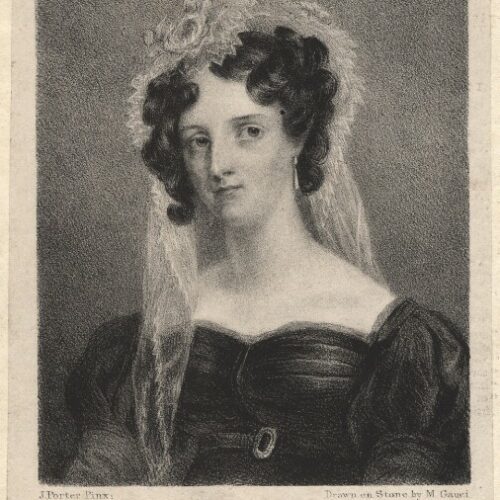
To women I would say… continue not to leave the bitter inheritance of ignorance and slavery to your daughters; plead for their rights, and that most precious of all, a sound and liberal education. Obtain this for your children and you secure the liberties of mankind! It is the duty as it is the interest of all, to aid in accelerating that justice of humanity!
Anna Wheeler, ‘Rights of Women‘, a lecture delivered at South Place Chapel, 1829
The biography reprinted below was first published in October 2009 as part of the Dictionary of Irish Biography. It is reproduced here under the terms of the Creative Commons Attribution Non Commercial 4.0 International license.
Contributed by Dooley, Dolores
Wheeler, Anna Doyle (1785–1848/9), pioneer feminist and reformer, was born in Clonbeg parish, Co. Tipperary, Ireland, daughter of the Rev. Nicholas Milley Doyle, clergyman, and Anna Doyle (née Dunbar). Little is known of her mother, but her father graduated from TCD in 1770 and became a prebendary of Fennor parish, Co. Tipperary. On the death of her father, Anna’s uncle, Gen. Sir John Doyle, became an affectionate paternal surrogate. She had no formal education but was self-taught in French, philosophy, geography, and politics, all encouraging her skills of conversation with foreign dignitaries visiting her brother and uncle, both prominent military men.
In 1800 the young Anna married Francis Massy-Wheeler, a wealthy Freemason and reputed playboy. The couple lived at his estate of Ballywire House, Co. Limerick, and had two daughters who survived infancy, Henrietta and Rosina, born in 1801 and 1802 respectively. Anna’s unmarried sister, Bessie, cared for the children while Anna expanded her knowledge of philosophy, reading works of eighteenth-century thinkers such as Diderot, Voltaire, Condillac, and d’Holbach. After twelve years of an acrimonious marriage Anna took the unconventional decision to leave her husband and, with her two daughters, sailed to the island of Guernsey where her uncle, Gen. Doyle, was then governor. Education in French, Italian, and philosophy continued in Guernsey and nurtured her skills of diplomacy, social repartee, and politics.
Wheeler arranged for the education of her daughters at finishing schools in London and Dublin, moving on to Caen in northern France, where she met the Saint-Simonian socialists and became known as ‘the Goddess of Reason’.
During 1816–20 Wheeler arranged for the education of her daughters at finishing schools in London and Dublin, moving on to Caen in northern France, where she met the Saint-Simonian socialists and became known as ‘the Goddess of Reason’. She honed her arguments to explain the social conditioning in women’s subordination, and repudiated claims that women’s inferior social status simply reflected differences of ‘innate nature’. In studying d’Holbach’s Système de la nature (1795–6) she developed a materialist view of human nature, while her social philosophy incorporated the social critique of Mary Wollstonecraft‘s Vindication of the rights of women (1792). Wheeler accepted Wollstonecraft’s arguments on women’s entitlement to rights, but criticised her work for failing to address proposals for a redistribution of wealth that might allow women to be economically independent. She assiduously studied Jeremy Bentham‘s proposals for reforms in political representation but found his views incoherent in denying women a right to the suffrage. Wheeler saw this political pragmatism as yet one more instance in history of a postponement of what should be a natural right. Yet her criticism of Bentham never diminished her affection for this fatherly philosopher and friend in her life.
During the early 1820s in London, Wheeler consolidated her friendships and intellectual collaborations with Jeremy Bentham, the cooperative philosophers Robert Owen and Frances Wright, and William Thompson, the political economist and feminist from Cork. In 1823 she moved to Paris, where she frequently met Charles Fourier, the French utopian socialist, at her own salon, which became a base of respectability and power. Here she could disseminate the views of the communitarians and test their plausibility with others. Years of liaison work for Charles Fourier with British cooperators ensued. Wheeler persisted in her efforts to persuade Robert Owen to join forces with Fourier in the task of establishing communities for industrial workers and their families. But it was not to be. Her translation skills facilitated the distribution of articles from the French feminist press for readers of the cooperative journals in England.
By 1825 Wheeler had became a close friend and collaborator of William Thompson… The fruit of the Wheeler–Thompson collaboration was the Appeal of one half the human race, women, against the pretensions of the other half, men (1825).
By 1825 Wheeler had became a close friend and collaborator of William Thompson. Both of them endorsed a utilitarian philosophy committed to the social pursuit of equality through reform of state institutions. Such reforms were a sine qua non for achieving human happiness. Wheeler and Thompson publicly deplored the inconsistency of the utilitarians, who embraced the rhetoric of equal respect for all persons, yet resisted inclusion of half of the human race both in the suffrage and in public office. The fruit of the Wheeler–Thompson collaboration was the Appeal of one half the human race, women, against the pretensions of the other half, men (1825). Thompson’s is the only name cited as author but he acknowledges the contribution of Wheeler to the topics and arguments of the book. In an ‘Introductory letter to Mrs Wheeler’ Thompson explains that he sees himself as the interpreter and scribe of Wheeler’s sentiments, reasonings, and experiences so well expressed in periodical publications under the feigned name of ‘Vlasta’, a sixteenth-century legendary lady with a mission to free women from subordination to men.
The Appeal criticised the main social institutions of education, church, marriage, and politics, showing how each had become ‘engines of oppression’ and failed the utilitarian requirement of justice to advance the happiness of all persons regardless of class, gender, and race. The principles of voluntary association and cooperation were pivotal in its proposals for alternative ways of living. Wheeler was a strong critic of social structures that intensified human competition, discord, and individual pursuit of progress, and showed scanty concern for those disabled by being disenfranchised. The Appeal gave Wheeler a visibility that drew audiences to hear her public lectures urging a social commitment to the pursuit of happiness in a non-adversarial way for women and men equally. In a famous lecture (1829) at Finsbury Square, London, Wheeler insisted that if women remained ill-educated, lacked development of their faculties, and were little more than ‘beasts of burden’, then this would redound negatively on men and perpetuate their ignorance, when they might otherwise benefit from the conjugal company of learned and independent women. Wheeler reasoned that women held a special public and social responsibility to mould the manners and morals of society. In defending such a moral and social role, Wheeler identified with numerous nineteenth-century English and French feminist philosophers and women novelists who made a pragmatic case for women’s liberty by claiming its potential social benefits.
Wheeler insisted that if women remained ill-educated, lacked development of their faculties, and were little more than ‘beasts of burden’, then this would redound negatively on men and perpetuate their ignorance, when they might otherwise benefit from the conjugal company of learned and independent women.
If Anna Wheeler is a powerful influence in the Appeal, her other journal writings and correspondence analyse a special form of oppression in women’s capacity for loving. She came to believe that the self-knowledge of women may err in believing that altruistic love aids women’s flourishing. It might just as readily be a form of learned subjugation. Love, like religion, Wheeler believed from a young age, had been made a superstition and the power to love in women was conceptualised by Wheeler as a fearful gift. Her intimate friend and colleague William Thompson died in 1833, leaving her with a splendid counter-example that relationships of loving need not always be oppressive.
By 1836, it was clear that Charles Fourier’s planned ‘phalanx’ community in France would not materialise, and the premature death of William Thompson rang the death knell for his detailed plans of 1830 for a cooperative community. By the late 1830s Wheeler wrote to Fourier admitting her sorrow that there was no established community that would enable her to die in France, since crippling neuralgia left her unable to travel. The exact date of her death is unknown, but it was probably in 1848/9. Wheeler was survived by only one daughter, Rosina Bulwer Lytton. All Wheeler’s letters to Fourier are in the National Archives, Paris; her letters to Owen are in the Owen papers, Cooperative Union Library, Manchester, England.
William Thompson, Appeal of one-half the human race, women, against the pretensions of the other half, men, to retain them in political and thence in civil and domestic slavery (1825); letters to Charles Fourier, 30 July 1830, 28 May 1833, 17 July 1833, 29 Oct. 1836 (Fourier papers, 10 Archives Sociétaires (AS) 25, dossier 3); ‘Rights of women’, The British Co-operator (Apr. 1830), 12–15; pt 2, ibid. (May 1830), 33–6; letters to Robert Owen, 19 July 1831 (Owen papers, Cooperative Union Library, Manchester, England, no. 426), 27 June 1836 (no. 891), 8 July 1847 (no. 1478), 18 Mar. 1848 (no. 1584); Vlasta (pseudonym), ‘To the editor of The Crisis’, The Crisis, ii, nos 35, 36 (31 Aug. 1833), 277–9; Vlasta to Lord Hampden in John Minter Morgan, Hampden in the nineteenth century (1834), 301–25; Louisa Devey, Letters of the late Edward Bulwer, Lord Lytton, to his wife (1884); ead., Life of Rosina, Lady Lytton (1887); Col. Arthur Doyle, A hundred years of conflict: some records of the services of six generals of the Doyle family 1756–1856 (1911); Richard K. P. Pankhurst, ‘Anna Wheeler: a pioneer socialist and feminist’, Political Quarterly, xxv, no. 2 (1954), 132–43; Wheeler to Marc Antoine Jullien de Paris, 15 Nov. 1832, in Stephen Burke, ‘Letter from a pioneer feminist’, Studies in Labour History, ed. John L. Noyce, no. 1 (1976); Barbara Taylor, Eve and the new Jerusalem: socialism and feminist in the 19th century (1984), 57–82; Olive Banks, Becoming a feminist (1986); Dolores Dooley, ‘Anna Doyle Wheeler’, Mary Cullen and Maria Luddy (ed.), Women, power and consciousness in 19th century Ireland (1995), 19–53; Margaret McFadden, ‘Anna Doyle Wheeler: philosopher, socialist, feminist’, Linda Lopez McAlister (ed.), Hypatia’s daughters (1996), 204–14; Dolores Dooley, Equality in community: sexual equality in the writings of William Thompson and Anna Doyle Wheeler (1996); ead. (ed.), Appeal of one half the human race (1997)
Main image: Anna Wheeler (née Doyle) by Maxim Gauci, printed by Charles Joseph Hullmandel, after J. Porter, lithograph, published 1825? NPG D13269 © National Portrait Gallery, London
To accept life fully seems to me the hallmark of the fine spirit. I think that it is possible for […]
Against the militarist totalitarian state, I have striven. For the freedom of the human spirit to develop under the kindly […]

Derek Lennard was a longtime member and former chair of LGBT Humanists—then known as the Gay and Lesbian Humanist Group […]
The adoption of the term Secularism is justified by its including a large number of persons who are not Atheists, […]