The Conscience has eclipsed the Scriptures; Science has destroyed the belief in Divine Interposition; Democracy and Civism have shown men how to help themselves… a radical reconstruction of belief has become inevitable.
Gustav Spiller
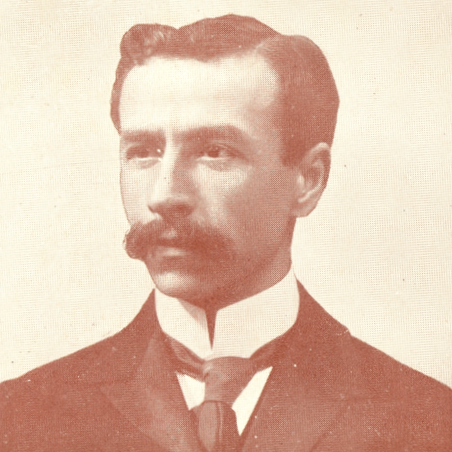
Gustav Spiller was a lifelong humanist: an active member and historian of the Ethical movement, as well as a writer on ethics and sociology. Entirely self-taught, Spiller was nonetheless devoted to the education of others, as well as to the possibilities of international cooperation. He helped to organise the inaugural International Moral Education Congress in 1908, as well as the First Universal Races Congress in 1911, and authored or contributed to a number of books designed for ‘ethical worship’.
Born in Budapest in March 1864, Gustav Spiller left school before he turned 12, thereafter working 65 hour weeks as a compositor. On moving to London in 1885, he continued in this trade, as well as keeping up the continuous programme of self-study maintained throughout his life. From 1893, he worked as a printer for the Bank of England, until 1901, when he became a lecturer for the Ethical movement. Inspired by the discourses of Stanton Coit at South Place Ethical Society, Spiller was one of the founders of the East London Ethical Society in 1890, along with Frederick James Gould, centring ‘the development of good character and the promotion of right conduct on a purely human basis’. In 1904, he took on the position of secretary for the International Union of Ethical Societies, which had been founded eight years earlier.
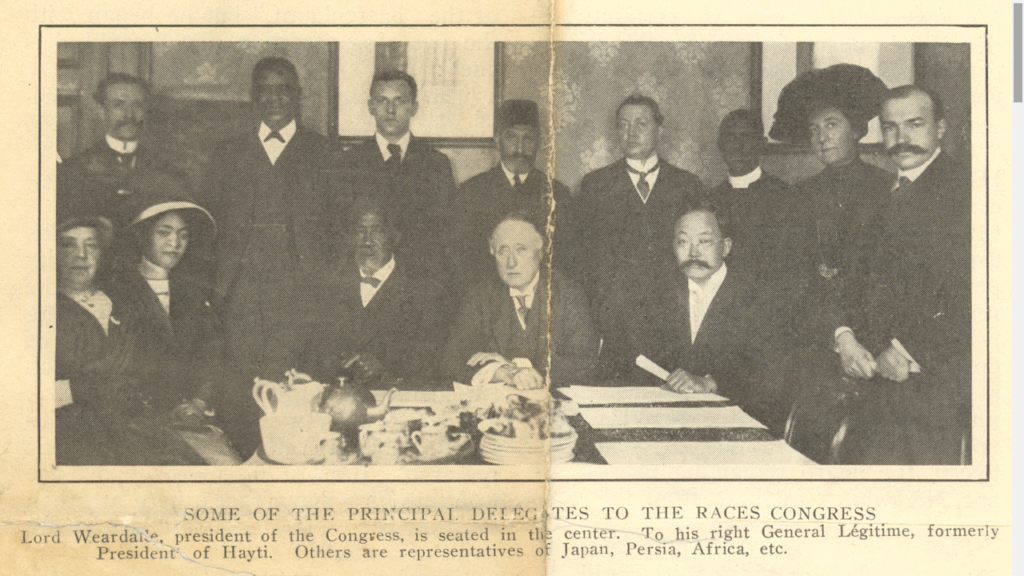
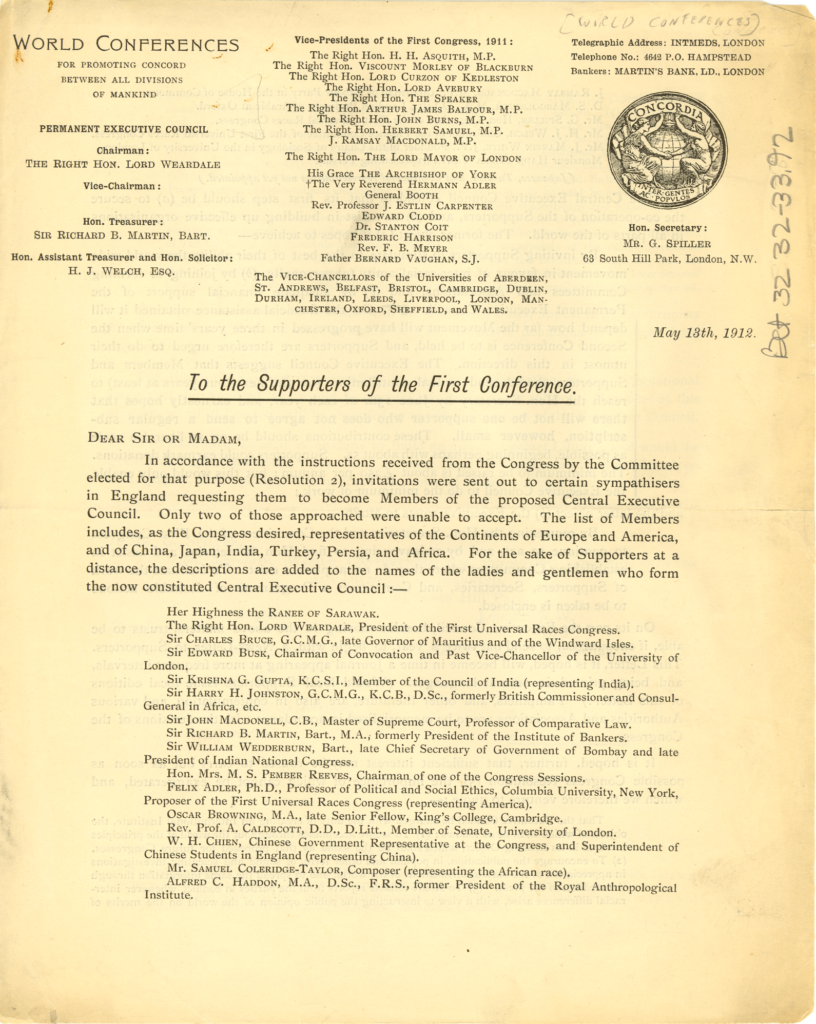
In this role, Spiller organised the first International Moral Education Congress, which took place at the University of London in 1908. In 1911, he was instrumental in creating the First Universal Races Congress, an effort towards greater unity between countries, creeds, and races. Its intention was
to discuss, in the light of science and the modern conscience, the general relations subsisting between the peoples of the West and those of the East, between so-called white and so-called coloured peoples, with a view to encouraging between them a fuller understanding, the most friendly feelings, and a heartier co-operation.
The First Universal Races Congress included representatives from 50 countries, among them politicians, academics, and reformers of international notability. Attendees over the conference’s three days in late July heard papers from W. E. B. Du Bois, J. M. Robertson, and Franz Boas, and attendees included suffragist Jane Addams and writer Alain Locke, who would go on to be one of the founders of the Harlem Renaissance. In records of both the International Moral Education Congress, and the First Universal Races Congress, Spiller’s commitment and organisational devotion was noted. A. C. Haddon wrote afterwards of Spiller’s ‘indefatigable energy and enthusiasm’, ‘ably assisted’ by his wife, suffragist Nina Spiller.
From 1920-1924, Spiller worked for the International Labour Office: the secretariat of the The International Labour Organisation, an agency of the League of Nations in Geneva. The ILO sought to advance social justice and equality by establishing international standards for labour. From 1925 he was the Honourable Secretary of Stanton Coit’s Ethical Church. In 1926, he joined the council of the British Sociological Society (of which he was a founding member), on which he stayed until his death.
Gustav Spiller died on 16 February 1940, at the age of 75. The Ethical Union’s annual report remembered his ‘scholarship and selfless devotion’ to the movement. His wife, Nina, active in both the Ethical Union and International Alliance of Women, died almost 30 years later, in 1968.
Though relatively unremembered today, Spiller was one of the primary drivers of the early Ethical movement, eclipsed somewhat by the better known Stanton Coit. Archives worldwide hold items of Spiller’s correspondence with giants of reform, including W. E. B. Du Bois and Jane Addams, as well as records of the groundbreaking events he played a key role in creating. His work both within and outside of the Ethical movement testifies to his devoted efforts towards peace, social equality, international cooperation, and progressive reform.
The tribute below, written by A. D. Howell Smith, appeared in The Ethical Societies’ Chronicle, Vol. XVIII, No. 132, April 1940, pp. 1–2.
GUSTAV SPILLER
1864–1940
Gustav the [sic] Spiller, the historian of the Ethical Movement and one of its most active representatives, has just passed away. The Ethical Movement, like so many movements of our time that have worked for “sweetness and light,” has entered a period of grave crisis. Old irrationalisms and immoralisms that seemed to be doomed are experiencing a resurrection, while new irrationalisms and immoralisms have come to birth.
As we observe the old warriors compelled, one by one, to lay down their swords that slew the dragons of their day, we wonder whether champions of the same energy, ability, and courage are waiting to follow them in the same spiritual fight. To the band of hero-saints belonged Gustav Spiller. He consecrated his life to the task of illuminating the whole field of moral idealism. To see the world of values and see it whole, to integrate will with intellect, loyalty to the noblest in action and sentiment with sincerity and depth of thought, was his ruling bias.
Gustav Spiller died on February 16th, after a long illness, in which he often suffered greatly; but sleep had relieved him of pain when death came. Two days before the end he was reading Plato, the great mystical philosopher and political dreamer of Ancient Greece.
Mr. Spiller’s parents were Hungarian. He was born at Galatz, near the mouth of the Danube, and was the youngest of the family. When he was twelve years old he left school and was apprenticed as a compositor, in accordance with his own choice, because he wished to become an author. During his apprenticeship he worked at a minimum of sixty-five hours a week—five hours on Sunday morning and ten on each of the remaining days.
His profession served as a stimulus to his education. Among the books he read at this time was an Encyclopaedia, a large illustrated Natural History, and a monumental History of the World.
Perhaps it was the last that aroused in him a desire to travel, which he was able to gratify while still under age. With his friends nearly as old as himself he started on a walking tour to Paris and different parts of Germany. A year later he and an elder brother visited Italy and Switzerland.
In 1885 we find him in London, still working at his profession of compositor. Here he became interested in the Secularist Movement, of which Charles Bradlaugh was then the chief protagonist.
Mr. Spiller’s first contact with Dr. Stanton Coit was three or four years after this. He heard a sermon by Dr. Coit in the old South Place Chapel and became an enthusiastic member of his congregation. This was the beginning of Gustav Spiller’s career as an Ethicist. His enthusiasm and interest in his cause never flagged, so that late in life he was able to write: “Age has brought me no disillusionment regarding the work, the beauty, and the practical value” of the ideal for which the Ethical Movement existed.
By 1889 he had saved a sufficiently large sum of money to feel justified in temporarily quitting his profession. He decided to devote a year or so to study, and followed a course that Dr. Coit had suggested. This course included a number of important works in psychology, ethics, logic, and philosophy. Economics, and the theory and history of education, were added. For “leisure hours” Mr. Spiller found he had enough energy left to enjoy great poetry and fiction. All this while he lived the frugal life expected of the ideal sage.
In 1893 Mr. Spiller returned to his profession. For just over eight years he was employed at the printing works of the Bank of England, for about six months in each year. Most of his free time was spent in the beautiful countryside near Hoddesdon, where many of his poems were composed.
At this time Gustav Spiller decided to undertake some special research, which should occupy him through a long series of years. He aimed at accomplishing for the twentieth century what Francis Bacon, through his Novum Organum, sought to do for the seventeenth—the giving of a scientific guidance to the processes of thought. The fruit of his laborious task, covering a period of thirty years, was A New System of Scientific Procedure, which was published in 1921.
By way of preparation for his magnum opus, Mr. Spiller brought out a book entitled The Mind of Man (pub. 1902), which considered mental processes as revealed to him by self-study and by an examination of the relevant literature.
A year previously he had accepted from Dr. Stanton Coit a three years’ engagement as an Ethicist leader; this took him over large areas of England, introducing him to a number of Ethical Societies and Brotherhood Churches. He conducted courses of lectures and classes, wrote much, and actively helped in the work of the Moral Instruction League. He helped to compile the Ethical Hymn Book, which was published in 1904. Many of his own poems—his familiar “Raise your standard, brothers” was one of them—were included in this book.
In 1903 Gustav Spiller married Mlle. Nina Barboza, of Paris, by whom he had one son and two daughters, who have all survived him. From 1904-15 he devoted himself to the international aspect of the Ethical Movement. During this period he wrote many valuable pamphlets. His most important achievements were the organisation of the First International Moral Education Congress and the First International Races Congress. Under the Ethicist banner fraternised for a while men of different creeds, tongues, and colours, and at any rate gained some appreciation of their common ground, which no variation in ideals can wholly destroy.
From March, 1920, to May, 1924, Mr. Spiller was on the staff of the International Labour Office in Geneva. During this time he continued to write. It was at this time that he published A New System of Scientific Procedure (noticed above) and The Origin and Nature of Man. All his books can be consulted in the British Museum Library. Thirty-two of his pamphlets are bound in one volume, under the title “Collective Papers.”
Gustav Spiller was an ethical optimist. His hopes were centred alike on the individual and the race. In ethics, interpreted by science, he beheld the magic key to human progress. The spirit of brotherhood was for him both the root and the fruit of purity of conscience and nobility of life. His claim to have “lived up to the Ethical Ideals,” reported by his daughter, will be endorsed by all who knew him; these were to him no shibboleths, but vital forces—let us say, far irradiating energies of the human soul.
Mr. Spiller suffered from the disadvantage of being outside those academic circles of professors who review one another’s books and recommend them to their students. Yet he was able truthfully to state that the reviewers had “frequently directed attention to the decided thoroughness and scholarliness of my three treatises”; but, he added: “So far as I can see our thinkers generally give a wide berth to any treatise that has the appearance of thoroughness, because the acceptance of its conclusions would lead to a revolution in their views on a given subject, and that they are not prepared to encourage.” These facts were emphasised by Dr. Hayward in his address at the Funeral Service at Golders Green, which was attended by representatives from the local Ethical Societies and the Positivist Society, as well as by members of Mr. Spiller’s family.
Dr. Hayward further attributed the cause of the relative boycott of Gustav Spiller’s literary work to certain grave faults in the academic intellectual outlook—the divorce between ratiocination and practical moral issues that academic studies tended to burke. “In fact,” he said, “there is a chasm between intellect or knowledge and conduct or behaviour.” For Gustav Spiller this chasm did not exist. None can reckon him among the “light half-believers of our casual creeds, who never deeply felt, nor clearly will’d.” Rather one may say of him, in the words of St. Paul, that he fought a good fight and finished the course, and has merited the victor’s crown.
A. D. HOWELL SMITH
Telegraph House stood on the West Sussex Downs, very near to the highest point called Beacon Hill… It stood out […]

Robert Owen, the son of a Newtown saddler and ironmonger, became one of the most successful mill owners of the […]
To provide Young People with opportunities for the discussion of religious, political, educational, professional, moral, personal, and social problems… To […]
Thomas Henry Huxley was a man of science, a biologist, and educator. He helped to transform scientific study into a […]