I think most Scottish Humanists feel themselves a minority group and uncomfortably isolated.
Nigel Bruce, ‘Humanism in Scotland’ (1983)
Nigel Bruce (born c. 1921) was a stalwart of the Edinburgh Humanist Group from the early 1960s. He convened the committee that founded Edinburgh Youth Homes in 1964, wrote regularly to The Humanist and New Humanist, the journals of the Rationalist Press Association, and in December 1978 became the first chairman of the re-formed Scottish Humanist Council, the 12-member federation of the Glasgow and Edinburgh groups created in anticipation of a Scottish Assembly. The Assembly never came: the devolution referendum of March 1979 fell short of the threshold required, and Scotland would wait another twenty years for its parliament.
In May 1983, the British Humanist Association (today’s Humanists UK) asked Bruce to explain humanism in Scotland to its readers of its magazine Humanist News in other parts of the UK. His answer, printed in reduced type because the editor could not bring himself to cut it, is the clearest statement we have of why Scottish humanists felt they needed a body of their own, six years before the Humanist Society of Scotland was founded.
The established Church of Scotland, religious instruction by ‘use and wont’ rather than statute, local authorities paying in full for Roman Catholic schools, and a political culture shaped by the Protestant–Catholic balance, Bruce said, were all distinctively Scottish problems needing distinctively Scottish answers.
Bruce also paid tribute to Margaret Knight, the Aberdeen psychologist whose 1955 broadcasts had scandalised the nation, who died the same month this piece appeared. His closing complaint, that Scottish humanists felt ‘a minority group and uncomfortably isolated’, and his wish for more visitors from the rest of the UK, read today as the opening of a conversation between Scottish and British humanism that continues in the partnership of Humanist Society Scotland and Humanists UK.
English Humanists may have only a vague idea of what it is like to be a Humanist in Scotland. I will try to give you a pen-picture of the Scottish scene, and of our activities and problems to give an idea of what we have in common and where things are different. In Scotland the established church is the Church of Scotland, which has special status accorded to it by legislation. The Queen is a member of this church when she comes to Scotland, but she is not head of it. The annual general assembly receives reports from a number of church committees, which cover not only questions of organisation and doctrine, but a wider spectrum of social and moral issues. Members of other churches and of none tend to resent the pomp and circumstance of the annual assemblies and the occasional implication that the assembly represents the people of Scotland as a whole.
There are smaller presbyterian churches which still survive: the Congregational Church, and the Free Church, which is active mainly in the north and is strongly Calvinist. The Anglican tradition is represented by the Scottish Episcopalian Church, which is independent of the Church of England but has similar doctrines. None of these other protestant churches has nearly as much influence as the Roman Catholic Church, which is particularly strong in the west; it has a powerful hierarchy and keeps its flock on a closer rein than the other churches.
Humanists feel that these churches possess more privileges and authority than is commensurate with their proper role in a democratic society. The following 5 examples are perhaps the most important and cause the most resentment:
Humanists feel that these churches possess more privileges and authority than is commensurate with their proper role in a democratic society.
Nigel Bruce
I imagine that if we were to substitute the C of E for the Church of Scotland, the first 3 of these 5 examples would apply equally to the English system. The other two reveal differences. Enid Rob (New Humanist Feb. 1976) said: ‘Humanists in England who object to the fact that the state pays 85% of the cost of building church schools probably do not realise that in Scotland the local authorities have borne the full cost of all the denominational schools ever since they took them over.’ This is an important difference and one which rankles with Scottish Humanists; but one ought to be careful to stress the word ‘denominational’, because all the schools which prior to 1906 belonged to the Church of Scotland opted to transfer into the non-denominational system. Thus local authorities now run both a non-denominational system, which is the mainstream of state education, and a denominational system, which is almost entirely Roman Catholic. Enid Rob also draws the distinction between the compulsory religious education and observance in the English legislation and the continuation of religious instruction in accordance with use and wont in the Scottish legislation. Scottish local authorities could only discontinue this practice after conducting a special poll of the local electorate – an incredibly complex operation which has never been tried. The necessary religious instruction has unobtrusively changed its title to religious education and Scottish Humanists have for many years suggested that it should change still further to become religious studies and be absorbed into a wider programme of social education.
Scottish local authorities could only discontinue this practice after conducting a special poll of the local electorate – an incredibly complex operation which has never been tried.
Nigel Bruce
There are many reasons why the Scottish population seems in general less receptive to Humanism than the English. Traditionally the churches probably had a stronger hold over the community. There has always been a large Roman Catholic population and the balance of power between Protestants and RCs has meant that religious affiliation has been a significant factor in the minds and policies of Scottish politicians. The Calvinist tradition also made a strong impact on the Protestant areas and lives on today – it seemed to find fruitful ground in the ancient Gaelic culture, which was inhabited by much myth and acceptance of supernatural influences.
Scottish Humanist groups have found it difficult to make much public impact. Although they are seldom now denounced as the work of the devil, they are still widely regarded as rather shocking and potentially subversive. Margaret Knight was probably the most outstanding campaigner for secular rights and undoubtedly she brought about a shift in official attitudes towards non-believers. The Scottish Humanist Council was born in 1978 in response to the prospect of the creation of a Scottish Assembly with powers to legislate on social and educational issues. The Assembly does not as yet exist, but the Council operates as a watchdog for Humanist interests and organiser of conferences. There are twelve members drawn from the Glasgow and Edinburgh groups and other parts of Scotland.
Although they are seldom now denounced as the work of the devil, they are still widely regarded as rather shocking and potentially subversive.
Nigel Bruce
The BHA is regularly represented at Scottish conferences, and Maeve Denby visited Scotland in October 1982 to exchange ideas for the future. She stressed how much the central organisation and the groups needed each other. We in Scotland share the concern of many groups who feel they are not attracting enough younger members. It would be a great pity to allow the movement to falter at a time when superstition still has a strong hold on people and when divisions within the educational system carry such a dangerous threat of social tension and violence.
I think most Scottish Humanists feel themselves a minority group and uncomfortably isolated. We write occasional letters to the press, to no very visible effect! We feel less isolated if we reinforce our links with the BHA and with the International Humanist & Ethical Union and if we are able to share our thoughts and feelings with others. We should welcome more visitors from England, Wales and Northern Ireland. Or if this is too costly and time-consuming, perhaps we should be communicating more often through the Newsletter!
NIGEL BRUCE – Chairman, Scottish Humanist Council
(Apologies for the reduction in type size on this page, but we ran out of space! Faced with either drastic pruning of Nigel Bruce’s letter or reducing the type size, we opted for the latter.)
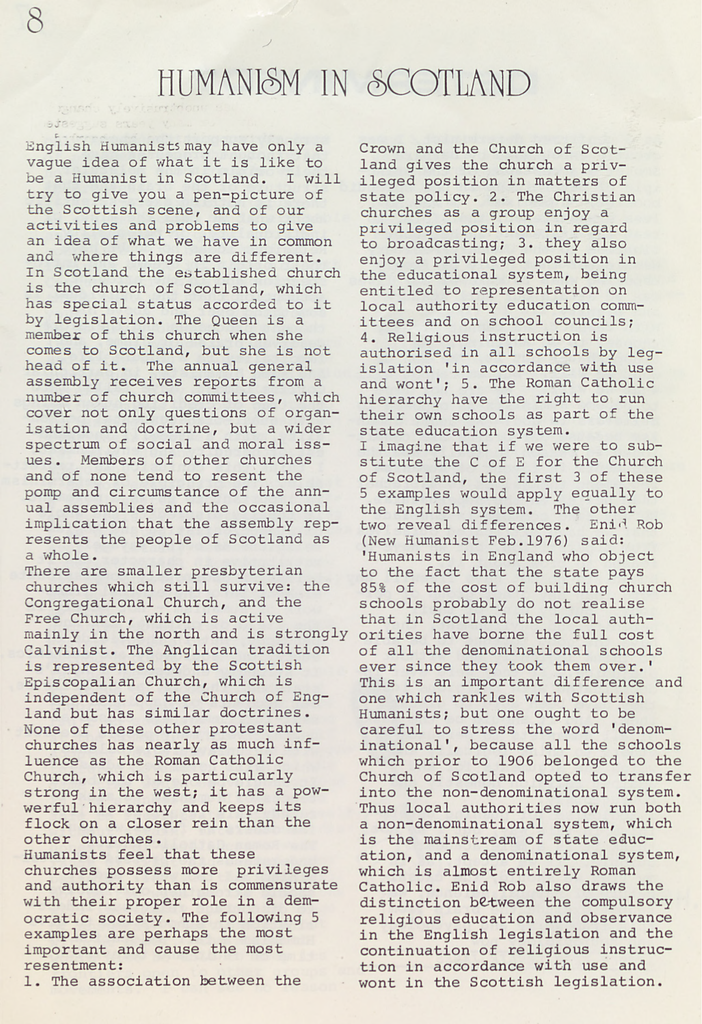
Nigel Bruce, ‘Humanism in Scotland’, Humanist News (British Humanist Association), May 1983, pp. 8–9. Transcribed from the original; spelling and punctuation as printed. The New Humanist article by Enid Rob that Bruce cites (February 1976) can be read in the magazine’s digital archive, available to subscribers at newhumanist.org.uk/subscribe.
Read more about Time for Reflection in the Scottish Parliament and Margaret Knight.
We are members of a community. We are indissolubly connected with the society of our fellowmen. We have duties. William […]
You can always appeal to common decency, which the vast majority of people believe in without the need to tie […]
Not by the Creed but by the Deed. Motto of the Society for Ethical Culture of New York, founded in […]
William Johnson Fox was an orator, writer, politician, and first minister of South Place Chapel (now Conway Hall) from 1824 […]