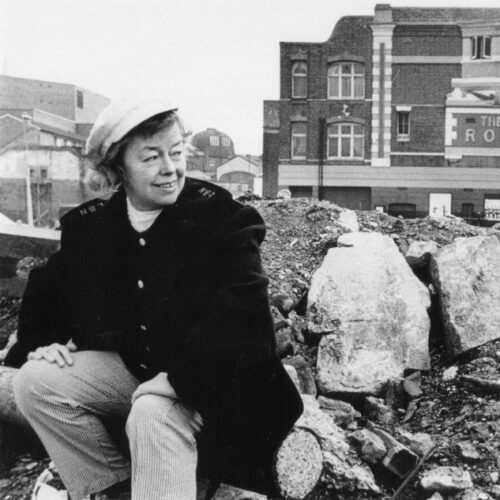
I do not believe in the supremacy of the director, designer, actor or even the writer. It is through collaboration that this knockabout art of theatre survives and kicks.
Joan Littlewood, quoted by Charles Marowitz in Confessions of a Counterfeit Critic (1973)
Joan Littlewood was one of the most influential theatre directors of the 20th century. With the company she founded, Theatre Workshop, she brought working-class lives, voices and audiences into the heart of British drama, launched the careers of writers including Shelagh Delaney and Brendan Behan, and created the anti-war musical Oh, What a Lovely War! (1963). A lifelong rebel against authority, she joined the Advisory Council of the newly formed British Humanist Association (today’s Humanists UK) in 1965, and her vision of a ‘Fun Palace’ for ordinary people to learn, play and create in still inspires a festival held every year in her name.
Her well-known humanity is given its head in this recreation by song, sketch, still photographs, and news flashes of the futile horror of World War One.
Ivor Russell on Oh What a Lovely War, ‘Not Such a Lovely War’, The Humanist, February 1964
Joan Maud Littlewood was born on 6 October 1914 in Stockwell, south London, and was brought up largely by her grandmother in a working-class household. She won a scholarship to La Retraite, a Catholic convent school in Clapham Park, where she staged and starred in her own production of Macbeth, and then a scholarship to the Royal Academy of Dramatic Art. She hated its polished, upper-class style of acting and left. In 1934 she moved to Manchester, where she found work reading and acting for BBC radio.
There she met the young playwright and singer Jimmie Miller, later famous as the folk singer Ewan MacColl, whom she married. Together they founded the agitprop company Theatre of Action in 1934 and Theatre Union in 1936, touring political plays to working-class audiences in the north of England. Their ‘living newspaper’ Last Edition, about the events leading to the Munich agreement, led to both being arrested in the middle of a performance, charged with disturbing the peace and bound over for two years. From 1939 the couple were kept under regular police and MI5 observation as suspected Communists, and in 1941 Littlewood was barred from broadcasting on the BBC for two years.
In 1945 Littlewood, MacColl and other members of Theatre Union founded Theatre Workshop, which spent the next eight years touring Britain and Europe. Her marriage to MacColl ended after the producer Gerry Raffles joined the company. Raffles became her partner in life and work until his death in 1975. MacColl, who remained a close collaborator, was later remembered by New Humanist as ‘a firm humanist’ as well as a faithful Communist.
In 1953 the company moved into the dilapidated Theatre Royal at Stratford East, in London’s East End, where many of its members lived on site while they restored it. There Littlewood directed the British premiere of Brecht’s Mother Courage and Her Children (1955), playing the title role herself, and a run of new work that changed British theatre: Brendan Behan’s The Quare Fellow (1956) and The Hostage (1958), Shelagh Delaney’s A Taste of Honey (1958), and the musical Fings Ain’t Wot They Used T’Be (1959). Reviewing the new British drama in The Humanist in 1970, Roger Manvell placed ‘the pioneering productions of Joan Littlewood at the Theatre Royal, Stratford East’ first in its history.
Her most celebrated production, Oh, What a Lovely War!, opened at Stratford in 1963. Built by the company from the songs of the First World War, with projected photographs and newspaper headlines behind the performers, it moved to the West End and Broadway, made Littlewood the first woman nominated for a Tony Award for directing a musical, and was filmed by Richard Attenborough in 1969. Writing in The Humanist, Ivor Russell set it beside Wilfred Owen’s poems and Britten’s War Requiem as works that had at last stripped war of its false glamour:
No one seeing this production will ever again be easily seduced by such life-depriving forces as militarism and chauvinistic religion.
Ivor Russell, ‘Not Such a Lovely War’, The Humanist, February 1964
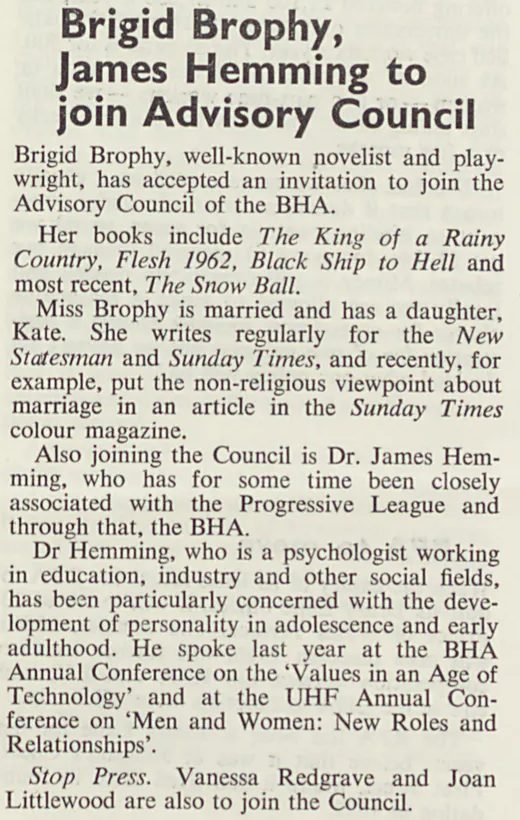
In April 1965 Humanist News announced that Littlewood and the actor Vanessa Redgrave would join the Advisory Council of the British Humanist Association, alongside the novelist Brigid Brophy and the psychologist James Hemming. The Council’s members, listed in the BHA’s pamphlet The Humanist Alternative, included Bertrand Russell, E. M. Forster, Julian Huxley, Francis Crick, Yehudi Menuhin and Peter Ustinov.
From the early 1960s Littlewood worked with the architect Cedric Price on the Fun Palace, a vast, changeable structure where anyone could come to learn, make, perform and play: in her words, a ‘laboratory of fun, a university of the streets’. It was never built, but the idea caught the imagination of many, among them the humanist doctor Alex Comfort, who suggested in the Rationalist Annual for 1967 that ‘Miss Littlewood’s universal funfair’ was groping towards the emotional power that religion had lost. In Stratford she turned cleared redevelopment sites into play spaces for local children.
After Gerry Raffles died in 1975, Littlewood left Theatre Workshop and gave up directing. She settled in France, where she became the companion of the wine-maker Baron Philippe de Rothschild and wrote his memoir, Milady Vine. Her own lively autobiography, Joan’s Book, appeared in 1994. She died on 20 September 2002, aged 87, in the London flat of Peter Rankin, her friend and colleague of 40 years.
Littlewood believed that theatre, like knowledge and joy, belonged to everyone, and she spent her life breaking down the walls that kept ordinary people out of it. Her collaborative, irreverent productions gave a stage to working-class experience, challenged censorship and authority, and in Oh, What a Lovely War! created one of the most powerful anti-war works of the century. Her place on the British Humanist Association’s Advisory Council reflected a view of life she shared with much of the humanist movement: that human beings, not gods or rulers, make their own world and are free to remake it. Since her centenary in 2014, the annual Fun Palaces festival has brought her ‘university of the streets’ to life in communities across Britain and beyond.
Joan Littlewood, Joan’s Book: Joan Littlewood’s Peculiar History As She Tells It (1994)
Ivor Russell, ‘Not Such a Lovely War’, The Humanist, February 1964
‘Brigid Brophy, James Hemming to join Advisory Council’, Humanist News, April 1965
Roger Manvell, ‘Revolution in the British Theatre’, The Humanist, March 1970
Ken Hunt, ‘Sandals and spooks’, New Humanist, July/August 2006
Robert Leach, Theatre Workshop: Joan Littlewood and the Making of Modern British Theatre (2006)
The full issues of The Humanist and New Humanist can be read in New Humanist’s digital archive, available via Exact Editions. Subscribe at newhumanist.org.uk/subscribe.
We’re part of society, part of the world whether we or society like it or not, and we have to […]
Those who, like myself, are in communication with the advanced thought and thinkers throughout the world know that hundreds —nay, […]
I remain an agnostic, and the practical outcome of agnosticism is that you act as though God did not exist. […]
Would it be too bold to imagine, that in the great length of time, since the earth began to exist, […]
