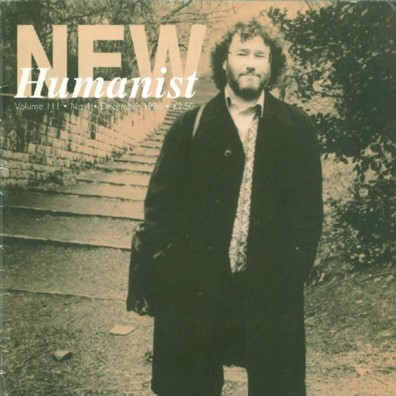
What Iain brought to his writing was himself. He brought a wonderful combination of the dark and the light side of life, and he explored them both without flinching.
Ken MacLeod on Iain Banks
Iain Banks was one of the most successful Scottish writers of his generation, publishing literary fiction as Iain Banks and science fiction as Iain M. Banks. He was an atheist, a Distinguished Supporter of Humanist Society Scotland, and an Honorary Associate of the National Secular Society, and he married his second wife in a humanist ceremony weeks before his death. His Culture novels imagine a society without gods, scarcity, or hierarchy, and remain the most fully worked-out secular utopia in modern fiction.
Banks was born in Dunfermline on 16 February 1954, the only child of an Admiralty officer and a former professional ice skater, and grew up in North Queensferry and Gourock. He wrote his first novel at 16 and studied English, philosophy, and psychology at Stirling. After a decade of jobs taken to fund his writing, he published The Wasp Factory in 1984, a book whose violence and black comedy divided reviewers and made him famous. He wrote roughly a book a year for the rest of his life.
Consider Phlebas (1987) introduced the Culture, a galactic civilisation run by benevolent artificial intelligences in which no one works, no one wants, and the only serious moral question is how to behave towards societies that have not got there yet. Nine further Culture novels followed, alongside the non-Culture science fiction and mainstream novels including The Crow Road (1992), Complicity (1993), and Whit (1995), the last a comedy about a girl raised in a small Scottish religious cult. Banks was public about his politics — he cut up his passport and sent it to Downing Street over the Iraq war, and supported Scottish independence — and about his atheism, telling BBC Radio 4 in 2011 that death was part of the totality of life and better faced realistically than feared. In an interview with New Humanist the following year, asked ‘Humanist, secularist, atheist, agnostic, freethinker, rationalist: which, if any of these, do you use to describe yourself?’ he said:
I am happy to sign up to all of them; the only caveat is with the “agnostic”. I’ve always felt that one ought to retain just the tiniest, sliveriest wee bit of agnosticism to season what is basically outright atheism, on the grounds that – in the end, after all – each of us is just a solitary smart ape on a piffling little planet in an ungraspably big universe, and the sheer bleeding obviousness of there being no supreme deity could itself be a huge cosmic joke on the part of a particularly annoying and mischievous god. It’s an admission that, well, you never entirely know. I maintain that this is close enough to absolute atheism as to make no damn difference.
Iain Banks, ‘Q&A‘ in New Humanist, July/August 2012
In April 2013 Banks announced that he had inoperable cancer and asked his partner Adele Hartley to ‘do me the honour of becoming my widow’. They married that month in a humanist ceremony at Inverlochy Castle. He died in Kirkcaldy on 9 June 2013, aged 59, days before the publication of his final novel, The Quarry.
I’ve had a brilliant life and I think I’ve been more lucky than unlucky, even including the news of the cancer. I’ve written 29 books. I’m leaving a substantial body of work behind me. Whether that’ll survive, who knows, but I can be quite proud of that and I am.
Iain Banks
In the Culture series, Banks produced a serious attempt to imagine what people might do with themselves once every material and political problem was solved. An asteroid and several SpaceX drone ships now carry names from his books. He was named by The Times among the fifty greatest British writers since 1945, and in 2016 The Wasp Factory was voted the second-best Scottish novel of all time.
Main image: Iain Banks on the cover of New Humanist, July/August 2012
… purely human and natural ethics, and not theology, was the source of this pioneer woman’s enthusiasm for justice, even […]
The British Museum is a museum of human history and culture in London. Its collections include objects of humanist heritage […]
… in broad terms, with our lecturers we attempt to define our intellectual standpoint; with our music we try to […]
Sarah Flower Adams was a writer, radical, and major influence on the religious thinking of William Johnson Fox at South […]