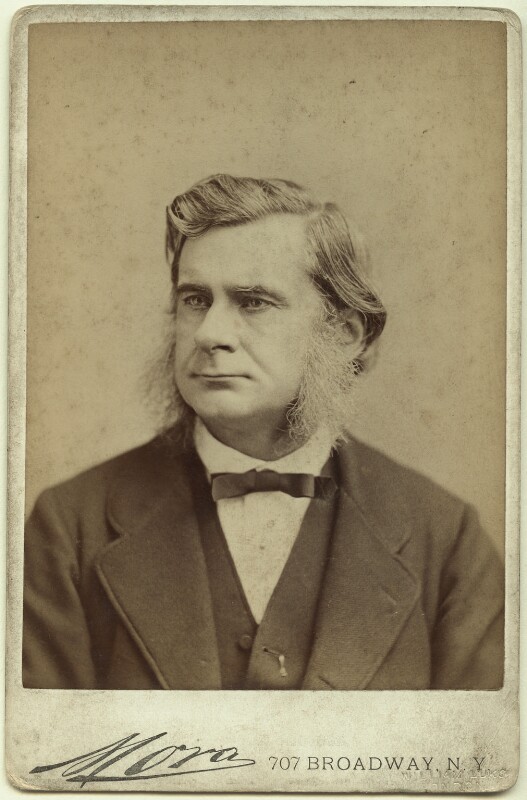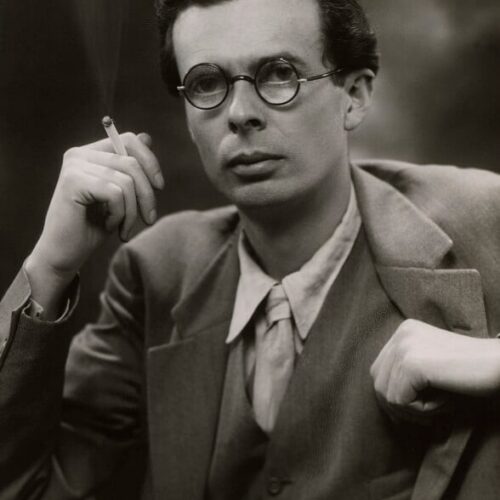
Aldous Huxley was never just a cynic or a mystic, or for that matter just a writer. He was a Humanist. What is more, he was a positive and constructive Humanist. What interested him was the better realization of human possibilities.
Julian Huxley, letter to the editor of The Humanist, March 1964
Aldous Huxley was a novelist and essayist whose Brave New World (1932) remains the most widely read picture of a scientifically managed society and of what such a society costs. A grandson of T. H. Huxley, son of Julia, and brother of Julian, he was a sceptic in the family tradition for the first half of his life. In the second half he turned to mysticism, though it remained a mysticism without dogma, priests, or a personal god.
Facts do not cease to exist because they are ignored.
Aldous Huxley, ‘A Note on Dogma’ in Proper Studies (1927)
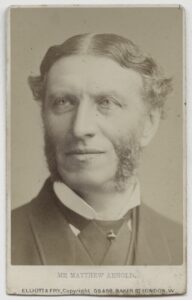
Huxley was born in Godalming on 26 July 1894, into a family that included biologists, schoolmasters, and Matthew Arnold. An eye disease at 16 left him nearly blind for a period and put an end to his hopes of becoming a doctor. He read English at Balliol College, Oxford instead, and by the early 1920s had made his name with satirical novels of the post-war intelligentsia. Crome Yellow (1921), Antic Hay (1923), and Point Counter Point (1928) are populated by clever people who believe in nothing, and the novels are hard on them and on their author.
Brave New World imagined a future in which humanity had been made contented by genetic engineering, conditioning, and a drug. It is a satire on utopia rather than on science, and it is even-handed enough that readers have argued ever since about which side Huxley was on. In the later 1930s he became a committed pacifist, joined the Peace Pledge Union, and moved to California, where he wrote screenplays and, in Ends and Means (1937) and The Perennial Philosophy (1945), set out the view that the mystical traditions of all religions pointed to a single truth beneath their doctrines. The Doors of Perception (1954) recorded his experiments with mescaline. His last novel, Island (1962), imagined a good society to set against the bad one of 30 years earlier. He died in Los Angeles on 22 November 1963, the day of President Kennedy’s assassination.
Although Huxley’s later philosophy took him well away from the confident rationalism of his grandfather and brother, his early works, particularly Brave New World, remain towering examples of writing in the humanist tradition. Much like contemporary humanist George Orwell’s Nineteen Eighty-Four is, Brave New World is read in schools as a warning about technology and the dangers of surrendering our freedom to think and ask questions of ideology.
Main image: Aldous Huxley by Bassano Ltd, bromide print, September 1931 NPG x84301 © National Portrait Gallery, London
There is no one who will deny the value and importance of truth, but how is it to be ascertained, […]
As well as being home to Conway Hall and its humanist library, Red Lion Square contains statues of two prominent […]
Margaret Chappellsmith was a devotee of the socialist and secularist ideas of Robert Owen, becoming one of the Owenite movement’s […]
Hath man no second life? Pitch this one high! Sits there no judge in Heaven our sin to see? More […]