Michael Foot (1913–2010)
( 12 October 2026 - 12 October 2026 )
( 12 October 2026 - 12 October 2026 )
‘His spirit is not the cause of our disease; it is the unapplied remedy.’
Michael Foot, on Voltaire
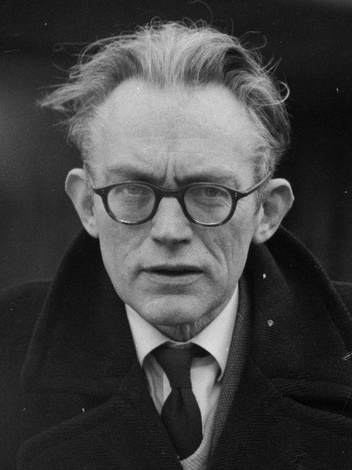
Michael Foot was a Labour politician, journalist, and author who led the Labour Party from 1980 to 1983. A celebrated orator and lifelong campaigner for peace and nuclear disarmament, he sat in the House of Commons for more than four decades and served in the Cabinets of Harold Wilson and James Callaghan.
A rarity in frontline politics, Foot was also one of the humanist movement’s most loyal friends in public life: a member and Distinguished Supporter of the British Humanist Association (today’s Humanists UK), an Honorary Associate of the Rationalist Press Association, and a member of the Humanist Parliamentary Group. When he died in 2010, the BHA mourned him as ‘a great British Humanist’.
Foot was born in Plymouth on 23 July 1913, the fifth of seven children of Isaac Foot, a Liberal MP and Methodist, and his wife Eva. He was educated at a Quaker school and at Wadham College, Oxford, where he read politics, philosophy, and economics, and joined the Labour Party in 1935. Turning to journalism, he worked on the left-wing Tribune and then, on Aneurin ‘Nye’ Bevan’s recommendation, for Lord Beaverbrook’s Evening Standard, which he edited from 1942. In 1940 he co-wrote, under the pseudonym ‘Cato’, Guilty Men, a polemic against the politicians who had appeased Hitler.
He was elected MP for Plymouth Devonport in 1945, lost the seat in 1955, and returned to edit Tribune. When Bevan, his friend and political hero, died in 1960, Foot succeeded him as MP for Ebbw Vale (later Blaenau Gwent), the South Wales seat he held until he retired in 1992. He went on to write a two-volume biography of Bevan.
When Labour returned to power in 1974, Wilson made Foot Secretary of State for Employment. In a hung Parliament he steered through the Health and Safety at Work Act 1974, created the conciliation service ACAS, and passed the Employment Protection Act 1975, which protected women against dismissal for pregnancy and introduced maternity pay. After coming a close second to Callaghan in the 1976 leadership contest, he became Leader of the House of Commons and Deputy Leader of the Labour Party, with responsibility for devolution to Scotland and Wales.
Foot succeeded Callaghan as Labour leader in 1980. His leadership coincided with the breakaway of the Social Democratic Party, and in 1983 Labour suffered its heaviest election defeat in half a century. He stood down and was succeeded by Neil Kinnock, his fellow humanist, but remained a much-loved figure on the left; in 2003, aged 89, he was determined to speak at the great London demonstration against the Iraq War.
Raised in a devout nonconformist household, Foot found his own heroes among the radicals and freethinkers: Jonathan Swift, Lord Byron, Voltaire, Thomas Paine, and Charles Bradlaugh. He did not keep his admiration private. At the National Secular Society’s centenary dinner in 1966 he paid a warm tribute to Bradlaugh, with whom, The Humanist observed, he had ‘very much in common apart from party politics’, and urged his audience to join the movement and extend its influence rather than merely express approval. A year later he introduced a new edition of Winwood Reade’s freethought classic The Martyrdom of Man, and in 1972 he remembered Bertrand Russell in the pages of New Humanist.
In 1974 New Humanist listed him as one of five humanist ministers in Wilson’s government; his brother John, Lord Foot, appeared among the humanist peers. In 1990 he accepted the Rationalist Press Association’s invitation to become an Honorary Associate, and spoke at the launch of its book Blasphemy Ancient & Modern, published at the height of the Rushdie affair. A year later, on the centenary of Bradlaugh’s death, he told the BBC World Service:
‘Bradlaugh was a great Victorian. When he was attacking most of the so-called Victorian values in almost every field, he was himself like the great Victorians… It took tremendous courage to say what he did and to go on saying it in defiance of all the pressure that was brought to bear against him.’
Michael Foot, BBC World Service, January 1991, printed in New Humanist, March 1991
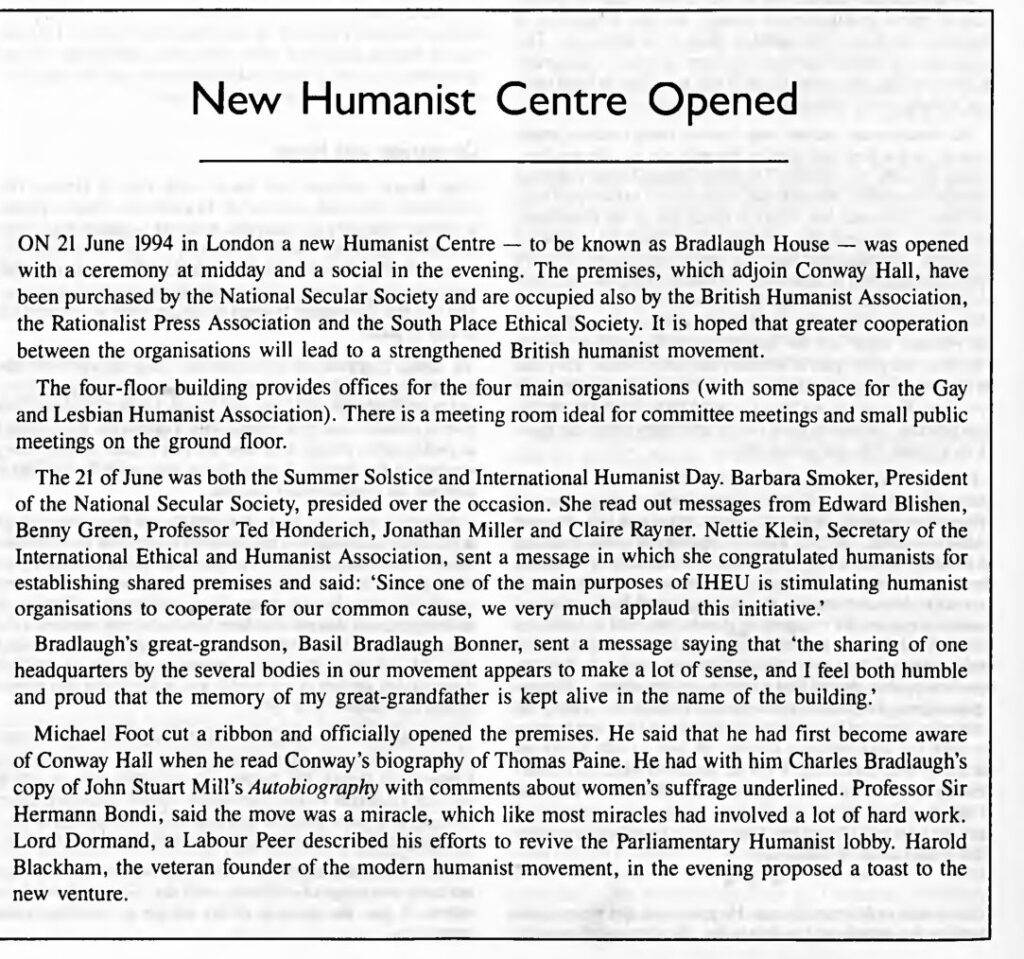
Paine was a lifelong passion. Foot reviewed books about him for New Humanist, co-edited The Thomas Paine Reader (1987), and spoke alongside Neil Kinnock at Thetford for the 250th anniversary of Paine’s birth. When the National Secular Society, the BHA, the Rationalist Press Association, and the South Place Ethical Society opened a shared centre next to Conway Hall in June 1994, it was Foot who cut the ribbon. He told the gathering that he had first heard of Conway Hall by reading Moncure Conway’s biography of Paine, and brought with him Bradlaugh’s own copy of John Stuart Mill’s Autobiography.
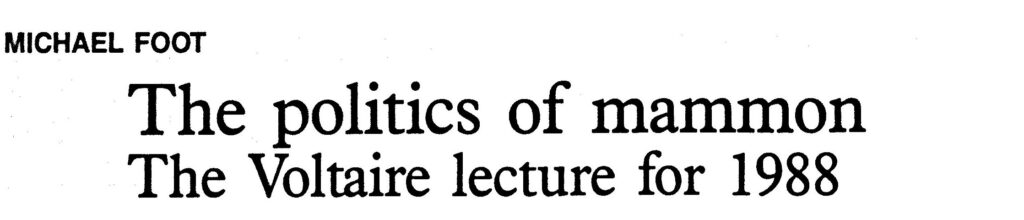
In July 1988 Foot gave the BHA’s Voltaire Lecture at its annual conference in York. Titled ‘The politics of mammon’, it was a tribute to the philosopher he admired above almost all others, and a fierce attack on the Thatcher government. That week ministers had used the Education Reform Bill to write Christianity into the law on religious education for the first time since 1944, a change Foot called ‘a disgrace’, agreed with a few bishops in the Lords and forced through the Commons with an hour and a half of debate. The 1944 settlement, he argued, had helped head off ‘interreligious feuds’ in an increasingly multiracial society.
‘As I sometimes hear the Prime Minister extoll almost in the same breath her peculiar form of religion and her peculiar form of economics, each with the unshakeable assurance which is the hallmark of intolerance, I sometimes wonder what will suffer most in the years or months to come.’
Michael Foot, ‘The politics of mammon’, the Voltaire Lecture, 1988
Voltaire, he told his audience, ‘stood for the assertion of reason, faith in the intellect and its capacity to make all different branches of knowledge serve humanity’, and the true tragedy of the modern age was that ‘we have not made it in his image’.
Foot died at his home in Hampstead on 3 March 2010, aged 96. His funeral at Golders Green Crematorium was a non-religious ceremony, attended by the Prime Minister, Gordon Brown, and closing with the singing of ‘The Red Flag’. The BHA paid tribute to its member and Distinguished Supporter, noting that ‘like Clement Attlee before him and Neil Kinnock after him, Michael was a Labour leader whose view of life was a humanist one’.
‘We remember Michael and celebrate his life not just as the life of an intelligent and principled politician but as a great British Humanist… His steadfast dedication to humanist and progressive ideals of freedom, peace, social justice was pursued in a life of both thought and action – another humanist ideal.’
Andrew Copson, Chief Executive of the British Humanist Association, 2010
Foot belongs to a long line of non-religious Leaders of the Opposition, from Ramsay MacDonald, Winston Churchill, and Clement Attlee to Neil Kinnock, Keir Starmer, and Kemi Badenoch. Had Labour won the 1983 general election, he would have filled a gap that became unusually long: between Callaghan’s departure from Downing Street in 1979 and Starmer’s arrival in 2024, Britain had no non-religious Prime Minister, a stretch of 45 years, more than twice as long as any since David Lloyd George took office in 1916.
Image: Michael Foot, 1960, by Geoff Charles. National Library of Wales, CC BY-SA 4.0, via Wikimedia Commons.
The full issues of The Humanist and New Humanist can be read in New Humanist’s digital archive, available via Exact Editions. Subscribe at newhumanist.org.uk/subscribe.
The British Museum is a museum of human history and culture in London. Its collections include objects of humanist heritage […]
If the basic cause of an unsuccessful marriage is removable, conciliation is the proper procedure. If it is not removable, […]
No one who came in contact with her failed to recognize in her fearlessness, honesty for the sake of honesty […]
Would it be too bold to imagine, that in the great length of time, since the earth began to exist, […]