From chartists and Owenites to secularists and humanists, Bristol has a rich history of radical action and freethought. This walk follows some of those who challenged religious dogma and political inequality to fight for a society built on reason, democracy, and ‘deed not creed’.
This page accompanies the printable Bristol walk.
Across the park, at 34 Castle Street, once stood the premises of J. Cossens, purveyor of radical literature. On this walk we meet some of the freethinkers and agitators who might have been drawn to such a shop: people who fought for change in Bristol and the wider world during the 19th century and beyond.
They included the chartists, a working-class movement agitating for democratic reform; Owenites, who advocated the reorganisation of society along communitarian lines; and secularists, whose philosophy described a this-worldly focus on doing good for the sake of humankind, almost identical to humanism today.
Broadmead was the site of the Owenite Hall of Science. Halls of Science were part of the Owenite vision of education, especially for adults, and sprang up in most major cities to encourage the discussion of scientific, literary, theological, social, and political subjects. Trustees of the Broadmead hall included the pawnbroker Robert Tovey, the carpenter Samuel Bromhead, and the engravers John Field and Charles Brown. It was built in 1840 and formally opened with a lecture on 21 December by Robert Owen himself.
The Hall of Science later became the Broadmead Rooms, continuing to welcome speakers of all stripes. One of these, in 1846, was the formerly enslaved abolitionist and freethinker Frederick Douglass.
Find out more: Handbill for lectures at a Hall of Science · African American Humanism
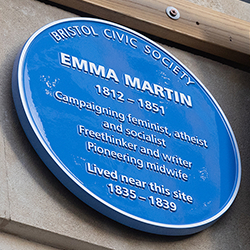
Near this site stood a house once occupied by Emma Martin, commemorated today by a blue plaque unveiled in 2023. Born in Bristol in 1812, Martin was in her early years a zealous Baptist. Drawn to their ideas on the equality of women, she attended her first Owenite socialist meeting in 1839. She was moved to hear beliefs so closely allied to her own, but disturbed by the Owenites’ rejection of Christianity and the Bible.
Starting out by debating the Owenites, Martin found her religious beliefs weakening over time, and by the winter of 1839 she had left behind her husband and church to live as a self-identified freethinker. She rapidly became one of Owenism’s most famous women lecturers, drawing crowds of thousands with fierce defences of Owenism and atheism. Armed with an exacting knowledge of the Bible, she became a fierce critic of religion, revelling in pointing out its inconsistencies.
Formerly a Unitarian meeting house, it was here in 1818 that a teenage Harriet Martineau came under the tutelage of the minister Dr Lant Carpenter. Born into a Unitarian family in Norwich in 1802, Martineau was sent to Bristol for schooling. Although she would later describe Carpenter as ‘superficial in his knowledge, scanty in ability, narrow in his conceptions, and thoroughly priestly in his temper’, the young Martineau was heavily influenced by him during her time in Bristol.
Over the following decades, though, Martineau progressively abandoned the religious faith of her childhood, embracing instead a rich humanist philosophy focused on free inquiry, social conscience, and the pursuit of happiness. Today she is remembered as the first woman sociologist, a prolific writer, and a vocal opponent of slavery.
Find out more: Ear trumpet
On 4 November 1880, when still known as Colston Hall, the Bristol Beacon was the site of a significant suffrage demonstration. Speakers included the freethinker Lydia Becker: suffragist, science advocate, and correspondent of Charles Darwin.
Another humanist with a link to Bristol suffrage was Jeanette Gaury Wilkinson, a working-class trade unionist and feminist. A powerful speaker, the London-born Wilkinson was invited to become the Bristol Society for Women’s Suffrage’s organising secretary and lecturer in 1884, until she was transferred back to London the following year.
Charlotte Street was one of the meeting places of the Bristol Ethical Fellowship, founded in 1934 as successor to the Bristol Ethical Society, active from 1898 to 1900. Ethical societies, which first formed in the UK in the 1880s, focused on living well without reference to supernatural ideas. They grew out of the American Ethical Culture movement, started by Felix Adler in New York in 1876 with the motto ‘deed not creed’. Spaces of secular community, they organised lectures and debates, and their members were often involved in wide-ranging charitable and reformist efforts.
Find out more: The Union of Ethical Societies
Brandon Hill was the outdoor venue for a variety of public meetings and lectures, including those of the radical speaker Henry Hunt and the National Union of the Working Classes in 1833. It was also the site of a lecture, in July 1869, by another radical, Charles Bradlaugh, who had founded the National Secular Society in 1866.
Bristol Secular Society was set up in 1869–70. The word ‘secularism’ had been coined by George Jacob Holyoake in 1851. Today secularism more narrowly means the separation of church and state, but Holyoake’s original definition was almost synonymous with humanism today: a philosophy placing the needs of human beings, and the achievements of this life, at its heart.
One Bristol-born secularist who gave his life to the movement was Charles Watts (1836–1906), born into the family of a Bristol bookmaker. Brought up a strict Methodist, he heard Holyoake speak and by the age of 16 had abandoned religion. He moved to London to join the national movement, and in 1866 became a full-time secularist lecturer and the first secretary of Bradlaugh’s National Secular Society.
The Institution for the Advancement of Science, Literature and the Arts opened here in 1823, originally a joint project of the Bristol Library Society (founded 1772) and the Philosophical and Literary Society. Housing a lecture theatre, library, and exhibition space, it sought to ‘disseminate useful knowledge through lectures and experiments’. Institutions like this often drew freethinkers, and helped to spread the scientific understanding which unsettled many people’s religious beliefs in the 19th century. That said, papers explicitly discussing religion or politics were forbidden at Philosophical and Literary Society lectures.
Queen Square was the site of the first public meeting organised by the Bristol Working Men’s Association, in October 1837. It was addressed by the chartist leader Henry Vincent, who began by reminding his audience of the principles of an earlier radical, Henry Hunt, who had preached in the city nearly 20 years before.
The People’s Charter, from which the chartists took their name, would be written the following year, setting out demands for the extension of voting rights. The Queen Square meeting ended by adopting the three points of Hunt’s radical reform programme of the 1820s: the vote for every man, annual parliaments, and the secret ballot.
This is the site of the Old Gaol, built in 1820 and mostly demolished by 1898. It was here that the avowed atheist Charles Southwell was imprisoned for blasphemy. Southwell had arrived in Bristol as an Owenite ‘missionary’, but resigned in 1841 over efforts to restrict his attacks on theology. With William Chilton and John Field he founded the Oracle of Reason, a weekly paper advocating atheism. After a vicious attack on the Bible, he was arrested in 1842, fined £100, and sentenced to a year in prison.
On his way to visit Southwell in jail, George Jacob Holyoake was himself arrested for blasphemy, after a flippant comment at a lecture on Owenism in Cheltenham in which he suggested the deity should be put on half pay. His imprisonment, and the death of his daughter during it, cemented his atheism.
The flurry of prosecutions in the 1840s that caught Southwell, Holyoake, and others recalled those of two decades earlier, when efforts to suppress ‘blasphemous’ or ‘seditious’ publications had seen freethinkers including Richard Carlile, Susannah Wright, and Robert Wedderburn imprisoned. As then, attempts to legislate opinion and belief were met with fury and opposition, and humanists then, as now, fought resolutely for freedom of the press, and of religion and belief.
Find out more: Bristol Gaol · Blasphemy Trials
Take the walk: download the printable Bristol walk (PDF), or see all of our walks.
Explore more: Emma Martin · Harriet Martineau · Charles Bradlaugh · Charles Watts · Bristol Gaol · Susannah Wright · Owenism · National Secular Society · Charles Darwin
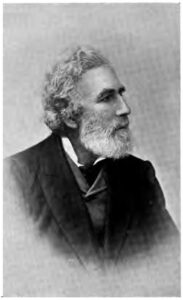
The radical publisher Edward Truelove found himself in court more than once defending freedom of belief and expression. He believed, […]
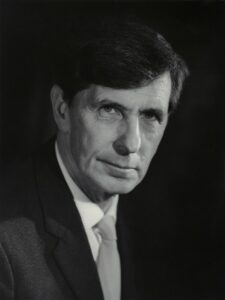
A wide-ranging Humanism will always seek to extend to more and more people, through education and opportunity, the enrichment of […]
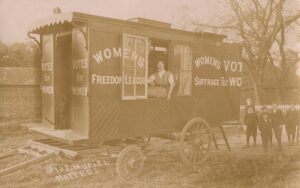
Dare to be free. Slogan of the Women’s Freedom League The Women’s Freedom League (WFL) was a militant suffrage organisation, […]
The basic human value is freedom, which means the right of a human being to live a human life. V.M. […]