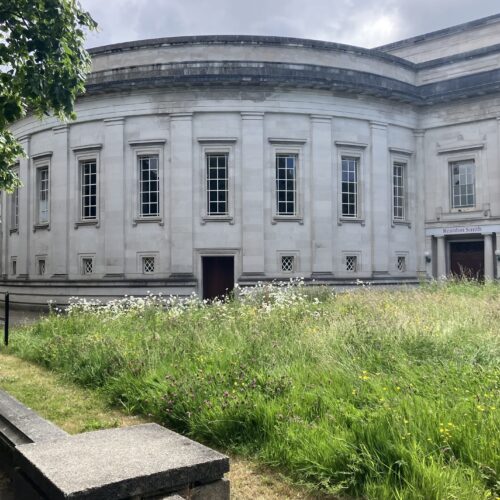
This walk introduces some of the key freethinkers and reformers who have shaped, and been shaped by, Cardiff: famous names like Aneurin Bevan, the architect of the NHS, and lesser-known figures like Millicent Mackenzie, a pioneer of women’s rights and secular education. The route highlights milestones in social progress, from the growth of ethical societies and organised humanism to the disestablishment of the Church in Wales, and beyond.
This page accompanies the printable Cardiff walk. For the wider story, see our page on humanism in Wales.
Parc Mackenzie is named for Millicent Mackenzie (1863–1942), a university professor and campaigner for women’s rights. Appointed Associate Professor of Education at the University College of South Wales and Monmouthshire (now Cardiff University) in 1904, in 1910 she became the first woman in Wales to achieve full professorial status. She was also, in 1918, the first woman in Wales to stand for election to Parliament.
Mackenzie was one of the earliest Vice Presidents of the Union of Ethical Societies (now Humanists UK). With her husband, John, she was a dedicated promoter of moral education, rather than religious instruction, in schools: teaching children how to be good citizens, using reasons that could be understood by all, whether or not they were brought up with a religious background.
Find out more: Mackenzie Hall · Humanism and the common good
The collections of National Museum Cardiff contain many busts and portraits of notable Welsh humanists, including Leo and Dannie Abse and Aneurin Bevan. Leo Abse was a lawyer and MP whose parliamentary efforts helped to decriminalise homosexuality, liberalise divorce laws, and support the abolition of capital punishment. His brother, Dannie Abse, was a doctor, poet, and writer, who said: ‘I like to think I’m a poet and Medicine my serious hobby.’ He saw poetry as ‘a kind of singing’ which helped to make life more beautiful.
Find out more: National Museum Cardiff · Humanist Parliamentary Group
These gardens were named for the Gorsedd Circle of standing stones, originally placed in Cathays Park for the 1899 National Eisteddfod and moved to their present location in 1905. In its early years the space was known as the Druidical Gardens, but the name Gorsedd Gardens was later adopted.
The gardens are home to ‘Girl’ by the sculptor Robert Thomas (1926–1999), who also created the statue of Nye Bevan we pass later. Thomas also made a bust of the Welsh writer Gwyn Thomas, which was stolen from the foyer of the Sherman Theatre and later recast. Like Bevan, Gwyn Thomas was a freethinker, whose autobiography A Few Selected Exits (1968) featured sections including ‘And ten more dogmas bit the dust’ and ‘See one miracle and you’ve seen the lot’.
Also here, unveiled in 1960, is a bronze statue of David Lloyd George, MP for Caernarvon for 55 years and Prime Minister from 1916 to 1922. As Prime Minister, Lloyd George oversaw the disestablishment of the Church in Wales in 1920, something he and many others had long campaigned for.
The Leonardo Hotel was formerly Park Hall, where the radical journalist and prominent secularist G. W. Foote lectured in March 1890. The Cardiff Times reported that ‘On Sunday morning at 11 o’clock, Mr Foote had for his theme, “Death — what after?” The gist of his contention was a recommendation to make the best of this world as there was no certainty of another’.
Although secularism today typically refers more strictly to the separation of church and state, in the 19th century its emphasis was, like Foote’s, on making the best of this world.
Find out more: Secularism · National Secular Society
Off the south side of Crockherbtown once lay Paradise Place, home to the Ruskin Institute, where the Cardiff Ethical Society held its meetings. The society was inaugurated in January 1904 with a lecture by Stanton Coit, a leader of the ethical (later humanist) movement. Ethical societies emerged in the late 19th century to bring people together on the basis of shared values, without reference to supernatural ideas. They sought to separate morals from religion, providing space for socialising and education, as well as opportunities for good works in the wider community.
Find out more: The Union of Ethical Societies
This statue of Aneurin Bevan was created by the Welsh sculptor Robert Thomas and unveiled in 1987. Thomas was described by his obituarist Meic Stephens as ‘staunchly humanist’ and ‘attracted as a sculptor to subjects whom he revered for their humanitarian ideals’. The statue commemorates one of Wales’ most famous humanists: Aneurin ‘Nye’ Bevan.
As Minister of Health after the ravages of the Second World War, Bevan was a driving force in creating the National Health Service and realising the welfare state. The politician and humanist Jennie Lee, Bevan’s wife, wrote of him:
He was not a cold-blooded rationalist. He was no calculating machine. He was a great humanist whose religion lay in loving his fellow-men and trying to serve them.
The Royal Hotel hosted the last public banquet of the explorer Captain Robert Falcon Scott (1868–1912) and fellow members of his ill-fated Antarctic expedition. They left Cardiff aboard the Terra Nova on 15 June 1910, beginning their journey to the South Pole; the party of five would die on their return from the Pole in early 1912. Louis Bernacchi, a member of Scott’s earlier Discovery expedition, wrote:
Truth and right and justice were his gods, and these did not come from any religious sense. They were something within himself. He led a decent human life because he was a decent human being.
Many humanists have been associated with Cardiff University, as students and as staff. Mary Adams, the first woman television producer at the BBC, gained a first-class degree in botany here in 1921, and later gave a young David Attenborough his start in broadcasting. Other humanist alumni include the former Humanists UK President (and current Vice President) Professor Alice Roberts.
Today, Wales Humanists continues to work for the non-religious in Wales.
Find out more: Humanism in Wales · Presidents of Humanists UK
Take the walk: download the printable Cardiff walk (PDF), or see all of our walks.
Explore more: Millicent Mackenzie · Mackenzie Hall · Aneurin Bevan · Jennie Lee · National Health Service · George William Foote · Stanton Coit · Wales
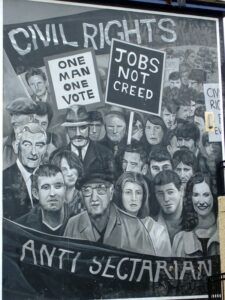
A brief history of humanism and secularism in Northern Ireland Organised humanism began in Northern Ireland in the 19th century, […]
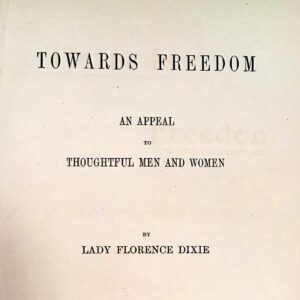
Truth needs the friendly grip of earnest men and women of every class. There is no distinction where it dwells. […]
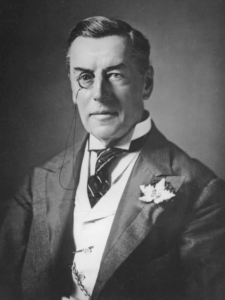
Radical Mayor of Birmingham and champion of unsectarian schools, who lost his Unitarian faith and called himself ‘a very reverent agnostic’.
How much of thankfulness we owe to the goodness, the intelligence and the untiring energy of men and women who […]