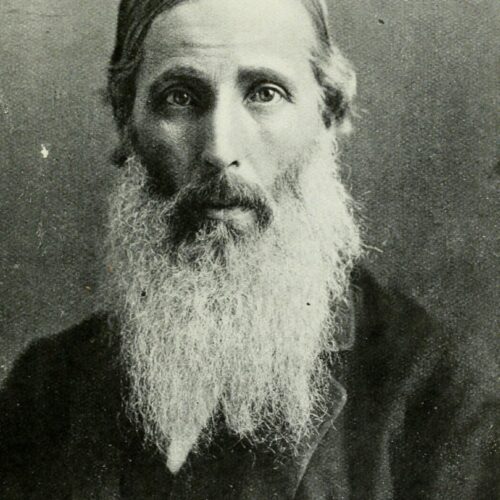
‘I have tried all methods in turn – all that I found pointed out by any of those who have gone before me; and all in turn have failed – revelational, rational, empirical methods – there is no proof in any of them. Still, it is premature to despair, and I am quite content to go on seeking while life lasts.’
Henry Sidgwick, letter to J.A. Symonds, 22 March 1874
Henry Sidgwick was a Cambridge philosopher, a pioneer of women’s higher education, and one of the first academics to throw his weight behind the Ethical movement in Britain, the forerunner of today’s Humanists UK. His The Methods of Ethics (1874) asked, with scrupulous fairness, how we can work out what we ought to do without leaning on religious authority. He gave up his Cambridge fellowship rather than profess beliefs he no longer held, co-founded Newnham College for women, and led ethical societies in Cambridge and London. To The Literary Guide, he was ‘a quiet enemy of theology’.
Henry Sidgwick was born in Skipton, Yorkshire, on 31 May 1838, the son of the Reverend William Sidgwick, headmaster of the town’s grammar school, who died when Henry was three. He was educated at Rugby School and Trinity College, Cambridge, where he became a Fellow in 1859. In 1869 he resigned his fellowship because he could no longer, in good conscience, declare himself a member of the Church of England, as fellows then had to. Once the Universities Tests Act of 1871 had abolished the religious test, Trinity elected him a Fellow again in 1885.
He published The Methods of Ethics in 1874, and in 1883 became Knightbridge Professor of Moral Philosophy at Cambridge. A committed campaigner for women’s education, he co-founded Newnham College in 1875 with Millicent Garrett Fawcett. In 1876 he married Eleanor Mildred Balfour, who became Newnham’s Principal in 1892. Women could sit university examinations but not take degrees, and depended ‘entirely on the goodwill of the examiners’: when the educationist Alice Woods and her friend E.E. Constance Jones of Girton College sat the Moral Sciences Tripos in 1880, they received their results pencilled on a note their mistress had sent to Sidgwick.
The Rationalist Press Association‘s Literary Guide (today’s New Humanist) later recorded that Sidgwick ‘rejected Jesus Christ mainly on the ground that his prophecy of the immediate end of the world was unfulfilled’. Despite his break with Christianity, he retained some fondness for it, thinking it untrue but socially useful: ‘indispensable and irreplaceable – looking at it from a sociological point of view’. Yet, he wrote in 1886, he found it ‘more and more incomprehensible how anyone whom I feel to be really akin to myself in intellectual habits and culture can possibly find his religion in it’.
The same open-mindedness led him to spend years on psychical research, as one of the founders and the first President of the Society for Psychical Research. He approached it, he said, exactly as he approached religion: ‘I believe there is something in it – don’t know what; have tried hard to discover, and find that I always paralyse the phenomena.’ A reviewer in The Literary Guide thought that ‘probably no more impartial investigator has taken the subject in hand’.
Britain’s first ethical society was formed in London in 1886, inspired partly by the Oxford philosopher T.H. Green. Two years later Sidgwick helped to found the Cambridge Ethical Society, and remained its President until the organisation’s closure in 1896. He gave its first address on 18 May 1888, to an audience of 70 men and women. Its subscribers included members of the Darwin, Keynes, and Clough families, and its committee included his wife, Eleanor.
Sidgwick was also elected President of the West London Ethical Society, later the humanist so-called ‘Ethical Church‘, whose members held that ‘the good life rests for its justification on no external authority, and no system of supernatural rewards and punishments’. His addresses to the societies were published as Practical Ethics in 1898. In them, he argued that a clergyman should not declare belief in the Virgin Birth if he did not believe it. When the movement launched the International Journal of Ethics in October 1890, the first article in its first issue was by Sidgwick, alongside a piece by the movement’s founder, Felix Adler.
‘Never was there such a cautious champion of the new thought as our Cambridge lecturer … One sees that the professor is a quiet enemy of theology.’
The Literary Guide, reviewing Practical Ethics, May 1898
Sidgwick’s most lasting gift to philosophy and to the humanist movement was an idea. He suggested that ethical societies should concentrate not on ultimate first principles, such as whether morality rests on God’s will or on human happiness, on which philosophers would never agree, but on what he called ‘middle axioms’: the moral principles that people with different beliefs and backgrounds could share, such as justice, truthfulness, and good faith. The idea anticipated what the philosopher John Rawls, an admirer of Sidgwick, would later call an ‘overlapping consensus’. Looking back in 1963, H.J. Blackham wrote that ‘philosophers of all schools joined in helping to promote Ethical Societies in England’ on that platform. News and Notes, the newsletter of the Ethical Union (today’s Humanists UK), argued in 1954 that the humanist movement was ‘no different in this respect’: people could agree on moral ideals while holding them for different reasons.
Sidgwick shaped a generation of Cambridge thinkers. Bertrand Russell remembered that when he arrived in the 1890s, ‘Henry Sidgwick still represented the Benthamite tradition’, the utilitarianism of Jeremy Bentham and John Stuart Mill. The legal historian F.W. Maitland ‘came under the influence of Henry Sidgwick, and Sidgwick’s influence left a mark on him for his life’. When the Ethical Union mourned G.E. Moore in 1958, it called him ‘close to Sidgwick in analytical acumen’. And when the West London Ethical Society decorated its ‘Ethical Church’ with its heroes, Sidgwick was there among them, alongside Leslie Stephen, Felix Adler, and Josephine Butler.
His reputation has only grown since. John Rawls, the leading political philosopher of his generation, built A Theory of Justice (1971) as an alternative to the classical utilitarianism that, he wrote, ‘receives perhaps its clearest and most accessible formulation in Sidgwick’. Ten years later Rawls wrote the foreword to a new edition of The Methods of Ethics, calling it ‘the first truly academic work in moral theory, modern in both method and spirit’.
‘The Methods of Ethics is, I believe, the outstanding achievement in modern moral theory.’
John Rawls, foreword to The Methods of Ethics (1981)
Henry Sidgwick died in Cambridge on 28 August 1900. As he lay dying, the writer Edmund Gosse saw a boat passing on the water and wrote a poem of what The Literary Guide called ‘tender Agnosticism’:
Thanks for the long day’s happy work he wrought,
Edmund Gosse, 1900
Thanks for his cheerful toil beneath the sun,
Thanks for the victories he won.
The full issues of The Literary Guide and its successors can be read in New Humanist’s digital archive, available via Exact Editions.

Humanism is a philosophy – one which gives us a coherent stance for living. We believe the humanist approach to […]
There is no one who will deny the value and importance of truth, but how is it to be ascertained, […]

The difference and variety of our human family more and more seems to me to be a wise provision that […]
Should STV ever be introduced in Westminster elections—as it has been in the Republic of Ireland, for Northern Ireland Assembly […]