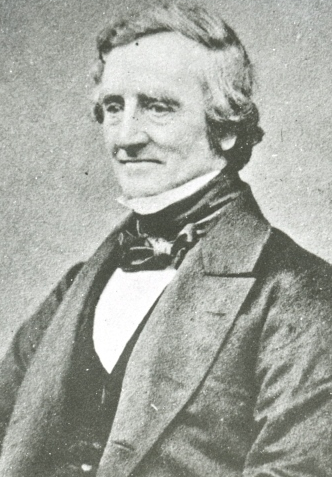
I have had but one object in view – to show my fellow-workmen that the humblest amongst them may render effectual aid to the cause of progress, if he brings to the task honest determination and unfaltering perseverance.
James Watson
A profile by Nicolas Walter of the freethinker and radical James Watson, published for the bicentenary of his birth in the New Humanist, September 1999.
JAMES WATSON, whose bicentenary falls this year, was one of the most important British figures in the struggle for the freedom of the press, in the campaign for radical political reform, and in the development of the Freethought movement.
He was born on 21 September 1799 in Malton, a small town in the North Riding of Yorkshire. His father died before he was a year old, and he was brought up by his mother. She was poor but intelligent, a domestic servant but also a Sunday-school teacher, and she gave him most of his education. At the age of 12 he was apprenticed to a local clergyman as a general labourer, but at the age of 18 he moved to Leeds, where he worked as a warehouseman.
* * *
In 1818 he met local Radicals and soon joined their activities, especially supporting the publishing work which Richard Carlile was conducting from prison. In 1822 he went to London to work in Carlile’s Fleet Street shop, and was soon imprisoned himself, for a week, for six weeks, then for a year. He spent his time inside talking to colleagues and educating himself by reading all the books he could get hold of. On his release he ran the business for a year, until Carlile’s release in 1825. He learnt printing – interrupted by attacks of cholera and typhus – and then worked for the freethinking philanthropist Julian Hibbert from 1826 to 1828. In 1830 he opened a bookshop and in 1831 he began a printing and publishing business, which was supported by Hibbert and soon superseded Carlile’s failing business.
In 1834 he married Ellen Byerley, who joined him in his work. For twenty years Watson was the leading British publisher of Radical literature by American and European as well as British authors – including Voltaire, Holbach, Paine, Godwin, Palmer, Volney, Byron, Shelley, Fourier, Weitling, Owen (father and son), Buonarroti, Hugo, Lamennais, Frances Wright, John Watts, Thomas Cooper, Joseph Barker, and so on. (An American work he published in 1841 was Charles Knowlton’s birth control tract, Fruits of Philosophy: or The Private Companion of Young Married People, which in 1876 became the subject of the prosecutions first of Charles Watts and then of Charles Bradlaugh and Annie Besant on charges of obscenity, an episode which led to the split in the National Secular Society.)
* * *
Watson was also one of the most active and best liked of the political Radicals. He joined the Owenites and helped to found the Cooperative movement, running the Cooperative Store in Red Lion Square from 1828 to 1829 and touring the North in 1830. During the early 1830s he joined Henry Hetherington in the successful campaign against the system of taxing periodicals which made them too expensive for working people, and was briefly imprisoned for selling unstamped periodicals in 1833 and in 1834. He helped to form the National Union of the Working Classes in 1831 and the London Working Men’s Association in 1836. He was arrested but acquitted in 1832 for organising a public feast demonstrating against a public fast. During the late 1830s he took a leading part in the formation of the Chartist movement, helping to draft the People’s Charter (which he published) in 1838 and trying to revive the movement in 1848; he was one of the leaders of the ‘moral force’ wing of the movement. He was also involved in the Republican movement. During the early 1850s he supported G. J. Holyoake in the foundation of the Secularist movement, publishing Holyoake’s early periodicals and pamphlets, and helping to form the London Secular Society, of which he was the first president in 1853.
When his friend and colleague Hetherington died in 1849, Watson took over his business as well. In 1853 he sold his business to G. J. Holyoake, and in 1854 it was taken over by his brother Austin Holyoake. Watson went into retirement, and on 23 January 1854 a Public Tea was held in his honour at the Literary & Scientific Institution in John Street near Fitzroy Square (reported in a special supplement of The Reasoner on 5 February 1854). An Address was presented, tributes were paid by several leading Radicals, and Watson himself gave a long speech describing his career.
* * *
The Watsons moved to South London and lived quietly on their meagre savings. He spent much of his time visiting the Crystal Palace, reading books and listening to concerts. He died on 29 November 1874, and his funeral on 4 December was attended by a large crowd, the address being given by Moncure Conway, the minister of the South Place chapel. He was buried in Norwood cemetery, where his tomb was given the inscription: ‘Erected by a few friends as a token of regard for his integrity of character and his brave efforts to secure the right of free speech and a free and unstamped press.’
The National Reformer announced the death of a ‘brave martyr to Freethought and Republican principle’, ‘one of the old school of Freethinkers’, ‘a man of inflexible principle, quiet resolution, and steady enthusiasm’ (6 December). A fortnight later it published a tribute describing him as ‘one of the most kindly and lovable of men’, without ‘an enemy in the world’ (20 December).
His friend and colleague, the Republican leader W. J. Linton, wrote a short biography, James Watson: A Memoir of the Days of the Fight for a Free Press in England and of the Agitation for the People’s Charter (1879). He described Watson as ‘a thin, haggard, thoughtful man, with a grave yet gentle manner… He seemed always, and in private as well as public, to have before him the ideal of what an English workman ought to be… But for his modesty, he had all the qualities of a leader. Yet, unobtrusive and unassuming as he was, he led, in virtue of his quiet self-possession, his sterling good sense, his dauntless courage, and that unbounded trust which all his associates placed in him.’
* * *
Watson said in his retirement speech; ‘I have had but one object in view – to show my fellow-workmen that the humblest amongst them may render effectual aid to the cause of progress, if he brings to the task honest determination and unfaltering perseverance.’ His personal example was widely admired, and his organisational work later bore permanent fruit. In the Freethought movement, for example, the London Secular Society, which passed under the leadership of Charles Bradlaugh and Charles Watts, was the nucleus of the National Secular Society in 1866; and his printing and publishing business, which passed to the Holyoakes and later on to Charles Watts and then to his son Charles A. Watts, became the nucleus of the Rationalist Press Association in 1899.
Dr Alice Vickery was a humanist, physician, and devoted champion of women’s reproductive rights. Her tombstone inscription remembers her as […]

What is needed is something in which [we] can all believe irrespective of religion, which in most cases, dare I […]
Richard Congreve was a devoted follower of Auguste Comte, whose positivist philosophies and ‘Religion of Humanity’ inspired Congreve to open […]
Humanism is less concerned with what to believe than with how to live. The meaning it gives to life lies […]