Birmingham was the birthplace of two key figures who quite literally defined the humanist movement at different stages of its evolution. George Jacob Holyoake (1817–1906) coined the term ‘secularism’ in 1851, describing an earthly philosophy synonymous with humanism today. Just over a century later, Harold John Blackham (1903–2009) became the first Executive Director of the British Humanist Association (now Humanists UK), earning the title of architect of the modern humanist movement.
These two men form part of a wider story of Birmingham freethought, spanning the scientific curiosity of the Lunar Society, the defiant atheism of John Baskerville, and the pioneering sociology of Harriet Martineau.
This page accompanies our printable Birmingham walk, with more about each stop and links to everyone and everything mentioned along the way.
The Ikon Gallery was once the Oozells Street Board School, opened in 1878 by the Birmingham School Board. Such boards were created after the 1870 Elementary Education Act, a landmark piece of legislation driven by the National Education League’s push for free, compulsory, and non-sectarian schooling. This movement attracted prominent secularists like G. J. Holyoake, who argued at the League’s founding conference that education should be practical and entirely secular.
Beyond its classroom history, the site was a meeting place in the early 1880s for the Birmingham Positivists. Adherents of Auguste Comte’s philosophy, they practised a ‘religion of humanity’ that replaced supernatural worship with a secular celebration of human achievement, eventually moving their ‘Church of Humanity’ to a permanent home at Broad Street Corner.
This gilded bronze statue by William Bloye, unveiled in 1956, depicts three steam engine pioneers: Matthew Boulton, James Watt, and William Murdoch. All three were members of Birmingham’s Lunar Society, sometimes known as the ‘Birmingham Philosophers’ or ‘Fellow schemers’. Another member was Erasmus Darwin (1731–1802), grandfather of Charles Darwin, who wrote on early concepts of evolution and supported the idea of women’s education.
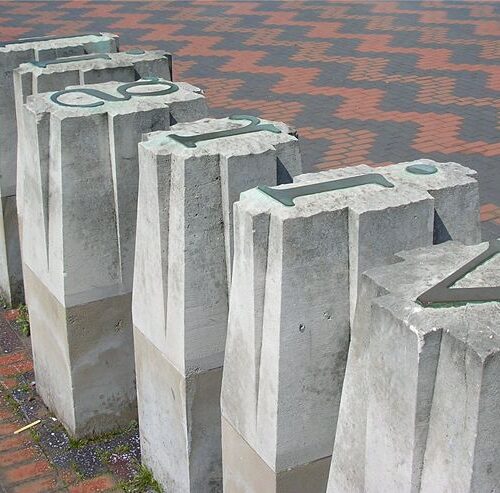
Centenary Square is home to Industry and Genius, a monument to the renowned printer and fervent atheist John Baskerville (1706–1775) by the Birmingham-born artist David Patten. Best remembered today for the typeface that bears his name, Baskerville printed admired editions of the works of Virgil and John Milton, as well as the Bible and the Book of Common Prayer.
Baskerville was an unapologetic non-believer, a fact celebrated by later generations of freethinkers. In 1877, just over a century after his death, the Birmingham secularists opened Baskerville Hall (at The Crescent), named in his memory.
Baskerville House occupies the site of John Baskerville’s home. Writing of his ‘Hearty Contempt for all Superstition’ (including that of consecrated ground), Baskerville asked to be buried in a conical building on his own premises. His self-penned epitaph read:
Stranger — Beneath this Cone in Uncons[e]crated Ground
A Friend to the Liberties of mankind Directed his Body to be Inhum’d
May the Example Contribute to Emancipate thy mind
From the Idle Fears of Superstition
And the wicked arts of priesthood.
His wishes were honoured, but when the area was redeveloped he was disinterred in 1820, and reburied nine years later in Christ Church. When that church was demolished, his remains were moved again, and now lie in the Church of England Cemetery in Warstone Lane.
Find out more: Industry and Genius
Birmingham Museum and Art Gallery first opened in 1885, and has more than 40 galleries of art, applied art, social history, archaeology, and ethnography. Paintings of and by a number of prominent freethinkers can be found in its collections, from James Millar’s 1774 portrait of John Baskerville to works by the humanist and Pre-Raphaelite painter Ford Madox Brown.
Find out more: Birmingham Museum and Art Gallery
Formed from the Philosophical Institute, Midlands Institute, Mechanics’ Institution, and Birmingham Society of Arts, the Birmingham and Midland Institute was set in motion in 1852 as a permanent institute to promote practical science, literature, and the arts. On 1 October 1877 the physicist John Tyndall delivered a Presidential Address here titled Science and Man, arguing that the roots of morality were human, not divine, and for the fundamental importance of honesty and the scientific method:
When facts present themselves let us dare to face them, but let the man of science equally dare to confess ignorance where it prevail.
Constance Naden was a writer and philosopher born and educated in Birmingham. From 1879 she took classes in botany, French, and German at the Institute, and then at the Mason College of Science (later the University of Birmingham). Naden developed an atheist philosophy called ‘hylo-idealism’, based on unity in diversity, and contributed to freethought journals like the Agnostic Annual. Bold in her own humanist philosophy, she observed that 19th century Britain was ‘a nation of practical secularists [who] can tolerate passive religion better than active atheism’.
Find out more: Birmingham and Midland Institute · Tyndall’s Belfast Address (1874)
Joseph Chamberlain was a businessman, social reformer, radical politician, and the father of Prime Minister Neville Chamberlain. Raised a Unitarian, he lost his faith after the death of his second wife, Florence Kenrick, in 1875. In stark contrast to the liberation expressed by some freethinkers, like Harriet Martineau (next stop), Chamberlain wrote bitterly: ‘I refuse to try & buy comfort by forcing myself into insincere conviction — but still I thoroughly abhor the result at which I have arrived’. It was Chamberlain who proposed the vote of thanks to John Tyndall after his 1877 lecture at the Birmingham and Midland Institute.
Birmingham’s Key Hill is the city’s oldest cemetery (outside a churchyard), opened in 1836 as the non-denominational Birmingham Central Cemetery. Alongside many of Birmingham’s great and good, two of the 19th century’s most remarkable freethinkers are buried here: Harriet Martineau and Constance Naden. Both women embraced a humanist philosophy of reason, empathy, and rational inquiry, detached completely from theological ideas.
Harriet Martineau was a pioneering writer, thinker, and activist, considered the first woman sociologist. She is buried here alongside several members of her family. In a letter written a few weeks before she died, she wrote: ‘I see nothing to be done but to wait, without fear or hope or ignorant prejudice, for the expiration of life. I have no wish for future experience, nor have I any fear of it.’
The scientist, poet, philosopher, and freethinker Constance Naden is buried alongside her mother and maternal grandparents. Her gravestone, replaced in 2019 after a fundraising campaign, bears a line from her poem ‘The Pantheist’s Song of Immortality’: ‘For earth is not as though thou ne’er hadst been’.
Find out more: Key Hill Cemetery
Take the walk: download the printable Birmingham walk (PDF), or see all of our walking tours.
Humanists UK began as the Union of Ethical Societies in 1896, becoming the Ethical Union in 1920, the British Humanist […]
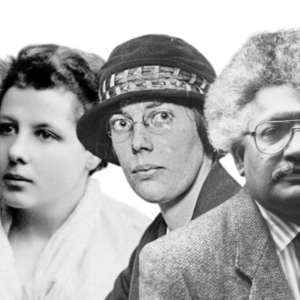
The adoption of the term Secularism is justified by its including a large number of persons who are not Atheists, […]
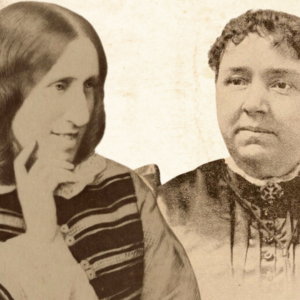
It is with a feeling of considerable deprecating delicacy that I venture to write of this woman, whom I so […]
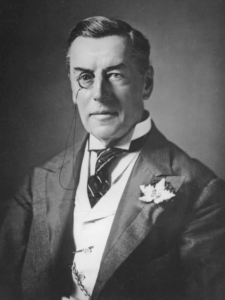
Radical Mayor of Birmingham and champion of unsectarian schools, who lost his Unitarian faith and called himself ‘a very reverent agnostic’.