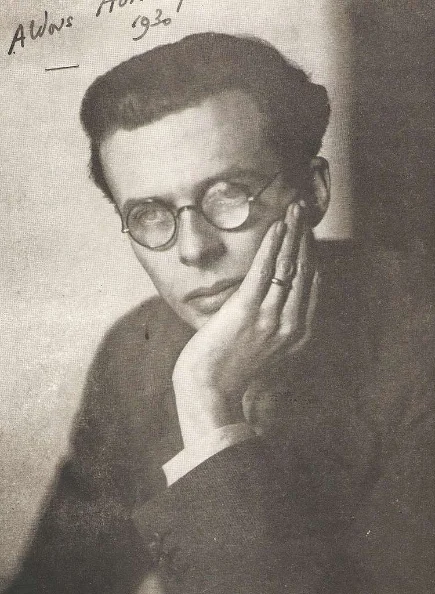
Aldous Huxley
1894–1963 Brave New World (1932)A family of activists and imagineers
Aldous Huxley, the novelist of Brave New World (1932), came from the most distinguished sceptical family in England. He was the grandson of T. H. Huxley and brother to Julian Huxley — the biologist who became the first Director-General of UNESCO, a founder of the International Humanist and Ethical Union, and in 1963 the first President of the British Humanist Association (today’s Humanists UK).
Brave New World is sometimes misread as an attack on science. In the story, a dictatorial World State has abolished religion, but also free inquiry, deep relationships, art, and even truth, and replaced them all with engineered contentment in the form of mood-altering euphoric drugs. Aldous’s own later path led away from his family’s strong humanist leanings and towards mysticism, as seen in The Perennial Philosophy and his psychedelic experiments recorded in The Doors of Perception. His final novel, Island (1962), nevertheless sketched a humane, this-worldly utopia of his own.